
A Detailed Breakdown of the Cost of Registering a Private Limited Company in India
Turning your business idea into a reality is an exciting journey, and choosing the right legal structure is your first critical step. For many, a Private Limited Company is the preferred choice for its credibility and scalability. However, one of the first questions every founder asks is: ‘What is the actual cost of registering a private limited company?’ The answer isn’t a single number, as it involves various government and professional fees. This comprehensive guide will demystify the entire process. We will provide a detailed cost analysis for private limited company registration in India, breaking down every expense so you can budget with confidence. At TaxRobo, we help hundreds of entrepreneurs navigate this process seamlessly.
Why a Private Limited Company is the Go-To Structure for Startups
Before diving into the costs, it’s worth reaffirming why a private limited company is such a popular choice among Indian startups and growing businesses. Its structure offers a perfect blend of legal protection and operational flexibility, making it highly attractive for serious entrepreneurs. Understanding these benefits helps put the registration costs into perspective as a long-term investment in your business’s future.
- Limited Liability: This is perhaps the most significant advantage. It creates a protective wall between your personal assets (like your home, car, and savings) and the business’s liabilities. If the company incurs debt or faces legal action, your personal wealth remains secure.
- Separate Legal Entity: A private limited company is treated as a distinct legal person in the eyes of the law. It can own property, enter into contracts, sue, and be sued in its own name. This identity is separate from its owners (the shareholders) and managers (the directors).
- Credibility & Trust: Operating as a registered company enhances your brand’s image. It signals to customers, suppliers, and lenders that you are a serious and legitimate business entity, which builds trust and improves business relationships.
- Easier Funding: This structure is the preferred choice for venture capitalists (VCs), angel investors, and private equity firms. The clear separation of ownership (shares) and management makes it straightforward for them to invest in your company in exchange for equity.
Understanding the Core Components of Company Registration Costs
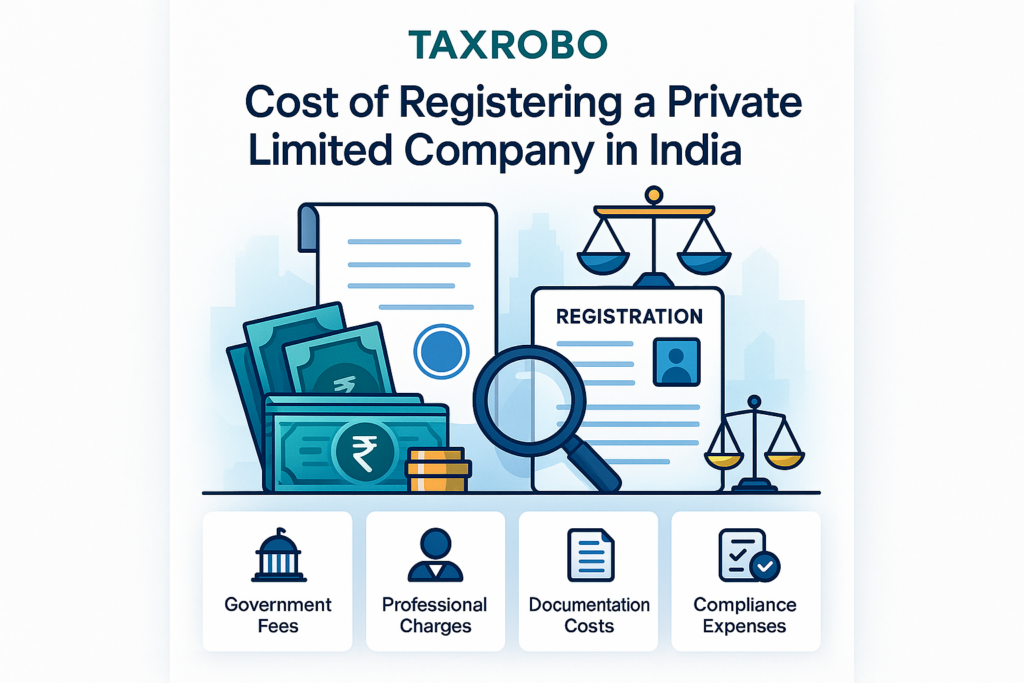
The total expenses of private limited registration India can be divided into two primary buckets: Government Fees and Professional Fees. Understanding the distinction is key to creating an accurate budget and appreciating where your money is going. One category covers mandatory statutory charges, while the other pays for the expertise required to navigate the complex legal and procedural landscape successfully. Let’s break down what each includes.
- Government Fees: These are direct payments made to central and state government bodies, primarily the Ministry of Corporate Affairs (MCA). These fees are mandatory and cover the costs of legal filing, name reservation, stamp paper, and the issuance of crucial identification numbers like PAN and TAN. These charges are largely fixed or vary based on specific parameters like your company’s authorized capital and the state of incorporation.
- Professional Fees: These are the charges you pay to a professional, such as a Chartered Accountant (CA), Company Secretary (CS), or a specialized firm like TaxRobo. This fee covers their expert services in handling the entire registration process. This includes drafting complex legal documents, ensuring all paperwork is accurate and compliant, filing the necessary e-forms on the government portal, and coordinating with the authorities to ensure a smooth and timely approval.
A Detailed Look at Government Fees in 2024
Government fees are variable and depend on factors like your company’s authorized capital and the state of registration. While the central government has simplified many aspects, state-level charges, particularly stamp duty, can significantly influence the final cost. It is crucial to get a precise estimate for your specific state to avoid any surprises during the incorporation process.
Ministry of Corporate Affairs (MCA) Filing Fees
The MCA is the central governing body for all companies in India. Most of the direct government charges are paid on its official portal.
- SPICe+ Form: The SPICe+ (Simplified Proforma for Incorporating Company Electronically Plus) is the integrated web form for company incorporation. The government has encouraged entrepreneurship by waiving the filing fee for this form for companies with an authorized share capital of up to ₹15 Lakh. While this is a great cost-saving measure, remember that other government charges are still applicable.
- Name Reservation (RUN Service): Before you can incorporate, you need a unique name for your company. This is done through the RUN (Reserve Unique Name) service on the MCA portal. The government charges a non-refundable fee of ₹1,000 for each name application you submit. It’s wise to have a couple of well-researched, unique names ready to increase your chances of approval in the first attempt.
- PAN and TAN Application: A Permanent Account Number (PAN) and a Tax Deduction and Collection Account Number (TAN) are mandatory for any company. The application for both is now integrated into the SPICe+ form, simplifying the process immensely. The standard government fees for issuing the PAN and TAN are included in the overall process, which typically amounts to around ₹160. You can find more information on the official MCA portal.
State-Specific Stamp Duty
Stamp duty is a state tax levied on legal documents like the Memorandum of Association (MoA) and Articles of Association (AoA). This is one of the most significant variables in the final registering private limited company fees India. Because it is a state-level tax, the amount varies dramatically from one state to another. For instance, stamp duty in Maharashtra for a company with a small authorized capital might be a few hundred rupees, whereas in Punjab or Delhi, it could be significantly higher. This cost is calculated based on the authorized capital mentioned in your MoA and AoA and is paid electronically during the filing process.
Decoding Professional Fees: The Value of Expert Help
While it’s tempting to save on costs by trying to handle the registration process yourself, it is a complex, multi-step procedure that can be overwhelming for a newcomer. Navigating the legal jargon, ensuring document accuracy, and correctly filling out intricate forms can lead to errors, rejections, and costly delays. Professional fees cover the expertise needed for a smooth, compliant, and hassle-free registration, allowing you to focus on your core business strategy.
Digital Signature Certificate (DSC)
A Digital Signature Certificate is the electronic equivalent of a physical signature. It is mandatory for all proposed directors and subscribers to sign the electronic forms submitted to the MCA. A professional will help you apply for and procure a Class 3 DSC, which comes in a secure USB token. The cost typically includes the DSC token and a validity of two years.
Director Identification Number (DIN)
Every individual who wishes to be a director of a company must have a unique Director Identification Number (DIN). Previously, this had to be applied for separately. However, the process is now streamlined, and the application for DIN for up to three directors is integrated within the SPICe+ incorporation form itself, with no separate fee.
Document Drafting and Preparation
This is where professional expertise is invaluable. A CA or CS will draft the foundational legal documents of your company with precision, ensuring they are compliant with the Companies Act, 2013, and aligned with your business objectives. Key documents include:
- Memorandum of Association (MoA): This document defines the company’s objectives and the scope of its operations.
- Articles of Association (AoA): This document outlines the internal rules and regulations for managing the company.
- Declarations and Affidavits: Various declarations are required from the proposed directors confirming their eligibility and compliance.
Filing and Coordination
The professional’s role extends beyond just paperwork. They manage the entire end-to-end process, which includes accurately filling out the complex SPICe+ form, uploading all required documents, paying the government fees and stamp duty, and submitting the application to the Registrar of Companies (RoC). They also handle any queries or requests for additional information from the MCA, ensuring timely follow-up and swift approval.
Sample Cost Analysis for Private Limited Company Registration in India
To give you a clearer picture, here is a sample breakdown of the private limited company registration charges in India for a standard company with 2 directors and an authorized capital of ₹1 Lakh. This table illustrates how the various components come together to form the total cost.
| Component | Estimated Cost (INR) | Notes |
|---|---|---|
| Government Fees | ||
| Name Reservation (RUN) | ₹1,000 | Per name application |
| SPICe+ Filing Fee | ₹0 | For capital up to ₹15 Lakh |
| Stamp Duty (MoA & AoA) | ₹500 – ₹2,000 | Varies significantly by state |
| PAN & TAN Application | ₹160 | Standard fee |
| Sub-Total (Govt. Fees) | ₹1,660 – ₹3,160 | |
| Professional Fees | ||
| Digital Signatures (DSC for 2) | ₹1,500 – ₹2,500 | Includes token and 2-year validity |
| Professional Service Charges | ₹4,000 – ₹8,000 | Includes drafting, filing, and expert consultation |
| Sub-Total (Prof. Fees) | ₹5,500 – ₹10,500 | |
| Total Estimated Cost | ₹7,160 – ₹13,660 | This is an estimate and can vary |
Disclaimer: Note: The figures above are estimates. The final cost can vary based on the state of registration, the number of directors, the authorized capital, and the professional service provider you choose. For an exact quote based on your specific needs, it’s best to consult with a professional.
Beyond Registration: Essential Post-Incorporation Costs
Your expenses don’t stop with the Certificate of Incorporation. Becoming a compliant corporate entity involves ongoing responsibilities and associated costs. Factoring these into your initial business budget is crucial for long-term financial planning and avoiding penalties for non-compliance. Here are a few immediate post-registration costs to factor into your budget.
- Share Capital Deposit: Once the company’s bank account is opened, the initial subscribers must deposit their subscribed share capital amount into this account. This is a mandatory step to commence business operations.
- Statutory Compliance: Your company must comply with annual filing requirements with the Registrar of Companies. This includes filing financial statements (Form AOC-4) and an annual return (Form MGT-7). These filings require professional assistance and have associated fees.
- Auditor Appointment: Every private limited company must appoint its first statutory auditor within 30 days of incorporation. The auditor’s fees will be an annual operational expense for auditing the company’s financial records.
- Business Licenses: Depending on your business nature and location, you may need other licenses to operate legally. This could include GST registration, a Trade License from the local municipality, FSSAI license for food businesses, or an Import Export Code (IEC). TaxRobo can assist you with services like GST Registration to ensure you are fully compliant.
Conclusion
In summary, the cost of registering a private limited company is a combination of fixed government fees, variable state stamp duties, and essential professional service charges. While an estimated range is ₹7,000 to ₹14,000, investing in professional guidance ensures a compliant and error-free process from day one. This initial investment saves you from potential legal complications and delays down the line, setting a strong foundation for your business. By understanding these costs upfront, you can plan your initial capital effectively and start your entrepreneurial journey on the right foot.
Ready to incorporate your company without the hassle? Contact TaxRobo’s experts today for a transparent quote and end-to-end registration support. Let us handle the paperwork while you focus on building your business.
Frequently Asked Questions (FAQs)
Q1: What is the minimum number of directors and shareholders required for a private limited company?
A: You need a minimum of 2 directors and 2 shareholders to register a private limited company in India. A director and shareholder can be the same person. The maximum number of shareholders is limited to 200.
Q2: Are there any hidden private limited company registration charges in India?
A: Not if you work with a transparent service provider. The main variable that can seem “hidden” is the state-specific stamp duty, which differs widely. Beyond registration, costs for annual compliance and auditing are separate operational expenses that should be planned for. At TaxRobo, we provide a clear, all-inclusive quote upfront with no hidden charges.
Q3: How long does the entire registration process take?
A: With all documents in order, the process typically takes 10-15 working days. This timeline includes obtaining Digital Signature Certificates (DSCs) for directors, getting the company name approved by the MCA, and receiving the final Certificate of Incorporation.
Q4: Can I register a private limited company at my home address?
A: Yes, absolutely. You can use your residential address as the registered office address for your company. To do this, you will need to provide a No Objection Certificate (NOC) from the property owner (even if it’s you or a family member) and a recent utility bill (like electricity or water bill) as proof of address.