
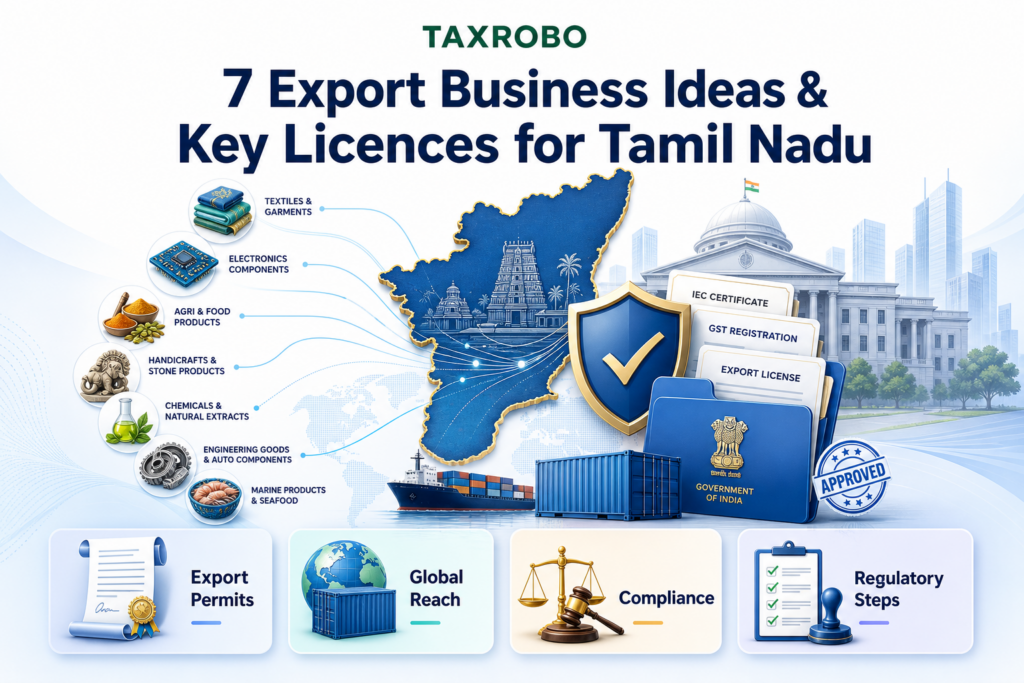

7 Profitable Export Business Ideas from Tamil Nadu – and the Licences You’ll Actually Need
Tamil Nadu, a powerhouse of Indian commerce, consistently ranks among the top exporting states in the country, contributing significantly to India’s global trade footprint. For many ambitious entrepreneurs and even salaried individuals looking for a side hustle, the world of international trade seems both lucrative and incredibly complex. This guide is designed to demystify the process by highlighting profitable export business ideas Tamil Nadu is renowned for, and more importantly, providing a clear, step-by-step breakdown of the essential licenses you will need. We will explore exciting Tamil Nadu export business opportunities and provide a practical roadmap for starting export business in Tamil Nadu, turning your global ambition into a tangible reality.
Why is Tamil Nadu a Goldmine for Export Business Opportunities?
Before diving into specific products, it’s crucial to understand why Tamil Nadu presents such a fertile ground for aspiring exporters. The state’s unique combination of geography, infrastructure, and industrial prowess creates a powerful ecosystem for global trade.
Strategic Location and Port Infrastructure
Tamil Nadu’s extensive coastline is home to three major ports—Chennai, Thoothukudi (V.O. Chidambaranar Port), and Ennore (Kamarajar Port)—and several minor ports. This robust maritime infrastructure provides excellent connectivity to key global shipping routes across Southeast Asia, the Middle East, Europe, and the Americas. This direct access significantly reduces logistical complexities and costs, giving local businesses a competitive edge in the global market.
Robust Industrial and Agricultural Base
The state boasts a highly diversified economy. It is a leader in manufacturing sectors like textiles, automotive components, and leather goods, earning it titles like the “Knitwear Capital of India” and the “Detroit of Asia.” Simultaneously, its rich agricultural landscape produces a vast array of high-demand products, from world-famous spices and coconuts to fruits and vegetables. This dual strength ensures a consistent and high-quality supply chain for a wide range of exportable goods.
Government Support and Skilled Workforce
The Tamil Nadu government actively promotes exports through various policies, incentives, and support systems. Bodies like the Federation of Indian Export Organisations (FIEO) have a strong presence, offering guidance and resources to new entrepreneurs. Furthermore, the state’s emphasis on education has resulted in a large pool of skilled and semi-skilled labor, which is essential for maintaining production quality and operational efficiency. One of the best exporting from Tamil Nadu business tips is to leverage these local resources and government schemes to your advantage.
The Foundation: Essential Licenses for Starting Your Export Business in Tamil Nadu
Before you can even think about shipping your first container, you must build a solid legal foundation. Getting these licenses in order is the most critical first step in your journey. Here is a clear breakdown of the essential licenses for export business Tamil Nadu entrepreneurs must secure.
Step 1: Business Registration & PAN
First, you need to establish a legal identity for your business. For a detailed walkthrough, see our guide on How to Register a Company in India: Complete Process & Checklist. You cannot conduct business in your personal name for long. You have several options:
- Sole Proprietorship: Easiest to start, with you and the business being the same legal entity.
- Partnership Firm: For businesses with two or more partners.
- Limited Liability Partnership (LLP): Offers the flexibility of a partnership with the benefit of limited liability.
- Private Limited Company: A separate legal entity that offers the most credibility, liability protection, and is preferred for scaling up and securing funding.
Your business will also need a Permanent Account Number (PAN) card issued by the Income Tax Department.
Actionable Tip: While a proprietorship is simple, establishing a Private Limited Company or LLP adds significant credibility when dealing with international buyers and financial institutions. It signals professionalism and long-term commitment. TaxRobo can help you navigate the entire process smoothly. Explore our TaxRobo Company Registration Service.
Step 2: A Dedicated Current Bank Account
Once your business entity is registered, you must open a current bank account in the business’s name. All your export-related transactions, from receiving payments from foreign buyers to paying local suppliers, must be routed through this account. It is essential for maintaining clean financial records and for regulatory compliance.
Step 3: The Importer-Exporter Code (IEC)
The Importer-Exporter Code (IEC) is the single most important license for your export business. It is a mandatory 10-digit code issued by the Director General of Foreign Trade (DGFT), Ministry of Commerce. Without an IEC, you cannot legally export goods from or import goods into India. It is a one-time registration with lifetime validity. You can apply for your IEC online through the official DGFT website.
Step 4: GST Registration
Goods and Services Tax (GST) registration is mandatory for any export business. Although exports are considered “zero-rated supplies” (meaning no GST is levied on the final product), you need a GST Identification Number (GSTIN) for two key reasons:
- To Claim Input Tax Credit (ITC): You can claim a refund on the GST you paid on raw materials, manufacturing, and other services used to produce your export goods.
- To Export without Paying IGST: With a GSTIN, you can file a Letter of Undertaking (LUT) with the GST department. This allows you to export goods without paying the Integrated GST (IGST) upfront, which greatly helps with working capital management. You can find more details in our Ultimate Guide to GST Registration for Small Businesses. You can register on the official GST Portal.
Step 5: Registration-cum-Membership Certificate (RCMC)
An RCMC is a certificate issued by the relevant Export Promotion Councils (EPCs) or commodity boards. It validates your business as a registered exporter of specific products. Holding an RCMC allows you to avail benefits under India’s Foreign Trade Policy, get assistance in finding buyers, and access valuable market information. Some of the key EPCs include:
- Federation of Indian Export Organisations (FIEO)
- Apparel Export Promotion Council (AEPC)
- Council for Leather Exports (CLE)
- Spices Board of India
- Agricultural and Processed Food Products Export Development Authority (APEDA)
7 Profitable Export Business Ideas from Tamil Nadu
Now that you know the legal framework, let’s explore some of the best export businesses Tamil Nadu has to offer. Each of these ideas leverages the state’s unique strengths and has a proven global demand.
1. Textiles and Readymade Garments (The ‘Tiruppur’ Advantage)
- Why: Tamil Nadu is the textile capital of India, with Tiruppur alone accounting for a massive share of the country’s knitwear exports. The entire ecosystem, from spinning mills to dyeing units and garment manufacturers, is concentrated here. The global demand for high-quality cotton apparel, sustainable fashion, and children’s wear is ever-growing.
- Products: Cotton T-shirts, polo shirts, children’s clothing, nightwear, home textiles (bed linens, towels), and organic cotton garments.
- Specific License: Beyond the basics, you will need an RCMC from the Apparel Export Promotion Council (AEPC).
2. Leather Goods and Footwear (The Ambur-Vaniyambadi Belt)
- Why: The Ambur-Vaniyambadi-Ranipet region is a world-renowned hub for finished leather products. The craftsmanship and quality are globally recognized. This sector provides a fantastic opportunity to export high-value finished goods rather than just raw materials.
- Products: Leather footwear (formal shoes, boots), leather jackets, wallets, belts, handbags, and industrial safety gloves.
- Specific License: An RCMC from the Council for Leather Exports (CLE) is mandatory for this sector.
3. Spices and Agri-Products (From Erode’s Turmeric to Theni’s Cardamom)
- Why: Tamil Nadu’s diverse agro-climatic zones allow for the cultivation of a wide variety of spices and agricultural products. Erode is one of Asia’s largest markets for turmeric, and the Western Ghats region is famous for cardamom and pepper. There is immense global demand for authentic Indian spices.
- Products: Turmeric (whole and powder), cardamom, black pepper, chillies, cloves, and blended curry powders or “masala” mixes.
- Specific Licenses: You will need an RCMC from the Spices Board of India or APEDA. An FSSAI License (Food Safety and Standards Authority of India) is also critical to ensure your products meet food safety standards.
4. Coir and Coir Products (The Coconut Economy)
- Why: With its long coastline and extensive coconut cultivation, particularly around the Pollachi-Coimbatore belt, Tamil Nadu is a leading producer of coir. As the world moves towards sustainable and eco-friendly products, the demand for coir-based items is soaring.
- Products: Coir pith (a growing medium for horticulture), coir fiber, doormats, brushes, geo-textiles for erosion control, and ropes.
- Specific License: Registration with the Coir Board of India is necessary to export these products.
5. Auto Components and Engineering Goods (The ‘Detroit of Asia’)
- Why: Chennai is a major hub for automobile manufacturing, hosting global giants and a massive ecosystem of ancillary units. This creates a huge opportunity for exporting high-quality, precision-engineered auto components to markets worldwide.
- Products: Engine parts, transmission parts, suspension components, castings, forgings, industrial fasteners, and electrical parts.
- Specific License: An RCMC from the Engineering Export Promotion Council (EEPC) India is required for this category.
6. Traditional Handicrafts & Silk Sarees
- Why: This is a niche but high-value market. Tamil Nadu’s rich cultural heritage offers unique products that command a premium price globally. These items are sought after for their intricate craftsmanship and cultural significance.
- Products: Authentic Kanchipuram silk sarees, Thanjavur paintings, bronze and brass idols, stone sculptures from Mahabalipuram, and Chettinad wooden crafts.
- Specific Licenses: Depending on the product, you’ll need an RCMC from the Handloom Export Promotion Council (HEPC) or the Export Promotion Council for Handicrafts (EPCH). For silk sarees, obtaining a Silk Mark certification adds authenticity and value.
7. Processed Foods (The Value-Addition Opportunity)
- Why: The state is a major producer of fruits like mangoes and bananas, and a variety of vegetables. Instead of exporting raw produce, there is a massive opportunity in value-added processed foods, which have a longer shelf life and higher profit margins.
- Products: Mango pulp, banana powder, fruit jams, pickles, canned vegetables, ready-to-eat curry meals, and traditional snacks (“murukku,” “thattai”).
- Specific Licenses: A central FSSAI License is mandatory for export. You’ll also need an RCMC from APEDA. Additionally, for plant-based products, a Phytosanitary Certificate issued by the plant quarantine department is required to certify that they are free from pests and diseases.
Your Next Steps: From Idea to First Shipment
Having an idea and the licenses is just the start. The real journey involves execution. Here are some crucial exporting from Tamil Nadu business tips to guide you.
Research Your Market & Find Buyers
You need to identify countries where your product is in demand. Use resources from Export Promotion Councils, participate in virtual and physical trade fairs, and leverage online B2B portals like Alibaba, Global Sources, and IndiaMART. Create a professional website and product catalog to showcase your offerings to potential international buyers.
Understand Pricing & Shipping Terms (Incoterms)
Pricing is more than just your product cost plus profit. You must factor in packaging, local transportation, customs clearance fees, freight charges, and insurance. It’s vital to understand standard international commercial terms (Incoterms) like FOB (Free on Board) and CIF (Cost, Insurance, and Freight), as these define who is responsible for the costs and risks at each stage of the shipping process.
Don’t Ignore Documentation
International trade runs on documentation. A single error can cause your shipment to be delayed, fined, or even rejected by customs. Key documents you will always need include:
- Commercial Invoice cum Packing List
- Bill of Lading (for sea freight) or Airway Bill (for air freight)
- Certificate of Origin
- Shipping Bill
- Other specific documents like inspection certificates or insurance policies.
Accuracy and attention to detail are non-negotiable.
Conclusion: Your Export Journey from Tamil Nadu Starts Now
Tamil Nadu offers immense potential for anyone willing to step into the world of global trade. The journey begins with a solid legal foundation—securing your business registration, IEC, and GST—and choosing from the many profitable export business ideas Tamil Nadu has to offer. From the textile looms of Tiruppur to the spice fields of Erode, opportunities are abundant. While the process involves multiple steps and careful documentation, it is entirely achievable with the right planning and guidance.
Feeling overwhelmed by the Tamil Nadu export regulations and paperwork? Don’t let compliance hurdles stop your global ambitions. TaxRobo’s experts can manage your Company Registration, IEC application, GST filing, and more, so you can focus on what you do best—building your business. Contact us today for a free consultation and take your first step into the world of exports!
Frequently Asked Questions (FAQs)
1. Can a salaried person start an export business from Tamil Nadu?
Answer: Absolutely. You can start as a merchant exporter (sourcing goods from manufacturers and exporting them) on a part-time basis. The key is to register a simple business structure like a proprietorship to begin with, get your mandatory IEC and GST registration, and perhaps start with small orders to understand the process before scaling up.
2. Do I really need a GST number for an export business?
Answer: Yes. While exports are ‘zero-rated’ under GST (meaning the final product has 0% GST), you absolutely need a GSTIN. It is essential for claiming refunds on the tax you’ve already paid on your inputs (like raw materials and services) or for exporting under a Letter of Undertaking (LUT) without paying IGST upfront. Without it, your business would be financially unviable.
3. How much capital is required for starting export business in Tamil Nadu?
Answer: This varies greatly depending on your business model. A service-based export business or a merchant exporter model requires significantly less capital than a manufacturer exporter who needs to invest in a production unit. At a minimum, you should budget for costs related to business registration, licenses, product sampling, website development, and the working capital needed to fulfill your first small order. For more details, you can read our guide on How Much Capital is Required to Start a Private Limited Company?.
4. Which are the easiest products to export from Tamil Nadu for a beginner?
Answer: For a beginner, products with established supply chains and strong global demand are often the best starting points. In Tamil Nadu, these include readymade garments from Tiruppur, coir products from the Coimbatore region, and spices like turmeric from Erode. These products have well-defined quality standards and a large base of manufacturers, making sourcing relatively straightforward. However, always conduct thorough market research for your specific product before investing.