
How to Prepare the Perfect DRC-01 Notice Response Format: A Complete Guide for Indian Taxpayers
Receiving a formal notice from the GST department can be stressful. But don’t panic. The notice, often in Form DRC-01, is an opportunity to present your case, and a well-structured reply can make all the difference. This comprehensive guide will break down the ideal DRC-01 Notice response format, providing you with actionable steps and clear instructions on how to reply to DRC-01 Notice in India effectively. A DRC-01 is a summary of a show-cause notice detailing potential tax liabilities, interest, and penalties under the Goods and Services Tax (GST) law. Understanding how to respond is not just about compliance; it’s about protecting your business from unnecessary financial strain. A timely and correctly formatted response is crucial to avoid hefty penalties and prolonged legal complications, ensuring your business remains in good standing with the tax authorities.
What Exactly is a DRC-01 Notice Under GST?
Before diving into the response, it’s essential to understand what this notice signifies. It’s the first formal communication from the GST department about a potential tax shortfall. Think of it as a detailed query asking you to explain certain discrepancies the tax officer has found. Ignoring it or providing a vague reply can escalate the matter, leading to a confirmed demand order against you. Therefore, treating this notice with the seriousness it deserves is the first step towards a successful resolution. Grasping The Significance of ‘Show Cause Notices’ in GST: Legal Framework and Compliance helps in appreciating the gravity of the situation.
A Simple DRC-01 Notice Explanation for Indian Taxpayers
Contrary to popular belief, a DRC-01 notice is not the final tax demand itself. Instead, it is a summary of a Show Cause Notice (SCN) that is issued to a taxpayer when a tax officer believes there is an unpaid tax liability. This notice is issued under Section 73 of the CGST Act for cases that do not involve fraud, willful misstatement, or suppression of facts. For more serious cases where the officer suspects intentional tax evasion, the notice is issued under Section 74. The primary purpose of the DRC-01 is to transparently communicate the alleged discrepancies and provide the taxpayer with a fair opportunity to explain their position or pay the outstanding amount before a final, legally binding order is passed. It formalizes the demand for the specific tax amount, any applicable interest, and potential penalties that were discovered during processes like departmental audits, scrutiny of returns, or other enforcement activities. Understanding the Key Differences Between Sections 73 and 74 of the CGST Act in GST Demand Notices is crucial for determining the severity and potential penalties.
Top 3 Reasons You Might Receive a DRC-01 Notice
Understanding why you received the notice is key to formulating an effective reply. While reasons can vary, most DRC-01 notices stem from a few common issues. Being aware of these can also help you maintain better compliance in the future. Here are the top three reasons taxpayers receive a DRC-01:
- Mismatch in Returns: This is one of the most frequent triggers. It occurs when there are significant discrepancies between the outward supplies (sales) declared in your Form GSTR-1 and the tax liability you have paid through your Form GSTR-3B. The GSTN’s advanced data analytics tools can easily flag such mismatches, prompting the tax officer to seek clarification.
- Excess Input Tax Credit (ITC) Claims: A tax officer may issue a DRC-01 if they find that the Input Tax Credit you claimed in your GSTR-3B is higher than the amount automatically populated in your GSTR-2A or GSTR-2B. This suggests that you might have claimed ITC for invoices that your suppliers have not reported, or you have claimed ineligible credit.
- Audit/Scrutiny Findings: During a departmental audit or a routine scrutiny of your GST returns, a tax officer might uncover discrepancies. These could range from incorrect tax rate applications and classification issues (HSN codes) to non-payment of tax under the Reverse Charge Mechanism (RCM). The findings from such proceedings are formally communicated through a DRC-01.
First Steps: What to Do Immediately After Receiving a DRC-01 Notice
Your actions in the first few hours and days after receiving the notice are critical. A calm and methodical approach will set the stage for a successful resolution. Rushing into a reply without proper preparation can do more harm than good, while ignoring the notice is the worst possible course of action.
Don’t Ignore the Deadline
The most critical piece of information on the notice, after the alleged discrepancy itself, is the due date for your reply. Typically, you are given 30 days from the date of receipt of the notice to submit your response. Ignoring this deadline is a significant mistake. If you fail to respond within the stipulated time, the tax officer is empowered to pass an ex-parte order. This means they will make a final decision based solely on the information they have, without considering your side of the story. This almost always results in a confirmed demand order against you, along with maximum penalties and interest.
Verify the Notice Details
Before you start preparing your defense, conduct a basic verification of the notice. Ensure that your GSTIN, legal name, and business address are correctly mentioned. Cross-check the tax period for which the discrepancy is being pointed out. It is also crucial to confirm the legitimacy of the notice. You can do this by logging into your account on the official GST portal and checking for the notice under the ‘View Additional Notices/Orders’ section. This step protects you from fraudulent communications and ensures you are responding to a genuine query from the department.
Gather Your Documents
A strong reply is always backed by solid evidence. Once you understand the allegations, your immediate next step should be to compile all relevant financial records for the period in question. This documentation will form the backbone of your rebuttal. Key documents to gather include:
- Copies of your GSTR-1, GSTR-3B, and GSTR-2B filings for the relevant tax period.
- Tax invoices related to both your sales and purchases.
- Detailed bank statements and reconciliation reports to prove transactions.
- Relevant e-way bills, especially if the dispute relates to the movement of goods.
- Any other supporting documents like credit notes, debit notes, or agreements that are relevant to the case.
Mastering the DRC-01 Notice Response Format: A Step-by-Step Guide
Once you have analyzed the notice and gathered your documents, you need to decide on your response strategy. Your approach will determine the format and content of your reply. A well-structured response not only makes it easier for the tax officer to understand your position but also reflects your professionalism and diligence as a taxpayer. Following a clear DRC-01 Notice response format is essential for presenting your case coherently and persuasively.
Understanding Your Two Main Options
Fundamentally, you have two paths you can take after receiving a DRC-01 notice. Your choice will depend on whether you agree or disagree with the allegations made by the tax department.
- Option 1: Agreeing with the Notice (Fully or Partially): If, after reviewing your records, you find that the tax officer’s observations are correct, the best course of action is to accept the liability. You can make the required payment of tax, interest, and any applicable penalty using Form GST DRC-03. There are significant benefits to doing this promptly, especially if the notice is under Section 73 (non-fraud cases). Paying the demand within 30 days of the notice often results in the waiver of penalties, saving you a considerable amount of money.
- Option 2: Disagreeing with the Notice: If you believe the notice is based on incorrect facts or a misinterpretation of the law, you must contest the allegations. To do this, you need to file a formal, detailed reply using Form GST DRC-06. This is where mastering the DRC-01 Notice response format India requires becomes absolutely critical, as this document will serve as your primary defense.
The Anatomy of a Strong Reply in Form GST DRC-06
Your written submission, which you will upload as a PDF while filing Form DRC-06, is your chance to make a compelling argument. It should be clear, professional, and address every point raised in the notice. Here’s a template-like structure to follow:
Part 1: Basic Details
Start your reply with a formal header that clearly identifies the notice you are responding to.
- Reference: Provide the Notice Reference Number (NRN) and the date mentioned on the DRC-01.
- Subject: “Reply to Show Cause Notice Summary in Form DRC-01”
- Recipient: Address it to the proper tax officer/authority who issued the notice.
- Your Details: Clearly state your Legal Name, GSTIN, and principal place of business.
Part 2: Point-by-Point Rebuttal
This is the core of your response. Do not provide a generic, vague denial. Instead, break down the allegations from the DRC-01 and address each one separately under a distinct heading.
- Example Heading: “Rebuttal to Allegation of Excess ITC Claim of Rs. 50,000 for October 2023”
- Under each heading, provide a factual and logical counter-argument. Explain why the department’s observation is incorrect. For instance, if the allegation is an ITC mismatch, you could explain that the supplier filed their GSTR-1 late, but the invoice and payment are legitimate.
Part 3: Legal Basis and Supporting Evidence
A factual argument becomes much stronger when supported by legal provisions and concrete evidence.
- Cite the Law: Wherever possible, cite relevant sections of the CGST Act, SGST Act, associated Rules, or any circulars and notifications issued by the CBIC that support your position.
- Refer to Annexures: Refer clearly to all the supporting documents you have gathered. For example, you might write, “A detailed reconciliation of ITC as per our books versus GSTR-2B is attached as Annexure-A,” or “Copies of the relevant tax invoices are attached as Annexure-B.”
Part 4: Prayer
Conclude your written submission with a formal request, known as a “prayer.” This section summarizes your desired outcome.
- Example Prayer: “In light of the facts, legal provisions, and documentary evidence submitted above, we humbly pray that your good office be pleased to review our submissions, find them satisfactory, and drop the proceedings initiated vide the aforementioned notice. We also request an opportunity for a personal hearing to explain our case further if required.”
This concluding part is a key element of responding to DRC-01 Notice effectively.
The DRC-01 Notice Compliance Procedure: How to File Your Reply Online
After preparing your detailed written reply and compiling all supporting documents, the final step is to submit them officially through the GST portal. The entire process is online, ensuring a transparent and trackable submission.
Filing Form GST DRC-06 on the GST Portal
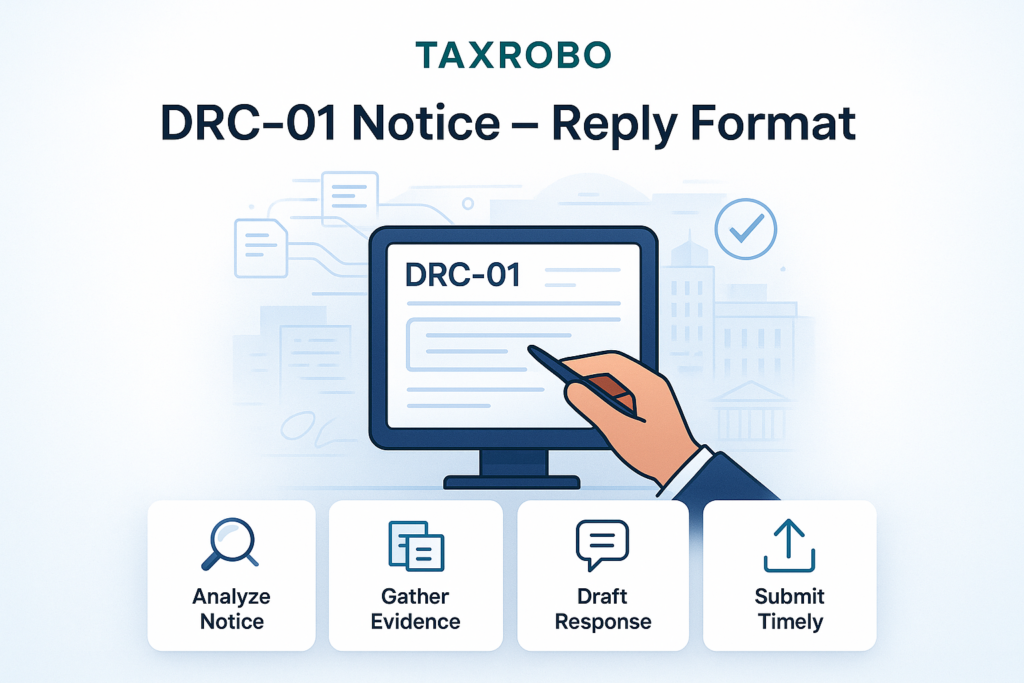
Filing your reply is a straightforward process if you follow these steps. This is the standard DRC-01 Notice compliance procedure India mandates for all taxpayers.
- Login: Access the official GST Portal at https://www.gst.gov.in/.
- Navigate: Go to the dashboard and follow this path: `Services > User Services > View Additional Notices/Orders`.
- Locate the Notice: Find the specific notice by its reference number and click on the “View” link.
- Initiate Reply: Navigate to the “Replies” tab within the notice details and click on the “Add Reply” button.
- Upload Submission: Select “Reply” from the dropdown menu. You will see a section to upload your detailed written submission. This should be the carefully drafted letter (as per the format above) saved in a single PDF file.
- Attach Documents: Use the “Upload Supporting Documents” option to attach all your annexures (reconciliations, invoices, bank statements, etc.). You may need to upload them as separate PDF files.
- Verify and Submit: Finally, verify your submission using a Digital Signature Certificate (DSC) for companies and LLPs, or an Electronic Verification Code (EVC) for other taxpayers.
What Happens After You File Your Reply?
Once you have successfully filed Form DRC-06, the ball is in the tax officer’s court. The officer assigned to your case will thoroughly review your written response and all the documents you have submitted. Based on their assessment, one of the following outcomes will occur:
- Proceedings Dropped: If the officer is satisfied with your explanation and evidence, they will issue an order dropping the proceedings, and the case will be closed.
- Personal Hearing: If the officer requires further clarification or is not fully convinced, they will schedule a personal hearing. This is an opportunity for you or your authorized representative to explain the case in person.
- Order Issued (DRC-07): If your reply is found to be unsatisfactory and the officer remains convinced of the tax shortfall, they will issue a final order in Form DRC-07, confirming the demand for tax, interest, and penalty. If you receive this order, it is important to know about the DRC-07 GST Demand Order – How to File Reply & Appeal.
Conclusion
A DRC-01 notice is a serious matter, but it is a manageable and structured part of the GST compliance framework. It provides you with a fair chance to be heard before any demand is finalized. The key to a successful outcome lies in a timely, professional, and well-documented response. By understanding the allegations, gathering your evidence, and following a clear DRC-01 Notice response format, you can present your case with confidence and clarity. This proactive approach significantly increases the chances of resolving the issue favorably and avoiding unnecessary financial liabilities for your business.
Navigating GST notices and legal jargon requires expertise. If you need help with understanding the DRC-01 Notice format India or drafting a compelling reply, TaxRobo’s team of GST experts is here to assist. Contact us today for a hassle-free compliance experience.
Frequently Asked Questions about DRC-01 Notices
Q1: What is the time limit to reply to a DRC-01 notice?
A: The time limit is always specified in the notice itself, but it is usually 30 days from the date you receive it. It is highly recommended to act promptly, as making a payment within this 30-day window for non-fraud cases (under Section 73) can lead to the waiver of penalties.
Q2: What happens if I don’t respond to a DRC-01 notice?
A: Failure to respond is a critical error. The tax officer will assume you have no defense and will pass an ex-parte order, meaning a decision made without hearing your side. This will confirm the entire tax demand mentioned in the notice via Form DRC-07, and the department will initiate recovery proceedings against you.
Q3: Is it mandatory to hire a professional to reply to a DRC-01?
A: While it is not legally mandatory, it is highly advisable. A GST professional or a Chartered Accountant understands the nuances of tax law, the proper legal language to use, and how to structure an effective argument. Their expertise in drafting a legally sound reply and gathering the correct evidence is key to responding to DRC-01 Notice effectively and can significantly improve your chances of a favorable outcome.
Q4: Can I make a partial payment if I agree with only some of the points in the notice?
A: Yes, absolutely. This is a common and practical approach. You can pay the portion of the demand that you agree with using Form DRC-03. For the remaining disputed amount, you should file a detailed reply in Form DRC-06, clearly stating which points you are contesting and why.