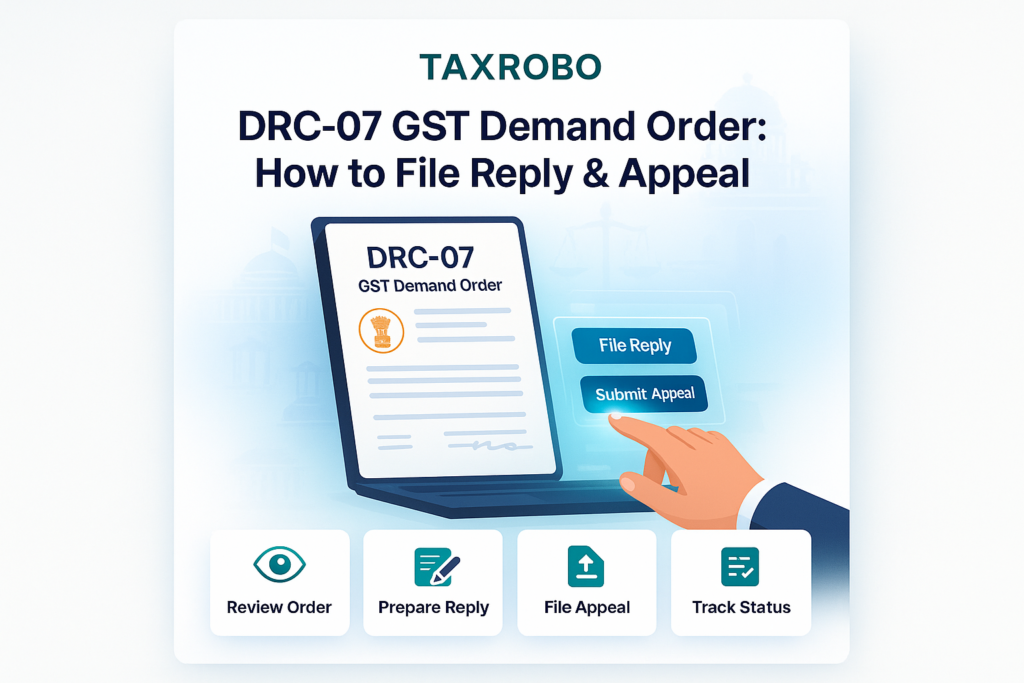

DRC-07 GST Demand Order – How to File Reply & Appeal
Receiving an official notice from the tax department can be a stressful experience for any business owner. When a form like DRC-07 lands on your GST portal dashboard, it’s easy to feel overwhelmed and confused. This notice represents a confirmed demand for tax, interest, or penalties from the GST authorities. However, panicking is not the solution. A structured and informed approach is key to handling this situation effectively. A well-prepared GST Demand Order reply or a timely appeal can protect your business from financial strain and legal complications. This comprehensive guide will walk you through the entire journey, from understanding the notice to understanding how to appeal a GST Demand Order in India, ensuring you are equipped to handle it with confidence.
What is a DRC-07 GST Demand Order?
Before you can formulate a response, it’s essential to understand what a DRC-07 is and where it fits into the GST compliance framework. It isn’t a surprise notice that appears out of nowhere; it’s typically the culmination of a detailed departmental proceeding.
Understanding the GST Notice Lifecycle
The journey to a DRC-07 usually begins with earlier communications from the GST department. An officer typically follows these steps:
- Scrutiny Notice (ASMT-10): This is often the first step, where an officer finds a discrepancy in your GST returns (e.g., a mismatch between GSTR-1 and GSTR-3B) and asks for an explanation.
- Show Cause Notice (DRC-01): If your explanation for the ASMT-10 is unsatisfactory, or for more serious issues, the department issues a Show Cause Notice (SCN) in Form DRC-01. This is a formal notice that details the alleged tax shortfall, interest, and proposed penalty, asking you to “show cause” why this amount should not be demanded from you.
- Adjudication Order: After you file a reply to the SCN (in Form DRC-06) and attend a personal hearing, the officer passes a final order. This order, known as the adjudication order, details the final decision on the matter.
Decoding Form DRC-07
Form DRC-07 is not the detailed order itself. Instead, it is a summary of the final adjudication order that is uploaded on the GST portal to create a demand against your GSTIN. It serves as a formal intimation of the dues you are liable to pay.
A typical DRC-07 will contain the following critical information:
- Demand ID: A unique identification number for the demand.
- Order Details: The number and date of the underlying adjudication order.
- Tax Period: The specific months or quarters to which the demand relates.
- Breakdown of Dues: A clear bifurcation of the amount payable under different heads:
- Central GST (CGST)
- State/Union Territory GST (SGST/UTGST)
- Integrated GST (IGST)
- Cess
- Interest
- Penalty
Why Would You Receive a DRC-07?
A demand order can be issued for various reasons, usually stemming from discrepancies found during the scrutiny of your GST returns and records. Properly understanding GST Demand Order appeals begins with identifying the root cause of the notice. Some common triggers include:
- Mismatch in GSTR-1 and GSTR-3B: The outward supplies declared in GSTR-1 are higher than the tax paid in GSTR-3B.
- Excess Input Tax Credit (ITC) Claims: Claiming ITC more than what is reflected in your GSTR-2A/2B or claiming ineligible ITC.
- Non-payment or Short Payment of Tax: Errors in calculating tax liability, applying the wrong tax rate, or simply failing to pay the required tax.
- Incorrect Classification: Classifying goods or services under the wrong HSN/SAC code, leading to a lower tax payment.
- Violation of E-way Bill Provisions: Discrepancies found during transit or failure to generate e-way bills where required.
Your Immediate Steps After Receiving a GST Demand Order
Once a DRC-07 appears on your portal, time is of the essence. Acting promptly and methodically can make all the difference. Here are the first three steps you must take.
Step 1: Don’t Panic, Verify the Details
The first step is to remain calm and carefully review the DRC-07 summary. Check for any clerical errors or basic mistakes. Verify the following:
- GSTIN and Legal Name: Ensure the notice is addressed to the correct legal entity.
- Demand Amount: Tally the amounts mentioned under each head (tax, interest, penalty).
- Tax Period: Confirm that the period mentioned in the notice is correct.
Any discrepancy, no matter how small, should be noted as it could be relevant to your reply or appeal.
Step 2: Read the Adjudication Order Thoroughly
This is the most critical step. The DRC-07 is just a summary; the real substance lies in the detailed adjudication order attached to it. This document contains the officer’s reasoning, the facts of the case they considered, the legal provisions they invoked, and their justification for confirming the demand. A thorough understanding of this order is fundamental to responding to a GST Demand Order effectively. Analyze the grounds on which the officer has confirmed the demand and identify the specific points you disagree with.
Step 3: Collate All Necessary Documents
To build a strong case, whether for rectification or for an appeal, you need solid documentary evidence. Start gathering all relevant records related to the tax period in question. This is your arsenal to counter the department’s claims. Key documents include:
- Copies of GSTR-1, GSTR-3B, and GSTR-9 for the period.
- Relevant sales invoices, purchase invoices, and debit/credit notes.
- E-way bills, where applicable.
- Bank statements to prove transactions.
- Your ITC ledger and records.
- Any previous correspondence with the GST department regarding this issue, including your reply to the SCN (Form DRC-06).
A Step-by-Step Guide to Filing Your GST Demand Order Reply (Using Form DRC-06)
It’s important to clarify a common point of confusion. A “reply” in the truest sense is filed in Form DRC-06 against the Show Cause Notice (DRC-01) before the final order (and DRC-07) is issued. This is your opportunity to present your case and prevent the demand from being confirmed. If you have already received the DRC-07, it means this stage has passed, and your next recourse is to pay the demand or file an appeal. However, understanding the GST Demand Order reply filing process for the SCN is crucial, as a strong DRC-06 reply forms the bedrock of a potential appeal.
Pre-requisites for the GST Demand Order Reply Filing Process
Before you begin filing Form DRC-06, ensure you have a well-reasoned argument supported by facts and legal provisions. Your reply should be structured, logical, and persuasive. Haphazardly filing a reply without proper documentation can lead to an unfavorable order.
How to File Form DRC-06 on the GST Portal
Here is the step-by-step process for filing your reply to the Show Cause Notice on the official portal:
- Login to the GST Portal at GST Portal.
- Navigate to the dashboard and go to Services > User Services > View Additional Notices/Orders.
- Click on ‘View’ to see the notices issued to you. Locate the relevant Show Cause Notice (DRC-01) by its reference number and click on the ‘Reply’ button.
- The system will display Form DRC-06. Fill in the required details. You will have options for personal hearing and other particulars.
- There will be a text box where you can type your reply. It is highly recommended to prepare a detailed, well-structured reply in a separate document (like a PDF) and attach it. Use the text box for a brief summary.
- Click on the ‘Upload’ button to attach your detailed PDF reply and all supporting documents (invoices, reconciliations, legal precedents, etc.).
- Once all details are filled and documents are attached, you can preview the form and then file it using either a Digital Signature Certificate (DSC) or an Electronic Verification Code (EVC).
Essential Guidelines for Filing a Strong DRC-07 Reply
The quality of your reply can significantly influence the outcome. When filing reply for DRC-07 GST Demand (or more accurately, the preceding SCN), follow these best practices:
- Structure Your Reply: A professional reply should have a clear structure. A common format includes:
- Statement of Facts: Present your version of the facts of the case chronologically and clearly.
- Grounds of Reply: Address each allegation or point raised in the Show Cause Notice one by one. Do not leave any point unanswered.
- Be Factual and Specific: Back up every claim with evidence. For example, if the notice alleges an ITC mismatch, provide a reconciliation statement with invoice-level details.
- Cite Legal Provisions: Support your arguments by citing relevant sections of the CGST Act, rules, and any applicable government circulars or notifications.
- Reference Case Laws: If there are favorable judgments from High Courts, the Supreme Court, or GST Advance Ruling Authorities on similar matters, cite them to strengthen your position.
- Maintain a Professional Tone: Keep the language formal, respectful, and objective. Avoid emotional or accusatory language. These
guidelines for filing DRC-07 replycan make your submission more credible and effective.
When and How to Appeal a GST Demand Order in India (The DRC-07 Appeal Process)
If your reply to the SCN did not result in a favorable outcome and the officer has issued an order confirming the demand via DRC-07, your next legal recourse is to file an appeal. The GST law provides a hierarchical appellate mechanism.
Understanding the Grounds for an Appeal
You can file an appeal if you are an “aggrieved person,” meaning you believe the order passed by the adjudicating authority is:
- Incorrect on Facts: The officer has misinterpreted the factual evidence you submitted.
- Incorrect in Law: The officer has incorrectly applied the provisions of the GST law.
- A Violation of Natural Justice: You were not given a proper opportunity to be heard or present your case.
The First Level: Filing an Appeal with the Appellate Authority (Form GST APL-01)
The first appeal against an order passed by an Adjudicating Authority lies with the First Appellate Authority. This is a critical stage with strict rules and deadlines.
- Timeline: The appeal must be filed within three months from the date on which the order is communicated to you. This is a strict deadline, and delays are generally not condoned unless there is a sufficient cause, which can extend it by one more month.
- Pre-deposit Requirement: This is a non-negotiable condition. To file a valid appeal, you must make a mandatory pre-deposit of 10% of the disputed tax amount. For example, if the disputed tax in the order is ₹5,00,000, you must first pay ₹50,000. The appeal will not be admitted without proof of this payment. The balance amount of the demand is stayed until the appeal is decided.
Step-by-Step DRC-07 appeal process in India:
The entire process is online. Here are the crucial steps to file GST Demand Order appeal:
- Prepare Appeal Documents: Draft a detailed ‘Statement of Facts’ and ‘Grounds of Appeal’. The grounds should clearly and concisely state every reason why you believe the order is wrong.
- Pay the Pre-deposit: Pay the mandatory 10% pre-deposit amount using Form DRC-03 on the GST portal. Select ‘Payment against demand’ as the reason for payment. Save the ARN/payment receipt.
- File Form GST APL-01: Login to the GST portal and navigate to Services > User Services > My Applications. Select ‘Appeal to Appellate Authority’ as the application type and file a new application.
- Fill and Upload: Fill in the details in Form GST APL-01. You will be required to upload the following documents in PDF format:
- The original adjudication order against which the appeal is filed (the one summarized in DRC-07).
- The Statement of Facts.
- The Grounds of Appeal.
- Proof of payment of the pre-deposit (DRC-03 challan).
- Any other supporting documents.
- Submit and Acknowledge: Submit the form using DSC or EVC. An appeal number (ARN) will be generated, which serves as your acknowledgment.
What Happens After Filing the Appeal?
Once your appeal is filed and accepted, the Appellate Authority will schedule a hearing. You or your authorized representative will have an opportunity to present your case. The authority will examine the facts, your grounds of appeal, and the original order before passing its own order, which can either uphold, modify, or set aside the original demand order.
Conclusion
Receiving a GST demand order in Form DRC-07 can be daunting, but it is a manageable part of doing business in a complex tax environment. The key is to act strategically and without delay. First, meticulously verify the details of the notice and the underlying order. If the order has not yet been passed, focus on preparing a robust and evidence-backed response to the Show Cause Notice. If an unfavorable order is already in your hands, remember that you have the right to appeal. Filing a timely appeal within three months, along with the mandatory 10% pre-deposit, is your best course of action. A well-drafted GST Demand Order reply or a strong appeal is not just about compliance; it’s about defending your business’s financial health and ensuring that you are treated fairly under the law.
Feeling overwhelmed by a GST notice? The experts at TaxRobo specialize in handling GST litigation and compliance. Contact us today for professional assistance with your GST Demand Order appeal steps and ensure your case is handled correctly. Visit our TaxRobo GST Service page to learn more.
Frequently Asked Questions (FAQ) Section
1. What is the time limit to file an appeal against a DRC-07 order?
Answer: You have three months from the date the order is communicated to you to file an appeal with the First Appellate Authority using Form GST APL-01.
2. Can I file an appeal without paying the 10% pre-deposit?
Answer: No, the pre-deposit of 10% of the disputed tax amount is a mandatory condition under the GST law for your appeal to be considered valid and be admitted for a hearing.
3. What is the difference between Form DRC-01 and Form DRC-07?
Answer: DRC-01 is a Show Cause Notice (SCN) which gives you an opportunity to explain your case and present evidence before a final decision is made. DRC-07 is the summary of the final order issued by the officer after considering your reply, confirming a tax demand against you and uploading it on the portal for recovery.
4. What happens if I ignore a DRC-07 and do not file an appeal?
Answer: If you do not pay the demand or file a valid appeal within the specified time, the demand becomes final and payable. The GST department can then initiate recovery proceedings, which may include actions like freezing your bank accounts, attaching your property, or debiting your electronic cash/credit ledgers.
5. Do I need a professional to handle my GST Demand Order reply?
Answer: While you can file it yourself, GST law is complex and litigation requires specialized knowledge. Engaging a professional like a Chartered Accountant or a Tax Lawyer can significantly improve the quality of your reply or appeal. They can help in structuring the arguments, citing relevant case laws, and representing your case effectively, thereby increasing your chances of a favorable outcome.