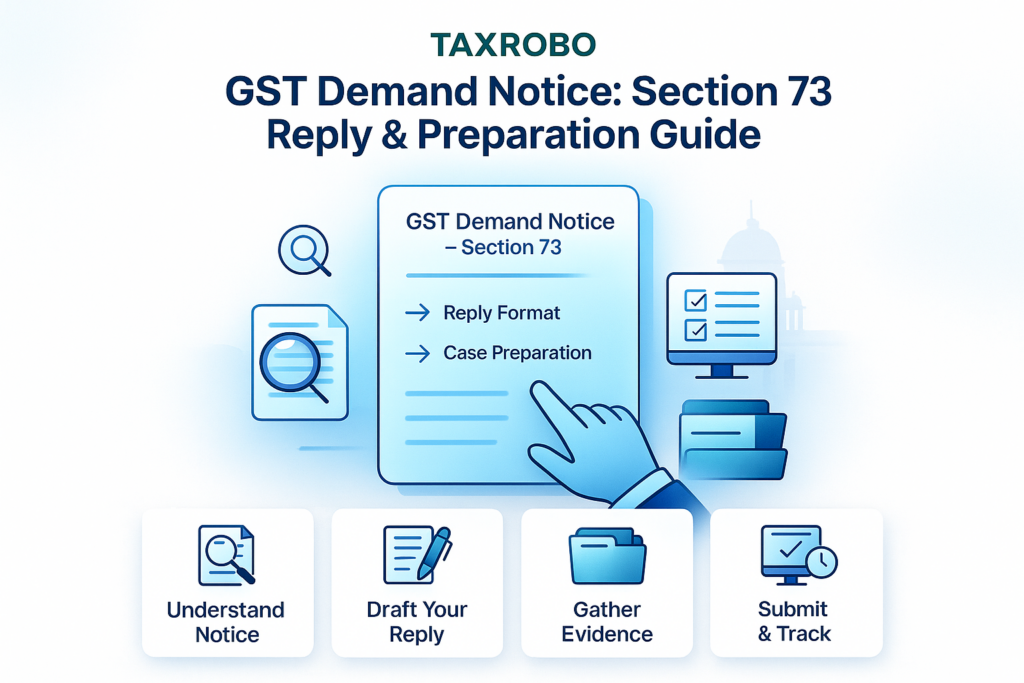

GST Demand Notice under Section 73 – Reply Format & Case Preparation
Receiving a notice from the GST department can be a stressful experience for any business owner. The official language and the threat of penalties can be intimidating, leaving you wondering about the next steps. However, not all notices are a cause for alarm. This guide is designed to demystify the process and provide you with a clear, step-by-step GST demand notice reply format for notices issued under Section 73 of the CGST Act. By understanding the notice and preparing a well-structured response, you can address the department’s queries effectively and avoid unnecessary complications. This article will walk you through understanding the notice, preparing your case, and drafting a professional reply.
What is a GST Demand Notice under Section 73?
A GST demand notice under Section 73 of the Central Goods and Services Tax (CGST) Act, 2017, is a formal communication from the tax authorities regarding tax that has not been paid, has been paid short, has been erroneously refunded, or when Input Tax Credit (ITC) has been wrongly availed or utilized.
The most crucial thing to understand about Section 73 is that it applies to cases where there is no element of fraud, willful misstatement, or suppression of facts to evade tax. These are genuine, unintentional errors. This distinction is important because it separates these notices from the more severe ones issued under Section 74, which deal with fraud and carry much harsher penalties. Understanding the Key Differences Between Sections 73 and 74 of the CGST Act in GST Demand Notices is critical. Proper Section 73 GST notice preparation begins with understanding the root cause of the notice.
Key Reasons for Receiving a Section 73 Notice
GST authorities issue these notices based on discrepancies found during scrutiny of your returns. Here are some of the most common triggers:
- Calculation Errors: Simple mathematical mistakes in calculating GST liability in your GSTR-1 or GSTR-3B filings.
- Claiming Ineligible Input Tax Credit (ITC): Accidentally claiming ITC on goods or services that are blocked under Section 17(5) of the CGST Act (e.g., on food and beverages, motor vehicles for personal use).
- Discrepancies Between Returns: Mismatches between the sales data reported in your GSTR-1 and the consolidated tax liability declared in your GSTR-3B.
- GSTR-2A/2B vs. GSTR-3B Mismatch: A significant difference between the ITC available as per your supplier’s filings (reflected in GSTR-2A/2B) and the ITC you have claimed in your GSTR-3B.
- Incorrect Tax Rates: Misclassifying goods or services and applying a lower GST rate than what is applicable, leading to a short payment of tax.
- Erroneous Refunds: Claiming and receiving a refund for which you were not eligible due to a calculation or interpretation error.
Step-by-Step Guide to Responding: The GST Notice Resolution Process in India
Receiving a notice requires a calm and systematic approach. Panicking can lead to mistakes. Follow this structured GST notice resolution process India to handle the situation professionally.
Step 1: Acknowledge and Analyze the Notice (Form GST DRC-01)
First things first, do not ignore the notice. A timely response is critical.
- Don’t Panic: Read the notice calmly. Remember, Section 73 is for non-fraudulent cases.
- Verify Authenticity: Log in to the GST portal and check for the notice under “View Additional Notices/Orders” to ensure it’s genuine.
- Read Carefully: Go through the entire notice, which is typically issued in Form GST DRC-01 (Show Cause Notice). For a detailed walkthrough, you can refer to this guide on How to Respond to a GST Show Cause Notice: A Step-by-Step Guide. Understand the specific allegations, the tax periods involved, and the detailed breakdown of the tax, interest, and proposed penalty.
- Note Key Details: Immediately note down the Demand ID or Reference Number, the date of issue, and, most importantly, the deadline for your response.
Step 2: Internal Reconciliation and Document Gathering
Before you can draft a reply, you need to verify the department’s claims against your own records.
- Gather Your Documents: Collect all relevant financial records for the specified period. This includes:
- Sales invoices and purchase invoices.
- General ledgers and accounting records.
- Bank statements.
- Filed GST returns (GSTR-1, GSTR-3B).
- ITC records and GSTR-2A/2B reconciliation statements.
- Conduct an Internal Audit: Meticulously compare your records with the discrepancies pointed out in the notice. For instance, if the notice alleges a mismatch between GSTR-1 and GSTR-3B, reconcile these returns line by line to pinpoint the exact source of the difference.
Step 3: Deciding on a Course of Action
Your internal audit will lead you to one of two conclusions. Your decision here will determine your next steps.
- Scenario A: You Agree with the Notice
If your review confirms that the department’s findings are correct and you did indeed make an error, the best course of action is to accept the liability. You should pay the demanded tax along with the applicable interest using Form GST DRC-03. The major benefit here is that if you make this payment within 30 days of the notice being issued, the penalty proposed under Section 73 (10% of tax or Rs. 10,000, whichever is higher) is typically waived. - Scenario B: You Disagree with the Notice (Partially or Fully)
If you believe the notice is incorrect, either in part or in its entirety, you must prepare a detailed reply to contest the demand. This is where a proper legal response for GST notice becomes essential to present your case clearly and logically to the tax officer.
Crafting Your Response: The Perfect GST Demand Notice Reply Format
When you disagree with the notice, your reply is your primary tool to defend your position. A well-structured and fact-based response can lead to the proceedings being dropped. The following GST demand notice reply format provides a comprehensive structure for a professional and effective response.
Essential Components of a Strong Reply
Your GST notice section 73 response should be formal, precise, and supported by evidence. It must be drafted on your official business letterhead and addressed to the issuing authority.
- Header: Your company’s letterhead with your business name, address, GSTIN, and contact information.
- Recipient Details: The designation and address of the GST officer who issued the notice.
- Reference Number: Clearly state the Show Cause Notice (SCN) number, Demand ID, and the date of the notice. This is crucial for easy identification.
- Subject Line: A clear and concise subject line, such as: “Reply to Show Cause Notice under Section 73 of the CGST Act, 2017 dated [Date of Notice]”.
- Introduction: Begin by acknowledging the receipt of the notice. For example, “This is with reference to the Show Cause Notice bearing No. [Notice Number] dated [Date], issued to us. We are herewith submitting our detailed point-wise reply for your kind consideration.”
- Factual Matrix (Point-by-Point Rebuttal): This is the core of your reply. Do not write a generic, long paragraph. Instead, address each allegation from the notice one by one in a structured manner. For each point:
- Quote the Allegation: Clearly state the allegation made by the department as mentioned in the SCN.
- Present Your Submission: Provide your counter-argument with clear facts and a logical explanation.
- Provide Documentary Evidence: Reference the supporting documents you are attaching. For example, “This claim is supported by Invoice No. 123 dated 01/01/2023, a copy of which is attached as Annexure-A.”
- Legal Submissions: If your case relies on a specific legal provision, a government circular, or a relevant court judgment, mention it here briefly. For complex legal arguments, it is highly advisable to seek professional help.
- Prayer/Conclusion: Conclude your reply with a formal request. For example, “In light of the facts, submissions, and documentary evidence provided above, we humbly request your good office to review our case and drop the proceedings initiated via the aforementioned notice.”
- Verification & Signature: End with a verification clause (“I verify that the contents of this reply are true to the best of my knowledge…”) followed by the signature, name, and designation of the authorized signatory.
- Annexures: Create a list of all the supporting documents you have attached, numbering them for easy reference (e.g., Annexure-A: Copy of Invoice, Annexure-B: Reconciliation Statement).
Sample Reply Snippet (Illustrative)
Here is a quick example of how to structure a point-by-point rebuttal:
Reference: Allegation 1 of the SCN – Discrepancy in outward taxable supplies between GSTR-1 and GSTR-3B for April 2023, amounting to a short payment of tax of Rs. 50,000.
Our Submission: We respectfully submit that the allegation of short payment is not tenable. The perceived discrepancy of Rs. 50,000 arises because an advance was received from a customer in March 2023, for which the GST was correctly paid and reported in the GSTR-3B for March 2023. The corresponding invoice was raised in April 2023 and reported in the GSTR-1 for April 2023, as per GST law. There is no short payment of tax.
Supporting Documents: We are attaching the following documents to substantiate our claim:
- Annexure-A: Bank statement highlighting the receipt of advance in March 2023.
- Annexure-B: Copy of GSTR-3B for March 2023 showing tax payment on the advance.
- Annexure-C: Copy of the tax invoice raised in April 2023.
Post-Reply Procedure and Next Steps
Submitting your reply is not the end of the process. Here’s what you can expect to happen next:
- Submission of Reply: You must file your detailed reply on the GST portal, usually as an attachment against the notice.
- Personal Hearing: The GST officer will review your written submission. If they are not fully satisfied, they will grant you an opportunity for a personal hearing. This is a chance for you or your authorized representative (like a CA or lawyer) to explain your case in person and clarify any remaining doubts.
- Final Order: After considering your reply and the personal hearing, the officer will issue a final order.
- If your explanation is accepted, an order will be passed dropping the proceedings.
- If the officer is not convinced, they will issue a demand order in Form GST DRC-07, confirming the tax, interest, and penalty.
- Appeal: If you receive an unfavorable order in DRC-07, you still have the right to file an appeal with the appellate authority within the prescribed time limit.
For all official procedures, you will need to use the official GST Portal.
Conclusion
A GST demand notice under Section 73 is a serious matter, but it is entirely manageable with a systematic and timely approach. The key is to analyze the notice carefully, reconcile your records thoroughly, and prepare a detailed, evidence-backed reply. Using a clear and structured GST demand notice reply format is crucial for presenting your case effectively and professionally to the tax authorities. By following the steps outlined in this guide—analyze, reconcile, and respond—you can navigate the process with confidence.
Navigating GST notices requires expertise. If you need assistance with your Section 73 GST notice preparation or want a professional legal response for your GST notice, TaxRobo’s team of experts is here to help. Contact us today for a consultation and ensure your case is handled with the diligence it deserves.
FAQs
- What happens if I ignore a GST notice under Section 73?
Ignoring the notice is the worst course of action. The tax officer will proceed on an ex-parte basis (without hearing your side of the story) and issue an order confirming the full demand of tax, interest, and penalty based on the information they have. This confirmed demand becomes a legal liability against you and your business. - Can I request an extension to file my reply?
Yes, you can request an extension. You should file a formal request for adjournment with the issuing authority well before the deadline, stating a valid reason for the delay. The officer has the discretion to grant or deny the extension. - What is the penalty under Section 73?
The penalty under Section 73 is a maximum of 10% of the tax due or Rs. 10,000, whichever amount is higher. For a more detailed breakdown, learn How Interest and Penalties Are Calculated on GST Demand Notices: A Detailed Guide. However, a significant benefit of this section is that no penalty is levied if you pay the tax and applicable interest either before the Show Cause Notice is issued or within 30 days of the date of the notice. - Do I need a lawyer or a CA to reply to a Section 73 notice?
While it is not legally mandatory to hire a professional, it is highly recommended. For simple cases with minor amounts, you may be able to handle it yourself. However, for complex matters involving significant tax amounts, legal interpretations, or detailed reconciliations, professional assistance from a Chartered Accountant or a tax lawyer is invaluable. They can ensure you prepare a robust and compliant GST notice section 73 response that effectively presents your case.