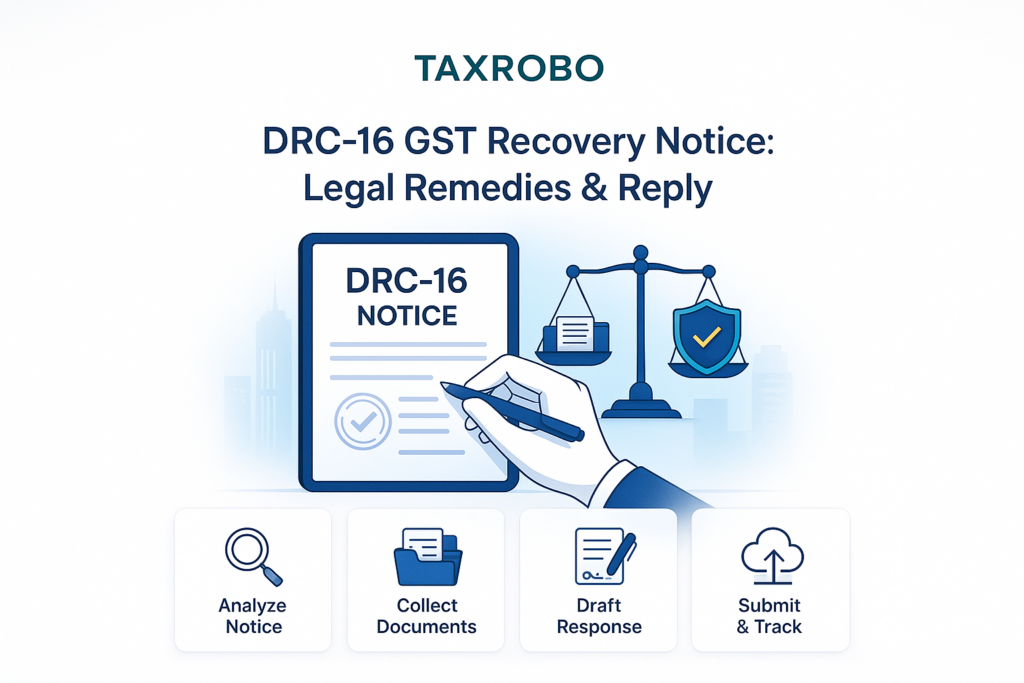

DRC-16 GST Recovery Notice – Legal Remedies & Reply Format
Receiving a formal notice from any tax department can be a stressful and confusing experience for even the most diligent business owner. The official language, legal references, and the looming threat of penalties can be overwhelming. Among the various notices under the GST regime, the DRC-16 GST Recovery Notice is particularly serious. It signifies that the GST department is moving beyond simple demands and is now taking direct action to recover unpaid tax dues by attaching your funds or assets held by a third party, like your bank. This article serves as your comprehensive guide to understanding this critical notice. We will break down what it means, the immediate steps you must take, explore the legal remedies against GST recovery notice India, and provide a clear format for drafting an effective response.
What Exactly is a DRC-16 GST Recovery Notice?
A DRC-16 notice is essentially a legal instruction from the GST authorities to a third party. It directs that third party to pay the government any money they owe you, or hold on your behalf, to settle your outstanding GST liability. This is a powerful tool used by the department when a taxpayer has failed to pay a confirmed tax demand after receiving multiple prior communications. Understanding its legal basis is the first step towards formulating a proper response.
The Legal Foundation: Section 79 of the CGST Act
The authority for issuing a DRC-16 notice comes from Section 79(1)(c) of the Central Goods and Services Tax (CGST) Act, 2017. This section empowers a proper GST officer to initiate recovery proceedings against a defaulting taxpayer. Specifically, it allows the officer to issue a notice in writing to any other person (the third party) who either owes money to the taxpayer or holds money for the taxpayer. This notice instructs the third party to pay the specified amount directly to the government’s account. This action is often referred to as a “garnishee proceeding,” where the department intercepts payments meant for you to settle its own dues.
Why is a DRC-16 Notice Issued?
It’s crucial to understand that a DRC-16 is not the first communication you will receive about a tax demand. It is a latter-stage recovery measure, typically issued only when:
- A tax demand was confirmed through an order (e.g., in Form DRC-07). Understanding the Key Differences Between Sections 73 and 74 of the CGST Act in GST Demand Notices can clarify how such demands are raised.
- The taxpayer has not paid the confirmed demand within the stipulated time (usually three months).
- The taxpayer has not filed a valid appeal or obtained a stay on the recovery of the demand.
The primary purpose of the DRC-16 is to enforce the payment of confirmed tax dues. By targeting your sources of funds—your bank accounts or payments from your clients—the department ensures the recovery of tax revenue that it believes is rightfully owed to the exchequer.
Who Receives this Notice?
While the notice pertains to your GST liability, it is officially addressed and sent to a third party. The taxpayer usually receives a copy for their information. Common recipients of a DRC-16 notice include:
- Banks and Financial Institutions: This is the most common scenario, where the notice is sent to the bank where you hold current or savings accounts, leading to the freezing of funds.
- Debtors or Clients: If the department is aware of clients who owe you money for goods or services supplied, a notice can be sent to them, directing them to pay the GST department instead of you.
- Any Other Person: This is a broad category that can include anyone holding assets or money on your behalf, such as a clearinghouse, a platform holding your funds, or even a tenant who owes you rent.
Immediate Steps After Receiving a DRC-16 Notice
The moment you become aware that a DRC-16 has been issued, time is of the essence. The third party (e.g., your bank) is legally obligated to comply with the notice, which could severely impact your business operations. Follow these steps methodically.
Step 1: Do Not Panic and Verify the Notice
Panic can lead to poor decisions. The first step is to stay calm and verify the authenticity of the communication. In today’s digital age, it’s essential to ensure the notice is genuine.
- Check the Document Identification Number (DIN): Every communication from the GST department must have a unique DIN. You can verify the legitimacy of the notice by using the “Verify DIN” facility on the official GST Portal.
- Confirm with the Third Party: If you hear about the notice from your bank or a client, ask them for a copy of the document so you can verify its details yourself.
You can verify the DIN on the official government website: GST Portal.
Step 2: Carefully Review the Details
Once you have the notice in hand, scrutinize every detail meticulously. Any discrepancy could be a potential ground for challenging the notice.
- Check Basic Information: Ensure your name, company name, address, and GSTIN are correct.
- Verify the Demand Amount: Cross-check the tax amount mentioned in the DRC-16 with the original demand order (DRC-07) and your own financial records. Are there any errors in the calculation of tax, interest, or penalty?
- Confirm the Tax Period: Make sure the tax period mentioned in the notice is accurate and corresponds to the demand order you previously received.
Step 3: Seek Professional Legal Advice Immediately
Given the serious financial implications of a DRC-16 notice, this is not the time for a DIY approach. The legal nuances of GST law are complex, and a misstep can be costly.
- Consult a Tax Expert: Immediately contact a chartered accountant or tax lawyer specializing in GST. They can provide a clear assessment of your situation and explain the available GST recovery notice legal options India.
- Strategic Planning: A professional can help you evaluate the validity of the demand, identify procedural errors by the department, and draft a legally sound response to protect your interests and business continuity. Firms like TaxRobo have dedicated teams to handle such critical GST matters.
Your Legal Remedies Against a GST Recovery Notice in India
Receiving a DRC-16 notice does not mean you are out of options. The law provides several avenues to address the situation, depending on the facts of your case. Exploring these legal remedies against GST recovery notice India with a professional is your best path forward.
Option 1: Payment of Dues
The simplest remedy, if the tax demand is correct and undisputed, is to pay the outstanding amount. If you agree with the department’s assessment and have the funds available, you should:
- Pay the entire amount of tax, interest, and penalty using Form GST PMT-06.
- After making the payment, immediately submit a letter to the proper officer who issued the DRC-16, providing the payment challan details (CIN).
- Request the officer to issue a withdrawal notice to the third party (e.g., your bank) to unfreeze your account.
Option 2: File an Appeal Against the Original Order
In many cases, the taxpayer disputes the underlying tax demand on which the recovery is based. If you believe the original demand order (e.g., DRC-07) is incorrect, you have the right to challenge it. For a comprehensive overview, read our guide on Navigating the Appeals Process Against GST Demand Orders: Essential Information.
- File an Appeal: Under Section 107 of the CGST Act, you can file an appeal with the first Appellate Authority. This must typically be done within three months from the date the original order was communicated to you.
- Pre-deposit Requirement: Filing an appeal is not free. To have your appeal admitted, you are required to make a pre-deposit of a certain portion of the disputed tax amount (generally 10% of the disputed tax).
- Stay on Recovery: Once you make the pre-deposit and your appeal is filed, the recovery proceedings for the remaining balance of the disputed demand are automatically stayed. You can then present a copy of the appeal acknowledgement and the pre-deposit challan to the recovery officer and request the withdrawal of the DRC-16.
Option 3: Request for Payment in Instalments
What if you agree with the tax liability but are facing a genuine financial hardship that prevents you from paying it all at once? The GST law provides a provision for this scenario.
- Use Form GST DRC-20: You can file an application in Form GST DRC-20 to the jurisdictional Commissioner, requesting permission to pay the outstanding dues in monthly instalments.
- Maximum Instalments: You can request a payment plan of up to 24 monthly instalments.
- Commissioner’s Discretion: Granting this request is at the discretion of the Commissioner, who will evaluate the reasons for your financial difficulty. If your request is approved, you can present the approval order to the recovery officer to get the DRC-16 notice withdrawn.
Option 4: Filing a Writ Petition
This is an extraordinary legal remedy and should be pursued only on the advice of a seasoned legal professional. A writ petition can be filed before the High Court under Article 226 of the Constitution of India. This option is generally considered when:
- There has been a violation of the principles of natural justice (e.g., you were not given a proper opportunity to be heard before the demand was confirmed).
- The GST officer has acted without jurisdiction or has exceeded their authority.
- The order or notice suffers from a fundamental legal error apparent on the face of the record.
Crafting a Legal Reply: DRC-16 Reply Format for GST Recovery
Even as you pursue other legal remedies like filing an appeal, it is crucial to submit a formal written reply to the GST officer who initiated the recovery. This creates an official record of your objections and the actions you have taken. A well-drafted legal reply for a DRC-16 notice is essential.
Key Elements of an Effective Legal Reply
- Clarity and Precision: Your reply should be clear, concise, and fact-based. Avoid emotional language and stick to the legal and factual points of your case.
- Reference the Notice: Always begin by clearly referencing the DRC-16 notice number, date, and the DIN.
- Factual Submission: Present your arguments logically. If you claim the demand is paid, state the payment details. If you have filed an appeal, state the filing date and attach the proof.
- Legal Grounds: If you are challenging the validity of the notice itself, cite the relevant sections of the GST Act or procedural lapses that support your claim.
- Supporting Documents: This is critical. Your reply is only as strong as the evidence you provide. Always attach copies of relevant documents, such as payment challans, appeal filing acknowledgements, stay orders, or previous correspondence.
Sample Structure for a Legal Reply for DRC-16 Notice
Here is a basic template you can adapt with the help of your tax consultant. This DRC-16 reply format for GST recovery covers the essential elements.
[Date]
To,
The Proper Officer,
[Designation and Address of the GST Office]Subject: Reply in response to DRC-16 GST Recovery Notice dated [Notice Date]
Reference: Notice Number [Your Notice Number] & DIN [Your DIN]Respected Sir/Madam,
1. This is with reference to the DRC-16 notice cited above, issued to [Name of the Third Party, e.g., Your Bank Name] for the recovery of alleged GST dues amounting to Rs. [Amount] for the tax period [Tax Period].
2. In this regard, we wish to submit the following facts for your kind consideration and necessary action:
- (Scenario A: Appeal Filed) We respectfully submit that the underlying demand order (Order-in-Original No. [Order Number] dated [Order Date]) is disputed by us. We have filed an appeal against the said order with the learned Appellate Authority on [Date of Appeal Filing]. As per the provisions of Section 107(6) of the CGST Act, 2017, we have made the mandatory pre-deposit of Rs. [Amount]. A copy of the appeal acknowledgement (Form GST APL-01) and the pre-deposit challan is attached for your ready reference.
- (Scenario B: Amount Already Paid) We wish to state that the demand raised in the original order has already been paid in full by us via Challan Identification Number (CIN) [Challan Number] on [Date of Payment]. A copy of the payment challan is enclosed herewith. Therefore, no amount is outstanding against us.
- (Scenario C: Factual Error) The demand confirmed in the order and mentioned in the subject notice is factually incorrect due to [briefly state the reason, e.g., a calculation error, an input tax credit that was ignored, etc.]. We are in the process of filing an appeal/rectification application to address this discrepancy.
3. Prayer: In light of the above submissions and the attached documentary evidence, it is established that the initiation of recovery proceedings under Section 79 is premature and not in accordance with the law. We humbly request your good office to:
- Withdraw the DRC-16 notice issued to [Name of the Third Party] with immediate effect.
- Drop the recovery proceedings initiated against us.
- Provide us with an opportunity to be heard before taking any further action.
Thank you for your consideration.
Sincerely,
[Your Name/Authorised Signatory]
[Your Company Name]
[Your GSTIN]Enclosures:
1. [Copy of Appeal Filing Acknowledgement]
2. [Copy of Pre-Deposit Challan]
3. [Copy of the Original Demand Order]
Conclusion
A DRC-16 GST Recovery Notice is undoubtedly one of the most stringent actions the GST department can take. It can disrupt your cash flow and bring your business operations to a halt. However, it is not the end of the road. The key is to act swiftly, verify the details of the notice, understand your legal remedies, and seek expert guidance without delay. Whether by paying the dues, filing a well-grounded appeal, or requesting an instalment plan, you have several legal pathways to resolve the issue. Navigating the complexities of tax law requires expertise, and professional guidance is invaluable in protecting your rights and ensuring a fair outcome.
Feeling overwhelmed by a GST notice? Let TaxRobo’s team of experts handle it for you. We provide end-to-end assistance, from verifying the notice to drafting a professional legal reply for a DRC-16 notice. Contact us today for a consultation.
Frequently Asked Questions (FAQs)
1. What is the difference between DRC-01 and DRC-16?
DRC-01 is a Show Cause Notice (SCN). It is the first step where the department proposes a tax demand and asks you to explain why that amount should not be recovered from you. DRC-16, on the other hand, is a Recovery Notice issued to a third party. It is issued much later, only after the demand proposed in the SCN is confirmed by an order (like DRC-07) and you have failed to pay it within the specified time.
2. Can the GST department freeze my bank account using a DRC-16?
Yes. A DRC-16 notice issued to your bank is the primary legal instrument used to attach your bank account. The notice instructs the bank manager to pay the amount specified in the notice to the government’s credit from your account balance. This action effectively freezes your account up to the amount of the tax demand.
3. What happens if the third party (e.g., my bank) ignores a DRC-16 notice?
A third party who receives a DRC-16 is legally bound to comply with it. Under Section 79(1)(c) of the CGST Act, if the third party fails to make the payment to the government as instructed, they can be treated as a “defaulter in respect of the amount.” This means the GST department can then initiate recovery proceedings directly against that third party (e.g., the bank or your client) to recover the amount.
4. How much time do I have to respond after a DRC-16 is issued?
The notice itself does not specify a response time for the taxpayer because it is technically addressed to the third party. However, from the taxpayer’s perspective, the urgency is extreme. You must act immediately. The goal is to get the notice withdrawn before the third party complies and transfers the funds to the government. Therefore, your reply, appeal, or payment should be made without any delay.