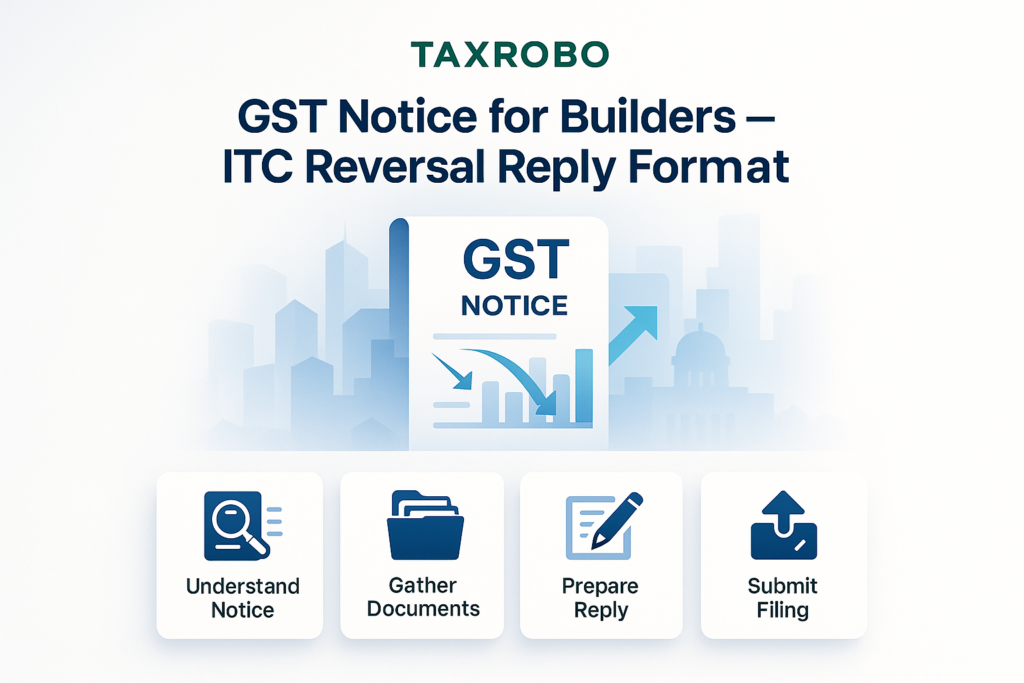

GST Notice for Builders – A Complete Guide to the ITC Reversal Reply Format
You’re a builder, meticulously managing timelines, materials, and a dozen other variables to bring your next project to life. Amidst this organized chaos, an official email lands in your inbox: a notice from the GST department. The most common culprit for such an unwelcome surprise is often a query about your Input Tax Credit (ITC). Receiving a notice regarding ITC reversal is a significant and frequent challenge within the construction industry, but it’s not a cause for panic. A timely, well-structured, and factually accurate response is your key to resolving the issue efficiently. This comprehensive guide will break down precisely why builders receive these notices and provide a clear, step-by-step GST notice builders reply format to help you respond with confidence and ensure your business stays compliant. Understanding the nuances of GST compliance for builders India is the first step towards navigating these official communications without disrupting your business operations.
Why Do Builders Receive GST Notices for ITC Reversal?
To effectively address a notice, it’s essential to understand the underlying reasons why the GST department might question your Input Tax Credit claims. The construction sector involves a high volume of transactions and complex supply chains, making it a focal point for tax authorities. Scrutiny is often aimed at ensuring that every credit claimed is legitimate and correctly accounted for, a cornerstone of builders GST compliance requirements. A small discrepancy can trigger an automated notice, requiring a formal explanation from your end. Proactively Understanding Input Tax Credit Reversals and these triggers not only helps in drafting a better reply but also in refining your internal processes to prevent future notices.
What is Input Tax Credit (ITC) in the Construction Sector?
Before diving into the reasons for notices, let’s simplify the concept of ITC. In the construction business, you pay GST on a wide range of goods and services you purchase to complete a project. This includes raw materials like cement, steel, and tiles, as well as services from architects, contractors, and engineers. Input Tax Credit (ITC) is a mechanism that allows you, the builder, to get a credit for the GST you have already paid on these “inputs.” You can then use this credit to reduce the final GST amount you owe to the government on the sale of your properties. Essentially, ITC prevents the cascading effect of taxes (tax on tax), ensuring you only pay tax on the value you add at each stage of construction.
Common Triggers for an ITC Reversal Notice
A GST notice for ITC reversal is not arbitrary; it’s usually triggered by specific red flags in your GST filings. Here are the most common reasons a builder might find themselves in this situation:
- Mismatch in GSTR-2B vs. GSTR-3B: This is the most frequent cause. GSTR-2B is an auto-generated statement that shows the ITC available to you based on the sales returns (GSTR-1) filed by your suppliers. GSTR-3B is the summary return where you declare and claim your ITC. If the amount you claimed in GSTR-3B is higher than what’s appearing in your GSTR-2B, the GST system flags it as a discrepancy.
- Violation of Rule 37: The GST law mandates that you must pay your supplier for an invoice within 180 days of its issue date. If you fail to do so, you are required to reverse the ITC you claimed on that invoice. The department’s systems can track payment timelines, and non-compliance often leads to a notice.
- Ineligible ITC Claims (Blocked Credits): Section 17(5) of the CGST Act lists specific goods and services on which ITC cannot be claimed. For builders, this is particularly relevant for goods or services used for the construction of an immovable property on one’s own account, even if used for business purposes. Claiming credit on such “blocked” items is a direct violation that will trigger scrutiny. It’s crucial to understand Blocked Credits Under Section 17(5): What ITC Cannot Be Claimed? to avoid these errors.
- Supplier Non-Compliance: Your eligibility to claim ITC is directly linked to your supplier’s compliance. If a supplier from whom you purchased goods has not filed their GSTR-1 or has failed to pay their collected taxes to the government, the ITC you claimed on their invoice becomes invalid in the eyes of the law, leading to a demand for reversal.
Decoding the GST Notice: Your First Steps
Receiving a formal notice can be intimidating, but the first step is to calmly and systematically decode the document. Every piece of information in the notice is a clue that will help you formulate a precise and effective reply. Rushing into a response without fully understanding the department’s query can lead to further complications. Taking a structured approach to analyzing the notice sets the foundation for a successful resolution. You need to identify what the department is asking, the specific transactions under review, and the timeline you have to respond.
Identifying the Type of GST Notice
GST notices come in various forms, each with a different implication. Understanding the form number helps you gauge the seriousness and the next steps involved. The two most common notices for builders regarding ITC are:
- Form GST ASMT-10 (Scrutiny Notice): This is a preliminary notice issued when the tax officer identifies discrepancies in your returns during scrutiny. It’s essentially a request for an explanation. You are given an opportunity to explain the discrepancy, and if your explanation is accepted, the matter is closed.
- Form GST DRC-01 (Show Cause Notice): This is a more formal and serious notice. It is issued when the officer has reason to believe that tax has not been paid or has been short-paid, or that ITC has been wrongly availed. This notice details the allegations and demands that you “show cause” as to why the proposed tax, interest, and penalty should not be levied on you. Knowing How to Respond to a GST Show Cause Notice: A Step-by-Step Guide is essential when faced with a DRC-01.
Key Information to Pinpoint in the Notice
Once you’ve identified the type of notice, comb through the document to extract the following critical details. This information will be the backbone of your reconciliation and reply drafting process.
- Notice Reference Number (ARN/Reference No.) and Date: Every official communication has a unique identifier. You must quote this number in all your future correspondence.
- The Specific Discrepancy Alleged: The notice will clearly state the reason it was issued. Look for phrases like “Excess ITC claim of ₹XX,XXX” or “Mismatch between GSTR-2B and GSTR-3B.” Note down the exact amounts and the nature of the allegation.
- The Financial Year or Tax Period: The notice will specify the exact month(s) or financial year(s) for which the discrepancy has been found. This helps you narrow down your search for supporting documents.
- The Deadline for Submitting a Reply: This is arguably the most important piece of information. The notice will give a specific date by which you must file your response. Missing this deadline can have serious consequences.
Actionable Tip: The moment you receive a notice, save a clear digital copy (PDF) in a dedicated folder. Immediately mark the reply submission deadline in your calendar with multiple reminders to ensure you do not miss it.
The Ultimate Builders GST Notice Response Guide
With the notice analyzed and key information gathered, it’s time to prepare your response. A methodical approach is crucial. Your goal is to provide a clear, factual, and well-documented reply that addresses every point raised by the tax officer. This structured process ensures that you don’t miss any critical details and can present your case in the most convincing manner possible. Following a step-by-step guide helps transform a complex task into a manageable workflow, reducing the stress and improving the quality of your submission.
Step 1: Acknowledge and Analyze
The first rule of receiving a GST notice is: do not ignore it. Acknowledging the notice internally and beginning the analysis process immediately is vital. Ignoring it can lead to an ex-parte order, where the officer confirms the demand without hearing your side of the story, along with penalties and interest. Carefully read the reasons and allegations cited in the notice multiple times. Compare these points against your own understanding of your GST filings and business transactions for the period in question. This initial analysis will help you determine whether the discrepancy is a genuine error on your part or a misunderstanding that can be clarified with proper evidence.
Step 2: Reconcile and Gather Evidence
This is the most critical and time-consuming step. Your reply is only as strong as the evidence that backs it up. Begin a thorough reconciliation of your financial records. This involves meticulously comparing your purchase register, the original tax invoices from suppliers, your GSTR-2B statement, and the ITC figures you claimed in your GSTR-3B returns for the specific period. For every single point of discrepancy raised in the notice, you need to find the corresponding transaction in your books and gather all supporting documents. This documentary evidence is your primary defense and can include:
- Tax Invoices: Ensure they are GST-compliant and contain all necessary details.
- Debit/Credit Notes: For any adjustments made post-invoice.
- Proof of Payment to Suppliers: Bank statements or transaction receipts to prove you’ve complied with the 180-day payment rule.
- E-way Bills: To substantiate the movement of goods.
- Contracts or Agreements: With suppliers or clients, which can provide context to certain transactions.
- Communication with Suppliers: Any emails or letters regarding invoice corrections or filing issues.
Step 3: Drafting the Reply
Once your reconciliation is complete and you have all the necessary evidence, you can begin drafting your response. A haphazard or poorly structured reply can confuse the officer and weaken your case. The response should be formal, polite, and to the point. It must directly address each allegation raised in the notice in a logical, point-by-point manner. The clarity and structure of your letter are paramount. This is where using a standardized and clear reply format for GST notice builders becomes essential, as it ensures all necessary components are included and your arguments are presented professionally.
The Definitive GST Notice Builders Reply Format
Your written submission is your formal argument to the tax officer. A well-organized reply not only demonstrates your professionalism but also makes it easier for the officer to understand your position and verify your claims. Using a standardized format ensures you don’t miss any crucial information. This section provides a detailed template and explains the essential components that should be part of every GST notice builders reply format. This template is designed to be a comprehensive guide for the GST notice reply for construction industry.
Essential Components of Your Reply Letter
Before you start writing, ensure your reply is structured with the following key elements, typically presented as a formal letter:
- Header: Your official letterhead should clearly display your registered company name, full address, and your Goods and Services Tax Identification Number (GSTIN).
- Recipient: Correctly address the reply to the officer who issued the notice. Include their full designation and the address of their office as mentioned in the notice.
- Reference: This is a crucial line. You must clearly state the Notice Reference Number (or ARN) and the date of the notice you are responding to. This helps the department link your reply to the correct file.
- Subject Line: The subject should be concise and informative. For example: “Reply to Show Cause Notice (Ref: XXXXX) dated DD/MM/YYYY regarding Alleged ITC Mismatch for the Financial Year 20XX-XX”.
Sample GST ITC Reversal Notice Format for Reply [Template]
Here is a structured template you can adapt for your specific situation. Remember to replace the bracketed information with your actual details.
[Your Company Letterhead]
[Your Company Name]
[Your Full Address]
GSTIN: [Your GSTIN]
Date: [Date of Reply]
To,
The [Designation of the Officer],
[Address of the GST Office],
[City, State, PIN Code].
Reference: Notice Number [Insert Notice Number] dated [Insert Date of Notice]
Subject: Submission of Reply to the Notice regarding alleged mismatch in Input Tax Credit (ITC) for the tax period [Mention Period, e.g., April 2022 to March 2023]
Respected Sir/Madam,
1. Introduction:
This letter is in reference to the notice (Ref No: [Insert Notice Number]) dated [Insert Date], issued to us under Section [e.g., 61] of the CGST Act, 2017. We have carefully reviewed the observations raised in the said notice and wish to submit our detailed, point-wise response along with supporting documents for your kind consideration.
2. Point-wise Rebuttal/Clarification:
We are providing our submissions against each discrepancy pointed out in the notice in the table below:
| S.No. | Observation as per Notice | Our Submission & Clarification | Annexure Ref. |
|---|---|---|---|
| 1. | [State the exact discrepancy from the notice, e.g., “Excess ITC of ₹50,000 claimed in GSTR-3B for Oct 2022 compared to GSTR-2B.”] | The alleged mismatch is due to an invoice (No. INV-123) from our supplier, ABC Steels (GSTIN: XXXXX), which they filed in their GSTR-1 of November 2022 instead of October 2022. The ITC was correctly availed by us in October as we received the goods and the invoice in that month, as per Section 16 of the CGST Act. The credit has auto-populated in our GSTR-2B for November 2022. | Annexure-A |
| 2. | [State the second discrepancy, e.g., “ITC of ₹25,000 claimed on ineligible goods.”] | This observation pertains to invoice (No. XYZ-456) from PQR Cements. The goods purchased were for repair and maintenance of our office building, which is an eligible expense for ITC and is not blocked under Section 17(5). We are attaching the invoice and a work order detailing the nature of the repairs. | Annexure-B |
| 3. | [State the third discrepancy, e.g., “ITC of ₹15,000 to be reversed as per Rule 37.”] | The payment for invoice (No. MNO-789) from LMN Electricals was delayed beyond 180 days due to a pending quality check dispute. We had already reversed this ITC of ₹15,000 in our GSTR-3B for May 2023, as per the legal requirement. We are attaching a screenshot of the relevant GSTR-3B entry. | Annexure-C |
3. Conclusion & Prayer:
In light of the explanations, factual clarifications, and supporting documents provided above, we humbly submit that the observations raised in the notice are based on an initial data mismatch and are suitably explained. We request your good office to kindly review our submission and consider dropping the proceedings initiated via the aforementioned notice.
We assure you of our full cooperation and are prepared to provide any further information or clarification as may be required.
Thank you.
Sincerely,
For [Your Company Name]
[Your Name/Name of Authorized Signatory]
[Your Designation]
4. List of Attachments (Annexures):
- Annexure-A: Copy of Invoice INV-123 and screenshot of GSTR-2B for Nov 2022.
- Annexure-B: Copy of Invoice XYZ-456 and the corresponding work order.
- Annexure-C: Screenshot of GSTR-3B for May 2023 showing ITC reversal.
How to Submit the Reply Online
After drafting the reply and compiling all annexures into a single PDF file, you need to submit it officially through the GST portal.
- Log in to the official GST Portal.
- Navigate to: Services > User Services > View Additional Notices/Orders.
- Click on the ‘View’ link for the relevant notice.
- You will see a ‘Reply’ tab. Click on it, enter your reply text (or a summary), and upload the PDF file containing your detailed letter and all annexures.
- File the reply using either a Digital Signature Certificate (DSC) or an Electronic Verification Code (EVC).
Conclusion
Facing a GST notice can be a stressful experience for any builder, but it is a manageable part of doing business in a structured tax regime. The key is to act promptly, analyze the notice carefully, gather all necessary documents for reconciliation, and use a structured GST notice builders reply format to present your case clearly and professionally. Submitting a comprehensive and well-supported response before the deadline is your best strategy for a favorable outcome. Ultimately, the best defense is a good offense. Proactive and meticulous GST compliance, including regular reconciliation of your books and adherence to GST ITC reversal guidelines India, is the most effective way to minimize the chances of receiving such notices in the first place.
Navigating GST notices can be complex, and the stakes are high. If you need expert assistance in drafting a precise reply, managing your reconciliation, or ensuring your overall builders GST compliance requirements are met, TaxRobo’s team of experts is here to help. Contact us today for a consultation!
Frequently Asked Questions (FAQ) Section
1. What is the deadline for replying to a GST notice for ITC reversal?
The time limit for responding is always specified in the notice itself. Typically, this ranges from 15 to 30 days from the date the notice is issued. It is absolutely crucial to adhere to this deadline, as failing to do so can result in the officer passing an order based on the information they have, which may not be in your favor.
2. What happens if I ignore a GST notice?
Ignoring a GST notice is a serious mistake. It can lead to the tax officer confirming the entire demand mentioned in the notice, along with applicable interest and penalties. This is done through an “ex-parte order,” meaning a decision made without hearing your side of the story. Further, it can trigger more stringent recovery proceedings and legal action against your business.
3. Do I need a professional like a CA to draft the reply?
While it is technically possible to draft a reply yourself for simple discrepancies, it is highly recommended to engage a professional like a Chartered Accountant or a tax consultant. They possess the legal and technical expertise to understand the nuances of the GST law, interpret the notice correctly, and draft a reply that is legally sound and persuasive. A professional can build a much stronger case and represent you effectively, significantly minimizing the risk of an adverse order.
4. Can I submit additional documents after filing my initial reply?
It is always best practice to submit all relevant and supporting documents along with your initial reply. This presents a complete and strong case from the outset. However, if a personal hearing is scheduled after you file your reply, the officer may allow you to present additional evidence or documents to further substantiate your claims. You should not rely on this opportunity and strive to make your first submission as comprehensive as possible.
5. What is the best way to avoid ITC mismatch notices in the future?
Prevention is always better than cure. To avoid ITC-related notices, builders should adopt a proactive compliance strategy. This includes performing a monthly reconciliation of your GSTR-3B with GSTR-2B *before* filing your returns. Maintain open communication channels with your suppliers to ensure they file their returns on time. Keep meticulous records of all purchase invoices, proofs of payment, and contracts. A robust internal accounting and review system is the key to mastering the GST ITC reversal process for builders and ensuring smooth compliance.