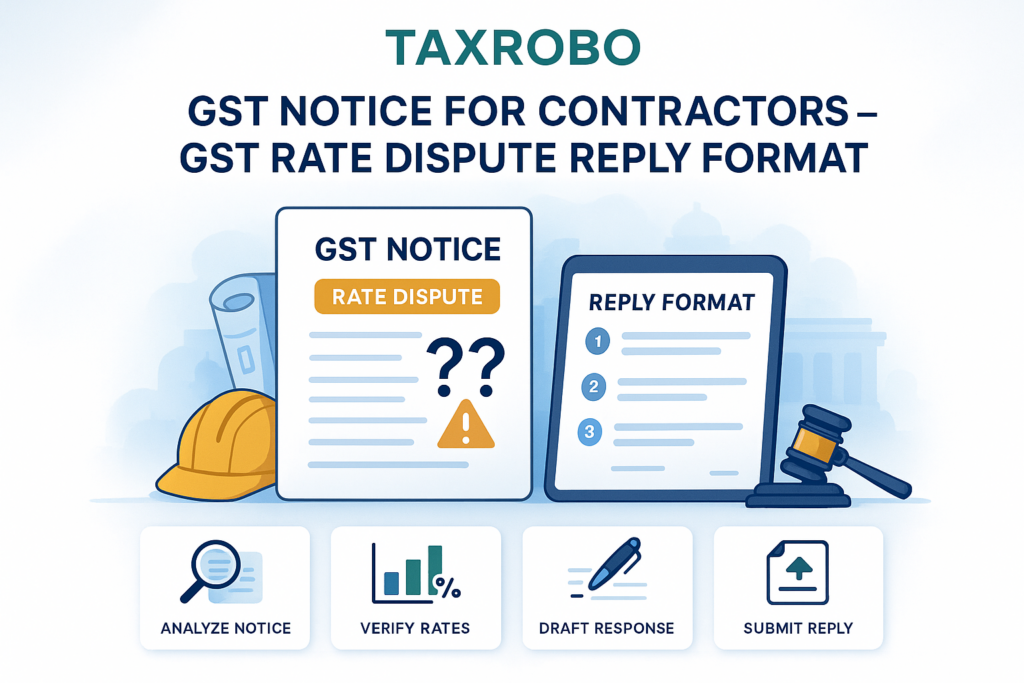

GST Notice for Contractors – GST Rate Dispute Reply Format
Receiving an official-looking envelope from the GST department can be a stressful experience for any business owner, especially for independent professionals and contractors. However, receiving a GST notice for contractors is more common than you might think, particularly when it involves disputes over the correct GST rate applied to your services. This situation, while serious, is manageable with the right approach. A timely, well-drafted response is not just a formality but a legal necessity to avoid hefty penalties, interest, and further legal complications. This comprehensive guide will provide clear GST notice guidelines for service providers, breaking down everything you need to know, from understanding the notice to using a proper GST rate dispute response format to protect your business.
Understanding Why You Received a GST Notice for Contractors
Before you can draft a reply, you need to understand the root cause of the notice. The GST department is increasingly using data analytics to flag discrepancies, and a notice is often the first step in their verification process. Understanding the potential triggers can help you pinpoint the exact issue and prepare a more effective response.
Common Triggers for GST Notices
GST notices are not sent randomly; they are triggered by specific red flags in your filings. For contractors, these often revolve around the classification of services and tax calculations. Here are some of the most common reasons you might receive a notice:
- Mismatch in Returns: One of the most frequent triggers is a discrepancy between the sales you declared in your GSTR-1 and the summary figures and tax paid in your GSTR-3B. The department’s systems automatically compare these two returns, and any mismatch will be flagged.
- Incorrect GST Rate Application: This is the core issue for many contractors. You might have charged a lower GST rate (e.g., 12% for certain works contracts) when the tax officer believes a higher rate (e.g., 18%) is applicable based on their interpretation of your services. This dispute forms the basis of a rate dispute notice.
- Input Tax Credit (ITC) Claims: Mismatches between the ITC you claimed in your GSTR-3B and the data available in your GSTR-2A/2B (which is based on your suppliers’ GSTR-1 filings) are a major cause for scrutiny. If your suppliers have not filed their returns correctly, your ITC claims may be questioned.
- E-way Bill Discrepancies: While more common for goods, works contracts that involve the movement of goods can also face scrutiny if there are discrepancies between the e-way bills generated and the invoices reported in GSTR-1.
These are some of the primary GST compliance issues contractors encounter, making it essential to maintain meticulous records and ensure accurate filings.
Decoding Your GST Rate Dispute Notice (e.g., ASMT-10, DRC-01)
When the notice specifically concerns a rate dispute, it means the tax officer believes the HSN/SAC code you used for your service or the corresponding GST rate you applied is incorrect. Notices like ASMT-10 (Notice for Scrutiny of Return) or DRC-01 (Show Cause Notice) are commonly used for this purpose. Don’t panic; instead, carefully read the document to identify the following crucial details:
- The Specific Financial Period: The notice will clearly state the month(s) or financial year(s) under scrutiny.
- The Exact Discrepancy: It will detail the specific services, invoice numbers, and the difference in the tax amount calculated by you versus the department.
- The Deadline for the Reply: This is a non-negotiable date. Note it down immediately.
- The Reference Number: A unique Document Identification Number (DIN) or Notice Reference Number is essential for verifying the notice and for all future correspondence.
Your Immediate Action Plan: First Steps After Receiving a Notice
Once you have understood the notice, taking swift and systematic action is critical. Your initial steps will lay the foundation for a successful resolution.
Step 1: Verify and Acknowledge
Before anything else, ensure the notice is genuine. Fraudulent notices are rare but possible.
- Authenticate the Notice: Visit the official GST Portal and use the reference number (DIN) to verify its authenticity. A valid notice will be available on your dashboard.
- Note the Deadline: The importance of the submission deadline cannot be overstated. Missing it can lead to an ex-parte order, where the officer makes a decision without hearing your side, usually resulting in a confirmed demand against you.
Step 2: Gather Your Arsenal of Documents
A strong reply is built on strong evidence. Start compiling all relevant documents that support your case. Preparing a comprehensive file is crucial for drafting a solid contractors GST notice reply India. Your document checklist should include:
- A clear copy of the GST notice you received.
- Work contracts or agreements with your clients. These are vital as they define the scope of your services and can justify the HSN/SAC code used.
- Copies of all tax invoices raised to clients during the disputed period.
- Proof of your GST returns filed (GSTR-1 and GSTR-3B) for the period in question.
- Bank statements that show the receipt of payments against the invoices, proving the transaction’s validity.
- Any relevant GST notifications, circulars, or legal precedents (case laws) that support the GST rate you have charged. This is where professional help can be invaluable.
How to Draft an Effective Reply: The GST Rate Dispute Response Format
Your reply is your formal, legal opportunity to present your case. It must be professional, factual, and legally sound. Using a structured GST rate dispute response format ensures you cover all necessary points clearly and effectively.
Key Elements of a Professional Reply
Your reply should be drafted as a formal letter. Here are the essential components to include:
- Formal Letterhead: Always use your official business letterhead for a professional touch.
- Addressee and Reference: Clearly address the reply to the issuing officer and mention their designation and office address as stated in the notice. Crucially, include the notice reference number and date for easy tracking.
- Subject Line: Make it specific and clear. For example: “Reply to Show Cause Notice (Ref: XXXXX) dated DD/MM/YYYY regarding GST Rate Dispute.”
- Factual Submission: Begin by stating the facts of the case in a point-wise manner. Describe the nature of your services in detail, aligning it with the contractual terms. Avoid emotional language and stick to the objective facts.
- Legal Justification: This is the heart of the
reply format GST dispute contractors.- Clearly state the HSN/SAC code you have used and provide a detailed justification for why it is the most appropriate classification for your service.
- Cite the specific GST rate notification (e.g., Notification No. 11/2017-Central Tax (Rate)) or the relevant schedule entry that prescribes the rate you have applied.
- If applicable, refer to any industry practices, contractual clauses, or circulars issued by the CBIC that support your classification and rate application.
- Attachment Annexure: Neatly list all the supporting documents you are attaching with your reply as annexures.
- Prayer Clause: Conclude your reply with a formal request (a “prayer”) to the officer to review your submissions and documentary evidence and to drop the proceedings initiated by the notice.
Sample Reply Format Template
Here is a simple template that you can adapt for your specific situation. Remember to customize it with your details and specific justifications.
[Your Company Letterhead]

To,
The Proper Officer,
[Officer's Designation and Address as per notice]

Ref: Notice No. [Enter Notice Number] dated [Enter Notice Date]

Subject: Submission of Reply to Notice regarding discrepancy in GST Rate

Respected Sir/Madam,

1.  This letter is in response to the notice referenced above, where a discrepancy regarding the GST rate charged on services provided by us for the period [mention period] has been pointed out.
2.  Factual Background: We are a business engaged in providing [e.g., Civil Construction Services]. During the period under review, we provided services to [Client Name] under a contract dated [Contract Date]. The scope of our work primarily involved [briefly but clearly describe the service, e.g., construction of a residential complex, interior decoration services, etc.].
3.  Legal Justification: The service provided by us is correctly classifiable under HSN/SAC Code [Your HSN/SAC Code]. As per Notification No. [e.g., 11/2017-Central Tax (Rate)] read with subsequent amendments, the applicable rate of GST for this specific service is [Your Rate]%. We have diligently charged and paid the same on our invoices, copies of which are attached for your reference. Our classification is based on [mention the reason, e.g., the nature of the works contract, the value of goods involved, etc.].
4.  Supporting Documents: We are enclosing the following documents for your perusal to substantiate our claims:
    a. Copy of the work contract with [Client Name].
    b. Copies of relevant tax invoices issued during the period.
    c. Copy of GSTR-1 and GSTR-3B returns filed for the said period.
5.  Prayer: In light of the facts, legal provisions, and documentary evidence presented above, we humbly request your good office to review our submission and consider the proceedings initiated via the aforementioned notice as dropped.

We are ready to provide any further information or clarification and appear for a personal hearing if required.

Thank you.

Sincerely,
[Your Name/Authorised Signatory]
[Designation]
[GSTIN]
Submitting Your Reply and What to Expect Next
Drafting the reply is only half the battle. Submitting it correctly and understanding the subsequent steps is equally important.
How to File Your Reply on the GST Portal
The entire process is online, ensuring a transparent and trackable submission.
- Log in to the GST Portal.
- Navigate to Services > User Services > View Additional Notices/Orders.
- Find the relevant notice and click the “View” link in the action column.
- Navigate to the “Replies” tab on the case details page and click “Add Reply”.
- Upload your drafted reply (in PDF format) along with all the scanned supporting documents.
- Submit and file the reply using a Digital Signature Certificate (DSC) or Electronic Verification Code (EVC).
Possible Outcomes After Submission
After you submit your reply, the tax officer will review it. There are three likely outcomes:
- Case Dropped: If the officer is satisfied with your explanation and supporting documents, they will issue an order (e.g., in Form ASMT-12) dropping the proceedings. This is the best-case scenario.
- Personal Hearing: The officer may still have questions or require further clarification. In this case, they will call for a personal hearing, giving you an opportunity to explain your case in person.
- Order Issued: If your reply is found to be unsatisfactory, the officer may issue an order (e.g., in Form DRC-07) confirming the tax demand, along with applicable interest and penalty. You have the right to file an appeal against this order with the appellate authority.
Conclusion
Receiving a GST notice for contractors can be intimidating, but it doesn’t have to be a crisis. The key is to act promptly and methodically. By understanding the notice, gathering the right evidence, and drafting a clear, factual, and legally-backed response, you can navigate the process effectively. Proactive Understanding GST Compliance: An Overview for Businesses, accurate record-keeping, and correct rate application are your best defenses against receiving such notices in the first place.
Effectively handling GST notices for contractors often requires specialized knowledge of GST law. If you feel overwhelmed or are unsure about the complexities of your case, seeking professional help is a wise investment. Our team of experts at TaxRobo is here to provide dedicated GST compliance help for contractors. We can help you draft a compelling reply and guide you through the entire process. Contact us today for a consultation and ensure your business stays compliant and protected.
Frequently Asked Questions (FAQ)
Q1. What is the standard time limit to reply to a GST notice in India?
A: The time limit to reply is always mentioned in the notice itself. Typically, it ranges from 15 to 30 days from the date of receipt. It is absolutely crucial to adhere to this deadline to avoid adverse action.
Q2. Can I ignore a GST notice if I think it’s incorrect?
A: No, never. Ignoring a GST notice is the worst course of action. It will lead the officer to pass an ex-parte order based solely on the information they possess. This will almost certainly result in the confirmation of the tax demand against you, along with hefty interest and penalties.
Q3. Do I need a Chartered Accountant (CA) or tax consultant to reply to the notice?
A: While it is not mandatory to hire a professional to reply, it is highly recommended for complex issues like a GST rate dispute. A CA or tax expert can help you frame a legally strong reply, cite the correct notifications and legal precedents, and represent you in a personal hearing if needed. Their expertise significantly increases the chances of a favorable outcome.
Q4. Where can I find the correct GST rate and HSN/SAC code for my services?
A: The official GST portal has an HSN/SAC code search tool. For the applicable rates, you should refer to the GST rate notifications issued by the Central Board of Indirect Taxes and Customs (CBIC). These are available on the official CBIC Website for Notifications. For complex works contracts with multiple components, it is always best to seek professional advice to ensure correct classification.