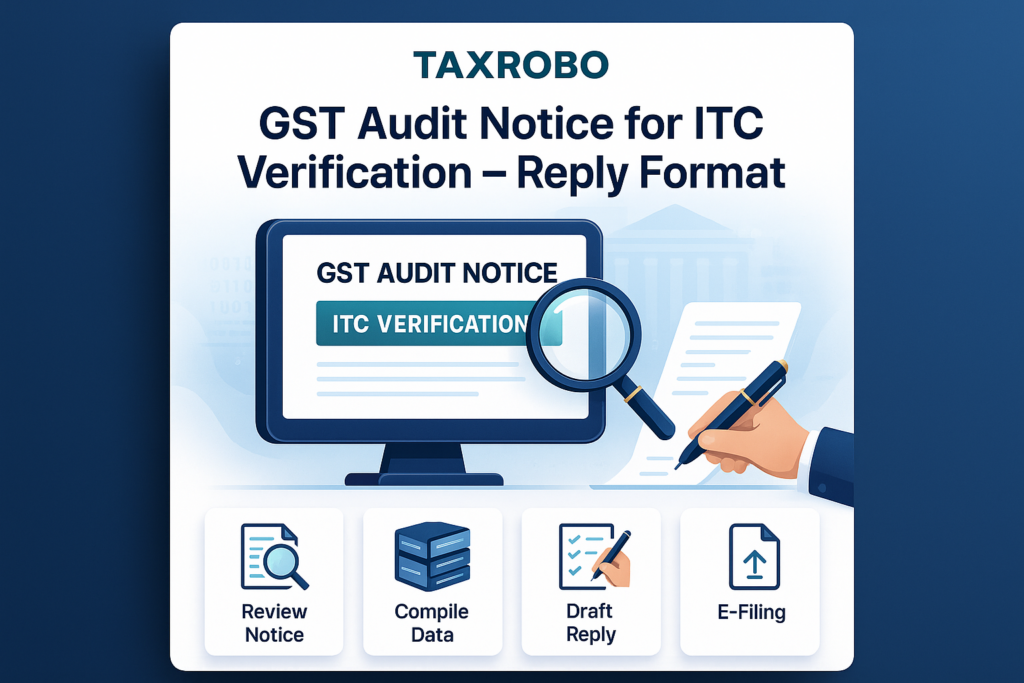

GST Audit Notice for ITC Verification – A Complete Guide to Drafting Your Reply Format
Receiving an official-looking envelope from the GST department can be a stressful moment for any business owner. Your mind races with questions about what you might have done wrong. Often, these notices are related to the Input Tax Credit (ITC) you’ve claimed. This is a common area of scrutiny, but it doesn’t have to be a cause for panic. A timely, well-documented, and professionally drafted ITC verification notice reply is your key to resolving the inquiry efficiently and demonstrating your commitment to compliance. This guide is designed to demystify the entire process, providing you with an actionable plan and a clear format for replying to GST ITC verification, turning a moment of anxiety into a manageable task.
Understanding the GST Notice for ITC Verification
Before you can draft a reply, you must first understand what the notice is, why you received it, and what it’s asking for. Rushing into a response without fully grasping the situation can lead to incomplete or incorrect submissions, potentially complicating the matter further.
What is an ITC Verification Notice?
In simple terms, an ITC verification notice is a formal inquiry from the tax authorities asking you to prove that the Input Tax Credit you claimed in your GSTR-3B returns is legitimate and accurate. The GST department uses sophisticated data analytics to compare the ITC you claim with the tax details your suppliers have filed. When a discrepancy appears, a notice is automatically generated to seek clarification. This is a standard part of the compliance process for ITC verification in India and is meant to ensure that the credit system is not being misused, either intentionally or through honest mistakes.
Common Triggers for an ITC Mismatch Notice
You might have received a notice for several reasons, most of which revolve around mismatches between different GST returns. Understanding the likely cause can help you pinpoint the issue faster.
- GSTR-3B vs. GSTR-2A/2B Mismatch: This is the most common reason. The ITC amount you claimed in your GSTR-3B return for a specific period does not match the amount auto-populated in your GSTR-2B, which is based on the GSTR-1 returns filed by your suppliers. Understanding the Impact of GSTR-2A and GSTR-3B Mismatches on ITC Claims is key to resolving these issues.
- Supplier Non-Compliance: Your supplier may have issued you a valid invoice but failed to file their GSTR-1 return or did not pay the collected tax to the government. In the eyes of the GST system, this makes your ITC claim invalid until the supplier fulfills their obligation.
- Ineligible ITC Claims: You may have inadvertently claimed ITC on goods or services that are blocked under Section 17(5) of the CGST Act. Common examples include expenses for motor vehicles (with certain exceptions), food and beverages, club memberships, and goods lost, stolen, or given as free samples. For a detailed list, refer to our guide on Blocked Credits Under Section 17(5): What ITC Cannot Be Claimed?.
- Errors in Documentation: Simple clerical errors can also trigger a notice. This could be an incorrect GSTIN of the supplier, a wrong invoice number, an incorrect date, or claiming an IGST amount as CGST/SGST.
How to Read the Notice Correctly
Panic is the enemy of clarity. When you receive the notice, take a deep breath and carefully examine it for these key details. This information is critical for drafting your response.
| Information to Find | Why It’s Important |
|---|---|
| Notice Reference Number (DIN/RFN) | This is the unique identifier for your case. You must quote it in all future correspondence. |
| Date of Issue | This is the starting point for calculating your reply deadline. Don’t delay. |
| Specific Discrepancy | The notice will clearly state the reason (e.g., “Mismatch in ITC as per GSTR-3B and GSTR-2B”). |
| Amount Disputed | This tells you the exact value of the ITC that is under scrutiny by the department. |
| Deadline for Reply | This is the most critical date. Missing it can lead to negative consequences. |
How to Reply to an ITC Verification Notice: A Step-by-Step Guide
A methodical approach is the best way to tackle the notice. Follow these steps to build a robust and evidence-backed response that addresses the department’s queries head-on.
Step 1: Acknowledge and Organize
First and foremost, never ignore a GST notice. Ignoring it is seen as an admission of guilt and can lead to an ex-parte (one-sided) order against you, confirming the tax demand along with interest and penalties. Acknowledge the notice internally and immediately block time in your calendar to prepare the reply. Create a dedicated folder, either physical or on your computer, to store the notice, your draft reply, and all supporting documents. This organized approach will save you time and stress.
Step 2: Gather Your Essential Documents (The Document Checklist)
Your reply is only as strong as the evidence you provide. Before you start writing, compile a complete file of all relevant documents. This process highlights The Importance of Accurate Record-Keeping to Prevent GST Demand Notices in the first place. Use this checklist to ensure you have everything you need.
- [ ] The official GST notice you received.
- [ ] Copies of all purchase invoices related to the disputed ITC. Ensure they are tax-compliant invoices.
- [ ] Corresponding E-way bills, if applicable, for the movement of goods.
- [ ] Proof of payment to the supplier. This can be bank statements highlighting the transaction, UPI records, or a confirmation letter from the supplier.
- [ ] Your filed GSTR-3B and GSTR-1 returns for the relevant tax period.
- [ ] The system-generated GSTR-2A and GSTR-2B forms for that period.
- [ ] A detailed ITC reconciliation statement, preferably in an Excel sheet, that compares your purchase register with your GSTR-2B.
Step 3: Perform a Thorough Reconciliation
With your documents in hand, it’s time to play detective. The goal is to perform a detailed reconciliation to find the exact source of the mismatch. Compare the ITC you claimed in your GSTR-3B, invoice by invoice, against the details appearing in your GSTR-2B. This exercise will help you identify and categorize the discrepancies. For example, you might find that a supplier entered your GSTIN incorrectly, filed their return late (causing the credit to appear in a later month), or you accidentally claimed credit on an ineligible item. Documenting the specific reason for each mismatch is crucial for your reply.
Step 4: Draft Your Response
Once your investigation is complete and your evidence is organized, you can begin drafting the reply. The response should be formal, factual, and polite. Avoid emotional language and stick to the facts as supported by your documents. Each point raised in the notice should be addressed individually with a clear explanation and a reference to the supporting evidence you are attaching.
The Essential ITC Verification Notice Reply Format India Needs
A structured reply is easier for the GST officer to understand and process. Following a standard format ensures you cover all necessary points and present your case professionally. Here’s a template you can adapt.
Part A: The Cover Letter
Your response should begin with a formal cover letter printed on your company’s letterhead.
[Your Company Letterhead]
To,
The Designated GST Officer/Authority,
[Jurisdiction/Address as mentioned in the notice]
Reference No.: [Your Unique Reply Reference Number]
Date: [Date of Your Reply]
Subject: Submission of reply in response to Notice Ref No. [DIN/RFN from the notice] dated [Date of Notice] regarding ITC verification for the period [Mention Period, e.g., FY 2022-23].
Respected Sir/Madam,
With reference to the notice mentioned above, we acknowledge its receipt on [Date you received the notice]. We have carefully reviewed the discrepancies pointed out regarding our Input Tax Credit (ITC) claim for the specified period.
We are herewith submitting our point-wise reply and clarification to the queries raised, along with all necessary supporting documents and reconciliations for your kind perusal. We have acted in good faith and believe our ITC claims are legitimate and in accordance with the provisions of the CGST Act, 2017.
Part B: Point-by-Point Rebuttal
This is the most critical section of your GST ITC notice response format. Use a table to clearly address each discrepancy mentioned in the notice. This makes your submission easy to read and assess.
| S.No. | Discrepancy as per Notice | Our Submission/Explanation | Supporting Evidence (Annexure No.) |
|---|---|---|---|
| 1. | Mismatch of ITC of Rs. 45,000 for Invoice No. INV-098 from ABC Pvt. Ltd. | The ITC is valid. The supplier filed their GSTR-1 for the month of July late, on August 15th. Consequently, this credit correctly appeared in our GSTR-2B for the month of August, and we claimed it in our August GSTR-3B. | Annexure A: Copy of Invoice INV-098 Annexure B: Bank statement showing payment Annexure C: Screenshot of GSTR-2B for August |
| 2. | Ineligible ITC claim of Rs. 5,400 on Invoice No. FNB-201. | We acknowledge this was a clerical error where ITC on food and beverage expenses was claimed. We have reversed this ineligible ITC of Rs. 5,400 (CGST Rs. 2,700 and SGST Rs. 2,700) along with applicable interest via Form DRC-03 dated [Date]. | Annexure D: Copy of DRC-03 challan showing payment. |
| 3. | ITC of Rs. 18,000 not appearing in GSTR-2A/2B for Invoice No. XYZ-555. | The ITC is valid. The supplier, XYZ Enterprises, incorrectly entered another party’s GSTIN while filing their GSTR-1. We have contacted them, and they have agreed to amend this error in their next GSTR-1 return. | Annexure E: Copy of Invoice XYZ-555 Annexure F: Bank statement showing payment Annexure G: Email communication with the supplier confirming the error. |
Part C: Conclusion and Annexures
Conclude the letter professionally and list all the documents you are attaching.
We believe the above submissions and the attached documentary evidence clarify the queries raised in the notice. We have taken utmost care to ensure compliance with all GST provisions.
We request your good office to kindly review our submission and drop the proceedings initiated by the said notice. We are ready to provide any further information or clarification as may be required.
List of Annexures:
- Annexure A: Copy of Invoice No. INV-098
- Annexure B: Bank statement highlighting payment for Invoice No. INV-098
- Annexure C: Screenshot from GSTR-2B of August
- Annexure D: Copy of DRC-03 Challan
- Annexure E: Copy of Invoice No. XYZ-555
- Annexure F: Bank statement highlighting payment for Invoice No. XYZ-555
- Annexure G: Email correspondence with XYZ Enterprises
Thank you for your consideration.
Sincerely,
[Your Name]
[Your Designation]
[Company Name & Stamp]
[GSTIN]
The ITC GST Notice Response Procedure: Submission and Next Steps
Drafting the reply is only half the battle. Knowing how to submit it and what to expect next is equally important.
How and Where to Submit Your Reply
The primary method for submitting your reply is online through the official GST Portal. The process is straightforward:
- Login to the GST Portal.
- Navigate to Services > User Services > View Notices and Orders.
- Find the relevant notice and click on the ‘Reply’ link.
- You can type your reply directly or, more commonly, attach your detailed PDF response (the one you drafted above) along with all scanned annexures.
- Submit the reply using a Digital Signature Certificate (DSC) or Electronic Verification Code (EVC).
Always save a copy of the submission acknowledgement for your records. In some jurisdictions, the officer may also ask for a physical copy of the submission to be delivered to their office.
What Happens After You Submit?
After you’ve submitted your reply, one of several outcomes is possible:
- Case Dropped: If the officer is satisfied with your explanation and evidence, they will issue an order dropping the proceedings. This is the ideal outcome.
- Further Information Requested: The officer might have follow-up questions or require additional documents for clarification. Respond to these requests promptly.
- Personal Hearing: You may be called for a personal hearing to present your case in person. This is an opportunity to explain complex issues directly to the officer.
- Order Issued: If your reply is found to be unsatisfactory or if you cannot provide adequate proof, the officer may issue an order (Form DRC-07) confirming the demand for tax, along with applicable interest and penalties. You would then have the option to pay the demand or appeal the order.
Conclusion
Receiving a GST notice for ITC verification can be daunting, but with a systematic approach, it becomes a manageable compliance task. The key is to never ignore the notice. Instead, focus on a calm and methodical response: understand the query, gather all your documents, perform a detailed reconciliation, and draft a factual, point-by-point ITC verification notice reply supported by solid evidence. A clear, well-documented, and timely response not only resolves the immediate issue but also establishes your credibility as a compliant taxpayer in the eyes of the department.
Navigating a GST notice can be complex. If you need expert assistance in drafting a professional response or require end-to-end ITC notice guidance India, the experts at TaxRobo are here to help. Contact us today for a consultation and let us handle the complexities for you.
FAQ Section
1. What is the time limit to reply to a GST ITC notice?
The time limit is typically 15 to 30 days from the date the notice is issued. However, you must always check the specific deadline mentioned in the notice itself, as it can vary. It is crucial to adhere to this timeline.
2. What happens if I don’t reply to an ITC verification notice?
If you fail to reply, the GST officer is empowered to pass an ex-parte (one-sided) order based on the information available to them. This usually results in the confirmation of the entire disputed tax amount, along with mandatory interest and penalties, as it’s assumed you have no defense to offer.
3. Can I request an extension to file the reply?
Yes, you can submit a formal written request for an extension to the concerned officer, clearly stating valid reasons for the delay (e.g., awaiting documents from a supplier, key personnel unavailability). The granting of an extension is entirely at the officer’s discretion, so it’s best to request it well before the original deadline.
4. Is professional help necessary to respond to a GST audit notice for ITC?
While it is not mandatory to hire a professional, it is highly recommended. Tax consultants and Chartered Accountants have the expertise to understand the legal nuances, draft a technically sound reply, and represent your case effectively. Professional help is especially valuable if the disputed amount is significant or if the case involves complex legal interpretations, as it can help minimize your potential liabilities and ensure the best possible outcome.