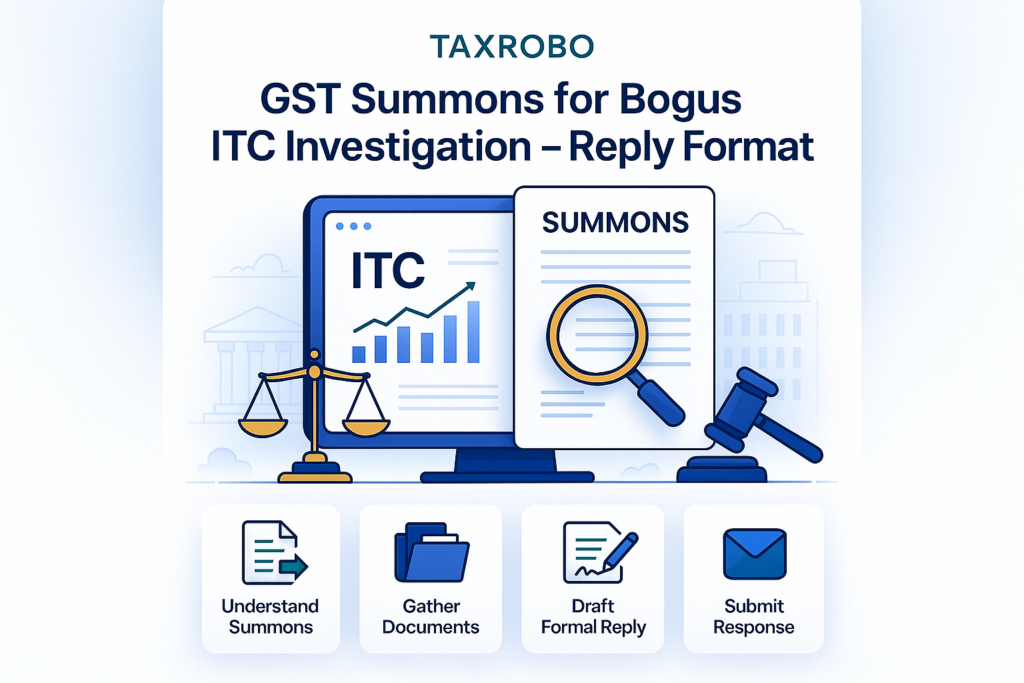

GST Summons for Bogus ITC Investigation – A Complete Guide to Drafting Your Reply
Receiving a formal notice from the GST department can be a stressful experience for any business owner. The sight of an official envelope containing a summons often brings a wave of confusion and anxiety. A GST summons, especially one concerning a bogus Input Tax Credit (ITC) investigation, is a serious legal matter that demands immediate and careful attention. A timely, accurate, and professionally drafted response is not just a formality; it is a critical step in protecting your business from heavy penalties and prolonged legal complications. This guide will walk you through the entire process, providing a clear format for your bogus ITC summons reply to ensure you handle the situation effectively.
What is a GST Summons and Why Did You Receive One?
Understanding the nature of the summons and the reasons behind it is the first step toward formulating a proper response. The GST department doesn’t issue these notices randomly; they are typically triggered by specific data anomalies or intelligence gathered by their investigation wings. Knowing the “why” helps you prepare the “what” for your reply and subsequent actions. This knowledge is crucial for anyone navigating the complex bogus ITC investigation process.
Decoding the Summons Under GST Law
A GST summons is a legal document issued under the authority of Section 70 of the Central Goods and Services Tax (CGST) Act, 2017. Its primary purpose is to legally compel a person to appear before a GST officer to either give evidence or produce specific documents and records relevant to an inquiry. Think of it as a formal call for information. These summons are typically issued by senior officers from departments like the Directorate General of GST Intelligence (DGGI), who are tasked with uncovering tax evasion. The proceedings under a summons are considered judicial proceedings, meaning any statement you provide is recorded under oath and can be used in legal proceedings against you. Therefore, it is essential to treat this document with the utmost seriousness. For further legal context, you can refer to the official CGST Act, 2017.
Common Triggers for a Bogus ITC Investigation
The GST ecosystem is data-driven, and the department uses sophisticated analytics to identify potential tax evasion. A summons for a bogus ITC investigation is usually triggered by one or more of the following red flags:
- Significant ITC Mismatches: One of the most common triggers is a major discrepancy between the Input Tax Credit reflected in your GSTR-2A/2B (details auto-populated from your suppliers’ returns) and the amount you have claimed in your GSTR-3B return.
- Transactions with Suspicious Suppliers: If you have claimed ITC from suppliers who are found to be non-existent, have had their GST registrations cancelled retrospectively, or do not have a legitimate business presence, it raises immediate suspicion. The department actively tracks down such “missing” or fake suppliers.
- Lack of Supporting Documentation: Claiming ITC without possessing the mandatory documents, such as a valid tax invoice, debit note, or proof of receipt of goods or services, is a direct violation of Section 16 of the CGST Act. The absence of e-way bills or lorry receipts for the movement of goods is a major red flag.
- Involvement in Circular Trading: This is a fraudulent practice where a chain of shell companies issues invoices to each other without any actual supply of goods or services. The sole purpose is to artificially inflate turnover and pass on fraudulent ITC. If your business is identified as a link in such a chain, you will receive a summons.
Your Step-by-Step Guide to Responding to a Bogus ITC Summons in India
Once you understand the context, your next move should be methodical and well-planned. This section serves as a practical GST summons investigation guide India, breaking down the immediate actions required to protect your interests. The initial hours after receiving the summons are critical and set the tone for the entire investigation. A well-prepared approach can significantly influence the outcome.
Step 1: Initial Actions After Receiving the Summons
The moment you receive the summons, your actions should be deliberate and calm. Panic can lead to mistakes that may complicate the situation later.
- Don’t Panic, Read Carefully: First, take a deep breath. Read the entire summons document thoroughly. Pay close attention to the issuing authority, the summons reference number, the date and time you are required to appear, and, most importantly, the specific list of documents or information requested.
- Seek Professional Advice: This is not the time for a DIY approach. Immediately consult with a tax expert, such as a Chartered Accountant or a tax lawyer. A professional can help you understand the gravity of the allegations, interpret the specific requirements of the summons, and guide you on the correct course of action. A proper
legal response to ITC summons Indiarequires specialized expertise. - Gather Your Documents: Begin compiling all the documents mentioned in the summons. It is crucial that you only gather existing, authentic documents. Do not create, alter, or backdate any paperwork, as this can be construed as an attempt to obstruct justice and will lead to severe penalties.
Step 2: Preparing the Necessary Documentation
Your documentation is your primary defense. A complete and organized set of records demonstrates your compliance and the legitimacy of your transactions. Being well-prepared shows the officer that you are a diligent taxpayer.
Here is a checklist of essential documents you should have ready:
- A copy of the summons you received.
- Original and copies of valid Tax Invoices for all transactions under scrutiny.
- Proof of movement of goods, such as E-way bills and lorry receipts (LRs).
- Bank statements clearly showing that payments were made to the supplier’s bank account.
- Copies of the ledger account for the concerned supplier from your books of accounts.
- A detailed reconciliation of GSTR-2A/2B with the ITC claimed in GSTR-3B for the relevant tax periods.
- Any contracts, purchase orders, or agreements you have with the supplier in question.
Step 3: Attending the Investigation
Appearing before the GST officer is a formal proceeding. How you conduct yourself can have a significant impact.
- Your Rights: You have the right to be treated with dignity and respect. You also have the right to request a copy of the statement that is recorded during the proceedings. It is advisable to be accompanied by your tax consultant, who can advise you, although they may not be allowed to speak on your behalf during the statement recording.
- Your Obligations: You are under a legal obligation to state the truth. Providing false information under oath is a punishable offense. You must cooperate with the officer and provide the information and documents requested in the summons. Non-cooperation can attract penalties up to ₹25,000 under Section 122 of the CGST Act.
How to Draft an Effective Bogus ITC Summons Reply
Your written response is a formal record of your position. It should be drafted with precision and clarity, supported by strong evidence. This section is dedicated to crafting a powerful bogus ITC summons reply that effectively communicates your side of the story to the department. A well-structured reply can often resolve many of the department’s queries at the very first stage.
Key Components of a Strong Reply
An effective reply should be formal, factual, and backed by evidence. Avoid emotional or aggressive language. Stick to the facts and present them logically.
- Reference and Acknowledgement: Start by clearly mentioning the summons number and date for easy reference. Acknowledge the receipt of the summons and state your intention to cooperate fully with the investigation.
- Factual Submission: Address the points of the inquiry one by one. If the department has raised specific allegations, counter them politely with facts. For instance, if the allegation is that you haven’t received goods, present the e-way bills and lorry receipts as proof.
- Evidence Annexure: Do not just make claims; support them with evidence. Clearly list all the documents you are submitting as annexures. For example, “A copy of the tax invoice is attached as Annexure A.”
- Legal Standing: Briefly and professionally state that your ITC claim is bonafide and fully compliant with the governing laws, particularly Section 16 of the CGST Act, which lays down the conditions for claiming ITC.
Bogus ITC Summons Reply Format India: A Sample Template
Here is a general template that can be adapted to your specific situation. This reply format for GST summons India provides a solid foundation for your response.
[Start of Template]
To,
The [Designation of Issuing Officer],
[Office Address of Issuing Authority].
Subject: Submission of information/documents in response to Summons No. [Summons Number] dated [Date].
Reference: Your Summons No. [Summons Number] dated [Date].
Respected Sir/Madam,
1. We, [Your/Company Name] (GSTIN: [Your GSTIN]), hereby acknowledge receipt of the summons cited above, directing us to provide certain documents and information regarding our Input Tax Credit (ITC) claims for the period [Mention Period].
2. In this regard, we wish to state that all our ITC claims are genuine and have been availed in compliance with the provisions of the CGST Act, 2017. The transactions with our supplier, M/s [Supplier Name] (GSTIN: [Supplier’s GSTIN]), are bonafide business transactions supported by valid documentation.
3. As required by the summons, we are enclosing the following documents as Annexures to substantiate our claim and demonstrate the legitimacy of the transactions:
- Annexure A: Copy of all relevant Tax Invoices.
- Annexure B: Copy of corresponding E-way Bills / Lorry Receipts confirming the movement of goods.
- Annexure C: Bank Statement reflecting payments made to the supplier.
- Annexure D: Reconciliation of GSTR-2A vs. GSTR-3B for the said period.
- Annexure E: Copy of the ledger account of the supplier in our books.
4. We assure you of our full cooperation in the ongoing investigation. We are prepared to furnish any further information or clarification that may be required from our end.
Thank you.
For [Your/Company Name],
[Authorized Signatory Name & Signature]
[Designation]
Date:
Place:
[End of Template]
Disclaimer: This is a general format. The final reply should be customized based on the specific facts and circumstances of your case, preferably under the guidance of a tax professional.
After the Reply: Navigating GST Summons Dispute Resolution
Submitting your reply and documents is just the first step. The process that follows is crucial, and understanding the potential outcomes will help you prepare for the next phase of GST summons dispute resolution India. Your continued diligence and professional representation are key to navigating this stage successfully.
Potential Outcomes
After reviewing your response and the documents you’ve submitted, the GST officer may take one of the following actions:
- Case Dropped: If the officer is satisfied with your explanation and the evidence provided, they may conclude the inquiry and drop the proceedings. This is the best-case scenario.
- Further Scrutiny: The officer might have follow-up questions or require additional documents. They may call for another hearing to seek further clarification on the matter.
- Show Cause Notice (SCN): If the officer is not convinced by your reply and believes that ITC has been wrongly availed, they will issue a Show Cause Notice (SCN). An SCN is a formal document that details the allegations and asks you to explain why a certain tax demand, interest, and penalty should not be imposed on you. This marks the beginning of the formal adjudication process.
The Importance of Professional Representation
If the case proceeds to the SCN stage, the stakes become significantly higher. Navigating the adjudication process requires a deep understanding of GST law, precedents, and legal procedures. This is where professional help becomes indispensable.
TaxRobo’s team of experts specializes in handling complex GST litigation. We can help you draft a robust reply to the SCN, represent your business before the tax authorities, and argue your case effectively to work towards a favorable resolution. Don’t risk your business’s financial health by handling it alone. TaxRobo’s GST experts are here to provide the support and representation you need.
Conclusion
Receiving a GST summons for a bogus ITC investigation is undoubtedly a serious matter that requires a careful and strategic response. However, by staying calm, seeking immediate professional advice, and meticulously organizing your documentation, you can effectively address the department’s concerns. The key lies in a factual, evidence-backed, and timely submission. By following a structured approach and using a clear format for your bogus ITC summons reply, you can navigate the investigation with confidence and protect your business from undue hardship.
Don’t face the GST department alone. If you’ve received a summons and need guidance on responding to bogus ITC summons India, contact the experts at TaxRobo today for immediate and professional assistance.
Frequently Asked Questions (FAQs)
Q1: Can I just ignore a GST summons?
A: Absolutely not. Ignoring a summons is a serious offense. Failure to comply can result in a penalty of up to ₹25,000 under Section 122 of the CGST Act and may even lead to prosecution. It is legally binding.
Q2: Do I have to personally attend, or can my CA/Lawyer go on my behalf?
A: The summons is typically issued to a specific person named in it (e.g., Director, Partner, Proprietor). That person is legally obligated to attend in person. However, you can and should be accompanied by your CA or lawyer. They can advise you during the process, even if they are not permitted to speak for you while your statement is being recorded.
Q3: What if I have genuinely made a mistake in claiming ITC?
A: If you discover a genuine error on your part, the best course of action is to be proactive. You should voluntarily reverse the wrongly claimed ITC along with the applicable interest and penalty using Form DRC-03. Informing the officer about this corrective measure can demonstrate your good faith and may result in a more lenient outcome.
Q4: How long does a bogus ITC investigation process take?
A: There is no fixed timeline for such investigations. The duration of the bogus ITC investigation process can vary widely depending on the complexity of the case, the number of transactions and suppliers involved, the amount of tax at stake, and the level of cooperation from the taxpayer. It can range from a few weeks to several months or even longer.