
GST Summons for Statement Recording – A Complete Guide on Your Rights and Precautions
Receiving an official notice from the GST department can be intimidating for any small business owner or individual. The formal language and the official seal can cause immediate anxiety. But what does a GST summons mean, and what should you do next? A summons is a legal document requiring a person to appear before a GST officer to give evidence or produce documents. Being uninformed can lead to critical mistakes and unnecessary legal complications. Knowing your GST summons rights precautions is the first step toward handling the situation correctly and with confidence. This comprehensive guide is designed for small business owners and salaried individuals across India to help you understand the process, protect your rights, and navigate the inquiry with clarity.
What is a GST Summons and Why Would You Receive One?
Before diving into rights and precautions, it is essential to have a clear picture of what a summons is and the legal framework that governs it. This foundational knowledge is key to understanding GST summons procedures India. A summons is not an accusation of guilt; rather, it is a tool used by tax authorities during an investigation to gather information and ascertain facts. The officer issuing the summons believes that you may possess information, documents, or evidence relevant to an ongoing inquiry. The entire process is a formal part of the tax administration system, designed to ensure compliance and investigate potential discrepancies. Responding to it appropriately is a legal obligation, and your cooperation, backed by an awareness of your rights, can lead to a smoother and quicker resolution of the matter.
Decoding the GST Summons under Section 70 of the CGST Act
A GST summons is issued under the authority of Section 70 of the Central Goods and Services Tax (CGST) Act, 2017. This section grants authorized GST officers the power to summon any person whose attendance they consider necessary, either to give evidence or to produce a document or any other thing in an inquiry. The core purpose is investigative. The department may be looking into a specific transaction, a mismatch in tax filings, or the activities of another taxpayer with whom you have done business. It’s crucial to understand that any proceedings under a summons are deemed to be “judicial proceedings” within the meaning of section 193 and section 228 of the Indian Penal Code. This legal classification means that you are legally bound to state the truth, and providing false information can lead to severe penalties, including prosecution for perjury.
Common Reasons for Receiving a GST Summons
While a summons can be issued for any reason deemed necessary for an inquiry, they are typically triggered by specific red flags in the GST system. Understanding these common triggers can help you maintain better compliance in your business.
- Mismatch in Returns: One of the most frequent reasons is a significant discrepancy between the data reported in different GST returns. For example, if the turnover declared in your GSTR-1 (outward supplies) does not match the turnover in your GSTR-3B (summary return), it can trigger an inquiry.
- Input Tax Credit (ITC) Issues: The GST department is particularly vigilant about fraudulent Input Tax Credit claims. You might receive a summons if your GSTR-3B shows a high ITC claim that doesn’t reconcile with the details provided by your suppliers in their GSTR-1 (which appears in your GSTR-2B), or if you have claimed ITC from a supplier who is found to be non-existent or has not paid their taxes.
- Investigation into a Supplier or Customer: Sometimes, you are not the primary subject of the investigation. The department may be investigating one of your suppliers or customers for tax evasion. In such cases, you may be summoned as a third party to provide documents like invoices, ledgers, or bank statements related to your transactions with them to help the department complete their investigation.
- Suspected Tax Evasion: If there is intelligence or data analytics suggesting that a business is under-reporting its sales, misclassifying goods or services to pay a lower tax rate, or collecting GST from customers but not depositing it with the government, a summons may be issued to investigate the matter thoroughly.
- Refund Claims: Large or unusual refund claims, especially for inverted duty structures or exports, are often subject to scrutiny. A summons may be issued to verify the authenticity of the claim and the supporting documents before the refund is processed.
Your Fundamental GST Legal Rights India: What You Must Know
When you receive a summons, it is natural to feel powerless. However, the law provides you with specific rights to ensure that the process is fair and just. Being aware of your GST legal rights India is your best defense against potential harassment or procedural errors. These rights are not just legal technicalities; they are fundamental protections that balance the investigative powers of the tax authorities with the civil liberties of an individual. Asserting these rights politely and firmly can make a significant difference in the outcome of the inquiry.
The Right to Know the Nature of the Inquiry
You have the right to be informed about the context of the investigation. While the GST officer is not obligated to reveal every detail of the ongoing inquiry (as it could compromise the investigation), you can and should ask for the reason for the summons. Specifically, you should inquire whether you are being summoned as a witness in a case involving another taxpayer or as the primary party under investigation. Knowing your role in the inquiry helps you prepare your response and gather the relevant documents more effectively. This clarity allows you to understand the scope of the questions you might face and ensures you do not inadvertently provide information that is irrelevant or self-incriminating.
The Right to Legal Consultation
This is a nuanced but critically important right. You have the absolute right to consult with your lawyer or a tax consultant before you appear for the summons and after your statement has been recorded. This allows you to understand the legal implications, prepare your answers, and discuss the next steps. However, in most cases, a lawyer is not permitted to be present with you during the statement recording itself. The courts, including the Supreme Court in cases like Pool Pandi vs. Superintendent, Central Excise, have held that the presence of a lawyer during the interrogation stage could disrupt the investigation. The rationale is to ensure that the statement given is voluntary and not influenced by legal counsel. Despite this, you can request a short break during a long recording session to consult with your lawyer if needed.
The Right to be Treated with Dignity
The GST officer must conduct the inquiry in a professional and respectful manner. Your statement must be given voluntarily, without the use of any threat, coercion, intimidation, or harassment. The summons itself should specify a reasonable time and place for your appearance. It should not be scheduled at odd hours (like late at night) unless there are exceptional circumstances. If you feel you are being treated unfairly or subjected to undue pressure, you have the right to report the officer’s conduct to their senior authorities. The proceedings should be conducted in a formal setting, and you should not be subjected to any form of physical or mental duress.
The Right to a Copy of Your Recorded Statement
After your statement has been recorded by the officer and you have signed it, you are legally entitled to receive a copy. This is an extremely important right. The signed statement is a crucial piece of evidence in the official record. Having a copy allows you to:
- Maintain an accurate record of what you said.
- Share it with your legal advisor for future strategy.
- Use it as a reference in case you are summoned again or if a Show Cause Notice is issued later.
Always insist on receiving your copy of the statement before you leave the GST office. If the officer hesitates, you can make a formal written request for it.
Essential Precautions During a GST Summons in India
Knowing your rights is the first half of the battle; the second is taking the right actions. Following a clear set of precautions during GST summons India can help you avoid common pitfalls and ensure the process is handled smoothly. These steps are part of the essential GST response guidelines for individuals India and businesses alike.
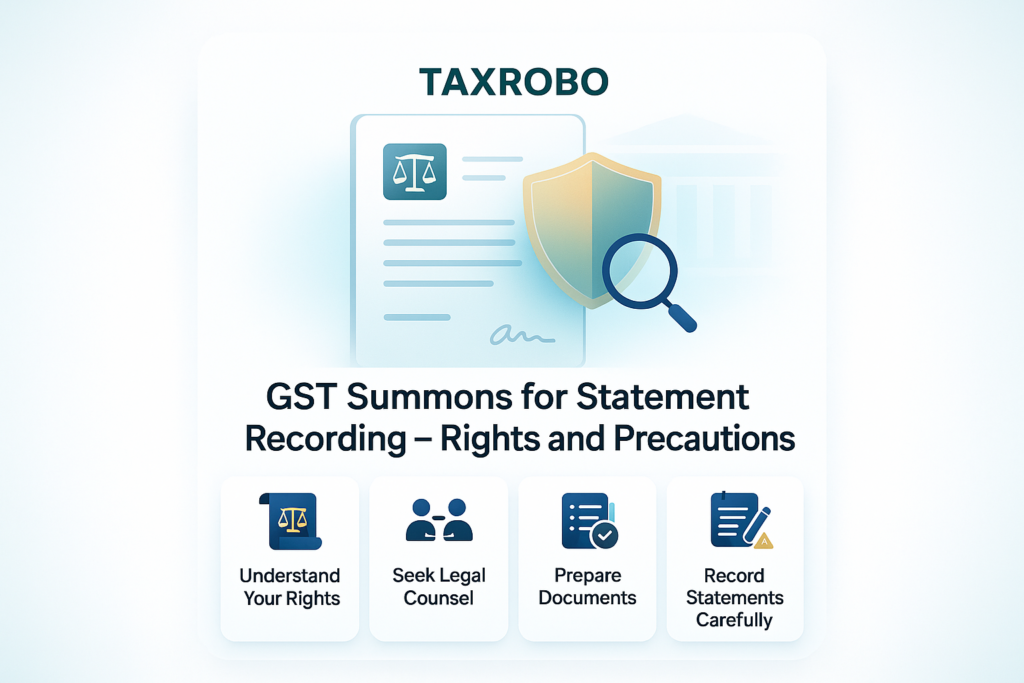
Step 1: Verify the Summons Authenticity
Upon receiving a summons, the first reaction should be calm verification, not panic. It is crucial to confirm that the document is genuine.
- Look for a DIN: As per a circular by the Central Board of Indirect Taxes and Customs (CBIC), any communication from the GST department, including a summons, must have a computer-generated Document Identification Number (DIN). A summons without a DIN is generally considered invalid unless issued under specific exceptional circumstances which must be recorded in writing.
- Actionable Tip: You can easily verify the DIN on the official CBIC website. Go to the portal, find the “Verify CBIC-DIN” option, and enter the number from your summons. This will confirm the authenticity and details of the communication.
- External Link: You can verify the DIN here: CBIC DIN Verification Portal.
Step 2: Prepare and Organize Your Documents
A summons will almost always require you to produce certain documents.
- Read Carefully: Read the summons thoroughly to understand exactly which documents, records, and data are being requested for a specific time period.
- Gather Systematically: Collect all relevant records, such as GST returns (GSTR-1, GSTR-3B), invoices (both sales and purchase), bank statements, e-way bills, ledgers, and any contracts or agreements mentioned.
- Actionable Tip: Do not take original documents unless specifically requested. Instead, create a well-organized file with indexed and paginated photocopies. Keep the originals with you, but present the copies to the officer. This ensures your original records remain safe and you have a clear record of what you have submitted.
Step 3: Be Truthful, Calm, and Precise
How you conduct yourself during the statement recording is vital.
- State the Truth: Remember, the proceeding is a “judicial proceeding.” Lying under oath is a punishable offense under the Indian Penal Code. Always provide information that is true and to the best of your knowledge. If you do not know an answer, it is better to say “I do not recall” or “I will have to check my records” than to guess or provide false information.
- Stay Calm and Composed: The officer’s job is to ask probing questions. Maintain your composure and listen to each question carefully before you answer. Do not get a defensive or argumentative.
- Be Precise: Answer only what is asked. Avoid the temptation to volunteer extra information or speculate on matters you are not sure about. Long, rambling answers can open up new lines of questioning that may complicate your case unnecessarily. Keep your answers concise and to the point.
Step 4: Read Before You Sign
The final and most crucial step before you leave is reviewing your statement.
- Review Thoroughly: After the officer has finished recording your statement, it will be typed or written and presented to you for your signature. Read every single word carefully.
- Ensure Accuracy: Check that the statement accurately reflects everything you said. Pay close attention to numbers, dates, and the context of your answers. Sometimes, the meaning of a sentence can change based on how it is written.
- Request Corrections: If you find any discrepancy, no matter how small, politely point it out and ask for it to be corrected. Do not sign the document until you are completely satisfied that it is an accurate transcript of your testimony. Your signature legally confirms your agreement with its contents.
After the Summons: What Are the Possible Next Steps?
The statement recording is just one part of the inquiry. Based on your statement and the documents you provide, the department will decide on its next course of action. Understanding the potential outcomes can help you prepare for what lies ahead.
Potential Outcomes Post-Statement Recording
- Case Closure: If your statement and documents clarify the officer’s doubts and they are satisfied with your explanation, the inquiry may be concluded without any further action. This is the best-case scenario.
- Show Cause Notice (SCN): If the officer finds discrepancies that indicate a potential short-payment of tax, incorrect ITC claim, or any other non-compliance, they will issue a Show Cause Notice. The SCN will detail the allegations, the amount of tax, interest, and penalty proposed, and will ask you to explain why this amount should not be recovered from you. For further information, see our guide on How to Respond to a GST Show Cause Notice: A Step-by-Step Guide.
- Further Investigation: Your statement might lead the officer to seek more information. They may ask you to submit additional documents or issue a summons to other individuals connected to the case, such as your accountant, director, or key suppliers.
- Prosecution or Arrest: This is the most severe outcome and is reserved for serious cases of tax fraud. Under Section 132 of the CGST Act, offenses like issuing invoices without supplying goods (fake invoicing) or wrongfully claiming ITC above a certain monetary threshold can lead to prosecution and even arrest under Section 69. These situations often involve Fake ITC Cases in GST – Latest Rules, Penalties & Defence Strategy. This is not a common outcome of a routine summons.
When to Seek Professional Help from Tax Experts
While you can handle the initial summons yourself, it is highly advisable to seek professional help. You should consult a tax expert immediately upon receiving the summons, and definitely if:
- The matter involves a large tax amount.
- The allegations seem complex or involve multiple business years.
- You have received a Show Cause Notice after your statement.
- You suspect the case could lead to prosecution.
Navigating GST law, presenting your case effectively, and drafting a reply to an SCN requires deep technical expertise. A professional can ensure your rights are protected and help you build a strong defense.
Conclusion
A GST summons can be a stressful experience, but it is a manageable one. It is a formal inquiry, not a guilty verdict. The key to navigating it successfully is to be prepared, calm, and well-informed. By understanding the process, knowing your legal rights, and taking the necessary precautions, you can handle the situation with confidence and minimize potential complications. Remember that the foundation of a successful response lies in your understanding of your GST summons rights precautions. Be honest, be organized, and never hesitate to seek professional guidance when you need it.
Facing a GST summons can be stressful, but you don’t have to do it alone. The expert team at TaxRobo is here to provide clear guidance and professional representation. Contact us today to ensure your rights are protected every step of the way.
Frequently Asked Questions (FAQ)
Q1. Can I ignore a GST summons?
No. Absolutely not. A summons issued under Section 70 of the CGST Act is a legal order. Failure to appear without a valid reason can lead to penalties. The officer can also initiate proceedings against you under Section 174 of the Indian Penal Code for non-attendance in obedience to an order from a public servant. You can learn more with this guide on GST Summons Notice – How to Respond Legally Without Mistakes.
Q2. Is a GST summons only for business owners?
No. A summons can be issued to any person whom the GST officer believes possesses information or documents relevant to an inquiry. This includes directors, partners, employees (especially from the finance or logistics departments), accountants, tax consultants, and even customers or suppliers of the business under investigation. This is a key aspect of GST summons for individuals India.
Q3. Can a GST officer arrest me when I appear for a summons?
A summons is issued for the purpose of inquiry and statement recording, not for arrest. The powers of summons (Section 70) and arrest (Section 69) are distinct. An arrest can only be made by an authorized officer who has “reasons to believe” that a person has committed one of the serious offenses specified under Section 132 of the CGST Act. While an inquiry that begins with a summons could eventually lead to an arrest in a severe fraud case, the two processes are separate.
Q4. What if I make a mistake in my statement?
You have the right to review your statement carefully before you sign it. If you notice a mistake at that stage, you must insist that the officer corrects it. If you realize you made a factual error after you have already signed and left, you should immediately contact a tax professional. The best course of action is to submit a written letter of retraction or clarification to the concerned officer at the earliest opportunity, explaining the error and providing the correct information. This proactive step can help mitigate potential negative consequences.