
DRC-01 Notice for Bogus Purchase Allegations – Your Complete Reply Format and Guide
Receiving an official notice from the GST department can be a stressful and confusing experience for any business owner. The sight of a formal document alleging tax discrepancies can trigger immediate concern about potential financial liabilities and legal complications. Among the various notices issued under GST law, Form DRC-01 stands out as a critical communication that demands a careful and timely response. This is especially true when the notice contains allegations of bogus purchases, a serious charge that can jeopardize your Input Tax Credit (ITC) and severely impact your business’s financial health. This guide is designed to demystify the process by providing a clear, step-by-step guide and a professional DRC-01 notice reply format to help you respond effectively. Understanding the correct structure for a bogus purchase allegations reply India is the first and most crucial step in defending your position and protecting your business.
What Exactly is a DRC-01 Notice Under GST?
A DRC-01 notice is formally known as a Summary of the Show Cause Notice (SCN). It is issued by a proper officer under the GST regime to inform a taxpayer about a potential tax liability. This form is a summary that accompanies a detailed SCN and outlines the specific amount of tax, interest, and penalty that the officer has determined to be payable by you. The legal basis for this notice is found in Section 73 and Section 74 of the Central Goods and Services Tax (CGST) Act, 2017. The key difference between these sections lies in the intent behind the tax discrepancy.
- Section 73: This section deals with cases where tax has not been paid or has been short-paid, or where ITC has been wrongly availed or utilized for reasons other than fraud, willful misstatement, or suppression of facts. These are generally considered non-fraudulent cases.
- Section 74: This section is invoked for more serious cases where the tax discrepancy is due to fraud, willful misstatement, or suppression of facts to evade tax. Allegations of bogus purchases, which imply a deliberate attempt to claim ITC on non-existent supplies, almost always fall under the stringent provisions of Section 74 of the CGST Act: Dealing with GST Demand Notices Involving Fraud.
The DRC-01 notice format clearly specifies the grounds on which the demand is being raised, providing you with an opportunity to present your case. For more details on GST forms and procedures, you can always refer to the official GST Portal. Understanding which section your DRC-01 notice India has been issued under is vital, as it dictates the penalty provisions and the overall gravity of the situation.
Common Reasons for Receiving a DRC-01 Notice for Bogus Purchases
When a DRC-01 notice lands on your desk alleging bogus purchases, your first question is likely, “Why me?” The GST department’s systems are increasingly data-driven, and various red flags can trigger such an inquiry. Understanding these common triggers can help you preemptively strengthen your compliance and documentation, and it is crucial for preparing a targeted response. The department doesn’t make these allegations lightly; they are typically based on specific information or data analysis that suggests a transaction may not be genuine.
Here are some of the most common reasons why you might receive a DRC-01 notice for bogus purchases:
- Supplier Non-Existence: The most direct reason is when a GST officer conducts a physical verification of your supplier’s registered place of business and finds them to be non-existent, fake, or non-operational at that address.
- Cancelled GSTIN: The notice may be issued if your supplier’s GST registration was cancelled by the department with retrospective effect, meaning it was considered invalid from a date that covers your transaction period. This invalidates the tax invoices they issued.
- Mismatched Invoices: The GST ecosystem relies heavily on data reconciliation. Significant discrepancies between the invoices appearing in your GSTR-2A/2B (details furnished by your supplier) and the How to Resolve ITC Mismatch Issues – GSTR-2A/2B vs 3B Guide you have claimed in your GSTR-3B return can trigger scrutiny.
- Lack of Supporting Documents: A valid tax invoice alone is often not considered sufficient proof. The absence of crucial supporting documents, such as proof of movement of goods (e-way bills, toll receipts, transporter challans) or proof of payment through regular banking channels, can raise suspicion about the genuineness of the transaction.
- Third-Party Information: The GST department often receives intelligence from other government agencies, such as the Income Tax Department or the Directorate General of GST Intelligence (DGGI), which may have flagged your supplier for suspicious activities or involvement in fake invoicing rackets.
A Step-by-Step Guide to Responding to a DRC-01 Notice
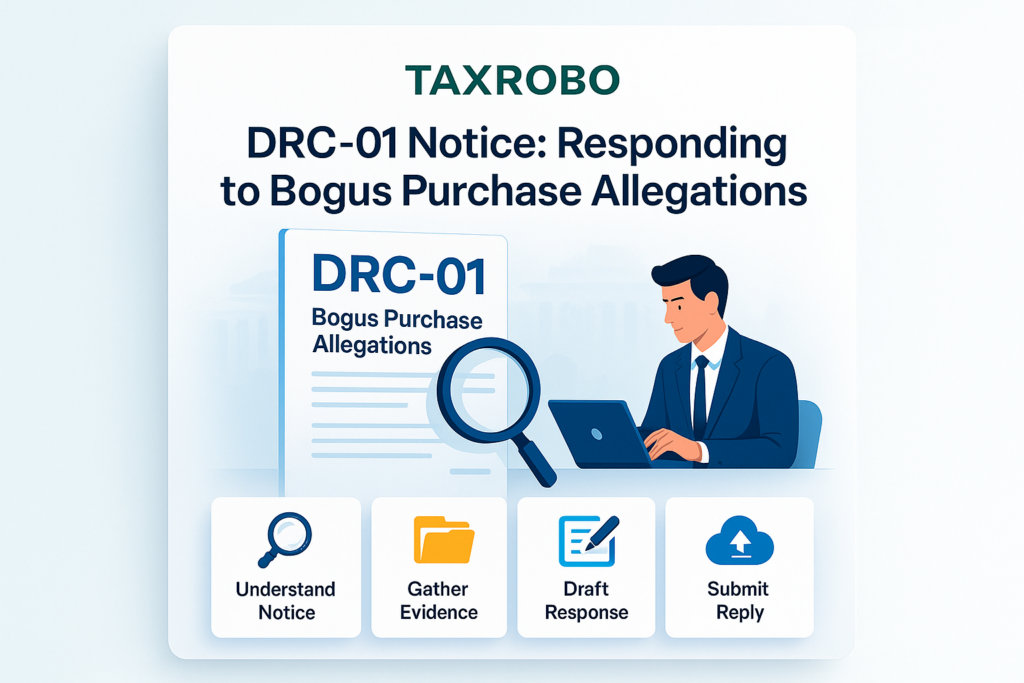
Receiving a notice is the start of a formal legal process, and your response sets the tone for the entire proceeding. A systematic and well-documented approach is essential. Instead of panicking, follow a structured process to build a robust defense against the allegations. Here’s a practical guide on how to reply DRC-01 notice effectively.
Step 1: Acknowledge the Notice and Check the Deadline
The first and most critical rule when responding to DRC-01 notice is to never ignore it. Ignoring the notice is equivalent to accepting the allegations. Upon receipt, immediately note the date of issue and, more importantly, the deadline for filing your reply. Typically, you are given 30 days to respond, but you must confirm the exact timeline mentioned in the notice itself. Missing this deadline can have severe consequences, as the GST officer is empowered to pass an ex-parte order (an order passed without hearing your side of the story) based on the information available to them, confirming the entire proposed tax demand, interest, and penalty against you.
Step 2: Scrutinize the Notice in Detail
Before you begin drafting your reply, you must thoroughly understand the case against you. Read the DRC-01 and the accompanying detailed SCN multiple times. Break it down to identify the core allegations. Note down the specific financial years involved, the names and GSTINs of the suppliers in question, the invoice numbers being disputed, and the exact amount of ITC being disallowed. Pay close attention to the reasoning provided by the officer for their belief that the purchases are bogus. This detailed analysis forms the foundation of your rebuttal, allowing you to address each point raised by the department directly and methodically.
Step 3: Gather All Necessary Documentary Evidence
Your words in the reply carry weight only when they are backed by solid, irrefutable evidence. A strong reply is not about eloquent arguments but about presenting a complete and verifiable paper trail for each transaction under scrutiny. This is the most crucial step in preparing your defense. Begin compiling every piece of documentation related to the disputed purchases. Treat it like building a case file where each document proves a different aspect of the transaction’s genuineness.
Here is a comprehensive checklist of documents you should gather:
- Valid Tax Invoices: Ensure the invoices comply with all the rules under the GST Act, containing all mandatory details.
- E-way Bills: This is critical evidence proving the actual movement of goods from the supplier’s location to yours.
- Proof of Payment: Collate bank statements, account ledgers, or letters from your bank confirming that payment was made from your business account to the supplier’s business account.
- Proof of Receipt of Goods: Gather documents like Goods Receipt Notes (GRN), transporter receipts (lorry receipts), weighbridge slips, and warehouse entry records.
- Purchase Orders and Contracts: The initial Purchase Order (PO) and any corresponding contracts or agreements establish the commercial basis for the transaction.
- Stock Registers: Your inventory records should clearly show the entry of the purchased goods into your stock and their subsequent consumption in manufacturing or sale.
- Subsequent Sale Invoices: If you resold the goods, provide copies of your own sale invoices to your customers. This proves that the goods were part of your legitimate business outflow and not just paper entries.
The Definitive DRC-01 Notice Reply Format for Bogus Purchase Allegations
Once you have gathered all your evidence, the next step is to structure it into a professional and legally sound reply. Using a clear and organized DRC-01 notice reply format is non-negotiable. It helps the adjudicating officer understand your arguments, review your evidence systematically, and appreciate the legitimacy of your claims. A haphazardly written response can confuse the officer and weaken your case, regardless of how strong your evidence is. This section provides a detailed DRC-01 notice response format that you can adapt for your specific situation.
Part 1: Header and Basic Information
Your reply must be formal and official. Always prepare it on your company’s official letterhead. This immediately establishes the authenticity of the document. The header should contain all the necessary reference information to ensure it is correctly filed and directed to the right officer.
- Date: The date on which you are submitting the reply.
- To:
The [Designated GST Officer’s Title]
[Office Address of the Officer as mentioned in the notice] - Reference No.: The unique Show Cause Notice (SCN) number or reference number mentioned in the DRC-01.
- Subject: Reply to Show Cause Notice (SCN) Ref No. [Enter the SCN Number] dated [Enter the Date of the SCN] regarding alleged bogus purchases.
Part 2: Introduction and Preliminary Submissions
Begin the body of your reply with a formal opening. This section sets a cooperative and professional tone while firmly stating your position.
- Acknowledge Receipt: Start by formally acknowledging that you have received the notice. For example: “This is with reference to the Show Cause Notice (SCN) bearing Reference No. [Your SCN Number] dated [Date of SCN], issued by your good office, which was received by us on [Date of Receipt]. We are hereby submitting our detailed reply to the allegations made therein.”
- State Bona Fides: Briefly introduce your company and assert your status as a compliant taxpayer. For example: “We, [Your Company Name], holding GSTIN [Your GSTIN], are a law-abiding registered person and have always strived to comply with all the provisions of the GST Act. We state that the transactions questioned in the SCN are genuine business transactions undertaken in good faith.”
Part 3: Point-by-Point Rebuttal of Allegations
This is the core of your reply and requires the most attention to detail. Do not provide a generic, consolidated response. Instead, address each allegation raised in the SCN as a separate point. This structured approach demonstrates that you have carefully considered every aspect of the notice and have a specific answer for each. Using the legal format for DRC-01 notice response here is critical.
Example Structure:
Allegation 1: It has been alleged that the purchases from the supplier M/s. [Supplier’s Name], GSTIN [Supplier’s GSTIN], for the period [Financial Year] are bogus as the supplier was found to be non-existent.
Our Rebuttal:
- We respectfully deny the allegation. We state that all purchase transactions with the said supplier are genuine and supported by valid documentation.
- At the time of entering into the transaction, we verified the supplier’s GSTIN on the official GST portal, and it was active and valid. A screenshot of the verification is attached as Annexure-1.
- For the said transaction, the supplier issued a valid tax invoice No. [Invoice Number] dated [Invoice Date], a copy of which is attached as Annexure-2.
- The movement of goods is substantiated by E-way Bill No. [E-way Bill Number], a copy of which is attached as Annexure-3.
- We made the payment of Rs. [Amount] to the supplier via a banking channel from our official bank account. The bank statement highlighting this transaction is attached as Annexure-4.
- The goods were duly received at our premises, as evidenced by the Goods Receipt Note and weighbridge slip, attached as Annexure-5.
(Repeat this structure for every allegation and every supplier mentioned in the SCN.)
Part 4: Annexures and Supporting Case Laws
To maintain clarity, all your documentary evidence should be compiled as annexures.
- Evidence List: At the end of your rebuttal section, create a clear index of all the documents you have attached. For example:
- Annexure-1: GSTIN verification of the supplier.
- Annexure-2: Copy of Tax Invoice.
- Annexure-3: Copy of E-way Bill.
- And so on…
- Legal Precedents: This can significantly strengthen your case. Mention relevant judgments from High Courts or the Supreme Court where it has been held that the recipient of goods should not be penalized for the supplier’s default, provided the recipient has fulfilled all its obligations (like having a valid invoice, proof of payment, and proof of goods movement). Highlighting such case laws showcases your diligence and understanding of the legal landscape.
Part 5: Prayer and Verification
Conclude your reply with a formal request and a verification statement.
- Prayer: This is your formal request to the officer to conclude the proceedings in your favor. For example: “In light of the above submissions, factual clarifications, and the documentary evidence provided, which unequivocally prove the genuineness of the transactions, we humbly pray that your good office be pleased to drop the proceedings initiated via the said Show Cause Notice and not raise any demand for tax, interest, or penalty.”
- Verification: This is a declaration confirming the truthfulness of your statements.
For [Your Company Name][Signature]
[Your Name/Director’s Name]
[Designation]
[Place: Your City]
Key Guidelines & Mistakes to Avoid in Your DRC-01 Notice Reply
Drafting and submitting the reply is a delicate process. Following best practices can significantly improve your chances of a favorable outcome. Here are some key guidelines for DRC-01 notice reply and common pitfalls to avoid.
Do’s:
- Be Factual and Concise: Stick to the facts of the case. Present your arguments clearly and support every claim with corresponding documentary evidence. Avoid long, narrative explanations that are not backed by proof.
- Maintain a Professional Tone: Your reply is a formal legal document. Use respectful and professional language throughout. Avoid any emotional, accusatory, or confrontational language against the department or the officer.
- File on Time: Adhering to the deadline is non-negotiable. If you need more time to gather documents, you can file a request for an extension, but do so well before the deadline expires.
Don’ts:
- Never Ignore the Notice: As mentioned earlier, this is the biggest mistake you can make. It leads to an automatic confirmation of the demand against you.
- Don’t Provide Vague Answers: Avoid generic statements like “all transactions are genuine.” You must provide specific proof for each and every transaction that is being questioned. The How to Handle GST Notices – ASMT-10, DRC-01, DRC-07 Explained Simply emphasize specificity.
- Don’t Submit Without Review: Before submitting, have the entire reply and all its annexures reviewed by a professional, like a Chartered Accountant or a tax lawyer. A single error or a missing document can weaken your entire case.
When to Seek Professional Help from TaxRobo
While this guide provides a comprehensive framework, GST law is complex, and the stakes in a bogus purchase case are very high. The officer’s interpretation of facts and law can have a massive financial impact on your business. In such situations, seeking professional help is not a cost, but an investment in protecting your interests. TaxRobo’s team of GST experts can provide invaluable assistance.
Our services include:
- Expert Analysis: We conduct a deep dive into your DRC-01 notice to understand the precise legal and factual grounds of the allegations.
- Evidence Collation: We guide you in gathering the most relevant and powerful documentary evidence required to build a strong case.
- Legal Drafting: We draft a legally sound and persuasive reply based on the correct DRC-01 notice reply format, incorporating relevant case laws and legal precedents.
- Representation: We can represent your business before the GST authorities, handling hearings and ensuring your case is presented effectively.
Don’t navigate this complex process alone. Let our experts handle the intricacies while you focus on running your business.
Consult with TaxRobo’s GST Experts Today
Conclusion
Facing a DRC-01 notice for bogus purchase allegations can be daunting, but it is a challenge that can be managed with a structured, diligent, and evidence-based approach. The key lies in understanding the allegations, gathering comprehensive proof, and presenting your case clearly. Remember that a timely and well-drafted reply is your first and best line of defense. Using the correct DRC-01 notice reply format is not just a matter of procedure; it is a critical strategy that ensures your arguments are heard and understood by the authorities. If you feel overwhelmed or unsure at any stage, do not hesitate to seek professional guidance. Protecting your business’s financial integrity is paramount, and TaxRobo is here to help you every step of the way.
Frequently Asked Questions (FAQs)
1. What is the time limit to reply to a DRC-01 notice in India?
The standard time limit provided to reply to a DRC-01 notice is 30 days from the date the notice is served. However, you must always verify the specific deadline mentioned in the notice you have received, as it is the official timeline you must adhere to.
2. What happens if I fail to respond to a DRC-01 notice?
If you fail to respond within the stipulated time, the GST officer has the authority to pass an ex-parte order. This means an order will be issued based solely on the information available to the officer, without considering your defense. This usually results in the confirmation of the full demand for tax, interest, and penalty as mentioned in the DRC-01, leading to recovery proceedings against your business.
3. Can I pay the proposed tax amount instead of filing a reply?
Yes, you have the option to pay the proposed tax amount along with applicable interest using Form DRC-03. Under Section 73 (non-fraud cases), if you pay the tax and interest within 30 days of the notice, the penalty proceedings are generally concluded. However, since bogus purchase allegations usually fall under Section 74 (fraud cases), simply paying the amount may not be sufficient, and heavy penalties can still be imposed. It is highly advisable to file a detailed reply to contest the allegations, especially if you believe your transactions are genuine.
4. Is it mandatory to use a specific legal format for a DRC-01 notice response?
While the GST law does not prescribe a single, rigid government template for the reply, using a professional and structured format is crucial for legal and practical reasons. A proper legal format for DRC-01 notice response, like the one detailed in this guide, ensures that your reply is clear, organized, and addresses all legal points methodically. It makes it easier for the adjudicating authority to navigate your arguments and evidence, thereby significantly increasing the chances of a favorable outcome.