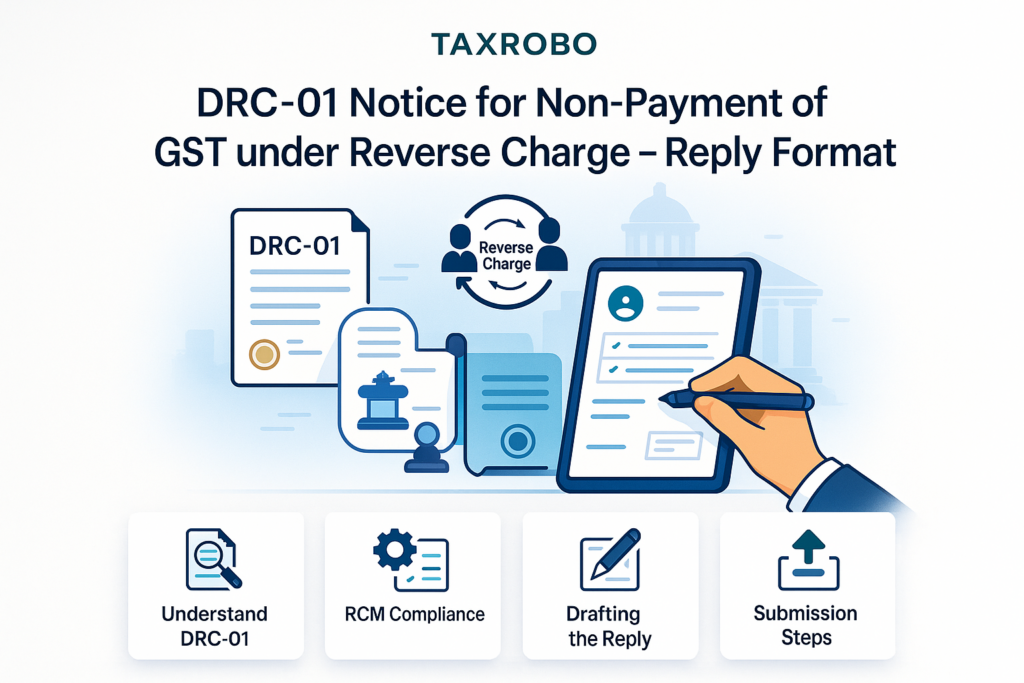

DRC-01 Notice for Non-Payment of GST under Reverse Charge – Reply Format
Receiving a notice from the GST department can be stressful for any business owner. One such crucial notice is Form GST DRC-01, and understanding it is the first step towards a successful resolution. A DRC-01 notice for non-payment is essentially a formal Show Cause Notice (SCN) from the GST authorities demanding to know why a certain tax amount, along with interest and penalties, should not be recovered from you. This notice often arises from discrepancies related to the Reverse Charge Mechanism (RCM), a common point of confusion for many businesses. This blog post will serve as your comprehensive guide, providing a clear, step-by-step process and a ready-to-use reply format for DRC-01 notice to help you respond effectively and avoid unnecessary legal complications. For a broader overview, see our guide on How to Respond to a GST Show Cause Notice: A Step-by-Step Guide.
What is a DRC-01 Notice for Non-Payment of GST?
Understanding the nature of the notice is critical before you begin drafting a reply. A DRC-01 is not a final demand for tax; rather, it is an opportunity for you to present your side of the story, supported by facts and documentation. The notice outlines the grounds on which the tax is being demanded and gives you a chance to explain why that demand may be incorrect. Properly handling this initial stage is key to resolving the issue efficiently.
Understanding Form GST DRC-01 and Its Purpose
Form GST DRC-01 is a summary of a Show Cause Notice issued by a proper officer under either Section 73 or Section 74 of the Central Goods and Services Tax (CGST) Act, 2017. Its primary purpose is to communicate the alleged tax deficiency to the taxpayer in a structured format. The notice will clearly state the amount of tax you have allegedly underpaid or not paid, the interest calculated on this amount, and any penalty that the department proposes to levy. It’s crucial to remember that this is a “show cause” notice. This means the burden is on the department to allege a discrepancy, and the opportunity is on you to prove why their allegation is incorrect or has already been rectified. It is the first formal step in the DRC-01 notice process India, initiating a dialogue between you and the tax authorities.
Why You Might Receive a DRC-01 for Reverse Charge Mechanism (RCM)
The Reverse Charge Mechanism (RCM) Under GST – Latest Applicability Chart 2025 is a concept that shifts the responsibility of paying GST from the supplier to the recipient of the goods or services. This is a common area for errors, often leading to scrutiny from the tax department. You might receive a DRC-01 notice for non-payment under RCM for several reasons, typically identified when an officer compares your GSTR-3B returns with your expense ledgers or other financial data.
Common RCM scenarios that trigger such notices for small businesses include:
- Services from a Goods Transport Agency (GTA): When you receive transportation services from a GTA that has not charged GST, you are liable to pay the tax under RCM.
- Legal services from an advocate or a firm of advocates: Businesses receiving legal services are required to pay GST on these services directly to the government.
- Services from a director to a company: Remuneration paid to a director that is not “salary” can be subject to GST under RCM.
- Sponsorship services: If you sponsor an event, you are liable to pay GST on the sponsorship fees under RCM.
If the GST department’s automated systems or a scrutinizing officer finds that you have recorded expenses for these services but have not declared the corresponding RCM liability in your GSTR-3B, a DRC-01 notice is likely to be issued.
First Steps: Key Details to Scrutinize in Your Notice
Before you even think about replying, you must carefully review the notice you have received. A calm and meticulous examination of the document will help you understand the core issue and prepare an accurate response. Pay close attention to the following details:
- Basic Information: Verify that your GSTIN, legal name, and business address are correctly mentioned.
- Notice Reference Number (SCN Number) and Date: These are unique identifiers for your case and must be quoted in all future correspondence.
- The Specific Tax Period: The notice must specify the exact month(s) or quarter(s) for which the discrepancy has been alleged.
- Grounds and Calculations: This is the most important part. The notice must provide a detailed breakdown of the alleged tax default, including the specific transactions, the tax rate applied, and the calculation of interest and penalty. Ensure you understand the basis of the officer’s claim.
For any official forms, rules, or updates, you can always refer to the official GST Portal.
How to Respond to a DRC-01 Notice: A Step-by-Step Guide
Once you have thoroughly analyzed the notice, you need to follow a structured approach to prepare and submit your response. A well-prepared reply, backed by solid evidence, can often lead to a swift resolution. Here are the essential steps on how to respond to DRC-01 notice.
Step 1: Acknowledge the Notice and Analyze the Allegations
The first rule is not to panic. Receiving a notice is a standard departmental procedure. Read the notice calmly and carefully to understand the exact allegations. Is the department claiming you completely missed paying an RCM liability? Or is there a mismatch in the amount you paid versus what they calculated? Identify the root cause of the discrepancy. It could be a simple clerical error, a misunderstanding of a GST provision, or a complete omission. Your entire response will be based on this initial analysis, so take the time to get it right.
Step 2: Gather All Supporting Documents and Evidence
Your reply is only as strong as the evidence that supports it. A factual rebuttal without documentary proof is unlikely to be accepted. Begin compiling a file of all relevant documents that can substantiate your claims. A comprehensive checklist of evidence is crucial for building a strong case.
Here’s a list of documents you should gather:
- A copy of the DRC-01 notice itself.
- Invoices related to the specific RCM transactions mentioned in the notice.
- Proof of payment to the supplier (e.g., bank transfer details, receipts).
- Bank statements that clearly highlight the payments for these transactions.
- Copies of your GSTR-3B filings for the relevant tax periods. This is especially important if you believe you have paid the tax but perhaps reported it incorrectly.
- Payment challans (Form PMT-06) that show you have already paid the RCM tax and interest, if applicable.
- Extracts from your expense ledger and general ledger accounts related to the transactions.
Step 3: Drafting a Factual and Professional Reply
With your analysis complete and your documents in order, it’s time to draft the reply. The tone should always be formal, professional, and respectful. Avoid emotional language or making vague statements. The best approach is a point-by-point rebuttal to each allegation made in the DRC-01. Clearly state whether you agree or disagree with the department’s observation. If you disagree, explain why in detail, and refer to the specific supporting documents you have gathered. If you agree partially or fully, state that clearly and provide proof of having paid the accepted liability.
Step 4: Submitting the Reply on the GST Portal
In the digital era of GST, replies are filed electronically. Your formal response to the DRC-01 notice must be submitted using Form GST DRC-06 on the GST Portal. Log in to your GST account, navigate to the ‘Notices and Orders’ section, and find the relevant SCN. You will find an option to file a reply. You can type your response directly or, more commonly, attach a detailed PDF reply along with scanned copies of all your supporting documents. Once you submit the reply, an Application Reference Number (ARN) will be generated. Be sure to save this ARN, as it is your official acknowledgement of submission. These are the core DRC-01 notice reply guidelines to follow for a compliant submission.
The Ultimate Reply Format for DRC-01 Notice
Using a structured format for your reply makes it easier for the tax officer to understand your position and review your evidence. Below is a template that you can adapt to your specific situation. This reply format for DRC-01 notice covers all the essential components of a professional and effective response.
Part A: Header and Subject
To:
The Office of the [Designation of the Officer],
[Jurisdiction/Address of the GST Office]
From:
[Your Legal Name / Company Name]
[Your GSTIN]
[Your Registered Business Address]
Date: [Date of Reply]
Subject: Reply to Show Cause Notice Ref. No. [Notice Reference Number] dated [Date of Notice] for the tax period [Tax Period, e.g., April 2022 to March 2023]
Part B: Introduction and Statement of Facts
Respected Sir/Madam,
This is with reference to the Show Cause Notice (SCN) bearing the reference number mentioned above, issued to us under Section [73/74] of the CGST Act, 2017. We acknowledge the receipt of the notice on [Date of Receipt]. We have carefully reviewed the observations and discrepancies pointed out in the said notice. In this regard, we wish to submit the following facts, legal submissions, and supporting documents for your kind consideration and perusal.
Our company, [Your Company Name], is engaged in the business of [Briefly describe your business]. We are a compliant taxpayer and have always strived to discharge our GST liabilities correctly and within the stipulated time. The observations raised in the SCN appear to have arisen from a misunderstanding of the facts, which we wish to clarify in the subsequent sections of this reply.
Part C: Point-wise Rebuttal to Allegations
For clarity and ease of review, we are providing a point-wise response to the allegations raised in the SCN.
| Allegation from DRC-01 Notice | Our Rebuttal / Factual Clarification |
|---|---|
|
Allegation 1: Non-payment of GST amounting to ₹[Amount] under Reverse Charge Mechanism (RCM) on legal services received from M/s. [Advocate’s Firm Name] during the period [Tax Period]. |
The said allegation is respectfully denied. We submit that we have duly paid the applicable GST of ₹[Amount] on this service under RCM. The payment was made via Challan No. [Challan Reference No.] on [Date of Payment]. This liability was also correctly reported in Table 3.1(d) of our GSTR-3B return for the month of [Month, Year]. A copy of the advocate’s invoice, the payment challan (PMT-06), and the relevant extract of our GSTR-3B are attached herewith as Annexure-A. |
|
Allegation 2: Short payment of GST of ₹[Amount] on services received from a Goods Transport Agency (GTA) vide Invoice No. [Invoice Number]. |
We partially agree with this observation. Due to a clerical error, the taxable value was incorrectly considered as ₹[Incorrect Amount] instead of ₹[Correct Amount], leading to a short payment of ₹[Amount]. We have since rectified this error and paid the differential tax of ₹[Amount] along with applicable interest of ₹[Interest Amount] via Challan No. [Challan Reference No.] dated [Date of Payment]. A copy of the challan is attached as Annexure-B. |
Part D: Prayer (Conclusion of the Reply)
In light of the above submissions, factual clarifications, and the documentary evidence provided herewith, we humbly submit that the allegations made in the SCN are not sustainable. We have either already complied with the law or have rectified the inadvertent error upon its discovery.
Therefore, we humbly pray that the proceedings initiated via the aforementioned Show Cause Notice be considered as concluded and dropped in their entirety. We also request an opportunity for a personal hearing to explain our case in person before any adverse order is passed in this matter.
Thank you for your consideration.
Yours Sincerely,
For [Your Company Name]
[Your Name]
[Your Designation]
(Authorized Signatory)
Common Mistakes to Avoid
Responding to a notice correctly is just as important as responding at all. Many taxpayers make simple mistakes that can complicate the process or lead to unfavorable outcomes. Here are some common pitfalls to avoid.
- Ignoring the Notice: This is the worst mistake you can make. If you fail to respond, the officer is empowered to pass an ex-parte order (an order without hearing your side) in Form DRC-07, confirming the entire tax demand along with interest and maximum penalty. This makes the demand final and binding.
- Missing the Deadline: The notice will specify a deadline for your reply, typically 30 days. Failing to respond within this timeframe can be treated as non-response. Always adhere to the deadline or request an extension in writing if you have a valid reason.
- Submitting an Incomplete or Vague Reply: A reply that simply denies the charges without providing any supporting documents or clear explanations holds very little weight. Ensure every claim you make is backed by concrete evidence.
- Failing to Request a Personal Hearing: You have a legal right to a personal hearing to explain your case to the officer. Always include this request in your prayer. It is a crucial opportunity to clarify any doubts the officer might have after reading your written submission.
Conclusion
A DRC-01 notice for non-payment under GST, especially for RCM liabilities, requires a structured, factual, and timely response. By understanding the notice, gathering the right documents, drafting a precise reply using a professional format, and submitting it on time, you can effectively address the department’s concerns and protect your business from unnecessary penalties. Remember to analyze the notice carefully, build your case with solid evidence, and follow the correct procedure for submission. While this guide provides a comprehensive overview, complex cases involving significant amounts or intricate legal interpretations may require professional assistance.
Navigating GST notices can be complex. If you need expert assistance in drafting a professional response to a DRC-01 notice for non-payment, connect with TaxRobo’s GST experts today. We ensure your reply is accurate, compliant, and effectively represents your case.
Frequently Asked Questions (FAQs)
Q1. What happens if I agree with the tax demand in the DRC-01 notice?
A: If you agree with the tax, interest, and penalty proposed in the notice, you can pay the amount using Form GST DRC-03. After making the payment, you must inform the issuing officer by submitting the payment details. This will generally lead to the conclusion of the proceedings, often with a reduced penalty if paid within 30 days of the notice.
Q2. Where do I file the reply to the DRC-01 notice?
A: The reply must be filed electronically on the official GST Portal using Form GST DRC-06. You can attach your detailed written submission and all supporting documents in PDF format. No physical submission is generally required.
Q3. Can I request an extension for filing the reply?
A: Yes, you can submit a formal written request for an extension to the proper officer who issued the notice. You must state valid reasons for needing more time, such as the complexity of the case or the unavailability of key personnel. Granting the extension is at the officer’s discretion.
Q4. What is the difference between a notice under Section 73 and Section 74?
A: This is a critical distinction. A notice under Section 73 is issued for the non-payment or short payment of tax for reasons other than fraud, willful misstatement, or suppression of facts. The penalties are lower. A notice under Section 74 is issued in more serious cases where there is evidence of fraud, willful misstatement, or suppression of facts to evade tax. The penalties under Section 74 are significantly higher, potentially up to 100% of the tax demanded. Always check your DRC-01 to see which section has been invoked. You can read more about the Key Differences Between Sections 73 and 74 of the CGST Act in GST Demand Notices.