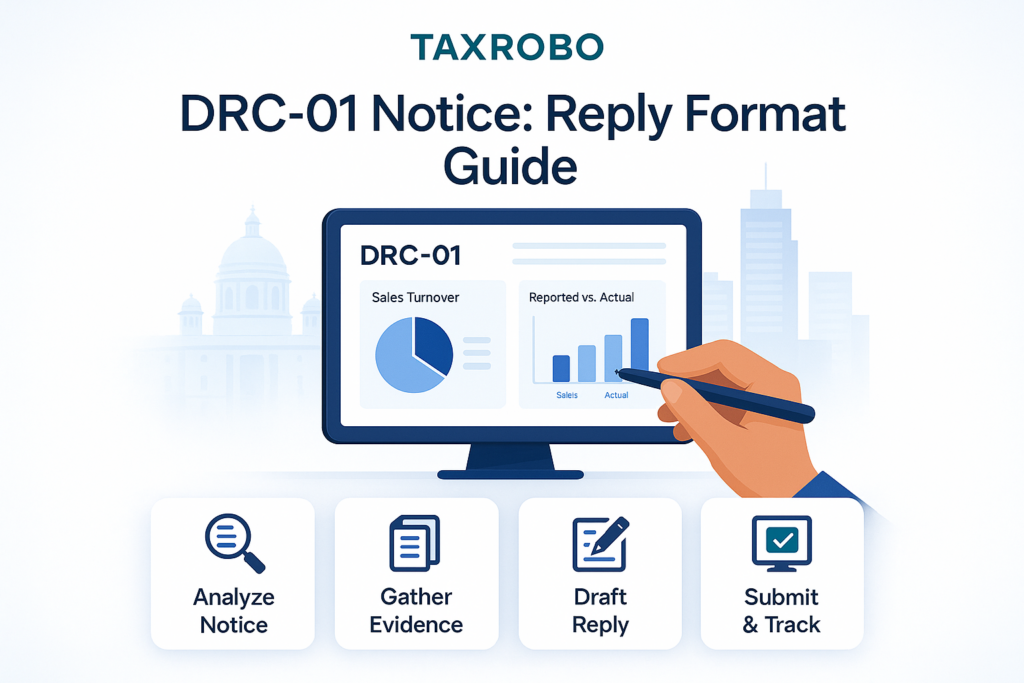

DRC-01 Notice for Suppression of Sales Turnover – Reply Format
Received a scary-looking DRC-01 notice from the GST department? Don’t panic. A well-structured reply can resolve the issue effectively, and understanding the proper DRC-01 Notice reply format is your first line of defense. A DRC-01 notice is a formal Show Cause Notice (SCN) issued by a tax officer who believes there has been an underpayment of tax, often due to alleged suppression of sales turnover. Responding to this notice in a timely and accurate manner is absolutely crucial to avoid hefty penalties, interest, and further legal complications. This article provides a detailed breakdown of the official reply format, helping you understand the notice, gather your evidence, and respond with confidence.
Understanding the DRC-01 Notice: What It Means for Your Business
A Form DRC-01 is a formal Show Cause Notice issued under the Central Goods and Services Tax (CGST) Act, 2017. It’s not just an inquiry; it’s a legal document that alleges a tax short-payment and asks you to explain why the proposed tax, interest, and penalty should not be levied on your business. This notice is a summary of the grounds for the proposed action and is typically issued under one of two key sections of the CGST Act: Section 73 or Section 74. Understanding the difference is vital as it directly impacts the penalty implications. For more details, see our guide on the Key Differences Between Sections 73 and 74 of the CGST Act in GST Demand Notices.
- Section 73: This is invoked in cases where the tax has not been paid or is short-paid due to reasons other than fraud, willful misstatement, or suppression of facts. This could be due to a genuine error or an oversight. The penalties under this section are comparatively lower.
- Section 74: This section is applied in more serious cases involving fraud, willful misstatement, or the deliberate suppression of facts to evade tax. The penalties here are much stricter, potentially reaching 100% of the tax amount demanded.
Following the correct DRC-01 Notice guidelines India is essential, as the notice you received will clearly state under which section it has been issued. This distinction will be the foundation of your defense strategy and the tone of your reply.
| Feature | Section 73 (Non-Fraud Cases) | Section 74 (Fraud/Willful Misstatement Cases) |
|---|---|---|
| Reason for Notice | Tax unpaid/short-paid due to genuine error or oversight. | Tax unpaid/short-paid due to fraud, willful misstatement, or suppression of facts. |
| Penalty Amount | 10% of the tax due or Rs. 10,000, whichever is higher. | 100% of the tax due. |
| Penalty Waiver | No penalty if tax and interest are paid within 30 days of the notice. | Penalty can be reduced to 25% if tax, interest, and this reduced penalty are paid within 30 days. |
| Intent | No malafide (bad) intent is presumed. | Malafide intent to evade tax is the basis of the notice. |
Why Did You Receive a “Suppression of Sales Turnover” Notice?
A notice for “Suppression of Sales Turnover” sounds alarming, but it’s often triggered by data mismatches between various financial filings. The GST department’s systems are designed to cross-reference data from multiple sources. When these sources don’t align, it raises a red flag. A proper Sales Turnover suppression notice response requires you to identify and explain these discrepancies. Here are the most common reasons you might receive such a notice.
Mismatch Between GSTR-1 and GSTR-3B
This is the most frequent trigger. Your GSTR-1 is a detailed statement of all your outward supplies (sales invoices), while GSTR-3B is a summary return where you declare your total sales and pay the corresponding tax. If the total taxable value of sales reported in your GSTR-1 is higher than the turnover on which you paid tax in your GSTR-3B for the same period, the system will flag it as a potential suppression of sales.
Discrepancies Between GSTR-3B and E-Way Bill Data
The e-way bill portal tracks the movement of goods across the country. The GSTN analytics engine compares the total value of goods you have shipped (as recorded in the e-way bills generated) with the turnover you have declared in your GSTR-3B. If the value of goods moved is significantly higher than your declared sales, the officer may infer that you have made undeclared sales and have suppressed your turnover. Refer to our Guide to GST E-Way Bill Generation for more details.
Mismatch with Income Tax Returns (ITR)
The tax departments share data. If the gross receipts or turnover you declared in your Income Tax Return (ITR) or which is reflected in your Form 26AS (from TDS deductions) is higher than the total annual turnover reported in your GST returns (GSTR-1 and GSTR-3B), it creates a major discrepancy. The officer will issue a DRC-01 to seek an explanation for this difference.
Third-Party Information or Investigation
Sometimes, the department receives information from other sources. This could be during an investigation of one of your major customers or suppliers, from another government agency like the Directorate General of GST Intelligence (DGGI), or based on specific market intelligence. If such information suggests that your actual turnover is higher than what you have declared, a notice will be issued.
Your First Steps: What to Do Immediately After Receiving the Notice
Receiving a DRC-01 can be stressful, but a calm and methodical approach is key. Acting promptly and correctly can make a significant difference in the outcome. Here is a checklist of immediate actions to take.
- Don’t Ignore It: This is the most important rule. Ignoring a DRC-01 will not make it go away. It will lead to an ex-parte order (an order passed without hearing your side), confirming the full demand with maximum penalties.
- Check the Deadline: Carefully note the date of issue on the notice. You typically have 30 days to file a reply. Missing this deadline can have serious consequences.
- Verify Authenticity: It’s a good practice to confirm that the notice is genuine. You can do this on the official GST portal.
- Log in to the GST Portal.
- Navigate to Services > User Services > View Additional Notices/Orders.
- You should find the notice listed there with its reference number.
- Gather Your Documents: Before you start drafting a reply, you need all your facts and figures in one place. Start collecting and organizing all relevant records for the period mentioned in the notice:
- GST Returns: Copies of GSTR-1 and GSTR-3B.
- Sales Records: Your sales ledger, tax invoices, credit/debit notes.
- Bank Statements: Your business bank account statements to correlate payments with invoices.
- Reconciliation Statements: Any internal reconciliation you may have prepared between GSTR-1 and GSTR-3B or your books of accounts.
- E-way Bill Records: A complete list of e-way bills generated during the period.
- Financials: Audited financial statements, ITRs, and Form 26AS.
Crafting Your Response: The Complete DRC-01 Notice Reply Format
Your reply is your opportunity to present your case clearly and factually. A vague or poorly structured response can be interpreted negatively. Following a professional DRC-01 Notice reply format ensures that the officer understands your arguments and can verify your claims easily. This is crucial for a favorable resolution. For a broader overview, you can also consult our article on How to Respond to a GST Show Cause Notice: A Step-by-Step Guide.
Key Components of a Strong Reply
Your response should be formal and comprehensive. Here are the essential elements to include:
- Official Letterhead: Always prepare the reply on your business’s official letterhead. This adds a layer of professionalism and authenticity.
- Header Information: At the top, clearly mention your business’s legal name, registered address, and GSTIN. Also, quote the Show Cause Notice (SCN) Reference Number and the date of the notice.
- Subject Line: The subject should be precise and easy to understand. For example: “Reply to Show Cause Notice (SCN) bearing Reference No. [Your SCN Number] dated [Date of Notice] for the tax period [e.g., FY 2022-23]”.
- Point-by-Point Rebuttal: This is the heart of your reply. Do not write a generic, long paragraph. Instead, address each allegation or discrepancy raised in the DRC-01 notice one by one, in separate paragraphs or numbered points. For each point:
- State the allegation exactly as mentioned in the notice.
- Provide your factual submission or explanation.
- Back up your explanation with data, calculations, and references to supporting documents.
- Legal Basis: If your case is supported by any specific provisions of the GST law, relevant circulars, or notifications, mention them clearly. This demonstrates that your position is legally sound.
- Supporting Evidence: After your rebuttal, include a section titled “List of Annexures.” Clearly list all the supporting documents you are attaching (e.g., Annexure-A: Reconciliation of GSTR-1 vs. GSTR-3B, Annexure-B: Copy of relevant sales invoices, etc.).
- Prayer/Conclusion: Conclude your reply with a formal “prayer.” This is a concluding paragraph where you summarize your position, reiterate that the allegations are based on a misunderstanding of facts, and respectfully request the officer to review your submissions and drop the proceedings initiated by the SCN.
Sample: Suppression of Sales Turnover Response Template
Using a structured template can help you cover all necessary points. Here is a sample Format for DRC-01 Notice reply in India that you can adapt.
(To be printed on your business letterhead)
Date: [Date of Reply]
To,
The [Designation of the Officer],
[Address of the GST Office],
[City, State, PIN Code].
GSTIN: [Your GSTIN]
Legal Name: [Your Company Name]
Address: [Your Registered Address]
Subject: Reply to Show Cause Notice (SCN) bearing Reference No. [Notice Reference Number] dated [Date of Notice]
Reference: SCN No. [Notice Reference Number] dated [Date of Notice]
Respected Sir/Madam,
1. Introduction: We acknowledge the receipt of the Show Cause Notice (SCN) cited above, issued under Section [73/74] of the CGST Act, 2017, for the tax period [Tax Period]. We have carefully reviewed the allegations mentioned in the notice and are providing our detailed point-wise reply and submissions for your kind perusal.
2. Background of the Assessee: We are engaged in the business of [Briefly describe your business]. We are duly registered under the GST Act and have been diligently filing our returns and paying our taxes on time.
3. Factual Submission against Allegation of Sales Suppression:
- Regarding Allegation 1: [State Allegation 1 from the Notice, e.g., “Mismatch of Rs. XXXXX between turnover reported in GSTR-1 and GSTR-3B for FY 2022-23”].
- Our Submission: We humbly submit that the aforementioned discrepancy is not due to suppression of sales but arises from [Provide your clear reason, e.g., “a clerical error in reporting an invoice in GSTR-1 of April 2022 which was subsequently corrected in the GSTR-1 for May 2022” or “issuance of credit notes in the subsequent month which were correctly adjusted in GSTR-3B but not amended in GSTR-1”].
- Evidence: To substantiate our claim, we are attaching a detailed reconciliation statement as Annexure-A, which clearly explains the month-wise differences and reconciles the turnover between GSTR-1 and GSTR-3B for the entire financial year.
- Regarding Allegation 2: [State Allegation 2 from the Notice, e.g., “Difference of Rs. YYYYY between turnover as per E-way Bills and GSTR-3B”].
- Our Submission: We submit that this difference is on account of [Provide your clear reason, e.g., “cancellation of certain e-way bills after generation due to order cancellation, which were not part of actual sales” or “e-way bills generated for movement of goods for job work, which is not a supply and hence not reported in GSTR-3B”].
- Evidence: A list of canceled e-way bills and delivery challans for job work is attached as Annexure-B.
4. Prayer: In light of the facts, submissions, and documentary evidence provided above, we humbly state that there has been no suppression of sales turnover on our part. The discrepancies pointed out in the SCN are procedural or reconcilable in nature. We, therefore, request your good self to kindly review our submissions and drop the proceedings initiated vide the said SCN.
We are ready to provide any further information or clarification as may be required.
Thank you for your understanding.
Sincerely,
For [Your Company Name],
(Signature)
[Your Name]
[Your Designation]
List of Annexures:
1. Annexure-A: Detailed Reconciliation of GSTR-1 and GSTR-3B for FY 2022-23.
2. Annexure-B: List of Cancelled E-way Bills / Job Work Challans.
3. Annexure-C: Copy of relevant Sales Invoices / Credit Notes.
This comprehensive DRC-01 Notice reply format India ensures your response is structured, clear, and professional.
How to Reply DRC-01 Notice India: A Step-by-Step Portal Guide
Once your reply PDF and all annexures are ready, you need to file them on the GST portal. Here is a simple guide on how to do it:
- Log in to the official GST Portal.
- Navigate to the dashboard and go to Services > User Services > View Additional Notices/Orders.
- On the “Notices and Orders” page, you will see the notice issued to you. Find the relevant SCN (DRC-01) and click on the “Reply” link in the “Action” column.
- A reply page will open. You will have fields to enter your reply. While you can type a brief response here, it is highly recommended to upload your detailed, professionally drafted reply (as per the format above) in PDF format.
- Use the “Upload” button to attach your main reply PDF and all other supporting documents (annexures). Ensure the file size is within the prescribed limit (usually 5 MB per file).
- Once all files are uploaded, you must submit the reply using either a Digital Signature Certificate (DSC) for companies and LLPs or an Electronic Verification Code (EVC) for other taxpayers.
- After successful submission, an Application Reference Number (ARN) will be generated. Save this ARN for your records as proof of filing.
Conclusion
A DRC-01 notice for suppression of sales is a serious matter, but it is entirely manageable with a systematic and well-documented approach. The key lies in understanding the reason for the notice, gathering the right evidence, and presenting your case clearly. Using the correct DRC-01 Notice reply format is not just a formality; it is a critical step in communicating effectively with the tax authorities and demonstrating your compliance. An accurate, factual, and timely reply is your best defense against unwarranted tax demands and penalties.
Feeling overwhelmed? A minor mistake in your reply can lead to significant penalties. Let the experts at TaxRobo handle your GST notices. Contact us today for a consultation and ensure your reply is professional, compliant, and effective.
Frequently Asked Questions (FAQs)
Q1: What is the time limit to reply to a DRC-01 notice?
A: The standard time limit is 30 days from the date of the notice, but you should always check the specific deadline mentioned in the notice you received.
Q2: What happens if I don’t reply to the DRC-01 notice?
A: If you fail to respond, the tax officer may pass an ex-parte order (an order without hearing your side) confirming the tax demand and penalties mentioned in the notice, using Form DRC-07.
Q3: Can I pay the amount mentioned in the notice without filing a reply?
A: Yes, you can. If you agree with the demand, you can pay the tax and interest using Form DRC-03. This can lead to reduced penalties, especially if done before the notice is issued or within 30 days of the notice. However, it’s crucial to ensure the demand is correct before paying.
Q4: Is it mandatory to hire a professional like a CA or tax consultant to reply?
A: While not legally mandatory, it is highly recommended. Professionals understand the legal nuances, documentation requirements, and DRC-01 Notice guidelines India. A professional reply significantly increases the chances of a favorable outcome.
Q5: What is the difference between Form DRC-01A and DRC-01?
A: DRC-01A is an intimation of tax liability issued before the formal Show Cause Notice (DRC-01). It gives the taxpayer an opportunity to pay the liability beforehand to avoid the SCN process. DRC-01 is the official Show Cause Notice that formally begins the adjudication proceedings.