
A Clear Guide to DRC-01 Notice Reply Format for Wrong GST Rate
Receiving a formal notice from the GST department can be a stressful experience for any business owner. One of the most common communications that can cause alarm is Form DRC-01. This notice often points out discrepancies, such as applying the wrong GST rate, which can lead to demands for tax, interest, and penalties. Understanding how to respond is crucial, and this guide provides a detailed DRC-01 notice reply format specifically for cases involving incorrect GST rates, helping you navigate the process with confidence and protect your business from unnecessary liabilities. This comprehensive article is tailored for small business owners and entrepreneurs in India who wish to handle such compliance matters effectively.
Understanding DRC-01 GST Notice: What Is It and Why Did You Receive It?
Form DRC-01 is officially a ‘Show Cause Notice’ (SCN) issued by a GST officer when they have reason to believe that there has been a short payment or non-payment of tax. Understanding The Significance of ‘Show Cause Notices’ in GST: Legal Framework and Compliance is the first step to handling them correctly. Think of it as an official query from the tax department asking you to explain why a certain amount of tax, along with applicable interest and penalty, should not be demanded from you. This DRC-01 notice explanation India is the first formal step in the demand and recovery process under GST. The notice provides you with an opportunity to present your case, submit evidence, and justify your tax position before any final order is passed. It’s a fundamental part of the principle of natural justice, ensuring that the taxpayer gets a fair chance to be heard.
The legal context of this notice is critical for understanding its implications. It is typically issued under Section 73 of the CGST Act, 2017 for genuine errors or non-fraudulent cases, or under Section 74 for cases where the department suspects fraud, willful misstatement, or suppression of facts. The distinction is paramount because the penalties under Section 74 are significantly higher and more stringent. A notice for applying the wrong GST rate is often issued under Section 73, assuming it was a bona fide error. However, if the department believes the incorrect rate was used intentionally to evade tax, it could be escalated to a Section 74 proceeding. Therefore, your response must be structured carefully to demonstrate that the error was not deliberate.
Misclassification of Goods or Services
One of the most frequent triggers for a DRC-01 notice is the misclassification of goods or services. The GST regime uses the Harmonized System of Nomenclature (HSN) for goods and the Services Accounting Code (SAC) for services to determine the applicable tax rate. With thousands of codes and nuanced descriptions, businesses can easily make mistakes. For instance, a software development company might classify its service under a SAC that attracts 12% GST, while the tax officer believes another SAC with an 18% rate is more appropriate. This difference of 6% might seem small on a single invoice, but over a financial year, it can amount to a substantial tax liability, leading the officer to issue a DRC-01 notice demanding the differential tax.
Incorrect Use of Exemption Notifications
The GST law provides exemptions for certain goods and services through official notifications. However, these exemptions often come with specific conditions and limitations. A business might incorrectly claim an exemption it is not eligible for, leading to a short payment of tax. For example, a business might provide educational services that it believes are exempt, but the services may not fit the exact criteria defined in the exemption notification. The GST officer, upon reviewing the GST returns and business activities, may identify this incorrect claim and issue a DRC-01 notice to recover the tax that should have been paid. It is essential for businesses to thoroughly read and understand the conditions of any exemption notification before applying it.
Errors in Applying CGST, SGST, or IGST
A fundamental principle of GST is determining the ‘place of supply’ to decide whether a transaction is intra-state or inter-state. For an intra-state supply (where the location of the supplier and the place of supply are in the same state), Central GST (CGST) and State GST (SGST) are levied. For an inter-state supply (where they are in different states), Integrated GST (IGST) is levied. A common error is charging CGST and SGST on a transaction that should have been subject to IGST, or vice versa. While the tax paid might reach the government, it goes to the wrong account (Central vs. State). This can lead to a DRC-01 notice demanding the correct tax (e.g., IGST), even though you have already paid the incorrect taxes (CGST/SGST). While it’s important to learn How to Correct Errors in Your GST Returns for future filings, the process to claim a refund for the wrongly paid tax is separate and does not negate the new demand.
The Official DRC-01 Notice Reply Format: A Step-by-Step Guide
Responding to a DRC-01 notice requires a methodical and well-documented approach. Panic can lead to mistakes, while a structured reply can often resolve the issue favorably. This section provides a step-by-step guide and a DRC-01 response template to help you formulate a comprehensive and effective response. Following these steps ensures that you address all aspects of the notice, present your case clearly, and fulfill your legal obligations in a timely manner. This structured approach is your best strategy for complying with DRC-01 notice requirements.
Step 1: Do Not Panic – Analyze the Notice
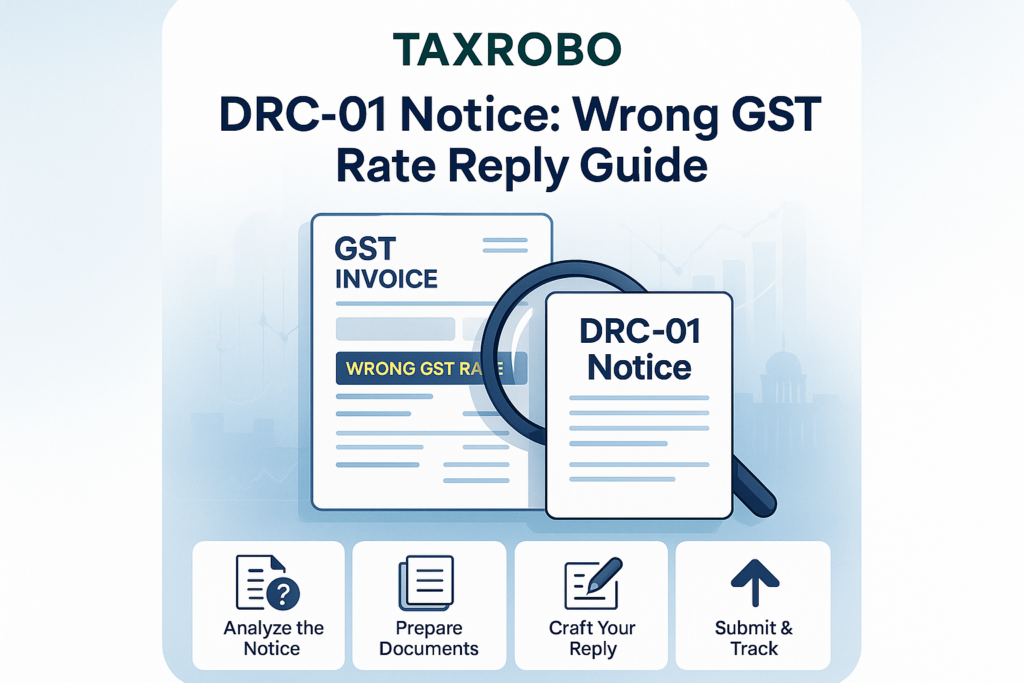
The moment you receive a DRC-01, the first action is to stay calm and carefully read the entire document. Do not jump to conclusions or immediately assume the worst. A thorough analysis is the foundation of a strong reply. Create a checklist to verify all the basic details mentioned in the notice, as any discrepancy here could be a preliminary point of defence.
- Check Basic Details: Verify your business name, GSTIN, and address.
- Note Key Information: Record the notice reference number (SCN number), the date of issue, and the specific tax period(s) under scrutiny.
- Understand the Allegation: Pinpoint the exact reason for the notice. In this case, it would be the alleged application of the wrong GST rate. The notice will detail the rate the officer believes is correct versus the rate you applied.
- Quantify the Demand: Carefully note down the proposed demand, which is typically broken down into three components:
- The differential tax amount.
- The calculated interest on this tax.
- The proposed penalty under the relevant section (73 or 74).
Step 2: Collate All Supporting Documents
Once you understand the notice, the next step is to gather all the evidence that supports your position. Your reply will be significantly weaker without proper documentation to back up your claims. This is your opportunity to build a fact-based case that can counter the officer’s allegations. The more robust your documentation, the higher the chance of a favorable outcome.
Here is a list of documents you should gather:
- Invoices: Copies of the tax invoices related to the transactions mentioned in the notice.
- Tax Worksheets: Your internal tax computation sheets or records showing how you arrived at the classification and tax rate.
- Contracts and Agreements: Any agreements with your clients that describe the nature of the goods or services supplied.
- HSN/SAC Justification: Any research, industry precedents, or expert opinions you relied on for HSN/SAC classification.
- Official Publications: Download and keep copies of any CBIC circulars, notifications, or advance rulings that support your tax rate decision. You can check the latest rates on the official CBIC GST Rate Finder website.
- Previous Communications: Any prior correspondence with the GST department on the same or a similar issue.
Step 3: Drafting the Perfect Response (The Reply Format)
Drafting the reply is the most critical step. The document should be formal, professional, and structured logically. Using a clear DRC-01 notice reply format ensures that the officer can easily understand your arguments and the evidence you are presenting. Avoid emotional language and stick to the facts and legal provisions.
Here is a section-by-section template for your reply:
1. Header:
- Use your official company letterhead.
- Include your Company Name, Registered Address, and GSTIN.
- Date the reply.
2. Addressee:
- To,
- The Designation of the Issuing Officer (e.g., The Assistant Commissioner of State Tax)
- Address of the Officer’s Division/Circle.
3. Reference:
- Ref: Your Reply to Show Cause Notice No. [Enter SCN Number] dated [Enter Date of Notice].
4. Subject:
- Subject: Reply to Show Cause Notice (SCN) regarding alleged short payment of GST for the period [e.g., April 2022 to March 2023].
5. Introduction:
- Start by acknowledging the receipt of the notice. For example: “Dear Sir/Madam, This is with reference to the Show Cause Notice (SCN) cited above, issued to us under Section [73/74] of the CGST Act, 2017. We have carefully reviewed the contents of the notice and are submitting our point-wise reply as follows.”
6. Facts of the Case (Your Version):
- Briefly state the nature of your business and the specific transactions under scrutiny. Present your understanding of the facts clearly and chronologically. This section sets the context for your arguments.
7. Point-wise Reply to Allegations:
- This is the core of your reply. Address each allegation from the SCN one by one. Use numbered paragraphs for clarity.
- For a wrong GST rate notice, your response could look like this:
- “Para 1: The notice alleges that we have short-paid GST by applying a rate of 12% instead of the applicable rate of 18% on the supply of [describe the goods/service].”
- “Para 2: Our Justification: We humbly submit that the rate of 12% was correctly applied. Our product, [Product Name], is correctly classifiable under HSN Code [XXXXXX]. As per Notification No. [XX/XXXX-Central Tax (Rate)] dated [Date], goods falling under this HSN are subject to a GST rate of 12%. We have attached a technical datasheet of the product and a copy of the said notification for your kind perusal.”
8. Legal Submissions:
- Strengthen your arguments by citing relevant legal provisions. Quote sections from the CGST Act, IGST Act, relevant rules, circulars, or even judgments from courts or advance ruling authorities that support your classification and rate application.
9. Conclusion & Prayer:
- Summarize your case in a concluding paragraph.
- Formally request the officer to drop the proceedings. For example: “In light of the facts, documentary evidence, and legal submissions presented above, we humbly request your good office to consider our reply and drop the proceedings initiated vide the aforementioned Show Cause Notice. We reiterate that there was no intention to evade tax.”
- If you agree with a portion of the demand, state that you have made the payment via Form DRC-03 and are only contesting the remaining amount.
Step 4: Filing the Reply on the GST Portal
After drafting and signing the reply, you must file it officially through the GST Portal. This is a crucial part of the DRC-01 notice procedure India. Simply sending a physical copy is not sufficient.
Follow these steps:
- Log in to the GST Portal using your credentials.
- Navigate to the dashboard and go to Services > User Services > View Additional Notices/Orders.
- You will see a list of notices issued to you. Find the relevant DRC-01 notice by its reference number and click on the ‘View’ link.
- Inside the notice details, you will find an option to ‘Reply’. Click on it.
- You will be taken to a reply page where you can type a brief response in the text box. It’s best to write “Detailed reply attached.”
- Use the ‘Attachments’ section to upload your comprehensive reply (which you drafted in Step 3) in PDF format. Also, upload all the supporting documents as a single, compiled PDF or multiple files.
- Once uploaded, submit the response using either a Digital Signature Certificate (DSC) or an Electronic Verification Code (EVC).
Key Guidelines for Businesses Responding to a DRC-01 Notice
Navigating a GST notice successfully goes beyond just filing a reply. Adhering to certain best practices can significantly impact the outcome. These DRC-01 notice guidelines for businesses are designed to help you manage the process professionally and minimize potential negative consequences. Properly complying with DRC-01 notice requirements involves timeliness, accuracy, and a strategic approach to communication with the tax authorities.
- Timeliness is Crucial: The DRC-01 notice will specify a deadline for your reply, which is usually 30 days. It is absolutely critical to adhere to this timeline. Failing to respond on time can lead the officer to issue an ex-parte order, which means they will pass the final demand order based solely on the information they have, without considering your side of the story. This almost always results in the confirmation of the full tax demand, penalty, and interest.
- Be Factual and Objective: Your reply should be based on facts, figures, and legal provisions. Avoid making emotional appeals or vague, unsubstantiated claims. Every argument you make should be backed by corresponding evidence, such as an invoice, a contract, or a legal circular. A clear, logical, and evidence-based response is far more persuasive to a tax officer than a poorly structured, emotional one.
- Consider Voluntary Payment via DRC-03: After analyzing the notice, if you find that the officer’s claim is partially or fully correct, it is often advisable to pay the accepted tax amount voluntarily. You can do this using Form GST DRC-03 on the GST portal. Making a voluntary payment, especially in non-fraud (Section 73) cases, can lead to a waiver or significant reduction in penalties. After payment, you must inform the officer about it in your reply.
- Seek Professional Help: GST laws and classifications are complex and subject to interpretation. Drafting a legally sound
wrong GST rate notice responsecan be challenging. For a robust and legally sound reply, it’s always advisable to consult with experts. TaxRobo’s team can help you navigate GST notices and ensure full compliance. A tax professional can identify the strengths and weaknesses of your case, cite relevant case laws, and represent you during personal hearings, greatly improving your chances of a favorable outcome.
Conclusion: Proactive Compliance is Your Best Defence
Facing a DRC-01 notice can be daunting, but with a systematic approach, it is a manageable process. The key is to carefully analyze the notice, collate all necessary documents, draft a clear and factual response using a structured DRC-01 notice reply format, and file it on the GST portal before the deadline. Remember that this notice is an opportunity to present your case and resolve discrepancies. A well-prepared reply can lead to the proceedings being dropped entirely or a significant reduction in the final demand.
Ultimately, the best way to handle such notices is to prevent them from being issued in the first place. Proactive GST compliance, which includes conducting regular reviews of your HSN/SAC classifications, staying updated on changes in GST rates and notifications, and performing periodic internal reconciliations, is your strongest defense. A key part of this is knowing How to Avoid Common Pitfalls Leading to GST Demand Notices. Don’t let a GST notice disrupt your business. If you need assistance drafting a professional reply or managing your GST compliance, contact the experts at TaxRobo today for a hassle-free experience.
Frequently Asked Questions (FAQ)
Q1: What is the time limit to reply to a DRC-01 notice in India?
Answer: The taxpayer is generally given 30 days from the date of receipt of the notice to file a reply. However, this period can vary, so you should always check the specific deadline mentioned in the notice you have received. If you need more time, you can request an extension from the officer, but granting it is at their discretion.
Q2: Can I pay the tax demand voluntarily without filing a detailed reply?
Answer: Yes. If you agree with the tax and interest calculated by the officer, you can make the payment using Form GST DRC-03 on the GST portal. After making the payment, you should still inform the proper officer in writing (a simple letter or via the portal’s reply function) that the payment has been made. This will typically lead to the conclusion of the proceedings without any penalty, especially in non-fraud cases under Section 73.
Q3: What happens if I ignore or fail to respond to a DRC-01 notice?
Answer: Ignoring a DRC-01 notice has serious consequences. If you fail to respond within the stipulated time, the GST officer has the authority to pass an order based on the information available to them. This is known as an ex-parte order. This order will confirm the tax demand, interest, and maximum applicable penalty, and the department will then initiate recovery proceedings to collect the amount from you, which can include freezing bank accounts.
Q4: Do I need a Chartered Accountant (CA) to prepare the DRC-01 notice reply format?
Answer: While it is not legally mandatory for you to hire a professional to draft the reply, it is highly recommended. A CA or a tax lawyer possesses deep knowledge of GST law and procedures. They can correctly interpret the legal nuances of the notice, build a stronger case with proper legal citations and precedents, and ensure your wrong GST rate notice response is correctly formatted and filed. Professional assistance significantly minimizes the risk of an adverse order and can save you money in the long run.