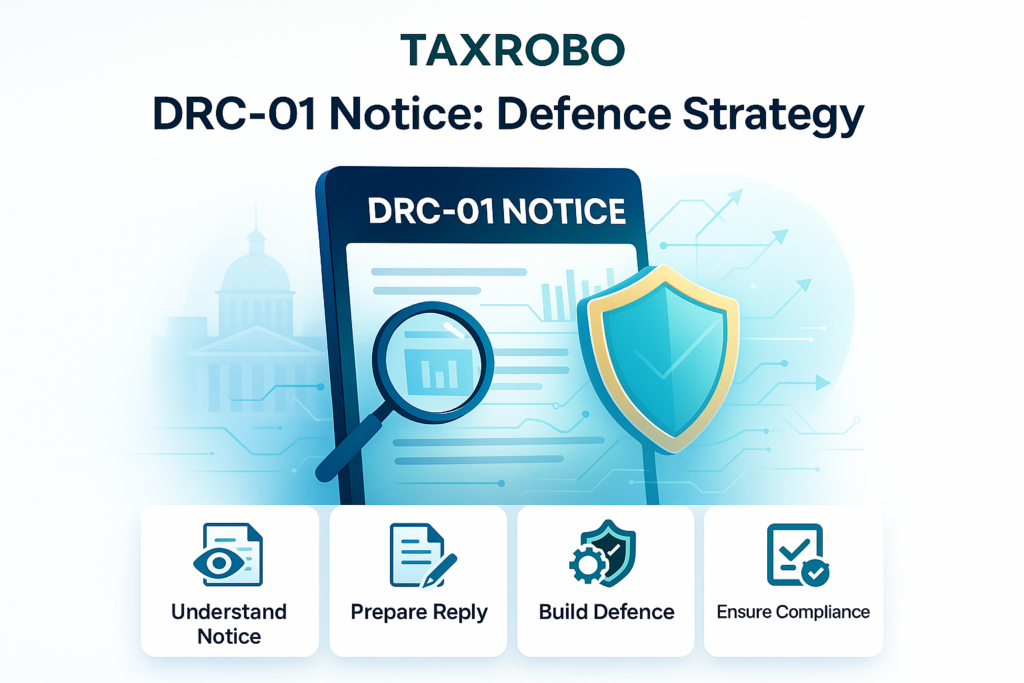

DRC-01 Notice for Excess ITC Claim – Reply Format & Defence Strategy
Receiving a notice from the GST department can be alarming for any business owner. One of the most common notices is Form DRC-01, often issued for alleged excess claims of Input Tax Credit (ITC). Seeing a demand for tax, interest, and penalties can be stressful, but with the right information and a clear plan, you can handle it effectively. The key lies in having a well-prepared DRC-01 notice reply strategy. This complete guide is designed to walk you through understanding the notice, preparing your documents, and drafting a robust response to defend your claim. We will break down the process step-by-step, providing you with the knowledge to navigate this challenge confidently and protect your business from unnecessary liabilities.
Understanding the DRC-01 Notice for ITC Claims
Before you can formulate a response, it’s crucial to understand exactly what a DRC-01 notice is and why you received it. This notice is not a final demand but a ‘Show Cause Notice’ (SCN), which means it’s an opportunity for you to present your side of the story with facts and evidence. A proper understanding of its components is the first step in your DRC-01 notice reply strategy India. It allows you to pinpoint the department’s exact concerns and build a targeted defence based on the specific allegations raised against your business, ensuring you address the core issues directly rather than providing a generic response.
What is Form DRC-01?
Form GST DRC-01 is an electronic summary of a Show Cause Notice issued by a GST officer. It is sent when the officer believes there is a discrepancy in the tax you have paid, leading to a short payment, non-payment, or an erroneous refund. For most businesses, it relates to a mismatch in the Input Tax Credit (ITC) claimed.
This notice is typically issued under one of two key sections of the CGST Act, 2017:
- Section 73: This is invoked in cases where the tax discrepancy is not due to fraud, willful misstatement, or suppression of facts. These are considered genuine errors, and the penalties are less severe.
- Section 74: This section is used for cases where the officer has reason to believe the tax was evaded through fraud, willful misstatement, or suppression of facts. The penalties under this section are significantly higher, reaching up to 100% of the tax amount.
Common Reasons for Receiving a DRC-01 for Excess ITC
The GST system is built on a complex web of interconnected returns, and a small error at any stage can trigger a notice. Here are the most common reasons a business might receive a DRC-01 for an excess ITC claim:
- GSTR-3B vs. GSTR-2B Mismatch: This is the most frequent trigger. The ITC you claimed in your summary return (GSTR-3B) is higher than the credit appearing as available in your auto-populated purchase register (GSTR-2B).
- Supplier Non-Compliance: Your supplier may have failed to file their GSTR-1 on time, entered your GSTIN incorrectly, or reported the invoice in the wrong tax period, causing the credit to not reflect in your GSTR-2B.
- Typographical or Clerical Errors: A simple data entry mistake while filing your GSTR-1 or GSTR-3B, such as adding an extra zero to an ITC figure, can lead to a significant discrepancy.
- Claiming Ineligible ITC: You may have inadvertently claimed ITC on goods or services that are blocked under Section 17(5) of the CGST Act (e.g., motor vehicles for certain uses, food and beverages, club memberships).
- Duplicate ITC Claims: Accidentally claiming ITC on the same invoice in two different tax periods is another common error that the system flags.
How to Read and Interpret the Notice
A DRC-01 notice contains specific details that you must carefully analyze. Breaking it down helps you understand the allegation and prepare your defence:
- DIN (Document Identification Number): This is a unique number for every communication from the GST department. Your first step should always be to verify its authenticity on the official GST Portal to ensure it’s a genuine notice.
- Allegations: This section details the specific reasons and legal provisions under which the notice is issued. It will clearly state why the department believes you have claimed excess ITC, often pointing to a specific mismatch between returns.
- Quantification: The notice will provide a detailed calculation of the disputed amount, broken down into the tax liability, the applicable interest calculated to date, and the penalty that is being proposed.
- Deadline: This is a critical piece of information. The notice will specify the date by which you must submit your written response. Missing this deadline can have serious consequences.
Immediate Steps to Address a DRC-01 Notice
Once you have received and verified the notice, it’s time to act. A systematic and calm approach is essential. Ignoring the notice or delaying your response can complicate the matter and may lead the officer to assume the allegations are correct. The following steps to address DRC-01 notice provide a clear and actionable checklist to ensure you start on the right foot.
Step 1: Don’t Panic – Verify the Notice
The initial reaction to any government notice is often panic. However, it’s crucial to remain calm and methodical. Do not ignore the notice or set it aside for later. The very first action should be to confirm that the notice is legitimate. Go to the official GST Portal, navigate to the ‘Services’ tab, then ‘User Services’, and select ‘Verify RFN/Notice Order’. Enter the DIN from your notice to confirm its authenticity.
Step 2: Acknowledge and Note the Deadline
Once verified, carefully read the entire notice and pay close attention to the deadline for submission of your reply, which is typically 30 days. Mark this date in your calendar and set reminders. Acknowledge the notice internally within your organization and assign the responsibility of preparing the reply to a specific person or team to ensure accountability and timely action.
Step 3: Gather All Necessary Documents
A strong reply is built on strong evidence. Before you begin drafting your response, you need to collect all the relevant documents to support your case. A comprehensive document file will be your best asset. Create a checklist and gather the following:
- A clear copy of the DRC-01 Notice and any accompanying attachments.
- Your GSTR-3B, GSTR-1, GSTR-2A, and GSTR-2B returns for the disputed tax period(s).
- All purchase invoices and bills that correspond to the ITC being questioned.
- Supporting proof of transaction, such as e-way bills, delivery challans, and goods receipt notes (GRNs) to prove the movement and receipt of goods/services.
- Bank statements or payment receipts showing that you have made the payment to the supplier for the said invoices.
- Any communication records with your supplier (emails, letters) where you may have asked them to correct their GSTR-1 filings.
Developing a Winning Defence Strategy for a DRC-01 Notice
With your documents in hand, you can now move to the core of your response: building a solid defence. This is the most critical part of your DRC-01 notice reply strategy. A generic denial will not be effective. You need to conduct a thorough internal review, identify the precise reason for the discrepancy, and build a logical, evidence-backed argument to counter the department’s allegations. A well-structured defence strategy can often lead to the proceedings being dropped entirely.
Perform a Thorough Internal Reconciliation
The first step in your defence is to conduct a detailed reconciliation of your own records. You need to compare the ITC you claimed in your GSTR-3B with the data available in your GSTR-2B for the period in question, invoice by invoice. This exercise will help you pinpoint the exact transactions that have caused the mismatch flagged by the department.
Here is a simple reconciliation table you can use:
| Invoice No. | Invoice Date | Supplier GSTIN | Taxable Value | IGST/CGST+SGST in Invoice | ITC in GSTR-2B | ITC in GSTR-3B | Difference |
|---|---|---|---|---|---|---|---|
| INV-001 | 01-Apr-2023 | 29ABCDE1234F1Z5 | ₹10,000 | ₹1,800 | ₹1,800 | ₹1,800 | ₹0 |
| INV-002 | 05-Apr-2023 | 27FGHIJ5678K1Z4 | ₹20,000 | ₹3,600 | ₹0 | ₹3,600 | ₹3,600 |
| INV-003 | 15-Apr-2023 | 24LMNOP9101Q1Z3 | ₹5,000 | ₹900 | ₹900 | ₹90 | -₹810 |
This table immediately highlights that the issue lies with INV-002 (not in GSTR-2B) and INV-003 (clerical error in GSTR-3B).
Identify the Root Cause of the Mismatch
Once your reconciliation is complete, you can identify the root cause for each discrepancy. The defence strategy for a DRC-01 notice will vary depending on the reason.
- Case 1: Supplier’s Error (e.g., late filing, wrong GSTIN)
Root Cause: Your supplier did not upload INV-002 to their GSTR-1 on time. However, you have received the goods, possess a valid tax invoice, and have paid the supplier.
Defence Strategy: Your claim is legitimate. In your reply, state that all conditions of Section 16(2) of the CGST Act are met. Provide a complete trail of documents as proof: the tax invoice, the e-way bill, the goods receipt note, and the bank statement showing payment. Also, include any email communication where you requested the supplier to correct their return. Argue that a procedural lapse by the supplier should not invalidate your substantive right to ITC. - Case 2: Your Clerical Error
Root Cause: You made a typographical error while filing GSTR-3B for INV-003, claiming ₹90 instead of the eligible ₹900. In another scenario, you might have claimed ₹9,000 by mistake. Let’s assume you over-claimed.
Defence Strategy: Honesty is the best policy here. Acknowledge the error in your reply. State that it was an inadvertent clerical mistake without any intention to evade tax. Immediately pay the differential tax (₹810 in this example) along with applicable interest using Form GST DRC-03. Attach the challan for this payment to your reply. This proactive step demonstrates good faith and can significantly reduce or even waive the proposed penalty under Section 73. - Case 3: Legitimate Claim Not Reflecting in GSTR-2B
Root Cause: The ITC relates to items like reverse charge mechanism (RCM) liabilities or specific transactions like import of goods, which are valid claims but may not appear in GSTR-2B in the same way as regular B2B invoices.
Defence Strategy: This requires a more technical legal response to DRC-01 notice India. Clearly explain the nature of the transaction. Cite the relevant legal provisions (e.g., Section 9(3) for RCM) that entitle you to the ITC. Provide all supporting documents, such as self-invoices for RCM, bills of entry for imports, and proof of tax payment on these transactions. A well-reasoned explanation backed by law and documents will validate your claim.
The Official DRC-01 Notice Reply Format for Businesses
After developing your defence strategy and gathering all evidence, the final step is to draft and submit your official response. The way you structure your reply is just as important as the content itself. A clear, professional, and point-by-point response makes it easier for the officer to understand your position. The excess ITC claim response format India should be formal and must address every single allegation made in the notice.
Structuring Your Written Submission
Your reply should be drafted on your company’s official letterhead and should follow a logical structure. Here is a recommended DRC-01 notice reply format for businesses:
- Header: Your company letterhead with your GSTIN, address, and contact details. Include the date and the recipient’s details (the designation and address of the issuing authority).
- Subject Line: Be precise. For example: “Reply to Show Cause Notice – Reference No. [Your SCN Reference Number] dated [Date of Notice]”.
- Introduction: Begin by acknowledging the receipt of the SCN. Clearly state the notice reference number, DIN, and the date of receipt.
- Facts of the Case: Briefly introduce your business and its activities. Mention your track record of being a compliant taxpayer if applicable. This sets a positive tone.
- Point-by-Point Rebuttal: This is the heart of your reply. Do not write a long, narrative paragraph. Instead, address each allegation from the DRC-01 notice one by one. Use a table or numbered paragraphs.
- Allegation 1: State the allegation exactly as mentioned in the notice.
- Our Submission/Reply: Present your counter-argument clearly and concisely.
- Supporting Evidence: Reference the specific documents you have attached to prove your point (e.g., “A copy of the valid tax invoice is attached as Annexure A,” or “Proof of payment is attached as Annexure B”).
- Legal Arguments: After the factual rebuttal, cite the relevant sections of the CGST Act, 2017, rules, or any relevant circulars and case laws that support your position. This adds legal weight to your arguments.
- Conclusion & Prayer: Summarize your stance. If you believe the claims are invalid, state that the ITC was correctly claimed and that all conditions have been met. Formally request the officer to review your submission and the attached evidence and to drop the proceedings initiated by the SCN.
How to Submit the Reply on the GST Portal
The reply and supporting documents must be submitted electronically through the GST portal. Follow these steps:
- Log in to the official GST Portal with your credentials.
- Navigate to Services > User Services > View Additional Notices/Orders.
- Find the relevant notice and click on the ‘Reply’ link.
- You can draft your reply directly in the provided text box for a brief response. For a detailed submission as structured above, it is highly recommended to upload the reply as a PDF file.
- Click on the ‘Upload’ button to attach your detailed written submission and all supporting documents (invoices, bank statements, etc.) as annexures.
- Once all files are uploaded, submit the reply using either a Digital Signature Certificate (DSC) or an Electronic Verification Code (EVC).
- Save the submission acknowledgement for your records.
Conclusion
Facing a DRC-01 notice can be a daunting experience, but it is a manageable one. The key is to be methodical, proactive, and thorough. By following a clear process—verifying the notice, gathering all necessary documents, performing a detailed internal reconciliation, and drafting a comprehensive, evidence-backed reply—you can effectively defend your position. Remember that a well-documented and professionally drafted response is the cornerstone of a successful DRC-01 notice reply strategy. Ignoring the notice is the worst possible course of action, as it can lead to confirmed demands and harsh recovery proceedings.
Navigating GST notices can be complex, and the stakes are often high. If you feel overwhelmed or need expert assistance in drafting a professional and legally sound response to a DRC-01 notice, don’t hesitate. Contact the GST experts at TaxRobo today for a consultation and ensure your case is presented in the strongest possible way.
Frequently Asked Questions (FAQ) Section
1. What is the time limit to reply to a DRC-01 notice?
The typical time limit to submit your reply to a DRC-01 notice is 30 days from the date of its issuance. However, you should always verify the specific deadline mentioned in the notice you have received. If you have a genuine reason and require more time to gather documents, you can submit a written request for an extension to the issuing authority.
2. What happens if I don’t respond to the DRC-01 notice?
If you fail to respond to the DRC-01 notice within the stipulated time, the GST officer will assume that you have nothing to say in your defence. They may then proceed to issue an order based on the information available to them (known as an ex-parte order). This order will confirm the demand for tax, interest, and the proposed penalty against you, which can subsequently lead to recovery proceedings.
3. Can I just pay the tax amount mentioned in the notice to close it?
Yes, you can. If you agree with the discrepancy pointed out in the notice, you can pay the demanded tax and the applicable interest using Form GST DRC-03. If you make this payment within 30 days of the issuance of the SCN, you may be eligible for a reduced penalty (in Section 74 cases) or a complete waiver of the penalty (in Section 73 cases). This is often a prudent choice if the error is on your part.
4. Do I need a Chartered Accountant (CA) or a lawyer to reply to a DRC-01 notice?
While it is not legally mandatory for you to hire a professional, it is highly recommended. A qualified CA or tax lawyer has the expertise to interpret the legal nuances of the notice, structure a legally sound defence, and ensure all your documents are presented correctly. Their involvement significantly increases the chances of a favourable outcome and can save you from higher penalties and prolonged litigation.