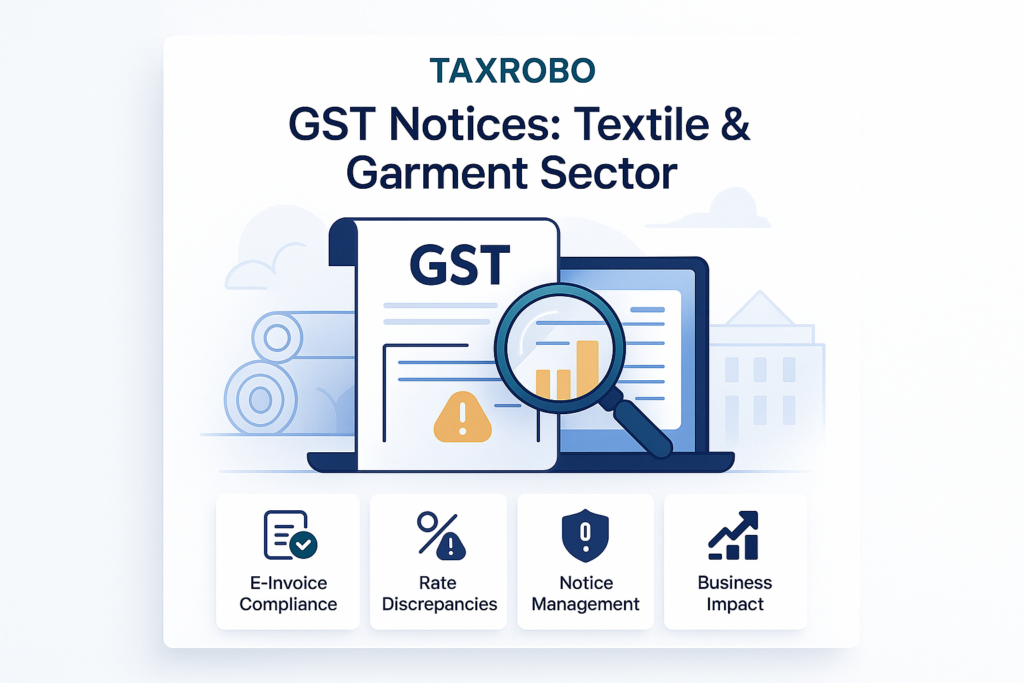

GST Notice for Textile & Garment Business – E-Invoice & Rate Issues
You’re running a busy textile or garment business, managing everything from sourcing fabric to shipping final products. Then, a formal envelope arrives. It’s a notice from the GST department. Panic sets in. What went wrong? What do you do next? If this scenario sounds familiar, you’re not alone. The textile sector, with its complex supply chain, varied product classifications, and recent e-invoicing mandates, is under constant GST scrutiny. This article aims to demystify why you might receive a GST notice textile business owners often dread, focusing on common e-invoice and rate-related issues. More importantly, it provides a clear roadmap for responding correctly and confidently.
Why the Textile and Garment Sector is on the GST Radar
Before diving into the specifics of e-invoicing and rate issues, it’s helpful to understand the common red flags that attract the attention of GST authorities. The department’s systems are designed to spot discrepancies automatically, and the textile industry’s inherent complexities often trigger these alerts. Understanding these triggers is the first step towards better compliance and avoiding notices altogether.
Common Triggers for a GST Notice
- Mismatch in Returns: This is one of the most frequent reasons. A notice may be issued if the sales you declared in your GSTR-1 (outward supplies statement) do not match the summary figures and tax paid in your GSTR-3B.
- Input Tax Credit (ITC) Errors: The GST system automatically cross-references the ITC you claim in your GSTR-3B with the data available in your GSTR-2A/2B (auto-populated from your suppliers’ GSTR-1 filings). Any mismatch here is a major trigger for scrutiny.
- E-Way Bill & E-Invoice Discrepancies: The tax department compares data from e-way bills (for goods movement) and e-invoices with the information filed in your GST returns. Significant differences in value or quantity can lead to a notice.
- Incorrect HSN/SAC Codes: The textile industry deals with a vast range of products—from different types of yarn and fabric to finished apparel with embroidery or embellishments. Using an incorrect HSN code can lead to applying the wrong tax rate, a mistake that the department is quick to question.
Decoding the E-Invoice Challenge for the Textile Industry
The introduction of e-invoicing was a major step towards formalizing the economy, but it has added a layer of complexity for many businesses. For the textile sector, which often involves numerous B2B transactions across the supply chain, getting e-invoicing right is critical for compliance. Failure to do so is a direct invitation for a GST notice textile business owners want to avoid.
What is E-Invoicing and Who Must Comply?
E-invoicing, or electronic invoicing, is a system where all B2B (business-to-business) invoices are electronically uploaded and authenticated by the Goods and Services Tax Network (GSTN) in real-time. Once an invoice is uploaded to the Invoice Registration Portal (IRP), it generates a unique Invoice Reference Number (IRN) and a digitally signed QR code. This IRN must be printed on the final invoice shared with the buyer.
Mandatory e-invoicing applies to businesses with an aggregate annual turnover exceeding a specific threshold in any preceding financial year from 2017-18 onwards. The threshold has been progressively reduced, bringing more businesses into its ambit.
Actionable Tip: The turnover limits are subject to change. It’s crucial to stay updated by checking the latest notifications on the official GST E-Invoice System.
Common E-Invoicing Mistakes Leading to a GST Notice
The stringent, real-time nature of e-invoicing leaves little room for error. The most common mistakes that can trigger a notice include:
- Failure to Generate IRN: The most significant error is not generating an IRN for a B2B transaction when you are legally required to. An invoice without a valid IRN is considered an invalid document, meaning your buyer cannot claim ITC, and you may face penalties.
- Errors in Invoice Details: Simple mistakes in the buyer’s GSTIN, incorrect HSN codes for fabrics or garments, or discrepancies in the taxable value can cause mismatches in the GST system, leading to scrutiny.
- Incorrect Amendment or Cancellation: E-invoices cannot be partially amended. If a mistake is made, the e-invoice must be cancelled on the IRP within 24 hours and a new one generated. After 24 hours, any changes must be made via a debit or credit note, which also needs an IRN. Improper handling of cancellations and amendments is a common issue.
Mastering compliance with the e-invoice textile industry India regulations is no longer optional; it’s a fundamental requirement for smooth business operations.
Navigating GST Rate Issues in the Textile Sector
Beyond procedural issues like e-invoicing, the very core of GST compliance—applying the correct tax rate—is a significant challenge in the textile industry. With different rates for different products and values, confusion is common, making it a hotspot for departmental inquiries.
Understanding the GST Rate Structure for Textiles
The GST Council has implemented different tax slabs for textile and garment products to balance tax collection and affordability. The primary rates are 5% and 12%. Understanding which rate applies where is crucial:
- Raw Materials: Cotton fibres, yarn, and fabrics are generally taxed at 5%.
- Finished Goods (Apparel): A key distinction was previously based on the sale value. Garments with a sale value below ₹1,000 attracted 5% GST, while those priced above ₹1,000 were taxed at 12%. While rate changes are considered by the GST Council, this value-based distinction has been a historical point of complexity.
- Other Textile Products: Items like readymade garments, blankets, bedsheets, and other textile-made-ups are also subject to this rate structure.
Why Rate Discrepancies Trigger Notices
Given the complexities, it’s easy to make mistakes that lead to a notice. These are some of the most critical garment business GST issues India faces:
- Applying a Lower Rate Incorrectly: The most common error is charging 5% GST on a finished garment that should be taxed at 12% due to its sale value or classification. This directly results in a short payment of tax, which the department will seek to recover with interest and penalties.
- Incorrect Classification of Supply: Businesses sometimes sell festive gift packs that include a garment along with other items like sweets or accessories. This can be classified as a “composite supply” or a “mixed supply.” A composite supply is taxed at the rate of the principal item (the garment), while a mixed supply is taxed at the highest rate applicable to any of the items in the bundle. Misclassifying this can lead to underpayment of tax.
- HSN Code Mismatches: Using an HSN code that corresponds to a 5% GST rate for a product that should fall under a 12% code is a direct trigger for a notice.
Properly addressing these GST rate issues textile sector India is essential for maintaining a clean compliance record.
Your Action Plan: How to Respond to a GST Show Cause Notice: A Step-by-Step Guide
Receiving a GST notice can be stressful, but a calm, methodical approach is key. Ignoring it is not an option and will only lead to more severe consequences. Here is a step-by-step guide to handling a notice effectively.
Step 1: Don’t Ignore It – Analyze the Notice
First, take a deep breath and read the notice carefully. Verify its authenticity by checking the Document Identification Number (DIN) on the GST portal. Identify the following key details:
- The specific issue raised: Is it an ITC mismatch, an e-invoicing error, or a rate discrepancy?
- The tax period in question.
- The deadline for your response.
Step 2: Reconcile Your Records and Gather Documents
Once you understand the query, start gathering all relevant documents to prepare your defense. This includes:
- Copies of your GSTR-1 and GSTR-3B for the period.
- Your sales and purchase ledgers.
- Copies of the specific tax invoices, e-invoices with IRNs, and e-way bills mentioned in the notice.
- Any correspondence with suppliers or buyers related to the transactions in question.
- Bank statements to prove payments.
Step 3: Draft a Factual and Point-by-Point Reply
Your response should be professional, factual, and directly address the points raised in the notice. Avoid vague explanations.
- Structure your reply point-by-point: Address each allegation or query from the notice separately.
- Provide a clear explanation: If there was a genuine error, admit it and explain the circumstances. If you believe the department’s understanding is incorrect, state your case clearly.
- Attach supporting evidence: Refer to the documents you gathered in Step 2. For instance, if the notice is about an ITC mismatch, provide a reconciliation statement with invoice copies from your supplier.
Step 4: Submit and Seek Professional Help
Submit your reply with all supporting documents through the GST portal before the deadline. While you can handle this yourself, navigating the complexities of GST law requires expertise. An incorrect or incomplete reply can worsen the situation. This is where professional help becomes invaluable for ensuring robust textile industry compliance India.
Call-to-Action: Consulting a tax expert is highly recommended. Professionals can help you draft a legally sound reply, represent your case before the authorities, and minimize potential liabilities. The team at TaxRobo has extensive experience in handling such matters.
Conclusion
The textile and garment industry faces unique GST challenges, from the technical demands of e-invoicing to the nuances of rate structures. Proactive reconciliation, accurate reporting, and maintaining meticulous records are your best defense against scrutiny. However, notices can still happen. The key is not to panic. A timely, well-documented, and professionally crafted response to a GST notice textile business receives can resolve the issue efficiently, preventing penalties and further legal complications. Don’t let a notice derail your focus from what you do best—running your business.
Received a GST notice? Don’t let it disrupt your business. The experts at TaxRobo specialize in GST compliance and litigation support for the textile industry. Contact us today for a consultation and handle your GST matters with confidence.
Frequently Asked Questions (FAQs)
Q: What is the penalty for not issuing an e-invoice when it’s mandatory?
A: Failure to issue an e-invoice is a serious non-compliance. The penalty is 100% of the tax due or ₹10,000, whichever is higher, for each such invoice. Additionally, a general penalty of up to ₹25,000 can be levied for any incorrect invoice.
Q: Can I file a revised GST return to correct a mistake after receiving a notice?
A: No, GST law does not permit the revision of filed returns (GSTR-1 or GSTR-3B). You can, however, make corrections for any errors or omissions in the returns of a subsequent tax period. But when you receive a notice, simply correcting it in a future return is not enough; you must submit a formal, detailed reply addressing the specific discrepancies pointed out in the notice.
Q: How do I find the correct HSN code for my garment products?
A: You can use the HSN code search tool available on the GST portal. For detailed classification rules and rates, you can refer to the rate schedules on the CBIC’s GST website. Given the complexity, if you are ever in doubt, it is highly advisable to consult a tax professional to ensure you are using the correct code and avoiding potential misclassification issues.
Q: How much time do I get to reply to a GST notice?
A: The time limit to respond will be clearly specified in the notice itself. Typically, this ranges from 7 to 30 days, depending on the nature and severity of the issue raised. It is absolutely crucial to adhere to this deadline, as failure to do so can lead to an ex-parte order (an order passed without hearing your side) and further penalties.