
GST Notice for Manufacturing Companies – ITC Mismatch & Stock Differences
Receiving an official-looking envelope from the GST department can send a shiver down the spine of any business owner. It’s a moment filled with uncertainty and questions. However, before you panic, it’s important to understand that a notice is often just a request for more information or clarification. For manufacturers in India, two of the most frequent triggers for such communications are Input Tax Credit (ITC) mismatches and discrepancies in stock records. A timely and correct response to an ITC mismatch notice manufacturing businesses receive is absolutely crucial for maintaining good GST compliance, avoiding hefty penalties, and ensuring smooth operations. This guide will break down exactly why these notices are issued and provide a clear, step-by-step approach to handle them effectively.
Why Manufacturing Companies Are Under the GST Scanner
The manufacturing sector is the backbone of the economy, but its operational complexity also makes it a key area of focus for GST authorities. The multi-stage process of converting raw materials into finished goods involves a high volume of transactions, which naturally increases the potential for errors and discrepancies.
Understanding the Complexities of GST Compliance for Manufacturers India
A typical manufacturing process under GST involves a continuous flow of goods and services. It begins with the procurement of raw materials (inputs), moves through a work-in-progress (WIP) phase, and concludes with the sale of finished goods. At each stage, GST is applicable, and correctly claiming Input Tax Credit on purchases is vital to manage production costs and maintain healthy cash flow. This intricate chain of transactions, involving numerous vendors and customers, creates multiple data points that must be perfectly aligned in your GST returns. Even a small error can cascade through the system, creating a mismatch that flags your business for scrutiny by the tax department. This high transaction volume, coupled with the critical role of ITC, makes robust GST compliance for manufacturers India a non-negotiable aspect of business management.
Common Triggers for a Notice Alert for Manufacturing Firms
While the reasons can be varied, most GST notices sent to manufacturers stem from data mismatches detected by the department’s sophisticated analytical tools. Being aware of these triggers can help you stay one step ahead.
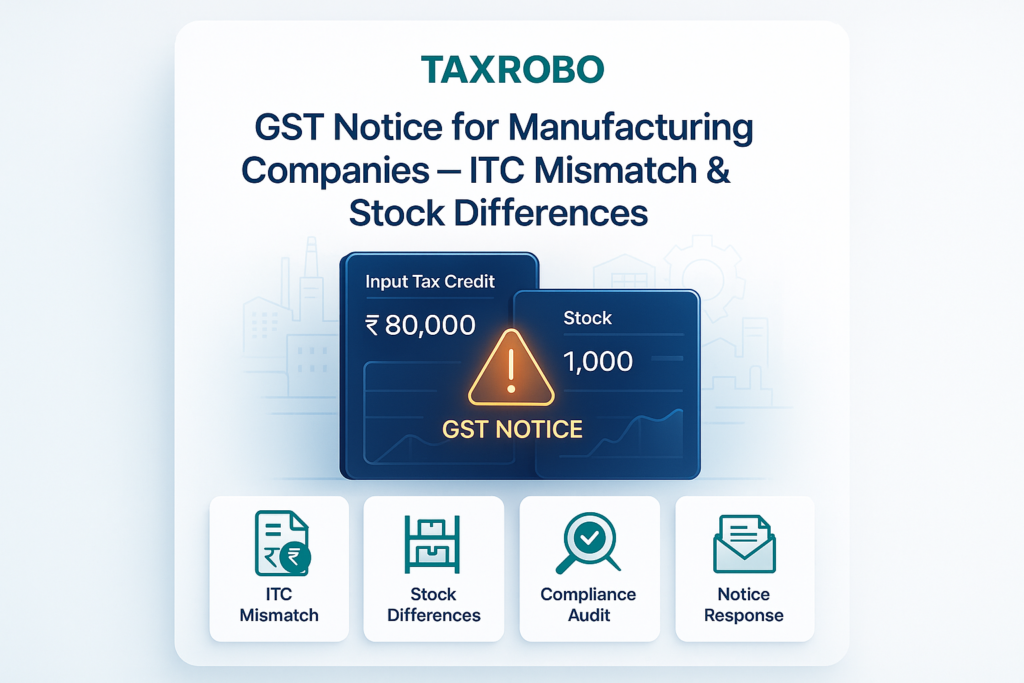
- ITC Mismatch: This is the most common reason. It’s a discrepancy between the ITC you claimed in your GSTR-3B return and the details of your inward supplies auto-populated in your GSTR-2B.
- Stock Discrepancy: A mismatch found between the stock declared in your books of accounts and the physical stock verified during a departmental audit or inspection.
- E-way Bill vs. GSTR-1 Mismatch: Discrepancies between the value of goods transported (as per e-way bills) and the sales reported in your GSTR-1 return can suggest under-reporting of sales.
- Unusual ITC Claims: A sudden, significant spike in your ITC claim compared to previous months without a corresponding increase in sales can raise a red flag.
- Late or Non-filing of GST Returns: Consistent delays or failure to file returns is a direct invitation for departmental action and a
notice alert for manufacturing firms.
Decoding and Responding to an ITC Mismatch Notice Manufacturing Businesses Receive
An ITC mismatch notice is the GST department’s way of saying, “The credit you’ve claimed doesn’t match what your suppliers have declared. Please explain.” Understanding how to dissect and reply to this notice is a critical skill for any manufacturing business owner.
What Exactly is an ITC Mismatch? (GSTR-2B vs. GSTR-3B)
In simple terms, GSTR-2B is an auto-generated statement that contains details of all the purchases you’ve made from your GST-registered suppliers, based on the sales returns (GSTR-1) they have filed. Your GSTR-3B is the summary return where you self-declare your sales, tax liability, and the ITC you are claiming for a particular month.
An ITC mismatch occurs when the amount of ITC you have claimed in your GSTR-3B is more than the amount that is available in your auto-populated GSTR-2B. The GST portal now has an automated system to detect this difference, and if it exceeds a certain limit, it can trigger a notice, often in the form of Form GST DRC-01B.
Top Reasons for ITC Issues for Indian Manufacturers
Mismatches are rarely intentional; they usually stem from procedural or clerical errors on either your end or your supplier’s. Identifying the root cause is the first step to resolving the issue.
- Supplier Errors: This is a very common cause. Your supplier might have failed to file their GSTR-1 on time, entered your GSTIN incorrectly, reported the wrong invoice value or tax amount, or mistakenly reported a B2B (business-to-business) transaction as a B2C (business-to-customer) sale.
- Your Clerical Errors: Simple data entry mistakes while preparing and filing your GSTR-3B can lead to you claiming an incorrect ITC amount. Learning How to File GSTR-1 & GSTR-3B Correctly – Step-by-Step Guide 2025 is a key preventive measure.
- Timing Differences: You may have received the goods and accounted for the invoice in one month, but your supplier filed their GSTR-1 for that invoice in the following month. This creates a temporary mismatch.
- Typographical Errors: A simple mistake in an invoice number, date, or taxable value entered by either you or your supplier can cause the system to fail in matching the records.
A Step-by-Step Guide for Handling ITC Mismatch India
Receiving an ITC mismatch notice doesn’t mean you’re at fault. It’s an opportunity to reconcile your records and present the facts. Follow this systematic approach:
- Step 1: Scrutinize the Notice: Don’t just skim the notice. Read it carefully to understand the specific tax period, the amount of discrepancy, and the list of invoices that are in question. Note the deadline for filing your reply.
- Step 2: Perform a Thorough Reconciliation: This is the most critical step. Log in to the GST portal and download your GSTR-2B for the period mentioned in the notice. Compare this, invoice by invoice, with your internal purchase register. Pro Tip: For a large number of invoices, use spreadsheet functions like VLOOKUP or INDEX-MATCH to quickly compare the data from your books with the GSTR-2B data. This will help you pinpoint the exact source of the mismatch. A detailed guide on How to Resolve ITC Mismatch Issues – GSTR-2A/2B vs 3B Guide can provide further assistance.
- Step 3: Communicate with Your Suppliers: If your reconciliation reveals that the mismatch is due to an error or omission by your supplier, contact them immediately. Share the details of the specific invoice and request them to amend their returns in the next filing period. It is crucial to maintain a record of this communication (emails, letters) as evidence for your reply.
- Step 4: Prepare a Detailed Reply: Draft a formal, point-by-point reply to the notice. The core of your reply should be a detailed reconciliation statement. This statement should be attached as an annexure and clearly explain the reason for each mismatched entry. For example, you can categorize discrepancies as “Supplier failed to upload invoice – Communication attached,” or “Clerical error in GSTR-3B – Excess ITC to be reversed via DRC-03.”
- Step 5: File Your Reply on the GST Portal: Once your reply and all supporting documents (reconciliation statement, supplier communications, etc.) are ready, you must submit them electronically through the GST Portal. Ensure you file it well before the deadline mentioned in the notice.
Managing Stock Differences Notice Manufacturing Companies Receive
Beyond ITC, the physical stock held by a manufacturing unit is a major area of GST compliance. Any difference between your recorded stock and actual physical stock can be interpreted as an attempt to suppress sales, leading to a notice.
How Stock Discrepancies Trigger a GST Notice
Under GST law, every registered business is required to maintain accurate and up-to-date records of its stock, including raw materials, work-in-progress, and finished goods. This highlights The Importance of Accurate Record-Keeping to Prevent GST Demand Notices. During a GST audit or inspection, officers physically verify the stock available at your premises and compare it with the stock records maintained in your books of account. If the physical stock is less than the book stock, it may be presumed that the differential quantity was sold without issuing an invoice and paying GST. This leads to stock difference disputes for manufacturers and the issuance of a notice demanding an explanation, and potentially tax, on the unaccounted stock.
The Crucial Role of Stock Verification for Manufacturers India
Prevention is always better than cure. Instead of waiting for a notice, manufacturers should implement robust internal controls for inventory management. Proactive stock verification for manufacturers India is essential.
- Periodic Physical Counts: Conduct regular physical stock verification, ideally on a monthly or quarterly basis. This helps in identifying discrepancies early and taking corrective action.
- Maintain a Detailed Stock Register: Your stock register should not just be a list of items. It must track the entire lifecycle of your inventory—from the receipt of raw materials, their issuance for production, conversion into finished goods, and finally, their clearance and sale.
- Account for Wastage and Scrap: Manufacturing processes inevitably involve some level of wastage, scrap, or processing loss. These must be properly documented as per industry norms and accounted for in your stock records to justify any reduction in quantity. Similarly, goods given as free samples must be recorded correctly.
How to Respond to a Stock Difference Notice
If you receive a notice for stock discrepancies, a clear and evidence-backed response is required.
- Step 1: Do Not Ignore the Notice: The first rule is to acknowledge the notice promptly and carefully note the deadline for submitting your response. Ignoring it will only lead to more severe consequences.
- Step 2: Conduct an Immediate Internal Stock Audit: As soon as you receive the notice, conduct a thorough re-verification of your entire inventory. Compare the physical count against your stock register, production records, and books of accounts to understand the exact nature and reason for the discrepancy.
- Step 3: Prepare a Detailed Stock Reconciliation Statement: Your reply must be supported by a comprehensive reconciliation statement. If there are valid reasons for the differences, explain them clearly. Examples of valid explanations include:
- Goods lost, stolen, or destroyed by fire or natural calamity (supported by an FIR, insurance claim, or photos).
- Normal processing loss or evaporation (supported by production records and historical data).
- Unrecorded sales returns or purchase returns that have not yet been entered in the books (supported by credit/debit notes and invoices).
- Step 4: Submit a Comprehensive Reply: Draft a formal reply that addresses all the points raised in the notice. Attach your detailed stock reconciliation statement and copies of all supporting evidence, such as production logs, damage reports, gate passes, and any other relevant documentation that substantiates your claims.
Conclusion
GST notices related to Input Tax Credit and stock differences are a reality for many businesses in the manufacturing sector. However, they are not a cause for alarm if handled correctly. A systematic, documented, and timely response is the key to resolving these issues without facing penalties. Effectively managing an ITC mismatch notice manufacturing firms receive is not just a compliance task; it is a critical business process that safeguards your cash flow, protects your rightful ITC claims, and maintains your reputation with the tax authorities. The best defense is a proactive offense: implement monthly ITC reconciliations and regular physical stock audits as a standard business practice.
Navigating the complexities of a GST notice can be daunting. If you need expert help in drafting a reply or implementing robust GST ITC mismatch solutions India, contact the specialists at TaxRobo’s GST Service today. Ensure your manufacturing business stays compliant and penalty-free.
Frequently Asked Questions
Q1: What is the time limit to reply to a GST notice for ITC mismatch (DRC-01B)?
A: You are generally required to reply within 7 working days from the date of the notice. The specific deadline will be clearly mentioned in the notice itself. It is crucial to adhere to this timeline to avoid further action from the department.
Q2: Can I still claim ITC if my supplier has not shown the invoice in their GSTR-1?
A: As per Section 16(2)(aa) of the CGST Act, a key condition for claiming ITC is that the details of the invoice have been furnished by the supplier in their GSTR-1 and have been communicated to you in your GSTR-2B. If the invoice is not appearing in your GSTR-2B, you should not claim the ITC for that period. Instead, you must follow up with your supplier to ensure they upload it. Claiming such ITC can directly lead to an ITC mismatch notice manufacturing businesses often face.
Q3: What are the consequences of not responding to a stock differences notice manufacturing companies might receive?
A: Ignoring a notice is a serious compliance failure. It can lead to the GST officer making a “best judgment assessment” based on the information available to them. This could result in a demand for tax on the entire value of the unaccounted stock (treating it as an undeclared sale), along with significant interest and penalties, which can be as high as 100% of the tax due.
Q4: How can technology help in handling ITC mismatch India?
A: Technology is a powerful ally in GST compliance. Many modern accounting and dedicated GST compliance software have built-in tools for automated reconciliation. These tools can automatically compare your purchase records with the data in your GSTR-2B in real-time. This helps you identify potential mismatches as they happen, allowing you to rectify them with your suppliers even before you file your returns, significantly reducing the chances of receiving a notice.