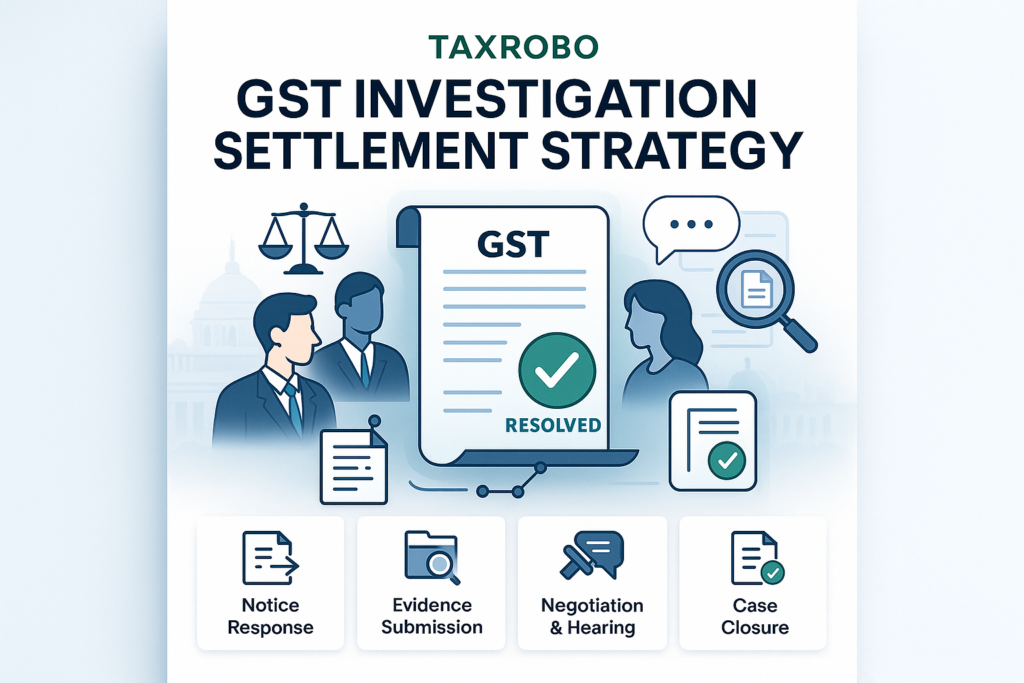

How to Close GST Investigation Case – Settlement Strategy
Receiving a notice from the GST department can be a daunting experience for any business owner. It signals the beginning of a formal inquiry that can disrupt operations, consume valuable time, and potentially lead to significant financial liabilities. A GST investigation is a detailed examination by tax authorities into your business’s financial records and tax compliance to check for discrepancies, errors, or potential tax evasion. Navigating this complex process without a clear plan can be overwhelming. This article provides a clear, actionable guide for closing a GST investigation case by outlining a step-by-step settlement strategy. Understanding the right how to close investigation case settlement strategy India is not just about responding to a notice; it’s about strategically managing the situation to minimize penalties, protect your business’s reputation, and achieve a swift resolution.
Understanding Why GST Investigations Are Initiated
Before devising a settlement strategy, it is crucial to understand why the GST department flags a business for investigation in the first place. These inquiries are rarely random; they are typically triggered by specific red flags detected by the department’s sophisticated data analytics systems or through manual scrutiny. Being aware of these triggers can help you understand the context of the notice you have received and prepare a more targeted response. The investigation process itself follows a structured path, from the initial notice to the final order, and knowing these stages can demystify the journey ahead and empower you to take control of the situation.
Common Triggers for a GST Department Inquiry
The Goods and Services Tax Network (GSTN) is a powerful digital ecosystem that cross-references data from multiple sources. Any inconsistency can trigger an automated alert, leading to an inquiry. Here are some of the most common reasons a business might come under the GST scanner:
- Mismatch in Returns: This is the most frequent trigger. Discrepancies between the sales declared in GSTR-1 and the tax paid in GSTR-3B, or a mismatch between the Input Tax Credit (ITC) claimed in GSTR-3B and the credit available in your GSTR-2A/2B, are immediate red flags.
- Significant or Suspicious Input Tax Credit (ITC) Claims: Claiming an unusually high amount of ITC compared to your output tax liability, or claiming ITC from suppliers whose GST registration has been cancelled or who are non-filers, can lead to an investigation.
- Non-filing or Consistent Delays in Filing GST Returns: A consistent pattern of filing returns late or not filing them at all suggests potential compliance issues and financial instability, prompting the department to take a closer look at your business activities.
- Anomalies Detected by Data Analytics: The GST department uses advanced analytics to identify unusual patterns, such as sudden spikes in turnover, frequent large refund claims, or transactions that don’t align with your industry’s typical business model.
- Information Received from Other Government Agencies: A tip-off or information shared by other bodies like the Income Tax Department, the Directorate of Revenue Intelligence (DRI), or the Enforcement Directorate (ED) can also initiate a GST investigation.
Key Stages of a GST Investigation
Understanding the procedural roadmap of an investigation helps you anticipate the next steps and prepare accordingly. The process generally unfolds in the following stages:
- Notice/Intimation: The process usually begins with an intimation, such as Form ASMT-10 for scrutiny of returns, asking for clarification on certain discrepancies. This is the department’s first official communication regarding their concerns.
- Summons: If the initial response is unsatisfactory or the matter is more serious, the department may issue a summons under Section 70 of the CGST Act, 2017. A summons is a legal order compelling you or your key personnel to appear in person to give evidence or produce specific documents. It is vital to understand the correct procedure, as detailed in our guide on GST Summons Notice – How to Respond Legally Without Mistakes.
- Inquiry & Hearing: This is the core investigation phase where you submit your detailed written replies, provide supporting documents, and attend personal hearings to present your case before the GST officer.
- Order: After considering all the facts, evidence, and your submissions, the officer will pass a final Order-in-Original (OIO). This order will either drop the proceedings or confirm the demand for tax, interest, and penalties.
Your Immediate Action Plan After Receiving a GST Notice
The moment a GST notice lands in your inbox or on your desk, your actions in the subsequent hours and days are critical. Panic and procrastination are your worst enemies. A calm, methodical, and prompt response sets a positive tone for the entire investigation process and demonstrates your willingness to cooperate. Following a structured action plan ensures you don’t miss any crucial details and positions you for a more favorable outcome.
Step 1: Acknowledge, Don’t Ignore
The single biggest mistake a taxpayer can make is to ignore a notice from the GST department. Ignoring official communication can lead to severe consequences, including ex-parte orders (decisions made without your presence), higher penalties, and even prosecution. It is imperative to formally acknowledge the notice within the stipulated timeframe. Regularly check the official GST Portal for any communications under the ‘View Notices and Orders’ tab. Acknowledging the notice is the first step in demonstrating your compliance and respect for the legal process.
Step 2: Scrutinize the Notice in Detail
Once you have acknowledged the notice, you must read it carefully to understand its contents fully. Do not just skim it; analyze every detail. Pay close attention to the following:
- Document Identification Number (DIN): Ensure the notice has a valid, computer-generated DIN. As per government circulars, any communication without a valid DIN may be treated as invalid.
- Reason for Inquiry: Identify the specific allegations, discrepancies, or issues raised by the officer. Is it related to an ITC mismatch, a valuation issue, or something else?
- Financial Period: Note the exact tax periods or financial years the investigation pertains to.
- Deadline for Response: The notice will specify a deadline by which you must submit your reply. Mark this date clearly and start working backward to prepare your response.
Step 3: Compile and Organize All Relevant Documents
Your response is only as strong as the evidence that backs it up. Begin compiling and organizing all documents related to the period and issues mentioned in the notice. This is a meticulous but non-negotiable step. The key documents you will likely need include:
- Tax Invoices: Both sales and purchase invoices.
- GSTR Filings: Copies of GSTR-1, GSTR-3B, GSTR-9, and GSTR-9C.
- Bank Statements: To corroborate your declared turnover and payments.
- Reconciliation Statements: Statements reconciling your GSTR-1 with GSTR-3B, GSTR-3B with GSTR-2A/2B, and your GST returns with your audited financial statements.
- E-way Bills: For movement of goods.
- Correspondence: Any relevant emails or letters with suppliers or customers that can support your claims.
Step 4: Seek Professional Guidance Immediately
While it may seem tempting to handle the matter yourself to save costs, navigating a GST investigation without expert help is a significant risk. The GST law is intricate, and procedural nuances can make or break your case. This is the point where you need robust legal strategies for closing GST cases. A qualified tax consultant or a lawyer brings several advantages:
- Expert Knowledge: They understand the law, precedents, and common departmental practices.
- Objective Analysis: They can objectively review your case, identify genuine errors, and formulate the strongest possible legal arguments.
- Effective Representation: They can draft a legally sound reply and represent you effectively during personal hearings, ensuring your rights are protected.
- Negotiation Skills: They are experienced in negotiating with tax authorities to achieve the best possible outcome.
Don’t delay. Engage a professional from the TaxRobo Online CA Consultation Service as soon as you receive the notice.
A Practical Settlement Strategy for Closing a GST Investigation Case
With a professional by your side and all documents in order, you can now focus on the core settlement strategy. The goal is to present a clear, factual, and persuasive case to the tax authorities. A successful strategy for closing a GST investigation case involves a combination of meticulous preparation, transparent communication, and strategic negotiation. It is about addressing the department’s concerns head-on while robustly defending your position where the law is on your side.
Preparing a Factual and Coherent Written Reply
The written reply is your first and most important opportunity to present your side of the story. It should be a comprehensive, point-by-point rebuttal to each allegation raised in the notice. Avoid vague statements or emotional arguments. Instead, focus on facts, figures, and legal provisions. Structure your reply logically, addressing each query separately. Most importantly, ensure that every single claim or explanation you make is substantiated with corresponding documentary evidence. A reply that is well-argued and heavily supported by proof is far more likely to be accepted by the officer, potentially closing the case at an early stage.
Effective Negotiation Strategies for GST Cases in India
If a written reply doesn’t resolve the matter, the next stage involves interaction and negotiation. This is where strategic decisions can significantly impact the outcome.
- Voluntary Payment (Form DRC-03): If, during your internal review, you discover a genuine error or an undisputed tax liability, it is often wise to make a voluntary payment using Form DRC-03. Paying the tax along with applicable interest before a Show Cause Notice (SCN) is issued can lead to a substantial reduction in penalties, sometimes even a complete waiver. This proactive step shows good faith and is one of the most effective
negotiation strategies for GST cases India. Understanding the Voluntary Tax Payment Before GST Show Cause Notice: Benefits and Procedures is crucial at this stage. - Personal Hearing: During a personal hearing, maintain a cooperative and professional demeanor. Clearly and calmly explain your position, referencing the documents you have already submitted. A well-prepared presentation can help clarify complex issues and build credibility with the adjudicating officer.
- Maintain a Cooperative but Firm Stance: While cooperation is key, do not admit to liabilities that are not legally sustainable. If you believe the department’s interpretation of the law is incorrect, politely but firmly state your position, supported by legal arguments and case law, if available.
Leveraging State-Specific Resolution Tactics
While the CGST Act is central, the implementation and procedural focus can vary slightly from state to state. Being aware of local tendencies can be advantageous. For example, the fundamental GST investigation resolution tactics Delhi authorities appreciate are transparency and quick, evidence-backed cooperation. Similarly, the process for closing GST investigation case in Mumbai involves dealing with Maharashtra GST officials who may have specific procedural expectations and a strong focus on documentation trails. Business owners seeking a GST investigation case settlement Gujarat should be prepared with meticulous documentation and reconciliations, as officials there are known for their thorough and detailed approach to scrutiny. A local expert can provide invaluable insights into these state-specific nuances.
Understanding Compounding of Offenses
In more serious cases where prosecution is a possibility, the option of “compounding of offenses” can be explored. Compounding is a legal mechanism where the taxpayer pays a monetary amount (the compounding fee) to the government in lieu of facing prosecution in a court of law. This effectively settles the matter and prevents a criminal proceeding. It is an advanced resolution tactic that should only be considered under the guidance of a seasoned tax lawyer, as it involves a formal application and acceptance by the competent authority.
When a Settlement Fails: Understanding the Next Legal Steps
While the goal is always to settle the case at the investigation stage, it’s important to know what happens if an agreement cannot be reached. If your replies and submissions are not found satisfactory by the officer, the proceedings will move to a more formal, quasi-judicial phase. Understanding this appellate path is crucial for long-term strategic planning.
The Show Cause Notice (SCN) and Adjudication Order
If the officer is convinced that a tax liability exists, they will issue a formal Show Cause Notice (SCN). The SCN is a detailed document that lays out the specific allegations, the proposed tax demand, interest, and the reasons for levying a penalty. You will be given an opportunity to reply to the SCN and attend a hearing. Knowing How to Respond to a GST Show Cause Notice: A Step-by-Step Guide is essential to present your case effectively. Following this, the officer will pass an Adjudication Order (also known as an Order-in-Original), which confirms the final demand. This order is a legally binding document.
Filing an Appeal
If you disagree with the Adjudication Order, you have the right to appeal. The GST law provides a hierarchical appeal mechanism to ensure justice and fairness. The typical appeal path is as follows:
- First Appellate Authority: The first appeal against the order of an adjudicating authority lies with the Joint/Additional Commissioner (Appeals).
- GST Appellate Tribunal (GSTAT): If you are not satisfied with the decision of the First Appellate Authority, you can file a further appeal with the GSTAT.
Filing an appeal is a complex legal process involving strict timelines, pre-deposits of a portion of the disputed tax, and drafting detailed legal grounds. It is a domain where expert representation is not just recommended but essential.
Conclusion
Facing a GST investigation is undoubtedly stressful, but it is a manageable process. The key to successfully closing a GST investigation case lies in a proactive, transparent, and well-documented approach. From the moment you receive a notice, every step you take matters. Acknowledge the communication promptly, meticulously gather your evidence, seek immediate professional guidance, and prepare a factual, evidence-backed reply. By employing effective negotiation strategies and understanding the legal pathways available, you can navigate the investigation efficiently, minimize potential liabilities, and get back to focusing on what you do best—running your business.
Navigating a GST investigation can be complex and stressful. Don’t leave it to chance. Contact the experts at TaxRobo today for professional guidance and a robust settlement strategy tailored to your business needs.
FAQs
Frequently Asked Questions about Closing GST Investigations
Q1: How long does it typically take to close a GST investigation case in India?
A: The timeline for closing a GST investigation case varies widely. A simple case involving minor discrepancies might be resolved in a few weeks with a prompt and clear reply. However, more complex cases involving multiple financial years, extensive documentation, or significant legal questions can take several months or even longer, depending on the taxpayer’s cooperation, the complexity of the issues, and the workload of the department.
Q2: Can I handle a GST investigation and settlement on my own?
A: While it is technically possible for a business owner to handle a very minor inquiry on their own, it is highly inadvisable for anything beyond a simple clarification. GST law is complex, with intricate rules on ITC, place of supply, valuation, and more. Procedural errors or a poorly drafted reply can inadvertently lead to higher penalties or a confirmed demand. Professional help is essential for deploying effective negotiation strategies for GST cases India and ensuring your rights are protected throughout the process.
Q3: What happens if I pay the disputed tax amount voluntarily using Form DRC-03?
A: Making a voluntary payment through Form DRC-03 is a powerful settlement tool. If you make the payment of tax and interest before a Show Cause Notice is issued, the penalty can be significantly reduced or, in many cases, waived entirely. This action demonstrates good faith and a willingness to comply, which is viewed favorably by tax authorities and is one of the quickest ways to bring an investigation to a close for any admitted liabilities.
Q4: Will a GST investigation always lead to a penalty?
A: Not necessarily. A GST investigation will not automatically result in a penalty. If you can successfully prove with sufficient evidence that there was no willful misstatement, fraud, or suppression of facts to evade tax, and that any discrepancy was a genuine clerical error or due to a reasonable interpretation of a complex law, the officer has the discretion to drop the proceedings without levying a penalty. A strong, well-documented defense is key to achieving this outcome.