
Checklist for GST Investigation – What Businesses Must Prepare
Receiving an official notice from the GST department can be a daunting experience for any business owner, often triggering a wave of stress and uncertainty. This feeling is understandable, but with the right preparation, it’s a process you can navigate with confidence. An investigation by tax authorities is simply a procedure to verify your compliance, check for any potential tax evasion, and ensure you’re paying the correct amount of tax. To help you face this situation head-on, we have created the ultimate GST investigation checklist, a comprehensive guide designed to help businesses in India understand the process, organize their documents, and stay prepared for any scrutiny. This article will serve as your roadmap, demystifying the process of preparing for GST investigation in India and empowering you with the knowledge to handle it smoothly.
Why GST Compliance is Non-Negotiable for Your Business
Under the Goods and Services Tax (GST) Act, every registered business has a legal mandate to maintain accurate and up-to-date records of its transactions. This isn’t just a bureaucratic formality; it’s the bedrock of a transparent tax system. The importance of GST compliance for businesses cannot be overstated, as it directly impacts your financial health and legal standing. Non-compliance, whether intentional or accidental, can lead to severe consequences. These include heavy financial penalties, the imposition of interest on any unpaid tax dues, and in more serious cases, legal action that could disrupt your operations and damage your reputation. On the other hand, being prepared for an investigation brings immense benefits. It provides peace of mind, ensures your business operations continue without interruption, and helps you build a strong, credible reputation with tax authorities, which can be invaluable in the long run.
What Triggers a GST Investigation? Common Red Flags
GST authorities use sophisticated data analytics tools to monitor filings and identify potential discrepancies. Understanding what raises a red flag can help you be proactive in maintaining compliance. This guide to GST investigation for Indian businesses highlights the common triggers that can lead to departmental scrutiny. Being aware of these points allows you to review your own processes and correct any inconsistencies before they attract unwanted attention from the tax department.
- Mismatch in Returns: One of the most common triggers is a discrepancy between the data in your GSTR-1 (details of outward supplies), GSTR-3B (summary return), and the auto-populated GSTR-2A/2B (details of inward supplies). Consistent mismatches suggest either under-reporting of sales or over-claiming of credit. You can learn How to Resolve ITC Mismatch Issues – GSTR-2A/2B vs 3B Guide.
- High ITC Claims: If your business claims an unusually high amount of Input Tax Credit (ITC) compared to the industry average or your own historical data, it can signal an alert to the tax authorities. This is especially true if the ITC is claimed from suppliers who are themselves under scrutiny.
- Inconsistent Filings: A pattern of frequent delays in filing GST returns or not filing them at all is a major red flag. It indicates poor financial discipline and can lead authorities to suspect that the business is attempting to evade its tax liabilities.
- E-way Bill Discrepancies: Significant mismatches between the e-way bills generated for the movement of goods and the actual supply of goods declared in your GSTR-1 and GSTR-3B can trigger an investigation. This suggests that goods might be moving without being properly accounted for in the tax returns.
- Specific Intelligence: Sometimes, an investigation is initiated based on specific information or intelligence received from other sources. This could be from a whistleblower, another government agency (like the Income Tax Department), or data analysis that points to a complex web of fraudulent transactions.
The Ultimate GST Investigation Checklist for Businesses
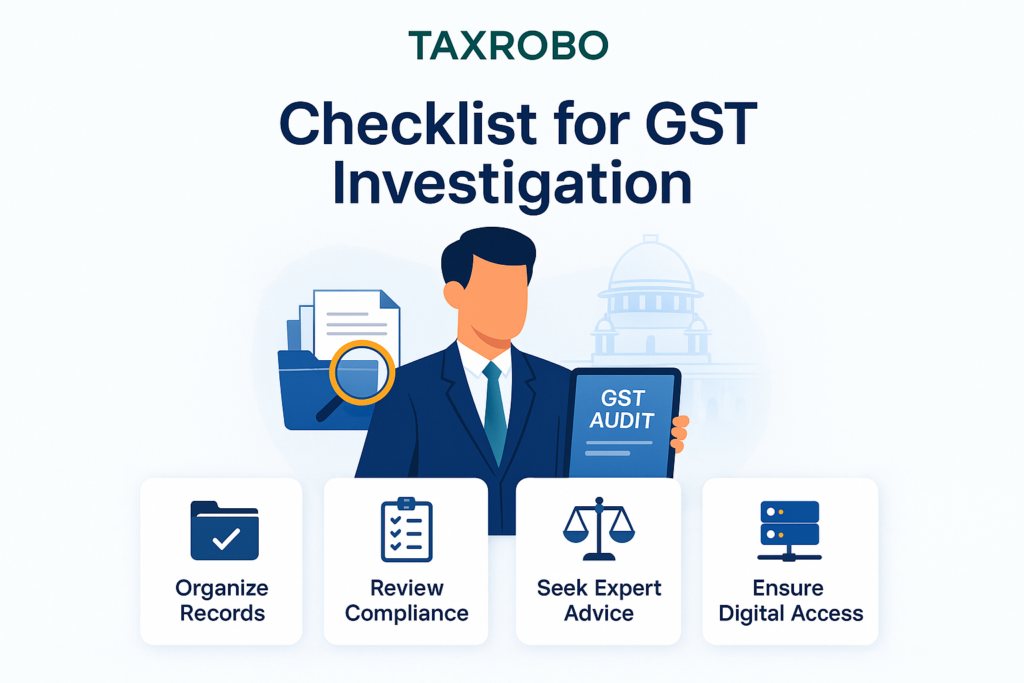
To ensure you are fully prepared, use this detailed GST investigation preparation checklist. Keeping these documents organized and readily accessible is the first and most critical step in handling any inquiry from the GST department smoothly and efficiently. We have broken down this GST investigation checklist for businesses into logical categories to help you systematically arrange your records.
1. Statutory and Registration Documents
These are the foundational documents that establish the legal identity and GST registration status of your business.
- GST Registration Certificate (Form GST REG-06).
- PAN Card of the business entity (company or LLP) or the proprietor/partners.
- Certificate of Incorporation (for companies), Partnership Deed (for firms), or other relevant business constitution documents.
- Proof of Principal Place of Business and any Additional Places of Business (e.g., latest electricity bill, rent agreement, ownership deed).
2. Sales and Outward Supply Records
This set of documents substantiates the sales you have declared and the tax you have collected.
- Complete series of Tax Invoices, Credit Notes, and Debit Notes that you have issued during the period under review.
- Detailed Sales Ledgers and monthly/quarterly sales summary reports from your accounting software.
- Copies of all GSTR-1 and GSTR-3B returns filed for the investigation period.
- A detailed reconciliation statement comparing the sales figures declared in your GST returns with the sales figures recorded in your books of accounts.
- Records of all E-way Bills generated, along with corresponding invoices and delivery challans.
3. Purchase and Inward Supply Records (ITC)
These records are crucial for justifying the Input Tax Credit (ITC) you have claimed in your returns.
- A complete file of Purchase Invoices received from all your vendors and suppliers.
- Detailed records of the Input Tax Credit (ITC) you have availed and utilized month-wise.
- The ITC register maintained as per your books of accounts.
- A comprehensive reconciliation of the ITC claimed in your GSTR-3B with the eligible credit reflected in your GSTR-2B.
- Proof of payment to your suppliers, such as bank statements or bank-generated payment advice, to validate ITC claims as required under Rule 37 of the CGST Rules.
4. Financial and Banking Records
This category covers the high-level financial documents that provide a complete picture of your business’s health and operations.
- Audited financial statements for the relevant financial year(s), including the Balance Sheet, Profit & Loss Account, and all schedules.
- Bank statements for all current and savings accounts registered in the name of the business.
- A detailed Stock Register showing opening balance, receipts, supply, goods lost or destroyed, and the closing balance of all key goods.
- Production records, manufacturing accounts, and raw material consumption statements (if you are a manufacturer).
- The Trial Balance and General Ledger from your accounting system for the period under investigation.
Proactive Steps: How Businesses Must Prepare for GST Investigation
Rather than waiting for a notice to arrive, the best strategy is to build a culture of compliance within your organization. Proactive preparation not only makes any potential investigation less stressful but also improves your overall financial management. The importance of GST compliance for businesses is best demonstrated through consistent, disciplined action. Here’s how businesses must prepare for GST investigation on an ongoing basis.
- Conduct Regular Internal Audits: Don’t wait for the government to find mistakes. Periodically, perhaps quarterly or semi-annually, conduct an internal audit of your GST filings and documentation. This exercise helps you identify and rectify errors, such as incorrect tax calculations or ITC claims, before they become major issues. Understanding the Primary Purpose of Internal Audit in the Modern Organization can strengthen this process.
- Perform Monthly Reconciliations: This is non-negotiable. Every month, you must perform critical reconciliations. Reconcile your GSTR-1 with GSTR-3B to ensure sales and tax liability match. Reconcile your purchase register with GSTR-2B to ensure you are claiming the correct ITC. Finally, reconcile your sales figures with your bank statements to ensure all revenue is accounted for.
- Maintain Impeccable Bookkeeping: Your accounting records are your primary defense. Use reliable accounting software that is GST-compliant. Ensure every single business transaction is recorded accurately and in a timely manner. Maintain a clear and organized filing system, both digital and physical, for all the documents mentioned in the checklist above. For more information on rules and regulations, you can refer to the official GST Portal.
- Seek Professional Help: Managing GST compliance can be complex. Consulting with GST experts, like the team at TaxRobo GST Service, can be a game-changer. Professionals can help you maintain flawless compliance, handle any departmental queries effectively, and provide expert guidance, ensuring you are always audit-ready.
During the Investigation: A Step-by-Step Guide
If GST officials visit your premises, your conduct can significantly influence the outcome. Staying calm and organized is key. This guide to GST investigation for Indian businesses provides a clear, step-by-step approach to handling the visit professionally.
- Step 1: Verify Authority: The first step is always to verify the identity of the visiting officers. Politely ask to see their official ID cards and the formal Authorization Letter (or Search Warrant) issued by a competent GST authority that permits them to conduct the investigation at your premises.
- Step 2: Cooperate Fully: Your full cooperation is legally required and highly advisable. Remain calm, courteous, and professional throughout the process. It’s a good practice to designate a single, knowledgeable point of contact—such as your accountant, CFO, or a director—to interact with the officers. This prevents confusion and ensures information is provided consistently.
- Step 3: Provide Documents Systematically: When asked for documents, furnish them from your prepared checklist. Do not offer unsolicited documents or information. Provide only what is requested. It is crucial to keep a detailed record or make a copy of every document you submit to the officers for your own records.
- Step 4: Record the Proceedings: During the investigation, officers may record statements (a process called ‘summons’). Pay close attention to the questions being asked and the answers being recorded. You have the right to read any statement before signing it. Understanding how to handle a GST Summons Notice – How to Respond Legally Without Mistakes is crucial at this stage. Do not sign any document you do not understand or agree with. If you are unsure, you can state that you need to consult with your tax advisor before signing.
Conclusion
Facing a GST investigation doesn’t have to be a nightmare. Preparation, not panic, is the key to navigating it successfully and with minimal disruption to your business. The core message is simple: diligent, regular reconciliation, meticulous record-keeping, and the proactive use of a comprehensive GST investigation checklist are your strongest defenses. By embedding these practices into your daily operations, you not only prepare for a potential investigation but also foster a robust and transparent financial framework for your business to thrive in.
Don’t wait for a notice to get your books in order. Let the experts at TaxRobo help you streamline your GST compliance and stay audit-ready. Contact us today for a GST health check-up!
Frequently Asked Questions (FAQs)
1. How long does a GST investigation typically last?
Answer: The duration of a GST investigation varies greatly depending on the complexity of the case, the volume of transactions to be reviewed, and the level of cooperation from the business. A straightforward inquiry might conclude in a few days, while a more complex case involving multiple financial years could extend for several months.
2. What are the potential penalties for non-compliance found during a GST investigation?
Answer: Penalties for non-compliance can be severe. They can range from a monetary penalty, which can be as high as 100% of the tax amount evaded, to the levy of interest on the tax shortfall from the date it was due. In cases of deliberate fraud or serious offenses, the GST Act also includes provisions for prosecution, which can lead to imprisonment.
3. Can I refuse to provide documents to a GST officer during an investigation?
Answer: No. Under the GST Act, you are legally obligated to cooperate with the investigating officers and provide them with the requested documents, records, and information. Non-cooperation is considered an offense and can lead to additional penalties and more stringent actions from the department.
4. Is professional help necessary for handling a GST investigation?
Answer: While it is not legally mandatory to have a professional representative, it is highly recommended. A qualified tax professional, such as a Chartered Accountant, can ensure your rights are protected throughout the process. They can help in presenting documents and information correctly, prepare robust replies to notices, and provide expert representation to minimize your potential liabilities and ensure a fair outcome.