
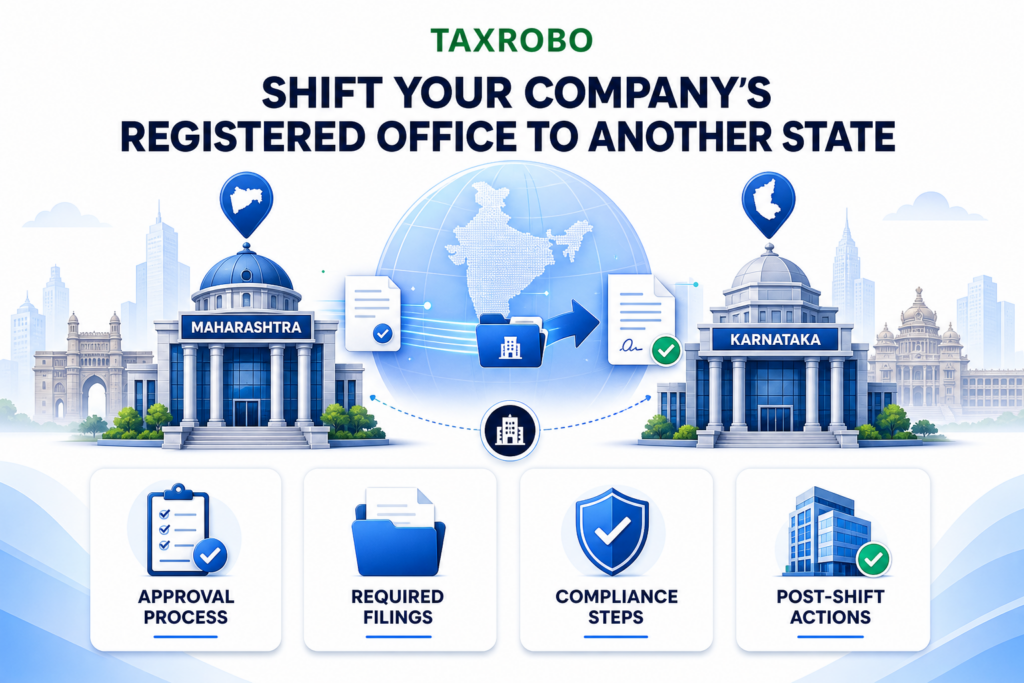

How to Shift Your Company’s Registered Office to Another State: A Step-by-Step Guide
Meta Description: Planning to shift your registered office to another state in India? This comprehensive guide details the complete legal process, required forms, and post-relocation compliances. Learn the step-by-step business address change process with TaxRobo.
As a business grows, its horizons expand. Strategic decisions related to market expansion, operational efficiency, or accessing a new talent pool often lead to the need for relocating a company’s core operations. While moving your physical office is a logistical task, the legal procedure to shift registered office to another state in India is a formal, multi-step process strictly governed by the Companies Act, 2013. This is not as simple as updating your address on a website; it involves a fundamental change to your company’s constitutional documents. The entire process requires a series of board resolutions, shareholder approvals, newspaper publications, and crucial permissions from central government authorities like the Regional Director. For many business owners, this can seem like a daunting maze of legal compliance. This article serves as a clear, actionable registered office relocation guide, designed to help you navigate the complexities of how to change registered office India and ensure a smooth transition for your relocating business registered office India.
Why a Company Might Need to Shift Registered Office
The decision to move a company’s legal home base is never taken lightly and is usually driven by compelling strategic objectives. Understanding these motivations provides context for the rigorous legal process that follows. The need for relocating business registered office India typically stems from a desire to optimize the business for long-term growth and sustainability. A change company address India across state lines is a significant move that aligns the company’s legal identity with its operational reality.
Some of the most common reasons include:
- Strategic Relocation: A primary driver is moving closer to the heart of the business. This could mean relocating to a state that is a major hub for your industry, bringing you closer to your target market, or positioning you near key raw material sources to streamline your supply chain. For technology companies, this might mean moving to a city with a large pool of skilled IT professionals.
- Operational Efficiency: Business overheads can vary significantly from one state to another. Companies often shift their registered office to consolidate operations or move to a location with better infrastructure, lower rental costs, reduced utility expenses, and more favorable state-level business policies. This move can directly impact the company’s bottom line and improve overall operational efficiency.
- Administrative Convenience: It is often more practical for a company’s registered office to be in the same state where the majority of its directors reside or where its primary business activities are conducted. This simplifies management oversight, facilitates easier conduct of board meetings, and streamlines communication and compliance with local authorities.
The Legal Framework: Key Provisions of the Companies Act, 2013
The process of a company registration state transfer is not an arbitrary one; it is meticulously laid out in the Companies Act, 2013, to protect the interests of all stakeholders, including shareholders, creditors, and government authorities. The primary regulations governing this change are found in Section 12 (related to the registered office of a company) and Section 13 (related to the alteration of the Memorandum of Association) of the Act.
The crux of the matter is that a company’s registered office state is mentioned in Clause II of its Memorandum of Association (MoA). The MoA is the company’s charter document, and any change to it is a significant legal event. Therefore, shifting the registered office from one state to another necessitates an alteration of the MoA, which requires more than just an internal decision. This process elevates the procedure beyond a simple address change and brings several key authorities into the picture. The journey involves approvals from the Board of Directors, a special resolution from the Shareholders, and most importantly, a confirmation order from the Regional Director (RD), who represents the central government’s Ministry of Corporate Affairs (MCA portal). Finally, the change must be registered with the Registrar of Companies (ROC) of both the original and the destination states, a process governed by various ROC Compliance for Private Limited Company.
A Step-by-Step Guide to Shift Registered Office to Another State
Navigating the legal requirements to shift registered office can be complex, but breaking it down into a sequence of clear steps makes it manageable. Follow this detailed guide to ensure you cover all necessary compliance checkpoints.
Step 1: Convene a Board Meeting
The very first official step is to get the company’s leadership on board. The Board of Directors must convene a formal meeting to discuss and approve the proposal to shift registered office from the current state to the new one. This meeting serves two critical purposes. First, the directors must pass a board resolution to formally approve the proposal in principle. Second, this resolution must authorize the company to take the necessary subsequent steps, including fixing the date, time, and venue for an Extraordinary General Meeting (EGM). The EGM is where the proposal will be presented to the company’s shareholders for their ultimate approval, so the notice for this meeting must also be approved by the board. Understanding the nuances of Board Meetings and Resolutions: Key Provisions in Section 173 is crucial at this stage.
Step 2: Pass a Special Resolution at the EGM
With the board’s approval secured, the focus shifts to the shareholders. An EGM must be held as per the date decided by the board. At this meeting, the shareholders must approve the proposal by passing a Special Resolution. This is a higher threshold than an ordinary resolution and requires the consent of at least 75% of the members present and voting. This resolution formally sanctions the alteration of the Memorandum of Association to reflect the new state. Once the Special Resolution is passed, the company has a legal obligation to file Form MGT-14 with the Registrar of Companies (ROC) within 30 days. This form is a declaration to the ROC that the company has passed a special resolution, and it must be accompanied by a copy of the resolution itself and the explanatory statement sent to the shareholders.
Step 3: Publish Newspaper Advertisement & Send Notices
This step is designed to ensure transparency and protect the interests of third parties, particularly creditors. Before applying to the central government for approval, the company must publicize its intention to shift the registered office. An advertisement in Form INC-26 must be published at least 14 days before filing the application with the Regional Director. This advertisement needs to appear in two newspapers: one in an English newspaper with wide circulation in the district of the current registered office, and another in a vernacular (local language) newspaper of the same district. Concurrently, the company must send individual notices via registered post to all its creditors, debenture holders, and relevant regulatory bodies like the ROC, SEBI (if the company is listed), and any other authority that governs the company’s operations. This gives them an opportunity to raise objections if they believe the shift will adversely affect their interests.
Step 4: File an Application with the Regional Director (RD)
This is the most critical and time-consuming part of the entire business address change process. After the 14-day notice period from the newspaper advertisement has passed, the company must file an application for approval with the Regional Director (RD) of the region where the current registered office is situated. This application is filed in e-Form INC-23. This form is a comprehensive petition and must be accompanied by a host of supporting documents that provide a complete picture of the company’s proposal and its compliance efforts so far.
The essential documents to be attached with Form INC-23 include:
- A certified true copy of the altered Memorandum of Association (MoA) and Articles of Association (AoA).
- A copy of the minutes of the EGM where the special resolution was passed.
- A copy of the Board Resolution that initiated the process.
- A complete list of all creditors and debenture holders, stating their names, addresses, and the nature and amount of debt owed to each.
- An affidavit signed by the Company Secretary and at least two directors (one of whom must be a managing director, if any) verifying that the list of creditors is complete, accurate, and that all their interests have been considered.
- A copy of the newspaper advertisement (Form INC-26) published earlier.
- Proof of service of notice to all creditors, debenture holders, and regulatory bodies.
Step 5: Obtain the Order from the Regional Director
Once the application in Form INC-23 is filed, the Regional Director will scrutinize it thoroughly. The RD will also consider any objections received from creditors or other stakeholders in response to the notices and advertisements. The RD may call for a hearing if there are objections or if further clarification is needed. If the RD is satisfied that the interests of all stakeholders are protected and that the company has complied with all legal requirements, they will pass an order approving the alteration of the MoA and the shift of the registered office. This confirmation order is issued in Form INC-28. The entire process, from filing the application to receiving the order, can take anywhere from two to four months, depending on the caseload of the RD’s office and the complexity of the application.
Step 6: File the RD’s Order with the ROC of Both States
Receiving the RD’s order is a major milestone, but it is not the final step. The company must now formally register this change with the ROCs. The confirmation order received from the RD must be filed in e-Form INC-28 with the ROC of both the original state and the destination state. This must be done within 30 days of receiving the order. Filing this form with the original ROC informs them that the company is moving out of their jurisdiction, while filing it with the new ROC informs them that the company is moving into their jurisdiction.
Finally, within 15 days of filing the RD’s order, the company must file e-Form INC-22 with the new ROC. This form provides the full address of the new registered office and serves as the official notice of the new location. Upon successful verification of these filings, the ROC of the new state will issue a fresh Certificate of Incorporation, which stands as conclusive evidence of the company registration state transfer.
Post-Relocation Checklist: Crucial Steps After You Shift Registered Office
Completing the legal formalities with the MCA is only half the battle. To ensure a seamless business transition, you must update your new address across all other statutory and business records.
Update GST Registration
GST registration is state-specific. Your existing GSTIN (Goods and Services Tax Identification Number) is tied to your old state and will become invalid for operations in the new state. You must surrender the old GST registration and simultaneously apply for a new GST registration in the destination state. This is a critical step, and you can follow our Comprehensive Guide to GST Registration for Businesses to manage it correctly. You can manage this process through the official GST Portal.
Inform Tax Authorities & Banks
Your company’s legal address is linked to its tax identity. You must update the new address in your company’s PAN (Permanent Account Number) and TAN (Tax Deduction and Collection Account Number) records. This can be done by filing a change/correction request form on the NSDL portal. Additionally, you must formally notify all your company’s bankers about the change of registered office. This involves submitting the required documents (like the new Certificate of Incorporation) to update the address in all company bank accounts. Visit the Income Tax Department e-filing portal for more information on updating tax profiles.
Update All Business Stationery and Records
Consistency is key to maintaining a professional image. Once the shift is legally complete, you must update the new address across all your business communications and official materials. This includes:
- Company Letterheads, Invoices, Quotations, and other official documents.
- The company’s official website, especially the “Contact Us” page and legal disclaimers.
- Email signatures of all employees.
- The company’s official seals and stamps.
Amend Other Licenses and Registrations
Your company likely holds several other state-specific or central licenses that are linked to its address. You must diligently go through all your registrations and update them with the new address. This list can include:
- Provident Fund (PF) and Employee State Insurance (ESI) registrations.
- Shops & Establishment Act license.
- Professional Tax registration.
- Import Export Code (IEC).
- Any industry-specific licenses or permits.
Conclusion
The process to shift registered office to another state is a significant legal and administrative undertaking that goes far beyond a simple change of address. It is a structured journey that requires meticulous planning, strict adherence to timelines, and careful documentation, from securing a Board Resolution and a Special Resolution from shareholders to obtaining the critical approval from the Regional Director and finally completing the ROC filings. While the procedure may seem long and complex, it is designed to ensure a transparent and compliant transition that protects the interests of everyone involved with your company.
The journey to transfer registered office to another state can be complex, and any misstep can lead to delays and legal complications. Don’t let paperwork and compliance slow down your business’s strategic growth. Contact TaxRobo’s experts today for a hassle-free relocation of your company’s registered office. Our team can guide you through every step, ensuring a smooth and successful transition.
Frequently Asked Questions (FAQs)
1. How long does it take to transfer registered office to another state in India?
The entire process, from the initial board meeting to the final approval from the new ROC, is a lengthy one. On average, it can take anywhere from 4 to 6 months. This timeline can be influenced by factors such as the processing time at the Regional Director’s office, whether any objections are raised by creditors, and the efficiency with which the company files all the required forms and documents.
2. What is the difference between changing the office address within the same state vs. to another state?
The complexity, required approvals, and legal implications vary significantly depending on the nature of the address change. The company registration state transfer is the most complex procedure because it involves altering the company’s charter document (MoA).
| Parameter | Within Same City | To Another City (Same State) | To Another State |
|---|---|---|---|
| Approving Authority | Board of Directors | Shareholders | Shareholders & Regional Director (Central Government) |
| Resolution Required | Board Resolution | Special Resolution | Special Resolution |
| Key Forms Filed | INC-22 | MGT-14, INC-22 | MGT-14, INC-23, INC-26, INC-28, INC-22 |
| MoA Alteration | No | No | Yes, requires alteration of the State clause |
| Complexity | Simple | Moderate | High & Time-consuming |
3. What are the main government fees involved in the business address change process?
The government fees primarily consist of charges for filing various e-forms on the MCA portal. This includes filing fees for MGT-14, INC-23, INC-22, and INC-28. The fees for these forms depend on the authorized capital of the company. Additionally, there is a significant cost related to paying stamp duty on the altered Memorandum of Association, the rate of which varies from one state to another. You will also incur costs for publishing the newspaper advertisements.
4. Can our company start operating from the new state before the official approval comes?
Yes, your company can start its business operations from a new location in another state by setting it up as a branch office or a corporate office. However, for all legal and official communication purposes, the “registered office” remains the old address until the process is officially completed and the ROC of the new state issues a fresh Certificate of Incorporation. All statutory notices from bodies like the ROC, Income Tax Department, and others will continue to be sent to the old address until the change is formally registered.