
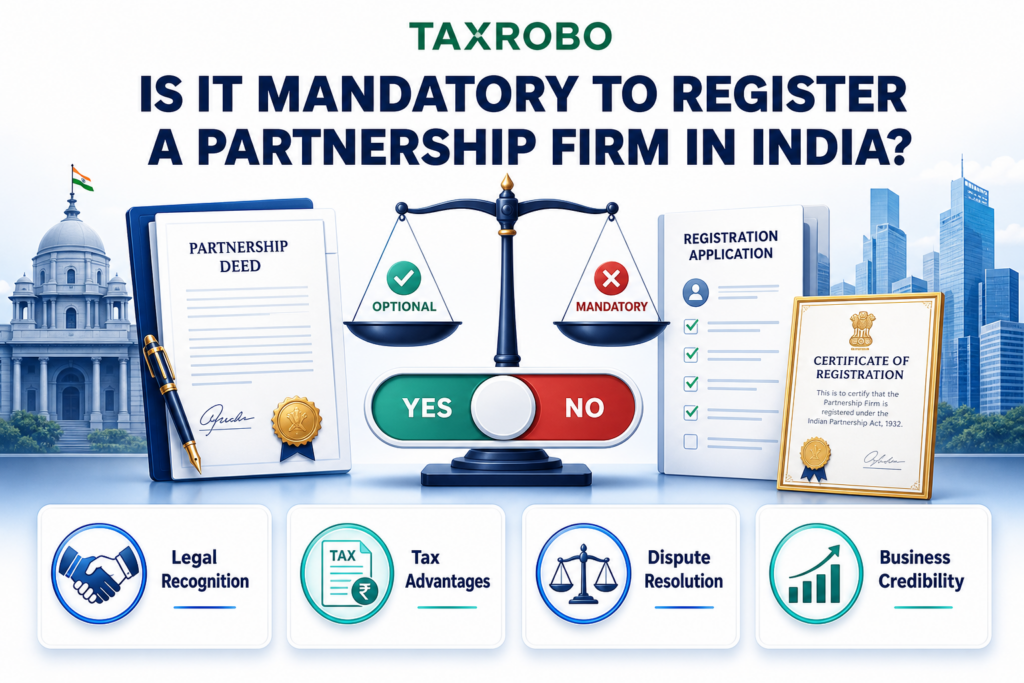

Is it Mandatory to Register a Partnership Firm in India?
You have a brilliant business idea and the perfect partner to build it with. But before you dive in, a crucial question arises: do you need to legally register your partnership? This is a frequent query we at TaxRobo receive from aspiring entrepreneurs. A partnership firm is a business structure where two or more individuals agree to share the profits of a business, governed by the Indian Partnership Act, 1932. The short answer is no. According to Indian law, mandatory partnership registration is not a legal requirement. However—and this is a big however—operating an unregistered firm comes with severe disadvantages that make registration a practical necessity for any serious business. This post will break down the legal standpoint, the significant benefits of registration, and the step-by-step process to get it done.
The Legal Truth: Understanding the Indian Partnership Act, 1932
The Indian Partnership Act, 1932, governs how partnership firms are formed and operated in India. A common misconception is that this law makes registration compulsory. In reality, the Act gives business owners the flexibility to choose whether to register their firm or not. However, this flexibility comes with a significant catch. The law strongly incentivizes registration by imposing serious limitations on unregistered firms, effectively making registration a strategic necessity rather than a legal obligation. This is primarily done through Section 69 of the Act, which details the consequences of non-registration. Understanding these consequences is the key to appreciating why virtually every successful partnership firm in India is registered. It’s not about following a rule; it’s about equipping your business with the legal tools it needs to operate, grow, and protect itself in a competitive marketplace.
The Impact of Section 69: The Consequences of Non-Registration
While the Act doesn’t force registration, Section 69 is a powerful provision that outlines the disabilities of an unregistered firm. These are not penalties but rather the inability to use the legal system to enforce your rights. This can leave your business incredibly vulnerable.
- Inability to Sue Third Parties: This is the most significant disadvantage. An unregistered firm cannot file a lawsuit against a third party (like a client, vendor, or supplier) to enforce a right arising from a contract. For example, if you deliver goods worth ₹1,00,000 to a client and they refuse to pay, your unregistered firm has no legal power to sue them for the recovery of that money. You are left with no legal recourse to claim what is rightfully yours.
- No Right of Set-Off: An unregistered firm cannot claim a “set-off” in legal proceedings. A set-off is a legal claim to reduce the amount you owe to someone by an amount they owe you. For instance, if a supplier sues your firm for ₹50,000 for unpaid invoices, and you have a separate claim of ₹30,000 against that same supplier for defective goods they provided, you cannot use your claim to reduce your payment to ₹20,000. You would have to pay the full ₹50,000 without being able to legally offset your own claim in the same lawsuit.
- Partners Cannot Sue the Firm or Each Other: The consequences extend to internal disputes. Partners of an unregistered firm cannot file a lawsuit against the firm or their fellow partners to enforce any right arising from the partnership agreement. If a partner violates the agreement—for example, by not contributing their share of capital or by misappropriating funds—other partners cannot take them to court to enforce the terms of the deed. This makes resolving internal conflicts legally impossible and can lead to the breakdown of the business.
The key takeaway is clear: Operating without registration cripples a firm’s ability to protect its legal and financial interests, making it a high-risk approach for any business.
The Strategic Edge: Top Benefits of Partnership Firm Registration
Choosing to register your partnership firm is one of the first and most important strategic decisions you will make. It moves your business from a vulnerable, informal arrangement to a recognized legal entity with the power to protect itself and grow. The benefits of partnership firm registration extend far beyond mere legal compliance; they form the foundation for credibility, security, and long-term success. By registering, you unlock the ability to enforce contracts, resolve internal disputes formally, and build trust with clients, banks, and investors. This simple administrative step provides a powerful strategic edge in the business world.
Legal Power to Enforce Your Rights
The most immediate and critical benefit of registration is that it reverses all the disabilities imposed by Section 69. A registered firm gains the legal authority to file a lawsuit against third parties. This means if a client defaults on a payment, a supplier fails to deliver on a contract, or any other party infringes upon your contractual rights, you can take them to court to seek a legal remedy. This ability to enforce contracts is the bedrock of commercial operations. It provides a crucial mechanism for debt recovery, ensuring that your cash flow and financial health are protected by the full force of the law. Without this power, your business operates on trust alone, which is a risky proposition in any commercial environment.
Protection and Dispute Resolution for Partners
Business partnerships, like any relationship, can face disagreements. Registration provides a formal and legal framework for resolving these internal disputes. If there’s a disagreement over profit sharing, the scope of a partner’s duties, capital contributions, or the admission of a new partner, a registered partnership deed becomes a legally enforceable document. Any partner can approach a court to seek resolution based on the terms agreed upon in the deed. This protects the rights of every partner and ensures that disputes are handled fairly and legally, preventing a single partner from making arbitrary decisions that could harm the business or other partners.
Enhanced Credibility and Trust
In the business world, perception matters. A registered partnership firm is universally viewed as more legitimate, professional, and credible than an unregistered one. This official status is a signal of seriousness and stability to the outside world. This enhanced credibility makes it significantly easier to conduct key business operations:
- Open a Business Bank Account: Most banks require a Certificate of Registration to open a current account in the firm’s name.
- Apply for Business Loans: Financial institutions and lenders are far more likely to grant loans to a registered entity, as it provides them with legal recourse.
- Obtain Licenses and Registrations: Many government registrations, such as GST registration, are simpler to obtain for a registered firm.
- Secure Contracts: Larger clients and government tenders often require proof of business registration as a prerequisite for entering into a contract.
Smooth Transition to Other Business Structures
As your business grows, your needs may evolve. Choosing the Right Legal Structure for Your Business becomes a critical decision. You might decide that a different business structure, such as a Limited Liability Partnership (LLP) or a Private Limited Company, is more suitable for your expanding operations. Converting a registered partnership firm into an LLP or a company is a much more straightforward and streamlined process. The existing legal documentation and recognized status of the registered firm provide a clear and organized foundation for the conversion process, saving you significant time, money, and administrative hurdles down the road.
How to Register a Partnership Firm in India: A Step-by-Step Guide
The partnership firm registration process, while detailed, is a logical sequence of steps that formalizes your business. It transforms your informal agreement into a legally recognized entity with all the associated benefits. Following this guide on how to register partnership firm India will help you navigate the process smoothly, ensuring your documentation is robust and your application is successful. From drafting the foundational deed to receiving your final certificate, each step is crucial for establishing a secure and credible business.
Step 1: Draft the Partnership Deed
The Partnership Deed is the cornerstone of your firm. It is a comprehensive written agreement that meticulously outlines the partnership firm rules in India that will govern your business relationship. This document minimizes ambiguity and provides a clear roadmap for operations, management, and dispute resolution. It is a critical document that should be drafted with care by a legal professional. Ensuring you cover all essential points is vital; our guide on Partnership Deed Clauses You Must Include (Profit Sharing, Capital, Exit) can serve as a helpful reference.
Essential clauses to include in the deed are:
- Basic Details: Name and address of the firm, along with the names and addresses of all partners.
- Business Scope: The nature of the business the firm will conduct.
- Duration and Commencement: The date the firm starts its operations and its proposed duration (whether for a fixed term or at will).
- Financials: The amount of capital contributed by each partner and the profit/loss sharing ratio.
- Interest & Remuneration: Rules regarding interest on capital, partner drawings, and any loans provided by partners to the firm. It should also specify any salaries or commissions payable to partners for their work.
- Partner Dynamics: The procedure for admitting a new partner, as well as the retirement or exit of an existing partner.
Pro Tip: The Partnership Deed must be printed on a non-judicial stamp paper of the appropriate value, which varies from state to state. It must then be signed by all partners in the presence of witnesses and notarized.
Step 2: Compile the Partnership Registration Requirements
Once the deed is finalized, you need to gather the necessary documents for the application. Having a complete and accurate set of papers is essential for a smooth registration process. The specific partnership registration requirements India generally include the following:
- Application for Registration (Form 1): This is the prescribed application form, which must be duly filled out and signed by all partners or their authorized agents.
- Certified Copy of the Partnership Deed: A true copy of the notarized partnership deed you drafted in Step 1.
- Affidavit: A sworn affidavit on appropriate stamp paper, declaring that all the details mentioned in the partnership deed and the application form are true and correct.
- Identity and Address Proof of Partners: Self-attested copies of the PAN card and address proof (such as Aadhaar Card, Passport, Voter ID, or Driver’s License) for all partners.
- Proof of Business Address: Documents confirming the principal place of business. This can be ownership documents (like a sale deed or property tax receipt) if the property is owned, or a rental/lease agreement if it is rented. A recent utility bill (electricity, water) and a No Objection Certificate (NOC) from the property owner are also typically required.
Step 3: File the Application with the Registrar of Firms (RoF)
With your complete document package ready, the next step is to submit the application to the Registrar of Firms (RoF) in the state where your business’s main office is located. Each state has its own RoF office that handles the registration of firms. The application, along with the prescribed government fees, must be physically or digitally filed. In recent years, many states have digitized this process, allowing for more convenient online submissions, which significantly speeds up the process.
Actionable Tip: For businesses located in Delhi, for example, you can initiate the process and find relevant forms on the official portal of the Industries Department, Government of NCT of Delhi.
Step 4: Verification and Issuance of Certificate
After you submit your application, the Registrar of Firms will scrutinize all the documents. The RoF will verify the details for completeness and accuracy. If they are satisfied that all legal requirements have been met, your firm’s name will be entered into the state’s Register of Firms. Following this, the Registrar will issue a Certificate of Registration. This certificate serves as conclusive and final proof that your partnership firm has been legally registered. You should keep this document safe, as it will be required for numerous business activities, including opening bank accounts and obtaining other licenses.
The Final Verdict on Mandatory Partnership Registration
In conclusion, the core question of whether mandatory partnership registration is enforced by law has a clear answer: no. However, viewing it merely as an optional formality is a critical business mistake. The crippling consequences of non-registration, particularly the inability to enforce legal rights against clients or even among partners, make it a non-negotiable step for any partnership aiming for longevity, growth, and security. Operating an unregistered firm is like navigating a ship without a rudder—you may stay afloat for a while, but you have no control when challenges arise.
The advantages of registration—gaining legal standing to sue, protecting partners from internal disputes, and enhancing business credibility—are fundamental to building a resilient enterprise. The partnership firm registration process involves careful documentation and adherence to legal nuances. Don’t let paperwork slow down your entrepreneurial journey. At TaxRobo, our experts streamline the entire process, from drafting a robust partnership deed to securing your registration certificate. Contact us today to get your partnership firm registered hassle-free!
Frequently Asked Questions (FAQs)
1. What is the minimum and maximum number of partners allowed?
To form a partnership, a minimum of two partners are required. Regarding the maximum limit, the Indian Partnership Act, 1932, does not specify an upper limit. However, the Companies Act, 2013, and the associated Companies (Miscellaneous) Rules, 2014, have set the maximum number of partners for a firm not to exceed 50. This is one of the key partnership firm rules in India to be aware of.
2. Can we register our firm after it has already started operating?
Yes, absolutely. The Indian Partnership Act, 1932, allows a partnership firm to be registered at any point during its existence. You can start your business and choose to register it later. However, it is crucial to remember that the legal protections and benefits of registration, such as the right to sue third parties, will only apply from the date the Certificate of Registration is officially issued by the Registrar.
3. What is the difference between a Partnership Firm and an LLP?
The primary and most significant difference lies in liability and legal status. In a traditional Partnership Firm, partners have unlimited liability, meaning their personal assets can be used to pay off the firm’s debts. The firm is not considered a separate legal entity from its partners. In contrast, a Limited Liability Partnership (LLP) provides limited liability to its partners, meaning their personal assets are protected, and their liability is limited to their capital contribution. An LLP is also a separate legal entity, just like a company. For a detailed comparison, see our guide on LLP vs Partnership Firm – Key Differences in Tax, Liability & Compliance.
4. Does a partnership firm need a separate PAN Card?
Yes. For all income tax purposes, a partnership firm is treated as a separate entity from its partners. Therefore, it is mandatory for the firm to apply for and obtain its own Permanent Account Number (PAN) after it is formed. The firm will file its own income tax returns using this PAN. You can apply for a PAN online through the official government-authorized portal, such as the NSDL portal for PAN application.
5. How much does the registration process cost?
The total cost of registering a partnership firm can vary significantly from one state to another. The primary factors influencing the cost are the state-specific government registration fees and the value of the non-judicial stamp paper required for the partnership deed, which is often based on the firm’s capital. Additionally, fees for professional assistance from experts like Chartered Accountants or lawyers to draft the deed and manage the application process will also contribute to the overall cost. At TaxRobo, we offer transparent and competitive packages for this service.