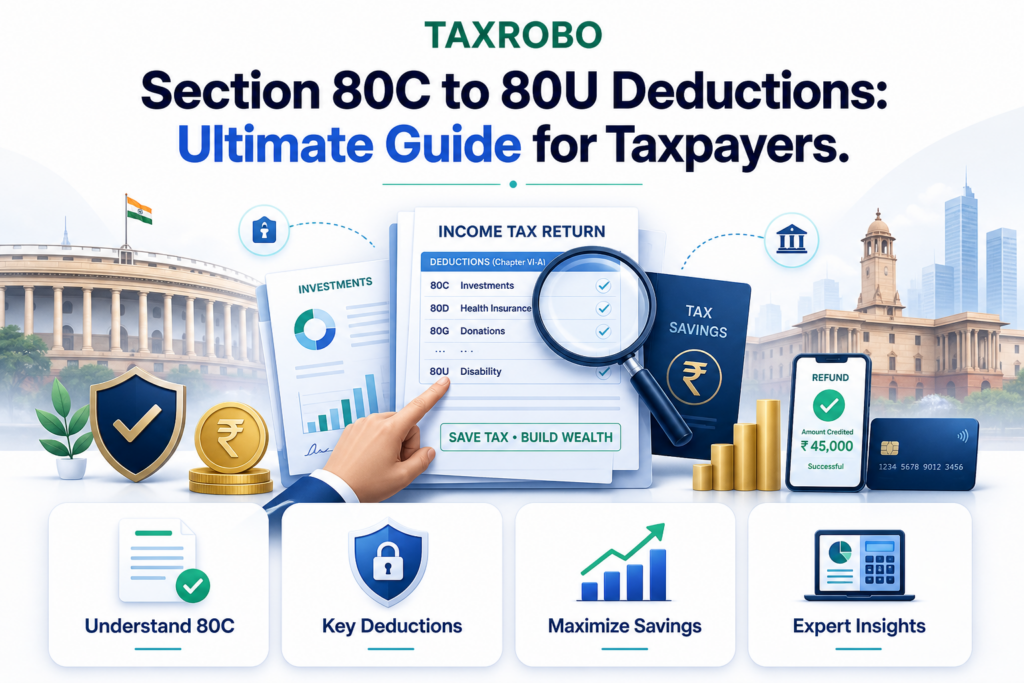

Section 80C to 80U Deductions: Ultimate Guide for Taxpayers
Are you paying more tax than you need to? What if you could legally reduce your tax bill and build wealth at the same time? The Indian Income Tax Act offers numerous avenues for taxpayers to lower their tax liability, and understanding them is the first step towards smarter financial planning. This comprehensive guide is designed to simplify the complex world of Section 80C to 80U deductions, helping you save money and invest for your future. These provisions, found under Chapter VI-A of the Act, are a powerful tool for both salaried individuals and small business owners to reduce their taxable income legally and efficiently. Many of these are covered in our guide on the Top 10 Tax Deductions for Salaried Employees in India.
This article serves as an ultimate guide to tax deductions India, breaking down each key section into simple, actionable information. We will explore everything from popular investment-linked deductions to benefits for medical expenses, donations, and more. By the end of this guide, you will have a clear roadmap to maximizing your tax savings for the financial year.
What Are Tax Deductions Under Chapter VI-A?
Before we dive into specific sections, it’s crucial to understand what tax deductions are. Simply put, deductions under income tax India are specific expenses or investments that the government allows you to subtract from your Gross Total Income (GTI). The resulting figure is your Net Taxable Income, which is the amount on which your income tax is actually calculated. A lower taxable income directly translates to a lower tax bill.
It’s important not to confuse a tax deduction with a tax exemption.
- Tax Exemption: This refers to income that is not taxed at all and is excluded from your Gross Total Income. An example is the interest earned on a Public Provident Fund (PPF) account.
- Tax Deduction: This is an amount that is subtracted from your Gross Total Income *after* all sources of income have been added up.
The deductions listed from Sections 80C to 80U in Chapter VI-A cover a wide spectrum of financial activities, encouraging citizens to save for retirement, secure their health with insurance, invest in their children’s education, and contribute to social causes.
The Most Popular Tax-Saving Cluster: Section 80C, 80CCC, & 80CCD
For most taxpayers, the journey of tax saving begins with this powerful combination of sections. Together, Section 80C, 80CCC, and 80CCD(1) offer a combined deduction limit of ₹1.5 lakh per financial year. Mastering these is fundamental for any income tax deductions guide for taxpayers, as they provide the largest and most accessible tax-saving opportunities. Additionally, Section 80CCD offers a path to save even more, making your total potential deduction under this cluster ₹2 lakh.
Section 80C Deductions India: The Foundation of Tax Saving
Section 80C is the most popular and versatile tax-saving provision available to individuals and Hindu Undivided Families (HUFs). It allows you to claim a deduction of up to ₹1.5 lakh for a variety of investments and expenses. This section is the cornerstone of any taxpayers guide to Section 80C because of the wide range of options it provides, catering to different risk appetites and financial goals.
Here are the most common eligible investments and expenses under Section 80C:
- Provident Funds: Your mandatory contribution to the Employee’s Provident Fund (EPF) automatically qualifies. You can also make additional contributions through a Voluntary Provident Fund (VPF).
- Public Provident Fund (PPF): A government-backed, long-term savings scheme. It enjoys an Exempt-Exempt-Exempt (EEE) status, meaning the investment, the interest earned, and the maturity amount are all tax-free.
- Life Insurance Premiums: Premiums paid for a life insurance policy for yourself, your spouse, or your children (dependent or independent) are eligible.
- Equity Linked Saving Scheme (ELSS): These are mutual funds with a mandatory lock-in period of just 3 years, the shortest among all tax-saving investment options. They offer the potential for higher returns linked to the equity market.
- Home Loan Principal Repayment: The principal component of the Equated Monthly Instalments (EMIs) paid towards your home loan is deductible.
- Children’s Tuition Fees: You can claim a deduction for tuition fees paid for the full-time education of up to two children at any school, college, or university in India.
- National Savings Certificate (NSC): A fixed-income investment scheme you can purchase from a post office.
- 5-Year Tax-Saving Fixed Deposits: These are special bank FDs with a lock-in period of 5 years that qualify for a deduction.
Section 80CCC: Premiums for Annuity/Pension Plans
This section allows for a deduction on the amount you invest in certain annuity or pension plans offered by insurers like the Life Insurance Corporation of India (LIC) or other providers. The primary goal of these plans is to provide you with a regular pension after retirement. The deduction available under Section 80CCC is part of the overall ₹1.5 lakh limit shared with Section 80C.
Section 80CCD: National Pension System (NPS) Contribution
The National Pension System (NPS) is a voluntary, long-term retirement savings scheme regulated by the government. It’s an excellent tool for retirement planning and offers some unique tax advantages.
- Subsection 80CCD(1): This applies to your own contribution to the NPS account.
- For salaried individuals: The deduction is limited to 10% of your salary (Basic + DA).
- For self-employed individuals: The limit is 20% of your gross total income.
- This deduction falls within the overall ₹1.5 lakh limit of Section 80C.
- Subsection 80CCD(1B): The Game-Changer: This is where NPS truly shines. You can claim an additional deduction of up to ₹50,000 for your contribution to NPS. This is *over and above* the combined ₹1.5 lakh limit of Section 80C. This means you can effectively claim a total deduction of up to ₹2 lakh (₹1.5 lakh under 80C/CCC/CCD(1) + ₹50,000 under 80CCD(1B)).
- Subsection 80CCD(2): This relates to the employer’s contribution to an employee’s NPS account. This is a significant benefit for tax deductions for salaried individuals India. The employer’s contribution of up to 10% of the employee’s salary (14% for Central Government employees) is deductible from the employee’s taxable income, and there’s no upper monetary limit, although it is clubbed with employer PF and superannuation contributions for an overall cap.
Deductions for Your Health and Well-being
Beyond investments, the Income Tax Act provides significant deductions to encourage individuals to secure their health and manage medical expenses for their families.
Section 80D: Health Insurance Premiums
This section allows you to claim a deduction for premiums paid towards a health insurance policy. It’s a crucial deduction that promotes financial preparedness for medical emergencies. You can explore the complete Section 80D: Benefits of Health Insurance Premium Deductions to understand its advantages. The limits are as follows:
| Premium Paid For | Taxpayer Age < 60 Years | Taxpayer Age > 60 Years (Senior Citizen) |
|---|---|---|
| Self, Spouse, & Dependent Children | Up to ₹25,000 | Up to ₹50,000 |
| Parents (Age < 60) | Up to ₹25,000 (additional) | – |
| Parents (Age > 60) | Up to ₹50,000 (additional) | Up to ₹50,000 (additional) |
Key Points:
- You can claim a maximum deduction of up to ₹1,00,000 if both you and your parents are senior citizens.
- This limit includes a deduction of up to ₹5,000 for preventive health check-ups.
- The premium must be paid in any mode other than cash to be eligible.
Section 80DD: Supporting a Dependent with a Disability
If you are supporting a dependent relative (spouse, children, parents, or siblings) with a disability, you can claim a flat deduction under Section 80DD. This deduction is meant to cover expenses for medical treatment, training, and rehabilitation. The amount is fixed and does not depend on the actual expenses incurred.
- Disability (40% to 80%): Flat deduction of ₹75,000.
- Severe Disability (80% or more): Flat deduction of ₹1,25,000.
You need to submit a certificate of disability (Form 10-IA) from a specified medical authority to claim this deduction.
Section 80DDB: Medical Treatment for Specified Ailments
This section provides relief for high expenses incurred on the medical treatment of specific critical illnesses for yourself or a dependent family member. The list of specified ailments includes cancer, chronic renal failure, AIDS, and certain neurological diseases.
- For individuals below 60 years: The deduction is the actual amount spent, up to a maximum of ₹40,000.
- For senior citizens (60 years or older): The limit is increased to ₹1,00,000.
Other Key Deductions from Section 80C to 80U
Beyond the major categories, several other sections offer valuable tax-saving opportunities that cater to different life events and financial choices.
Section 80E: Interest on Education Loan
This is a highly beneficial deduction for individuals who have taken a loan for higher education for themselves, their spouse, or their children.
- Deductible Amount: The entire interest component of the EMI paid during the financial year can be claimed. There is no upper limit on the amount of interest you can claim.
- Deduction Period: This benefit is available for a maximum of 8 consecutive years, starting from the year you begin repaying the loan.
Section 80G: Donations to Charitable Causes
If you donate to specified funds and charitable institutions, you can claim a deduction under Section 80G. These donations are categorized based on the percentage of the donation you can claim as a deduction.
- 100% Deduction (without qualifying limit): Donations to funds like the National Defence Fund, Prime Minister’s National Relief Fund, and PM CARES Fund.
- 50% Deduction (without qualifying limit): Donations to funds like the Jawaharlal Nehru Memorial Fund and Prime Minister’s Drought Relief Fund.
- 100% or 50% Deduction (with qualifying limit): Donations to other approved institutions, trusts, and local authorities.
To claim this, you need a valid receipt and the donation must be made in a mode other than cash if the amount exceeds ₹2,000.
Section 80TTA & 80TTB: Interest Income
These sections offer relief on the interest you earn from your bank accounts.
- Section 80TTA: This is available to individuals (other than senior citizens) and HUFs. It allows a deduction of up to ₹10,000 on interest earned from all your savings bank accounts.
- Section 80TTB: This is exclusively for senior citizens (aged 60 and above). It provides a much larger deduction of up to ₹50,000 on interest income from both savings accounts and fixed deposits.
Understanding Section 80U Deductions India
While Section 80DD is for those supporting a disabled dependent, the Section 80U tax benefits India are for the taxpayer themselves. This provision offers tax relief to a resident individual who suffers from a disability.
- Key Difference: Section 80U is for self, while 80DD is for a dependent.
- Deduction Amount: The deduction is a flat amount and is identical to Section 80DD.
- Disability (40% or more): Flat deduction of ₹75,000.
- Severe Disability (80% or more): Flat deduction of ₹1,25,000.
The taxpayer must furnish a medical certificate confirming the disability to claim this benefit.
A Practical Guide: How to Claim Section 80C and Other Benefits
Knowing about the deductions is one thing; claiming them correctly is another. Here’s a simple guide on how to claim Section 80C benefits and others.
- Proof Submission (For Salaried Individuals): Towards the end of the financial year (typically between January and March), your employer will ask for investment proofs. You must submit documents like insurance premium receipts, PPF passbook statements, ELSS investment statements, home loan certificates, and donation receipts. This allows your employer to calculate your tax liability accurately and deduct the correct amount of Tax Deducted at Source (TDS).
- Filing Your Income Tax Return (ITR): This is the most crucial step. Whether you are salaried or self-employed, you must declare all your eligible investments and expenses in the appropriate schedule of your Income Tax Return form. All deductions from Section 80C to 80U are claimed under the ‘Chapter VI-A’ schedule in the ITR. Even if you have submitted proofs to your employer, you must report them again in your ITR. For a detailed walkthrough, our Step-by-Step Guide to Filing Income Tax Returns for Salaried Individuals in India can be very helpful.
- Document Keeping: It is essential to keep all original receipts and certificates related to your claimed deductions safe. The Income Tax Department may ask for these documents during an assessment or scrutiny. This includes premium receipts, bank statements, donation receipts (with Form 10BA where required), and disability certificates for claims under 80U/80DD.
For the latest forms and official updates, you can always visit the official Income Tax Department portal.
Conclusion
Tax planning is not a last-minute activity; it is a year-long process of making informed financial decisions. The effective use of Section 80C to 80U deductions is a smart, legal, and powerful way to reduce your tax burden while simultaneously building wealth, securing your family’s health, and planning for your retirement. By understanding and utilizing provisions like the combined ₹1.5 lakh limit under Section 80C, the additional ₹50,000 benefit of Section 80CCD(1B), and the health-related deductions under Section 80D, you can significantly increase your take-home income and get closer to your financial goals.
Navigating tax laws can be complex. Don’t leave money on the table. Contact the experts at TaxRobo for personalized tax planning and filing services to ensure you make the most of every available deduction!
Frequently Asked Questions (FAQs)
Q1: What is the difference between Section 80DD and Section 80U?
A: Section 80DD allows a taxpayer to claim a deduction for expenses related to a disabled *dependent* relative (like a spouse, child, or parent). In contrast, Section 80U provides a deduction for the taxpayer *themselves* if they suffer from a disability. The deduction amounts are identical for both sections.
Q2: Can I claim the full ₹1.5 lakh under Section 80C even if my EPF contribution is high?
A: Yes. Your Employee’s Provident Fund (EPF) contribution is part of the overall ₹1.5 lakh limit under Section 80C. If your mandatory EPF contribution for the year is, for example, ₹70,000, you can still invest another ₹80,000 in other eligible options like PPF, ELSS, life insurance, or home loan principal repayment to claim the full ₹1.5 lakh benefit.
Q3: Can I claim a deduction for health insurance premiums paid in cash?
A: No, except for the amount paid for preventive health check-ups (up to ₹5,000). To claim a deduction for health insurance premiums under Section 80D, the payment must be made through any non-cash mode, such as a cheque, net banking, UPI, or debit/credit card.
Q4: Is it possible to claim a deduction for both HRA and home loan interest/principal?
A: Yes, it is possible under certain conditions. You can claim House Rent Allowance (HRA) if you are living in a rented accommodation. At the same time, you can claim deductions for home loan interest (under Section 24) and principal (under Section 80C) if the house you own is in a different city, or if it is in the same city but you are unable to reside in it due to your place of employment and can prove it is let out.