

Reverse Charge Mechanism (RCM) Under GST Explained with Examples
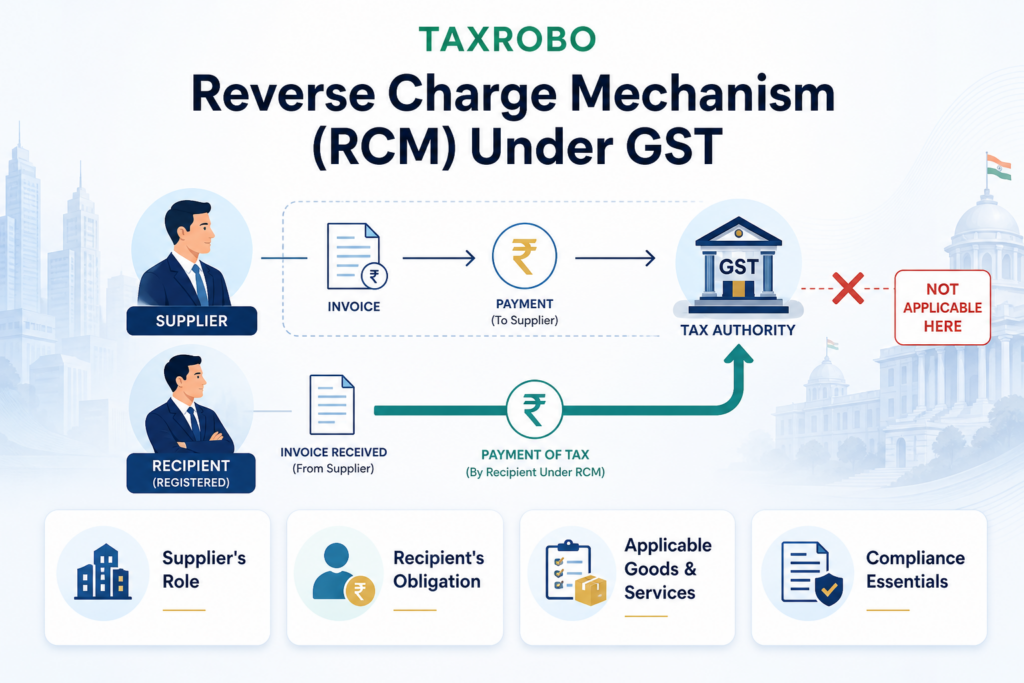
As a business owner in India, have you ever paid a lawyer or a transport agency and felt unsure about the GST implications? You’re not alone. The concept of a ‘reverse charge’ can be confusing. To properly comply with tax laws, it is crucial to understand the reverse charge mechanism under GST, a concept that flips the standard tax collection process on its head. In the normal GST system, known as the ‘Forward Charge’, the supplier of goods or services is responsible for collecting GST from their customer and remitting it to the government. However, the reverse charge mechanism shifts this responsibility entirely. Under RCM, the liability to pay GST to the government moves from the supplier to the recipient of the goods or services. Understanding reverse charge mechanism India is therefore not just an academic exercise; it’s a critical component of financial compliance for any business, ensuring you can avoid penalties, maintain a clean financial record, and manage your cash flow effectively. This guide will break down the concept with clear, practical examples to demystify it for you.
What is the Reverse Charge Mechanism (RCM) Under GST?
At its core, the reverse charge mechanism under GST is a system where the receiver of goods or services pays the GST directly to the government, instead of the supplier. Think of it this way: in a regular transaction, the shopkeeper (supplier) charges you for a product plus GST, and then the shopkeeper pays that GST to the government. Under RCM, you (the customer/recipient) pay the shopkeeper only for the product’s value and then pay the applicable GST directly to the government yourself. The primary purpose of this mechanism is to widen the tax base and bring unorganized or smaller, unregistered sectors into the tax net, thereby preventing tax evasion on certain types of transactions. This process is not arbitrary; it is governed by specific legal provisions, primarily outlined in Section 9(3), 9(4), and 9(5) of the Central Goods and Services Tax (CGST) Act, 2017, which notify the specific goods, services, and circumstances under which this rule applies. This detailed article on reverse charge mechanism explained India will guide you through all these aspects.
Forward Charge vs. Reverse Charge: A Simple Comparison
To truly grasp the concept, it’s helpful to see a direct comparison between the standard ‘Forward Charge’ and the ‘Reverse Charge Mechanism’. The fundamental difference lies in who bears the responsibility for depositing the tax with the government. The following table highlights the key distinctions every business owner should know.
| Feature | Forward Charge Mechanism | Reverse Charge Mechanism (RCM) |
|---|---|---|
| Who Pays GST? | Supplier collects from the recipient & pays the government | Recipient pays GST directly to the government |
| Who Issues Invoice? | Supplier issues a tax invoice | Supplier issues a bill of supply; Recipient does “self-invoicing” |
| Applicability | Default mechanism for most transactions | Applicable only on specified goods/services |
When Does Reverse Charge Mechanism Under GST Apply?
The Reverse Charge Mechanism (RCM) is not a universal rule applied to all business transactions. Its application is specifically limited to situations mandated by the government to ensure better tax compliance and monitoring in certain sectors. For a business, knowing precisely when RCM is triggered is the first step towards correct compliance. The GST law broadly categorizes the application of RCM into three distinct scenarios: when dealing with the supply of specific government-notified goods and services, when a registered dealer procures certain items from an unregistered supplier (with very specific conditions), and when services are supplied through an e-commerce operator. Each of these scenarios has its own set of rules and implications that businesses must understand to correctly calculate and pay their tax liabilities without error.
Supply of Notified Goods and Services (under Section 9(3))
The most common application of RCM falls under Section 9(3) of the CGST Act. Under this provision, the government has created a specific list of goods and services where the recipient is always liable to pay the GST. This is done to ensure tax is collected on transactions from largely unorganized sectors where it might be difficult for the individual suppliers to manage GST compliance. As a business owner, if you receive any of these notified supplies, the onus is on you to calculate the GST, pay it to the government, and handle the related compliance.
List of Common Services Under RCM:
- Goods Transport Agency (GTA) Services: When a business entity receives transportation services from a GTA that has not opted to pay GST at 12%.
- Legal services provided by an individual advocate, a senior advocate, or a firm of advocates to any business entity.
- Services from an Arbitral Tribunal to a business entity.
- Sponsorship services provided to any body corporate or partnership firm.
- Services supplied by a director of a company or a body corporate to the said company.
- Services from an insurance agent to any person carrying on an insurance business.
List of Common Goods Under RCM:
- Cashew nuts (not shelled or peeled)
- Bidi wrapper leaves
- Tobacco leaves
- Silk yarn
- Raw cotton (supplied by an agriculturist to a registered person)
- Lottery supply
Actionable Tip: This list is subject to change based on government notifications. It’s crucial to stay updated by regularly checking the official CBIC website for the latest list of notified goods and services.
Purchases from an Unregistered Supplier (under Section 9(4))
Section 9(4) of the CGST Act was originally introduced with a broad scope, stating that if a registered person purchases taxable goods or services from an unregistered supplier, the registered person would have to pay GST under the reverse charge mechanism. This was intended to discourage registered businesses from dealing with unregistered suppliers to evade taxes. However, this provision caused significant compliance burdens for small businesses.
Crucial Clarification: Recognizing the challenges, the government has deferred the applicability of this provision for most goods and services. Currently, Section 9(4) is only active and applicable for a specific sector: promoters and builders in the real estate industry. They are required to pay RCM on specified procurements of goods like cement and other materials from unregistered suppliers if their total purchases from unregistered dealers exceed a certain threshold of their total procurements. For all other industries, this section is not currently in force, which is one of the most important GST reverse charge implications for businesses to note.
Services Through an E-commerce Operator (under Section 9(5))
The rise of the platform economy has led to a specific provision for RCM under Section 9(5). This section mandates that for certain services provided through an e-commerce operator (ECO), the operator itself is considered the supplier for GST purposes and is liable to pay the tax. This simplifies tax collection from a large number of individual service providers who might otherwise remain outside the tax net. In this scenario, the individual service provider (like a driver or a host) does not have to worry about GST, as the platform they use handles the liability.
Common Examples:
- Passenger transport services provided through platforms like Uber and Ola. The company (Uber/Ola) is responsible for paying the GST, not the individual driver.
- Accommodation services in hotels, inns, or guest houses provided through platforms like OYO and Airbnb, especially if the underlying accommodation provider is not registered under GST.
- Housekeeping and personal care services like plumbing or carpentry, when supplied through an operator like Urban Company.
Practical Guide: GST Reverse Charge Implications for Businesses
Understanding the “what” and “when” of RCM is only half the battle. The other half is knowing how to comply with it in your day-to-day operations. The GST reverse charge implications for businesses are significant and require specific actions related to registration, invoicing, tax payment, and return filing. Ignoring these steps can lead to penalties and legal complications. Here’s a practical, step-by-step guide to ensure your business remains compliant when dealing with RCM transactions.
Mandatory GST Registration
One of the most critical rules associated with RCM is that it triggers a mandatory requirement for GST registration. Under normal circumstances, a business only needs to register for GST if its aggregate annual turnover exceeds a specified threshold (e.g., ₹40 lakhs for goods and ₹20 lakhs for services in most states). However, this threshold limit does not apply to RCM. If you are a person or business liable to pay tax under the reverse charge mechanism for any transaction, you must obtain GST registration, regardless of your annual turnover. This means even a small business with a turnover of just ₹5 lakhs would need to register for GST if it receives, for instance, legal services from an advocate, as that transaction falls under RCM.
Invoicing and Payment Vouchers
The invoicing rules under RCM are different from the standard forward charge mechanism. Since the supplier in many RCM cases (especially an unregistered one) cannot issue a tax invoice, the compliance burden shifts to the recipient.
- Self-Invoicing: When a registered business purchases goods or services from an unregistered supplier and the transaction is covered under RCM, the registered recipient must issue an invoice for the purchase to themselves. This is known as a “self-invoice.” This invoice must contain all the particulars that a standard tax invoice would, and it serves as the official document for accounting and claiming input tax credit.
- Payment Voucher: In addition to the self-invoice, the registered recipient is also required to issue a payment voucher to the supplier at the time of making the payment for the RCM-covered supplies.
Input Tax Credit (ITC) on RCM
One of the most frequently asked questions about RCM revolves around Input Tax Credit (ITC). The process is straightforward but has a crucial condition attached to it. The tax paid under RCM is available as Input Tax Credit (ITC), but the flow of funds is specific and must be followed correctly.
- Pay First in Cash: The GST liability that arises from a reverse charge transaction must be paid to the government in cash. This means you must deposit the tax amount through your electronic cash ledger. You are strictly not allowed to use your existing ITC balance in the electronic credit ledger to offset or pay your RCM liability.
- Claim Later as ITC: Once you have discharged the RCM liability by paying it in cash, you can then claim the same amount as Input Tax Credit in your GST return for the same month. This credit can then be used to pay off your future output tax liabilities, subject to the standard ITC rules and conditions (e.g., the supply must be used for business purposes).
GST Return Filing and Compliance
Accurate reporting is key to RCM compliance. You must declare your RCM liabilities and the corresponding ITC claims in your monthly GST return filing. Failure to report these transactions correctly can lead to notices and penalties from the tax authorities.
- Form GSTR-3B: This is the primary return for reporting RCM transactions.
- The tax liability on your inward supplies subject to reverse charge must be declared in Table 3.1(d) of GSTR-3B. This is where you declare the tax you need to pay in cash.
- The eligible Input Tax Credit on the tax you just paid can be claimed in Table 4(A)(3) of the same GSTR-3B form.
- Form GSTR-1: This form is used to declare details of your outward supplies (sales). Since RCM transactions are related to inward supplies (purchases), they are not reported in GSTR-1 by the recipient.
Reverse Charge under GST Examples (India-Specific Scenarios)
Theoretical knowledge becomes much clearer when applied to real-world business scenarios. To further simplify the concept, here are a few practical reverse charge under GST examples India that illustrate how the mechanism works. These scenarios cover some of the most common transactions small and medium-sized businesses encounter, making it easier to understand the practical application of the reverse charge GST explained with examples India.
Example 1: A Company Hires a Lawyer
This is a classic and frequent example of RCM in action for almost every business entity. Legal services are one of the notified services under Section 9(3).
- Scenario: ABC Pvt. Ltd., a company registered under GST, hires a law firm to handle a legal matter. The law firm issues a bill for their professional services amounting to ₹1,00,000.
- RCM Application:
- Since legal services provided by a firm of advocates to a business entity fall under RCM, the law firm will not charge GST on its invoice.
- ABC Pvt. Ltd. will pay the full amount of ₹1,00,000 to the law firm.
- ABC Pvt. Ltd. must then calculate the GST on this amount. Assuming the rate is 18%, the GST liability is ₹18,000 (18% of ₹1,00,000).
- The company will pay this ₹18,000 directly to the government’s account in cash while filing its GSTR-3B for that month.
- Simultaneously, ABC Pvt. Ltd. can claim this ₹18,000 as Input Tax Credit (ITC) in the same GSTR-3B, which can be used to offset its future output tax liability.
Example 2: A Manufacturer Uses a Goods Transport Agency (GTA)
Transportation is another key area where RCM is commonly applicable, affecting businesses in manufacturing, trading, and distribution.
- Scenario: XYZ Manufacturing, a registered entity, hires a Goods Transport Agency (GTA) to transport its finished products to a distributor. The freight charge is ₹50,000. The GTA has not opted to pay GST under the forward charge mechanism (which would be at a 12% rate).
- RCM Application:
- Services provided by a GTA are notified under RCM. When the GTA does not charge GST at 12%, the liability falls on the recipient at a 5% rate.
- XYZ Manufacturing will pay the ₹50,000 freight charge to the GTA.
- The company will then calculate GST at 5% on this amount, which comes to ₹2,500 (5% of ₹50,000).
- This ₹2,500 must be paid directly to the government by XYZ Manufacturing.
- This amount of ₹2,500 can then be claimed as ITC by XYZ Manufacturing in its monthly GST return.
Conclusion
The reverse charge mechanism under GST might seem like an added layer of complexity, but it is a systematic tool designed by the government to improve tax compliance in specific sectors. For businesses, the key takeaways are clear: RCM shifts the tax payment liability from the supplier to the recipient, it is applicable only in specific, government-notified cases, and compliance requires a disciplined approach. This includes mandatory GST registration regardless of turnover, diligent self-invoicing where required, and the crucial two-step process of paying the tax liability in cash before claiming it as Input Tax Credit. While it demands careful attention, a proper understanding of RCM is absolutely essential for smooth business operations, accurate financial reporting, and avoiding unnecessary legal issues and penalties.
Navigating the nuances of GST can be challenging. If you need expert assistance with your GST compliance or want to understand the GST reverse charge implications for your business in more detail, schedule a consultation with TaxRobo’s experts today. We make GST simple for you.
Frequently Asked Questions (FAQs)
Q1: Do I need to register for GST if my only tax liability is under RCM?
A: Yes. GST registration is mandatory for any person required to pay tax under the reverse charge mechanism, even if their total turnover is below the standard threshold limit (e.g., ₹20/40 lakhs). The threshold exemption does not apply to RCM liabilities.
Q2: Can I use my Input Tax Credit (ITC) balance to pay my RCM liability?
A: No. This is a common point of confusion. Tax liability arising from RCM must be paid in cash through the electronic cash ledger. You cannot use your existing ITC balance for this payment. However, once you have paid the tax in cash, you can claim the amount paid as ITC in the same month’s tax return.
Q3: What is self-invoicing under RCM?
A: When a registered business purchases goods or services (that fall under RCM) from an unregistered supplier, the supplier cannot issue a GST-compliant tax invoice. In such cases, the law requires the registered buyer to issue an invoice to themselves for the transaction. This is known as a self-invoice, and it serves as the primary document for accounting for the purchase and claiming ITC.
Q4: Is RCM applicable on import of services?
A: Yes, the import of services is a key area where the reverse charge mechanism under GST applies. When a business in India receives a service from a supplier located outside India, the Indian recipient of the service is liable to pay the Integrated GST (IGST) on a reverse charge basis. This ensures that services consumed within India are taxed, regardless of the supplier’s location.