
How to Register a One Person Company (OPC) Online in India: A Step-by-Step Guide for 2023
Are you a solo entrepreneur, a freelancer with big ambitions, or a salaried professional looking to turn your side hustle into a legitimate business? The dream of running your own company often comes with the daunting thought of complex legal structures and finding business partners. Fortunately, the Indian legal landscape offers a perfect solution for the solo visionary. This comprehensive guide will explain exactly how to register a One Person Company online, a structure designed specifically for single founders. A One Person Company (OPC) is a revolutionary concept in India that allows a single individual to form a company with the dual benefits of limited liability and a separate legal identity, traditionally available only to larger enterprises. This guide will walk you through the complete online registration process for a One Person Company in India, covering everything from eligibility criteria and required documents to the final steps of receiving your incorporation certificate, empowering you to start your business journey with confidence.
What is a One Person Company (OPC)? A Quick Overview
A One Person Company, as introduced by the Companies Act, 2013, is a modern corporate structure that uniquely blends the advantages of a sole proprietorship with those of a private limited company. For the solo entrepreneur, this means you get the best of both worlds: complete control over your business operations, similar to a proprietorship, combined with the significant legal protection of limited liability, a hallmark of corporate entities. This structure ensures that your personal assets are shielded from any business debts or liabilities, providing a crucial safety net as you grow your venture. The company is treated as a distinct legal entity separate from you, the owner, which enhances its credibility in the eyes of clients, suppliers, and financial institutions, making it easier to secure loans and enter into contracts.
Key Features of an OPC
Understanding the core characteristics of an OPC can help you decide if it’s the right fit for your business idea. These features are designed to support and protect the solo entrepreneur. To see how an OPC compares to other business types, you can read our guide on Comparing Business Structures: Private Limited, LLP, OPC & More.
- Single Member: As the name suggests, only one individual is required to act as both the member and director of the company.
- Separate Legal Entity: The OPC is legally distinct from its owner. It can own property, incur debts, and enter into contracts in its own name.
- Limited Liability: This is the most significant advantage. The owner’s personal liability is limited to the extent of their investment in the company. Your personal property, like your home or car, is safe from business creditors.
- Perpetual Succession: The company’s existence is not tied to the life of its member. An OPC requires the appointment of a nominee who takes over the company’s affairs upon the death or incapacitation of the original member, ensuring business continuity.
Who Should Register a One Person Company?
The OPC structure is an ideal choice for a wide range of professionals and entrepreneurs who wish to operate a formalized business single-handedly. This includes consultants, creative professionals like designers and writers, tech entrepreneurs building a new app, and salaried individuals looking to legitimize a side business. By forming an OPC, you immediately gain a professional image and enhanced credibility, which can be pivotal when dealing with larger clients or vendors. Furthermore, this corporate structure provides better access to funding options from banks and investors compared to an unstructured proprietorship. The fact that you can register a One Person Company OPC online in India with relative ease has made it an increasingly popular and accessible choice for ambitious solo founders across the country.
Eligibility & Legal Requirements to Register a One Person Company in India
Before diving into the registration process, it’s crucial to ensure you meet all the prerequisites set forth by the Ministry of Corporate Affairs (MCA). Fulfilling these One Person Company legal requirements India is the first step towards a smooth and successful incorporation. These rules are in place to maintain the integrity of the OPC structure and ensure it is used by the individuals for whom it was intended.
Director and Member Requirements
The foundation of an OPC rests on its single member, and specific criteria must be met to qualify for this role.
- Citizenship & Residency: The individual forming the OPC must be a natural person (not a corporation), an Indian citizen, and a resident of India. The residency rule specifies that the person must have stayed in India for a period of at least 120 days during the immediately preceding financial year.
- Age: The member and director must be at least 18 years old.
- Single OPC Rule: An individual is permitted to form and be a member of only one OPC at any given time. This prevents the misuse of the OPC structure by a single person creating multiple entities.
Nominee Requirement
A unique and mandatory aspect of an OPC is the appointment of a nominee. This is a crucial provision for ensuring the company’s perpetual succession.
- The nominee is the person designated to take over the company in the unfortunate event of the sole member’s death or incapacity to contract.
- The nominee must also be a natural person, an Indian citizen, and a resident of India, meeting the same 120-day residency criteria.
- Written consent from the nominee is mandatory and must be filed with the Registrar of Companies (ROC) using Form INC-3 at the time of incorporation.
Capital & Naming Rules
Properly structuring the capital and selecting a compliant name are essential final checks before beginning the application process.
- Capital: There is no minimum paid-up share capital requirement to start an OPC. You can begin with any amount of capital that suits your business needs.
- Name: The chosen name for your company must be unique and not resemble any existing company or trademark. Most importantly, the name must end with the suffix “(OPC) Private Limited” to clearly identify its legal structure. It is highly recommended to check the availability of your proposed name on the MCA portal before starting the application to avoid rejection and delays. You can check for name availability at the official MCA Name Check facility.
Document Checklist for One Person Company Registration in India
Having all your paperwork in order is critical to ensuring a seamless and swift registration process. A well-organized document checklist for One Person Company registration India will help you avoid back-and-forth communication with authorities and prevent unnecessary delays. For a comprehensive overview, you can also refer to our master list of Documents Required for Incorporation of a Company. The documents are broadly categorized into those required for the individuals involved (director and nominee) and those for the company’s registered office.
Documents for the Director/Member & Nominee
Both the primary member and the appointed nominee need to provide a standard set of identity and address proofs. Ensure these documents are clear, valid, and self-attested where required.
- PAN Card: A scanned, self-attested copy of the Permanent Account Number (PAN) card is mandatory.
- Identity Proof: A scanned copy of a government-issued photo ID, such as an Aadhaar Card, Voter’s ID, Passport, or Driving License.
- Address Proof: A recent copy (not older than two months) of a bank statement, telephone bill, mobile bill, or electricity bill displaying the current address.
- Photograph: A recent passport-sized photograph in digital format.
Documents for the Registered Office Address
The registered office is the official address of your company where all official correspondence will be sent. You must provide valid proof of this address.
- Proof of Address: A recent utility bill, such as an Electricity Bill, Telephone Bill, or Gas Bill (not older than two months), for the proposed registered office premises.
- NOC (No-Objection Certificate): If the premises are rented or owned by a third party (like a family member), a No-Objection Certificate from the property owner is required, stating they have no objection to the company using their address as its registered office.
- Rental Agreement: A scanned copy of the rental agreement if the property is leased.
The Step-by-Step Online Registration Process for a One Person Company (OPC)
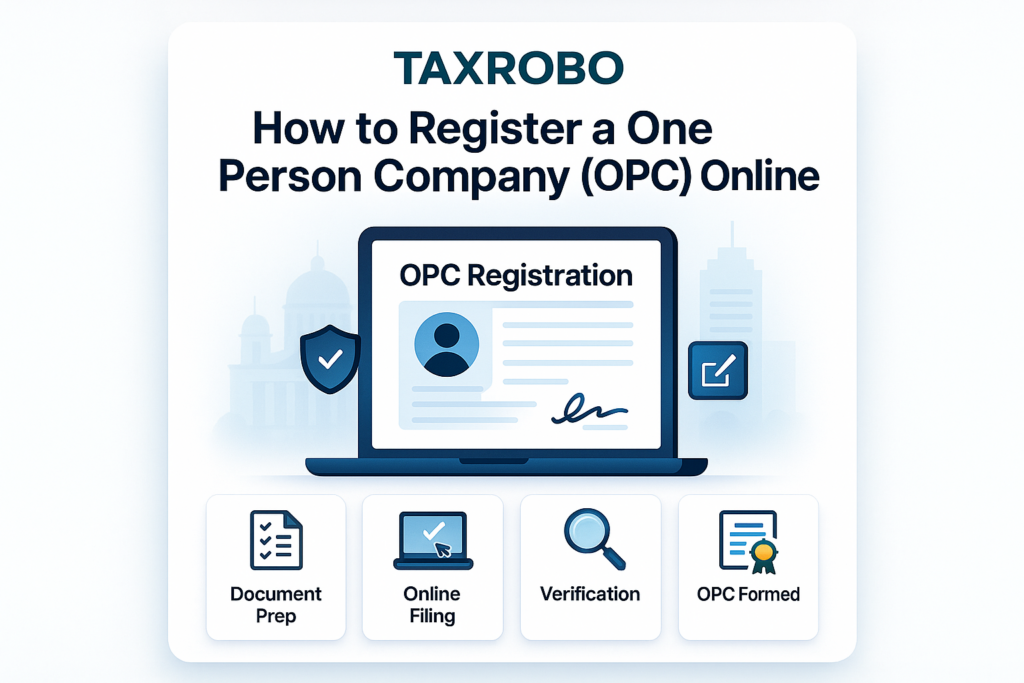
The Ministry of Corporate Affairs has significantly streamlined the incorporation process through its online portal. The following steps to register a One Person Company online in India are integrated into a single, comprehensive web-based form called SPICe+ (Simplified Proforma for Incorporating Company Electronically Plus). This integrated approach has simplified the overall One Person Company registration procedures in India and reduced the time it takes to get your business legally recognized.
Step 1: Obtain Digital Signature Certificate (DSC)
Before you can file any electronic forms on the MCA portal, you must obtain a Digital Signature Certificate (DSC). A DSC is the electronic equivalent of a physical signature and is used to verify the identity of the signatory. For company registration purposes, a Class 3 DSC is required for the sole member/director. This certificate is issued by licensed Certifying Authorities (CAs) and is the foundational step for initiating the entire register OPC online process in India.
Step 2: Apply for Director Identification Number (DIN)
Every individual intending to be a director in a company must have a unique Director Identification Number (DIN). Previously, this was a separate application process. However, with the introduction of the SPICe+ form, the application for DIN for a new director is integrated directly into the incorporation form itself. This simplification means you don’t have to file a separate form for DIN, making the process faster and more efficient.
Step 3: Company Name Reservation (SPICe+ Part A)
The first part of the SPICe+ form is Part A, which deals with name reservation. You can propose up to two names for your company in order of preference. The name must be unique and adhere to the naming guidelines prescribed by the MCA. To increase the chances of quick approval, ensure your proposed name is not identical or too similar to an existing company name or registered trademark and is not generic or offensive. Once submitted, the ROC will review the name, and upon approval, it will be reserved for 20 days, within which you must file Part B of the form.
Step 4: Filing the Main Incorporation Form (SPICe+ Part B)
This is the core of the application where you provide all the detailed information required to register a One Person Company. SPICe+ Part B is a comprehensive electronic form that consolidates applications for several services into one. It requires details about the company’s capital structure, registered office address, the sole member and director, and the nominee. Along with this main form, several linked electronic forms must be filed simultaneously:
- e-MOA (INC-33): The Memorandum of Association is a charter document that defines the company’s objectives and the scope of its business activities.
- e-AOA (INC-34): The Articles of Association outlines the internal rules and regulations for the management and governance of the company.
- AGILE-PRO-S: This integrated form is for applying for GSTIN (Goods and Services Tax Identification Number), EPFO (Employees’ Provident Fund Organisation) registration, ESIC (Employees’ State Insurance Corporation) registration, and opening a corporate bank account.
Step 5: Upload Documents & Pay Fees
After meticulously filling out SPICe+ Part B and the linked forms, you must upload all the supporting documents listed in the checklist above. Each form needs to be digitally signed using the director’s DSC. Once all forms and documents are attached and signed, you proceed to pay the requisite government fees and stamp duty, which vary depending on the state of registration and the authorized capital of the company.
Step 6: Scrutiny by ROC & Certificate of Incorporation
The final step involves the verification of your application by the Registrar of Companies (ROC). The ROC official will scrutinize all the submitted forms and documents for accuracy and compliance. If everything is in order, the ROC will approve the application and issue the Certificate of Incorporation (COI). This certificate is conclusive evidence of your company’s existence. Along with the COI, the ROC will also allot the company’s Permanent Account Number (PAN) and Tax Deduction and Collection Account Number (TAN).
Post-Registration Compliances for an OPC
Successfully registering your OPC is a significant milestone, but it also marks the beginning of your responsibilities as a corporate entity. Adhering to post-registration compliances is mandatory to maintain your company’s active status and avoid penalties. These ongoing tasks are crucial for legal and financial good standing. For a detailed checklist and procedures, please refer to our guide on Annual Compliances for One Person Company (OPC).
Open a Corporate Bank Account
Immediately after receiving the Certificate of Incorporation, you must open a current bank account in the name of the OPC. This is essential for keeping your business finances separate from your personal finances. All business-related transactions should be conducted through this corporate account. The AGILE-PRO-S form facilitates the opening of a bank account with a designated bank, simplifying this step.
Annual ROC Filings
Every OPC is required to file annual returns with the Registrar of Companies to provide a yearly overview of its financial and operational status.
- Financial Statements: You must file your company’s audited financial statements (Balance Sheet, Profit & Loss Account) in Form AOC-4 within 180 days from the end of the financial year (i.e., by September 27th).
- Annual Return: An Annual Return containing details about the company, its member, etc., must be filed in Form MGT-7A within 60 days from the conclusion of the Annual General Meeting (AGM).
Income Tax Filing
Like any other business entity, an OPC is legally obligated to file an annual Income Tax Return with the Income Tax Department. The applicable form for an OPC is ITR-6. This must be filed by the due date prescribed under the Income-tax Act to report the company’s income and calculate its tax liability for the financial year. You can find more details and file your return on the official Income Tax India Website.
Conclusion
The One Person Company structure has truly empowered solo entrepreneurs in India, offering them a formal, credible, and legally protected way to conduct business. While the government has simplified the steps to register a One Person Company online, the process still demands meticulous attention to legal details, accurate documentation, and procedural adherence. From obtaining a DSC and reserving a unique name to filing the comprehensive SPICe+ form and fulfilling post-registration compliances, each step is critical. The register OPC online process in India is a journey that transforms an individual’s business idea into a recognized corporate entity with limited liability and perpetual succession.
Ready to start your entrepreneurial journey? The process to register a One Person Company can be complex. Let TaxRobo’s experts manage the entire registration for you, from DSC to receiving your Certificate of Incorporation. Contact us today for a seamless and hassle-free experience!
Frequently Asked Questions (FAQs)
Q1. Can a foreign national register an OPC in India?
A: No. To register an OPC, the sole member must be a natural person, an Indian citizen, and a resident of India. This means they must have resided in India for at least 120 days in the preceding financial year.
Q2. What is the tax rate for a One Person Company?
A: An OPC is taxed as a domestic company. The income is taxed at a flat rate of 25% (plus applicable cess and surcharge), provided its total turnover or gross receipts in the previous year did not exceed ₹400 crore. Otherwise, a higher rate may apply.
Q3. Can I convert my OPC into a Private Limited Company?
A: Yes. An OPC can be voluntarily converted into a Private Limited or Public Limited Company at any time. However, mandatory conversion is required if its paid-up share capital exceeds ₹50 lakhs or its average annual turnover for the relevant period exceeds ₹2 crores.
Q4. Is an audit mandatory for an OPC?
A: Yes. An OPC is a type of private company registered under the Companies Act, 2013. Therefore, it is mandatory for an OPC to have its financial accounts audited by a qualified Chartered Accountant at the end of every financial year.