
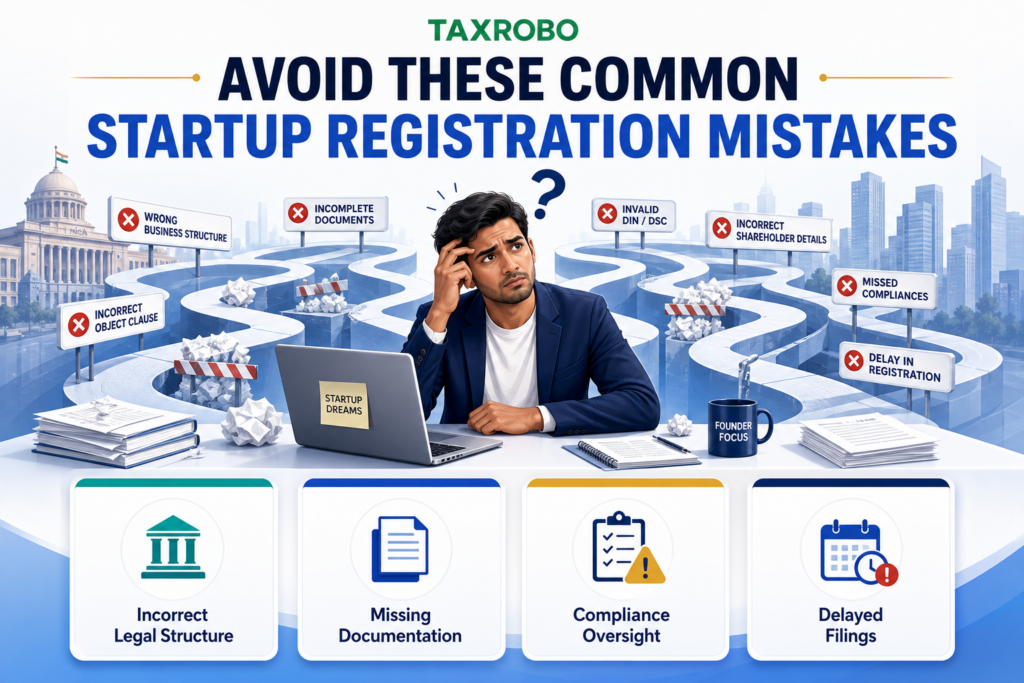

Top 10 Mistakes Startups Make During Company Registration in India
Bringing a business idea to life is one of the most exciting journeys an entrepreneur can embark on. In the rush of developing a product, building a team, and chasing the first customer, it’s easy to see legal paperwork as a mere formality. However, this enthusiasm can lead to overlooking critical legal steps, and one of the biggest hurdles is the company registration process itself. The initial incorporation is more than just getting a certificate; it’s the legal bedrock upon which your entire venture will be built. Making even minor oversights here can create significant legal and financial problems down the line, which is why understanding the common mistakes startups make during company registration is crucial.
Minor errors in your application can become major startup company registration pitfalls India as your business grows. Getting the foundation wrong can lead to compliance issues, shareholder disputes, funding roadblocks, and unnecessary financial penalties. By understanding these potential missteps from the outset, you can save an incredible amount of time, money, and stress, allowing you to focus on what truly matters: growing your business. In this detailed guide, we will break down the top 10 mistakes startups make during company registration in India and provide actionable steps to ensure you start your venture on the right foot.
Mistake #1: Choosing the Wrong Business Structure
One of the earliest and most fundamental decisions a founder must make is choosing the right legal structure for their company. Unfortunately, many entrepreneurs default to registering a Private Limited Company without thoroughly evaluating other options like a Limited Liability Partnership (LLP), a One Person Company (OPC), or even a Sole Proprietorship. This is one of the biggest registration mistakes startups make in India because the chosen structure has long-term consequences that are difficult and expensive to reverse.
The choice of business entity directly impacts everything from your annual compliance costs and tax liabilities to your personal liability and ability to raise external funding. For example, a Private Limited Company is ideal for startups seeking venture capital, but it comes with a higher compliance burden compared to an LLP. An LLP offers a great balance of limited liability and operational flexibility, making it perfect for service-based businesses, but it’s not suitable for issuing stock options (ESOPs) to employees. Making the wrong choice can trap your business in a structure that doesn’t align with its long-term goals.
How to Avoid It:
Before settling on a structure, carefully consider your business goals for the next three to five years. Do you plan to raise funds? Do you need to limit your personal liability? How many partners or shareholders will be involved? Here’s a quick guide to help you decide.
Private Limited Company (Pvt. Ltd.)
- Best for: Ambitious startups that plan to raise equity funding from angel investors or venture capitalists. It’s the most scalable business structure, allows for offering Employee Stock Ownership Plans (ESOPs), and separates your personal assets from the company’s liabilities.
Limited Liability Partnership (LLP)
- Best for: Professional service firms (like chartered accountants, lawyers, or consultants) and small businesses that want the benefit of limited liability but with fewer compliance requirements than a Private Limited Company. It combines the flexibility of a partnership with the advantages of a corporate entity.
One Person Company (OPC)
- Best for: Solo entrepreneurs who want to operate as a formal corporate entity with limited liability. An OPC is a great way to test a business idea without the complexities of having multiple shareholders, but it has limitations on turnover and paid-up capital, after which it must convert to a Private Limited Company.
Actionable Tip: Create a simple comparison table weighing these structures against key factors: Compliance Costs, Tax Rates, Liability Protection, Fundraising Ability, and Scalability. This exercise will provide clarity and help you make a data-driven decision.
Mistake #2: Not Conducting a Thorough Company Name Search
Founders often become attached to a specific brand name, only to have their registration application rejected because the name is already taken or doesn’t comply with official guidelines. Simply checking if the domain name is available is not enough. The Ministry of Corporate Affairs (MCA) has strict rules for name approval, and failing to follow them wastes valuable time and money on re-application fees.
A poorly researched name can cause two major problems. First, if the proposed name is identical or too similar to an existing company or LLP, the MCA will reject it outright. Second, even if the MCA approves the name, it might infringe on an existing registered trademark. This can lead to a legal battle later on, potentially forcing you into a costly and damaging rebranding exercise. This is a common but easily avoidable error among the top registration errors for startups in India.
How to Avoid It:
Conduct a multi-level search before finalizing your company name.
Check for Uniqueness & Similarity
- Before filing your application, use the MCA portal’s free name search tool. Search for your desired name and several variations to see if any phonetically or alphabetically similar names exist. You can access this feature directly on the official MCA portal.
Check for Trademark Availability
- Company registration does not grant you trademark rights. Your approved company name could still infringe on someone else’s registered trademark. To avoid this, perform a public search on the IP India portal to ensure your name or logo isn’t already protected. You can search the database on the IP India Public Search portal.
Follow MCA Naming Guidelines
- The MCA will reject names that are too generic (e.g., “Best Marketing Services Pvt. Ltd.”), offensive, or falsely imply a connection with a government body or international organization (e.g., using words like “National,” “Union,” or “RBI”). The name should be unique and reflect your business activities.
Mistake #3: Incomplete or Poorly Drafted MOA and AOA
The Memorandum of Association (MOA) and Articles of Association (AOA) are the two most important constitutional documents of a company. The MOA defines the company’s objectives and the scope of its operations, while the AOA outlines the internal rules for its management. Many founders make the mistake of using generic, copy-pasted templates for these documents without customizing them to their specific business needs.
This oversight can have serious repercussions. A narrowly defined “object clause” in the MOA can legally prevent your company from diversifying into new business areas in the future without going through a cumbersome amendment process. For example, if your MOA only states “software development” as your objective, you may face legal hurdles if you later decide to venture into hardware sales. Similarly, a poorly drafted AOA can lead to internal conflicts between directors and shareholders over issues like voting rights, share transfers, and the appointment of directors, as the default rules may not suit your startup’s context.
How to Avoid It:
- Draft a Comprehensive MOA: Clearly define your primary business activities in the main object clause. In the ancillary objects section, think long-term and include any potential business lines or related activities your company might pursue in the future. This gives you the flexibility to pivot or expand without needing to amend the MOA.
- Customize Your AOA: Don’t rely on a standard template. Carefully draft the AOA to define the internal governance structure. This includes specifying the rights and powers of directors, rules for board and shareholder meetings, procedures for issuing and transferring shares, and protocols for decision-making. A well-defined AOA acts as a clear rulebook that can prevent future disputes.
Mistake #4: Ignoring the Importance of a Founders’ Agreement
When a startup is founded by friends or family, there is often a high level of trust. This trust leads them to rely on verbal understandings about their roles, responsibilities, and equity stakes, causing them to skip a formal Founders’ Agreement. This is one of the most dangerous startup company registration pitfalls India. As the business grows and faces challenges, disagreements are inevitable, and without a written agreement, these disputes can tear the company apart.
Verbal promises are nearly impossible to enforce legally. What happens if one founder contributes less work than expected? What if someone wants to leave the company after a year? Who owns the intellectual property created for the business? Without a Founders’ Agreement, there are no clear answers to these critical questions, often leading to deadlocks, costly legal battles, and the potential collapse of the venture.
How to Avoid It:
- Draft and sign a comprehensive Founders’ Agreement before you even begin the company registration process. This document should be a legally binding contract that clearly outlines the relationship between the co-founders.
Key Clauses to Include
- Equity Ownership & Vesting Schedule: Define the exact percentage of equity each founder holds. Implement a vesting schedule (e.g., over 4 years with a 1-year cliff) to ensure founders earn their equity by staying with the company for a specified period.
- Roles and Responsibilities: Clearly outline the specific duties, roles, and titles of each founder to avoid ambiguity and ensure accountability.
- IP Ownership: Specify that all intellectual property (code, designs, brand assets) created by any founder related to the business is owned by the company, not the individual.
- Exit Clauses: Define what happens if a founder leaves the company, becomes incapacitated, or passes away. This includes buyout terms and the process for transferring their shares.
- Decision-Making Process: Outline how major business decisions will be made (e.g., by majority vote or unanimous consent) to prevent operational gridlock.
Mistake #5: Incorrect Director and Shareholder Details
The company registration process in India is entirely digital and requires the submission of precise personal information for all proposed directors and shareholders. A common and frustrating mistake is providing details—such as name spelling, date of birth, father’s name, or address—that do not exactly match the information on official documents like the PAN card and Aadhaar card.
Even the smallest discrepancy will cause the MCA system to flag and reject the application forms (like SPICe+). This leads to significant delays as you have to correct the information and resubmit the forms. Furthermore, failing to procure a Digital Signature Certificate (DSC) and Director Identification Number (DIN) for all proposed directors at the beginning of the process can bring everything to a halt, as these are mandatory prerequisites for filing any electronic forms with the MCA.
How to Avoid It:
- Double-Check Every Detail: Before filling out any forms, collect the PAN cards, Aadhaar cards, and address proofs of all directors and shareholders. Scrutinize them to ensure every detail is entered exactly as it appears on the documents.
- Use Recent Address Proof: The address proof submitted (such as a bank statement or utility bill) must not be older than two months from the date of filing. Ensure the name and address on the proof match the PAN and Aadhaar records.
- Apply for DSC and DIN First: Obtaining the Class-3 DSC and applying for the DIN should be the very first steps you take. The entire registration process hinges on these credentials, so getting them sorted out early will prevent bottlenecks later.
Mistake #6: Not Registering Intellectual Property (IP)
Many founders mistakenly believe that registering their company name with the MCA automatically protects their brand. They focus all their energy on incorporation and completely overlook the registration of their intellectual property, such as the brand name, logo, or a unique invention.
This is a critical error because company registration and trademark registration are two completely separate legal processes governed by different authorities. Registering “MyUniqueBrand Pvt. Ltd.” with the MCA does not grant you the exclusive right to use the “MyUniqueBrand” name in commerce. Another individual or company can register “MyUniqueBrand” as a trademark and legally stop you from using it. If this happens, you could be forced into a costly rebranding exercise or a lengthy legal dispute to reclaim your brand identity.
How to Avoid It:
- File for a Trademark Concurrently: Treat trademark registration with the same urgency as company registration. As soon as you have finalized your brand name and logo, you should file a trademark application. This can be done simultaneously with the company incorporation process.
- Understand the Difference: Recognize that the MCA grants you the right to operate as a corporate entity under a specific name, while the IP India registry grants you the exclusive right to use your brand name and logo for specific goods or services across the country. Protecting your IP is as important as creating your legal entity.
Mistake #7: Misunderstanding Authorized vs. Paid-Up Capital
The concepts of authorized and paid-up share capital often confuse first-time entrepreneurs. Authorized capital is the maximum amount of share capital that a company is legally permitted to issue to its shareholders, as stated in its MOA. Paid-up capital is the actual amount of money that shareholders have paid to purchase shares. A frequent mistake is setting an unnecessarily high authorized capital (e.g., ₹10 Lakhs or more) at the time of incorporation, thinking it makes the company look more valuable.
The problem with this approach is that the government fees and stamp duty payable during incorporation are directly linked to the amount of authorized capital. Setting a higher capital means you pay higher registration fees, even if you have no immediate plans to issue that many shares. This unnecessarily increases your initial setup costs, diverting precious funds that could be used for business operations.
How to Avoid It:
- Start with Minimum Capital: For most startups, it is advisable to start with the minimum required authorized capital, which is typically ₹1,00,000. This keeps the initial incorporation fees low.
- Increase Capital When Needed: Understand that authorized capital is not set in stone. It can be increased at any time in the future by passing a shareholder resolution and paying the applicable MCA fees and stamp duty. It is far more cost-effective to increase capital as and when you need to raise more funds, rather than paying a large fee upfront.
Mistake #8: Forgetting Post-Registration Compliances
Receiving the Certificate of Incorporation is a moment of celebration, but many founders mistakenly believe their work is done. They assume the company is fully operational and ready to go. However, there are several mandatory post-registration compliances that must be completed within a specific timeframe. Ignoring these steps is one of the most serious company registration mistakes in India that can cost you dearly.
Failure to complete these initial compliances can lead to heavy penalties from the MCA, the company being marked as “inactive,” and even the disqualification of its directors. These consequences can cripple a young startup before it even has a chance to get off the ground, creating legal hurdles that hinder its ability to conduct business.
How to Avoid It:
- Treat the post-incorporation phase with the same diligence as the registration itself. Create a checklist of immediate next steps and assign deadlines.
Immediate To-Do List After Incorporation
- Open a Corporate Bank Account: Open a current bank account in the company’s name within 30 days of incorporation.
- Deposit Share Capital: The initial subscribers to the MOA must deposit their respective share subscription amounts into this new corporate bank account.
- File Form INC-20A: Within 180 days of incorporation, the company must file Form INC-20A (Declaration of Commencement of Business) with the MCA. This form confirms that the subscribers have paid for their shares. You cannot legally start business operations until this is filed.
- Appoint the First Auditor: The Board of Directors must appoint the first statutory auditor for the company within 30 days of incorporation.
Mistake #9: Overlooking Necessary Tax and Other Registrations
Company registration is just one piece of the legal puzzle. Depending on the nature and scale of your business, you will likely need several other registrations to operate legally. Startups often overlook the need to apply for GST registration, TAN, Professional Tax, or other licenses required by their specific industry or state.
This oversight can cause significant operational bottlenecks. For instance, without a GST registration, you cannot issue GST-compliant invoices to your clients, which can be a deal-breaker for B2B transactions. Without a Tax Deduction and Collection Account Number (TAN), you cannot legally deduct TDS on payments like salaries or rent, leading to non-compliance. Failing to register under state-specific laws like the Shops & Establishment Act can also result in fines.
How to Avoid It:
- Assess Your Registration Needs: Immediately after incorporation, analyze which other registrations are mandatory for your business.
- GST Registration: Check if you need to register for GST registration. Registration is mandatory if your annual turnover exceeds the threshold limit (₹40 lakhs for goods and ₹20 lakhs for services in most states). It is also compulsory for businesses engaged in e-commerce or inter-state sales, regardless of turnover. You can register on the official GST Portal.
- TAN Registration: Apply for a TAN if your company is liable to deduct Tax at Source (TDS) on payments such as salaries, contractor fees, rent, or professional fees.
- State-Specific Registrations: Research and comply with local laws. This may include Professional Tax (for employing staff), Shops and Establishment Act registration (for having a commercial premise), and any industry-specific licenses (e.g., FSSAI for a food business).
Mistake #10: Trying to Do Everything Yourself (DIY)
In an effort to bootstrap and save on initial costs, many founders attempt to navigate the entire company registration process on their own. While the intention is admirable, this DIY approach is often a false economy. The incorporation process involves multiple complex forms (like the integrated SPICe+ form), legal jargon, and specific online procedures that can be confusing for a layperson.
A single error in a form, an incorrectly uploaded document, or a missed procedural step can lead to the application being rejected or sent for resubmission. This not only causes frustrating delays but can also end up costing more in resubmission fees and the opportunity cost of wasted time. By trying to save a small amount on professional fees, you risk delaying your business launch and making costly errors. To avoid these company registration mistakes India, seeking professional guidance is often the wisest path.
How to Avoid It:
- Hire a Professional: Engage a reputable firm of Chartered Accountants (CAs), Company Secretaries (CSs), or a legal-tech platform like TaxRobo. These experts live and breathe corporate law and MCA procedures.
- Focus on Your Strengths: A professional will handle the entire end-to-end process, from name search and document preparation to filing and post-incorporation compliances. This ensures everything is done correctly and efficiently, freeing you to focus on your core business activities like product development, market research, and strategy. They can provide invaluable guidance on the common mistakes startups make in business registration India and help you build a solid legal foundation.
Why You Must Avoid These Startup Registration Errors
Getting your company registration right from the very beginning is not just about ticking a legal box; it’s a strategic investment in your company’s future health and stability. The mistakes outlined above can have a cascading effect, leading to severe consequences that can jeopardize your startup’s success.
- Financial Costs: Simple errors can lead to re-filing fees, government penalties for non-compliance, and higher professional fees required to fix the initial mistakes.
- Legal Risks: An incorrect structure or a poorly drafted Founders’ Agreement can lead to legal disputes between co-founders. Non-compliance with post-registration requirements can result in fines and director disqualification.
- Operational Delays: A delayed Certificate of Incorporation means you cannot open a corporate bank account, sign contracts with clients or vendors, or hire employees legally. This brings your business to a standstill.
It’s crucial to learn from startup registration errors India so that you don’t repeat them. A smooth and correct registration process sets a professional tone for your venture and ensures you start on a solid, compliant footing.
Conclusion
Launching a startup is a marathon, not a sprint, and the first few steps are the most critical. While it’s tempting to rush through the administrative tasks, building a strong legal foundation is non-negotiable for any business aspiring to long-term success. Avoiding common pitfalls like choosing the wrong business structure, failing to protect your intellectual property, and ignoring post-registration compliances will save you from future headaches and position your company for sustainable growth. Proactive planning and meticulous attention to detail are key to avoiding the common mistakes startups make during company registration.
Feeling overwhelmed? Don’t let paperwork stand in the way of your vision. The experts at TaxRobo have helped thousands of founders launch their businesses seamlessly. Contact us today for a free consultation and ensure your company registration is done right the first time!
Frequently Asked Questions (FAQs)
1. What is the single biggest mistake a startup can make during registration?
- Answer: The most critical error is choosing the wrong business structure (e.g., an LLP when a Pvt. Ltd. is needed for funding). This foundational decision impacts everything from taxation and compliance to your ability to raise capital and is very difficult and costly to change later.
2. Can I change my company name or business objective after registration?
- Answer: Yes, you can change both the company name and the object clause in your MOA after registration. However, the process requires passing a special resolution in a shareholder meeting and filing the necessary amendment forms with the MCA. It is a time-consuming and costly procedure, so it’s always better to get it right during the initial registration.
3. Do I need a physical office to register my company in India?
- Answer: You need a registered office address in India to receive official communication from government authorities. However, a dedicated commercial space is not mandatory at the time of registration. You can use a residential address as the registered office, provided you obtain a No Objection Certificate (NOC) from the property owner.
4. How long does the company registration process typically take?
- Answer: If all your documents are in order and there are no discrepancies, the entire process—from applying for the name to receiving the Certificate of Incorporation—can typically be completed within 7 to 15 working days. Delays most often occur due to the top registration errors for startups in India mentioned in this article, such as name rejection or incorrect document submission.