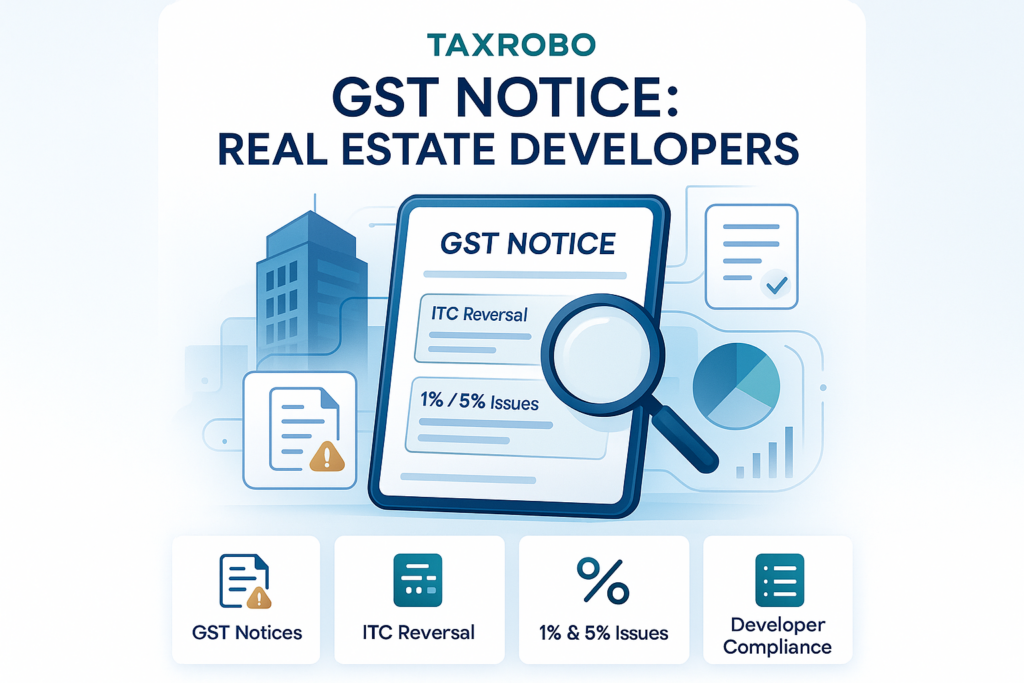

GST Notice for Real Estate Developers – ITC Reversal & 1%/5% Issues Explained
Have you recently received a GST notice that left you confused? You’re not alone. Many real estate developers across India are facing scrutiny, especially regarding the new GST rules introduced a few years ago. Since the government rolled out the new 1% and 5% GST rates for the real estate sector, one of the primary points of conflict and confusion has been the correct handling of Input Tax Credit (ITC), leading to a significant surge in GST notices from the department. The core of this challenge lies in understanding the complex ITC reversal issues real estate developers are grappling with, particularly for projects that were already underway when the new rules came into effect. This article will break down the complexities behind these notices, clarifying the root causes of compliance challenges. We will explain the core ITC reversal problems, clarify the 1% and 5% GST schemes, and provide a clear roadmap to help you respond to notices and maintain compliance, safeguarding your business from unnecessary penalties and legal troubles.
Understanding the GST Shift in Indian Real Estate
To grasp why these notices are being issued now, it’s essential to understand the fundamental shift in the GST landscape for the real estate industry. The changes, effective from April 1, 2019, were designed to make housing more affordable by lowering the tax burden on homebuyers, but they inadvertently created significant operational hurdles for developers. These GST impacts on the real estate sector in India have been profound, altering how project costs are calculated, how cash flow is managed, and most importantly, how tax liabilities are reported to the authorities. The transition from the old regime to the new one was not seamless, and the lingering effects of this change are the primary reason for the current wave of departmental scrutiny and notices.
The Old vs. New GST Regime: A Quick Recap
Before April 1, 2019, the GST system for real estate was relatively straightforward from a tax credit perspective. Developers would typically charge a higher rate of GST, such as 12% (after a one-third abatement for land value), on the sale of under-construction properties. The key advantage of this system was that they were eligible to claim Input Tax Credit (ITC) on all the goods (like cement, steel, tiles) and services (like architect fees, labour contracts) used in the construction process. This ability to claim ITC helped reduce the overall cost of construction, and the benefit was often passed on to the buyer. However, the new regime introduced concessional rates but came with a major condition: the disallowance of ITC. This change fundamentally altered the cost structure for developers and laid the groundwork for the compliance issues we see today.
What are the 1% and 5% GST Rates?
The new tax structure introduced two primary concessional rates for residential real estate, which came into effect on April 1, 2019. Understanding these is crucial to navigating the current GST rates for the real estate industry in India.
- 5% GST Rate: This rate is applicable on the total value of residential apartments in non-affordable housing projects. The critical condition attached to this rate is that the developer cannot claim any Input Tax Credit (ITC) on the inputs and services used for construction.
- 1% GST Rate: This highly concessional rate applies to affordable housing projects. A project is classified as “affordable” based on specific government criteria, such as a carpet area of up to 60 sq. meters in metropolitan cities (or 90 sq. meters elsewhere) and a property value of up to ₹45 lakhs. Just like the 5% rate, this scheme also prohibits the developer from claiming ITC.
It’s important to note that this ITC restriction primarily applies to residential projects. For the construction and sale of commercial properties (like shops or offices), the old rules generally still apply. Developers can charge 12% GST and are fully eligible to claim ITC, which creates a dual system for builders involved in mixed-use projects.
The Core Problem: ITC Reversal Issues for Real Estate Developers
The heart of the matter and the primary reason for the flood of GST notices is the complicated process of ITC reversal. For developers who had projects spanning the old and new tax regimes, the transition was fraught with challenges. The rules required a precise and often confusing calculation to reverse the credit that was no longer eligible, and even minor errors in this process have triggered departmental queries years later. These ITC reversal issues real estate developers face are not just a matter of simple accounting; they involve complex legal interpretations and meticulous documentation, making it a high-risk area for compliance.
What is Input Tax Credit (ITC) and Why Does it Matter?
In simple terms, Input Tax Credit (ITC) is the mechanism that allows a business to reduce its final tax liability. When a developer buys goods like steel or cement, they pay GST on that purchase. When they sell a property, they collect GST from the homebuyer. ITC allows them to deduct the GST they have already paid on their purchases (inputs) from the GST they have collected on their sales (output). This mechanism is the cornerstone of the GST system, as it prevents the “tax on tax” effect, where tax is levied on a value that already includes a previous tax. For a capital-intensive industry like real estate, ITC is vital for managing project costs and maintaining healthy cash flow, as it directly reduces the amount of tax paid to the government.
Why is ITC Reversal a Major Concern Now?
The central problem emerged from “ongoing projects”—those that had commenced before April 1, 2019, but were not completed by that date. The government gave developers of such projects a one-time option: either continue with the old GST regime (12% with ITC) or switch to the new, lower rates of 1% or 5% without ITC. Many developers opted for the new rates to make their properties more attractive to buyers. However, this choice came with a significant compliance burden. Since they had already claimed ITC on inputs during the initial phase of construction under the old regime, they were now required to reverse a portion of that credit. The Reversal of ITC: When and How Does It Occur? had to be calculated proportionately based on the percentage of the project that was yet to be completed as of April 1, 2019. This calculation is incredibly complex, involving specific formulas and interpretations of circulars, making it a major source of errors and subsequent departmental scrutiny.
Common Scenarios Leading to ITC Reversal Notices
Several specific missteps are triggering these notices. Understanding these common pitfalls can help developers identify potential risks in their own filings. The issues related to GST for developers in India often stem from the following:
- Incorrect Proportional Calculation: The most frequent error is miscalculating the amount of ITC to be reversed. The law required developers to reverse ITC based on the ratio of remaining work to be completed. Errors in determining the completion percentage or applying the reversal formula correctly are red flags for the tax department.
- The 80% Procurement Rule: Under the new scheme, developers must procure at least 80% of their total inputs and input services from GST-registered vendors. If there is a shortfall, the developer is liable to pay GST on a Reverse Charge Mechanism (RCM) basis at 18% on the deficient amount. Many developers either failed to track this percentage accurately or were unaware of this rule, leading to tax demands.
- Transitional Credit Errors: To formally switch to the new scheme and report the ITC reversal, developers had to file a specific form, GST ITC-03. Any mistakes, delays, or inconsistencies in filing this form have created discrepancies in the GST system, triggering automated notices. Following the correct ITC reversal guidelines for developers in India during this transition was critical, and failures are now coming to light.
Decoding a GST Notice: Your Step-by-Step Action Plan
Receiving a formal notice from the GST department can be intimidating, but a systematic approach can help you manage the situation effectively. The key is to understand what the notice is asking for and to formulate a clear, evidence-backed response within the stipulated time frame. Ignoring a GST notice real estate developers India receive is the worst possible course of action, as it can escalate the issue significantly.
Common Reasons You Received a GST Notice
GST notices are typically system-generated or issued after an officer scrutinizes your returns. It is crucial to understand How to Handle GST Notices – ASMT-10, DRC-01, DRC-07 Explained Simply. The most common forms you might receive are:
- ASMT-10: This is a Scrutiny Notice. It is issued when a tax officer finds a discrepancy in your GST returns (e.g., a mismatch between your GSTR-1 and GSTR-3B, or inconsistencies in your ITC claims). It is not a demand notice but an opportunity for you to explain the discrepancy.
- DRC-01: This is a Show Cause Notice that precedes a formal demand for tax. It is issued when the officer believes you have underpaid tax, wrongly claimed ITC, or are liable for interest and penalties. This is a more serious notice and requires a detailed formal reply.
What to Look for in the Notice
Before you begin drafting a reply, carefully read the notice and identify the following key pieces of information:
- The Financial Year/Tax Period: The notice will specify the exact period for which the discrepancy has been found.
- The Specific Discrepancy: Look for the precise reason mentioned, such as “Excess ITC Claimed as per GSTR-3B compared to GSTR-2A/2B” or “Non-reversal of ITC for ongoing projects.”
- The Amount Demanded: The notice will quantify the tax, interest, and any proposed penalty.
- The Deadline for Response: Pay close attention to the date by which you must submit your reply or appear before the officer.
How to Respond Effectively
- Acknowledge, Don’t Ignore: The first and most crucial step is to acknowledge the notice. Ignoring it empowers the officer to make a “best judgment assessment,” which often results in a confirmed demand for the full amount plus penalties.
- Reconcile Your Records: Immediately begin a thorough reconciliation of your financial records. Compare your filed returns (GSTR-3B, GSTR-1), your books of accounts, and your purchase registers to trace the source of the alleged discrepancy. For ITC reversal issues, revisit your original working papers and calculations.
- Prepare a Detailed Reply: Draft a clear, point-by-point response to each issue raised in the notice. Do not provide vague answers. Your reply should be supported by documentary evidence, such as copies of invoices, detailed ledgers, your ITC reversal calculation sheet, and any relevant legal provisions or circulars that support your position.
- Seek Professional Help: Given the complexities involved, a flawed or incomplete response can lead to confirmed demands and penalties. It is highly advisable to consult with a tax professional who can help you draft an effective reply and represent your case before the authorities.
You can also check the authenticity of any notice you receive by using the ‘Search Taxpayer’ facility on the official GST Portal.
Navigating Compliance Under the 1% and 5% GST Scheme
Avoiding future notices requires a proactive approach to compliance. The new GST regime for real estate demands meticulous record-keeping, and understanding The Importance of Accurate Record-Keeping to Prevent GST Demand Notices is paramount. The unique conditions of the regime must be deeply understood. The real estate GST compliance challenges India faces are significant, but with the right processes, they can be managed effectively.
The 80% Procurement Rule Explained
One of the most misunderstood and challenging aspects of the new scheme is the 80% procurement rule. This rule mandates that a developer or promoter must procure at least 80% of the value of their inputs and input services from suppliers registered under GST. This calculation is to be done for each financial year. If, at the end of the year, the procurement from registered suppliers falls below this 80% threshold, the developer is liable to pay GST under the Reverse Charge Mechanism (RCM) at a rate of 18% on the shortfall. For example, if total procurement is ₹100 and only ₹70 (70%) is from registered suppliers, there is a 10% shortfall. The developer must then pay 18% GST on that ₹10 shortfall. This is one of the key 1% GST issues explained India that developers often overlook, leading to unexpected tax liabilities during audits.
Practical Tips for Maintaining Compliance
To stay ahead of potential issues and avoid notices, developers should implement the following best practices:
- Maintain Separate Project-Wise Accounting: If you are developing multiple projects, especially a mix of residential and commercial, it is crucial to maintain separate books of accounts for each. This ensures that ITC is correctly claimed for eligible commercial projects and not inadvertently mixed with non-eligible residential projects.
- Regularly Track Procurement Sources: Implement a system to continuously monitor the percentage of purchases from registered versus unregistered suppliers. This should not be a year-end activity. Regular tracking allows you to make informed procurement decisions throughout the year to ensure you meet the 80% threshold.
- Conduct Periodic Internal GST Audits: Don’t wait for the department to find errors. Conduct your own internal audits or hire a professional firm to review your GST compliance on a quarterly or semi-annual basis. This proactive approach helps in identifying and rectifying potential issues before they become major liabilities.
Conclusion
The transition to the 1% and 5% GST rates has undeniably introduced major compliance hurdles for the real estate sector. The complexities surrounding transitional credits and ongoing operational rules have left many developers vulnerable to departmental scrutiny. Understanding the root causes of the ITC reversal issues real estate projects face is the first and most critical step towards building a robust compliance framework. A prompt, accurate, and well-documented response to any GST notice is non-negotiable, but the ultimate defense is proactive compliance and meticulous bookkeeping. By paying close attention to rules like the 80% procurement mandate and maintaining project-wise records, you can significantly reduce your risk exposure.
Feeling overwhelmed by a GST notice or worried about compliance? Don’t navigate these complex real estate GST compliance challenges India alone. Contact the experts at TaxRobo today for a consultation and ensure your business stays on the right side of the law.
Frequently Asked Questions (FAQ)
Q1: What happens if I ignore a GST notice for ITC reversal?
A: Ignoring a notice is highly risky. It can lead to the department making a best-judgment assessment, where they confirm the entire tax amount mentioned in the notice without considering your side of the story. This will be followed by a demand order for the tax, along with hefty interest and penalties. In serious cases, it can also trigger further legal proceedings, including bank account attachment.
Q2: Can developers still claim ITC on commercial real estate projects?
A: Yes. The restrictions on claiming ITC are primarily for residential projects being sold under the new 1% and 5% concessional GST schemes. For commercial properties that are being sold or rented out, developers can typically charge 12% GST and are eligible to claim the corresponding ITC on their inputs and input services, subject to the standard conditions and restrictions laid out in the GST law.
Q3: Is there a deadline for reversing ITC for an ongoing project that shifted to the new scheme?
A: Yes, the transitional provisions had specific deadlines. The ITC reversal calculations and the filing of Form GST ITC-03 to report this reversal were time-sensitive activities that needed to be completed shortly after the new rules came into effect in 2019. Any delays, non-filing, or incorrect calculations made at that time are a common trigger for the notices being issued now. Consulting the latest ITC reversal guidelines for developers India or seeking advice from a tax expert is crucial to address these historical compliance gaps.
Q4: How is the 80% procurement value calculated?
A: The 80% procurement threshold is calculated on the total value of inputs and input services for a specific project during a financial year. To calculate this, you take the total value of all inward supplies (from both registered and unregistered suppliers) as your base. At least 80% of this total value must come from registered suppliers. Importantly, the value of certain services and goods, such as capital goods, Transferable Development Rights (TDR), FSI, long-term lease premiums, and high-sea sales, are excluded from this base calculation.