
GST Notice for GSTR-1 vs GSTR-3B Difference – Reply Format
Receiving a formal notice from the GST department can be a stressful experience for any business owner. The official language and the threat of penalties can cause immediate panic. One of the most common automated intimations business owners receive is regarding a GSTR-1 vs GSTR-3B difference. This notice points out a mismatch between the tax liability you declared on your sales and the actual tax you paid. This guide will serve as your go-to resource to understand why this difference occurs, what the notice means, and most importantly, provide a clear, step-by-step format on how to reply to the GST notice in India effectively and confidently.
Decoding the Basics: Understanding GSTR-1 and GSTR-3B
Before diving into the mismatch, it’s crucial to have a clear grasp of the two returns at the heart of the issue. A solid understanding of these forms is the first step in mastering the GSTR return filing process in India and ensuring long-term compliance. These two returns serve distinct but interconnected purposes within the GST framework, and knowing their roles is fundamental for every business owner.
What is GSTR-1? The Statement of Outward Supplies
Think of GSTR-1 as a detailed record of all your sales for a specific tax period (monthly or quarterly, depending on your turnover). It is not a summary; instead, it is a comprehensive declaration where you must provide invoice-level details for all your business-to-business (B2B) sales. For business-to-consumer (B2C) sales, a consolidated summary is required.
Key Details of GSTR-1:
- Invoice-Level Declaration: It captures specific details like the recipient’s GSTIN, invoice number, date, value, tax rate, and amount.
- Foundation for ITC: The information you file in your GSTR-1 is automatically reflected in your customers’ GSTR-2A and GSTR-2B forms. This data forms the basis for them to claim their Input Tax Credit (ITC). Any error in your GSTR-1 can directly impact your customer’s ability to claim their rightful credit.
- Due Dates: For monthly filers, the due date is the 11th of the following month. For those under the QRMP (Quarterly Return Monthly Payment) scheme, it is the 13th of the month following the end of the quarter.
What is GSTR-3B? The Monthly Summary Return
GSTR-3B is a self-declared summary return that every registered taxpayer must file every month. Unlike GSTR-1, it doesn’t require invoice-level details. Instead, it consolidates the total values of your sales, purchases, and the resulting tax liability. This is the crucial return where the actual tax payment is made to the government.
Key Details of GSTR-3B:
- Consolidated Figures: It provides a summary of outward supplies (sales), input tax credit claimed, and the final net tax payable.
- Tax Payment: The actual GST liability for the month is discharged through the filing of GSTR-3B, using cash from the electronic cash ledger and/or credit from the electronic credit ledger.
- Summary Nature: It’s important to remember that GSTR-3B is a summary. The values reported here should ideally be the sum of the detailed transactions reported in GSTR-1 (for sales) and reflected in GSTR-2B (for purchases/ITC). While this article focuses on the GSTR-1 mismatch, understanding the Impact of GSTR-2A and GSTR-3B Mismatches on ITC Claims is equally important for overall compliance.
The Core Problem: Explaining the GSTR-1 vs GSTR-3B Difference
The core issue arises when the numbers reported in these two returns do not match. The GST portal’s automated systems are designed to cross-reference the data from GSTR-1 and GSTR-3B. When the system detects a discrepancy, it flags your GSTIN and triggers an automated intimation. Understanding the differences between GSTR-1 and GSTR-3B and why they must align is fundamental to maintaining good GST compliance for businesses in India.
Why Does This Mismatch Trigger a Notice?
The GST department’s logic is straightforward and is designed to prevent tax evasion. Here’s how they see it:
- GSTR-1 declares your tax liability: When you report your sales invoices in GSTR-1, you are officially declaring to the government the amount of tax you have collected from your customers and are liable to pay.
- GSTR-3B is where you pay that liability: Your GSTR-3B filing is where you are supposed to pay the liability you declared in GSTR-1.
Therefore, if the total tax liability reported in GSTR-1 is higher than the tax paid through GSTR-3B, the system interprets this as a potential short payment of taxes. This immediately raises a red flag, suggesting that you have declared a higher liability but paid a lower amount, depriving the government of its due revenue. Conversely, if the liability in GSTR-3B is higher, it could indicate a clerical error or other issues that need clarification.
Actionable Tip: The best way to avoid this notice is through proactive GSTR-1 and GSTR-3B compliance. Make it a monthly practice to reconcile the figures in your GSTR-1, GSTR-3B, and your internal books of accounts before filing. This proactive approach is a key part of maintaining accurate accounting records for tax purposes. This simple discipline can save you significant time and stress.
Common Reasons for GSTR-1 and GSTR-3B Mismatches
Mismatches are not always intentional; they often stem from simple human errors. To prevent these, it’s useful to be aware of the Common Mistakes in GST Return Filing and How to Avoid Them. Here are some of the most frequent reasons:
- Typographical Errors: A simple data entry mistake is the most frequent culprit. For instance, entering ₹55,000 in GSTR-1 but mistakenly typing ₹5,500 in the GSTR-3B summary.
- Invoices Issued But Not Accounted For: An invoice raised and reported in GSTR-1 might be accidentally omitted from the consolidated sales figure when preparing the GSTR-3B for that month.
- Amendments Made in a Later Period: You might discover an error in a January invoice and amend it in your March GSTR-1. However, if the corresponding tax effect (either an increase or decrease) is not correctly reflected in your March GSTR-3B, a mismatch will occur.
- Reporting in Different Tax Periods: This is a common timing issue. For example, an invoice dated 31st January is correctly included in the GSTR-1 for January. However, due to an oversight, the tax on this sale is paid with the GSTR-3B for February. While no tax is lost, it creates a temporary mismatch for January.
- Incorrect Treatment of Credit/Debit Notes: When you issue a credit note, it reduces your tax liability. This must be reported in GSTR-1. If you forget to make the corresponding downward adjustment in your GSTR-3B’s outward supplies table, your paid tax will be higher than your net liability, causing a mismatch.
You’ve Received a Notice (DRC-01B): What to Do Next?
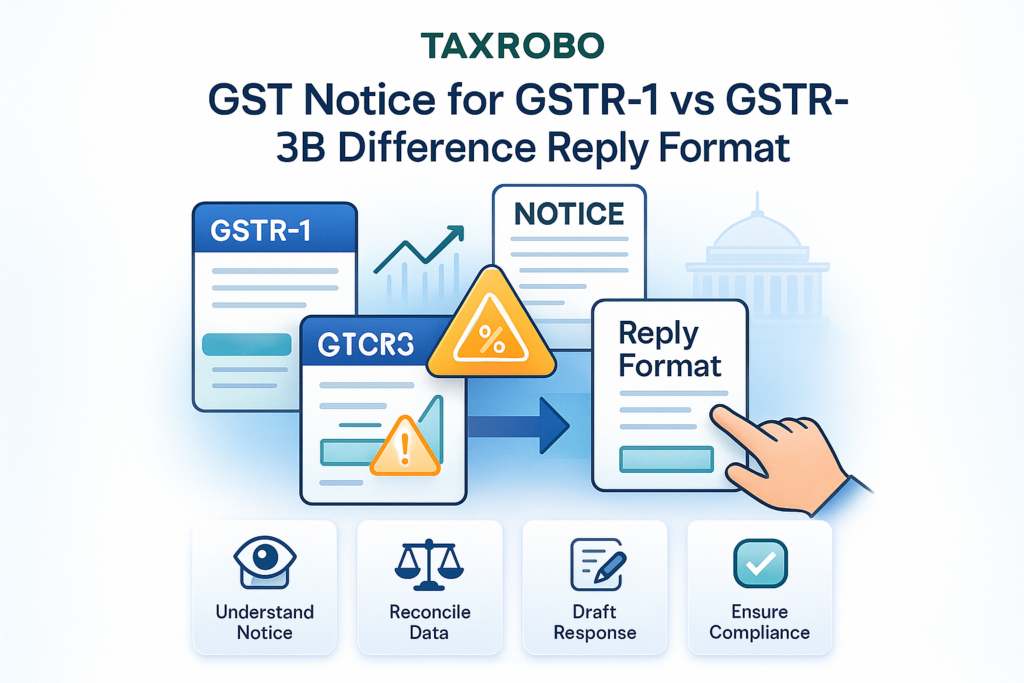
The moment you see an intimation in Form DRC-01B on your GST portal dashboard, follow these steps systematically. Knowing how to reply to a GST notice in India is a process that requires careful analysis and documentation, not panic.
Step 1: Don’t Panic – Analyze the Notice
The first rule is to stay calm and read the notice carefully. Form DRC-01B is an automated intimation, not a demand order. It’s the system asking for a clarification. Pay close attention to these details:
- The specific tax period(s): The notice will clearly mention the month(s) or quarter(s) for which the discrepancy has been found.
- The exact amount of the discrepancy: Note the precise difference amount that the system has calculated.
- The deadline for the reply: The notice will specify a deadline, typically within seven days, by which you must either pay the difference or submit a reply.
Step 2: Reconcile Your Data
This is the most critical step. You need to perform a thorough reconciliation to find the root cause of the mismatch.
- Action: Go back to your records for the specified period. Compare your GSTR-1 data, GSTR-3B data, and the sales register from your accounting software (like Tally, Zoho Books, etc.).
- Tool Tip: You can use a simple Excel sheet for this. Create columns for Invoice Number, Invoice Date, Taxable Value, and Tax Amount. Populate one sheet with data from your GSTR-1 and another with data from your books. Use formulas like VLOOKUP or SUMIF to quickly identify which invoices are causing the difference.
Step 3: Prepare Your Response and Supporting Documents
Once you have identified the reason for the mismatch, you can prepare your reply. Your response should be clear, concise, and supported by evidence.
- Action: Draft a point-by-point reply explaining each reason for the discrepancy. Refer to the sample format provided in the next section.
- Documentation: Gather all necessary supporting documents. This could include:
- Copies of tax invoices that were incorrectly reported.
- Copies of credit or debit notes.
- A reconciliation statement in Excel showing the timing differences.
- A copy of the DRC-03 challan if you have paid the differential tax and interest.
The Ultimate GST Notice Reply Format India
When drafting your response, clarity and professionalism are key. Your goal is to provide the tax officer with a logical explanation and sufficient proof to close the inquiry. A well-structured letter makes it easy for the officer to understand your position.
Sample GST Notice Response Template India
Here is a template you can adapt for your reply. Ensure you fill in all the details accurately.
[Date]

To,
The GST Officer,
[Jurisdiction/Address as per Notice]

**Subject: Reply to Intimation under Rule 88C (Form DRC-01B) regarding difference in liability reported in GSTR-1 and GSTR-3B**

**Reference No.:** [Your Notice/ARN Number]
**Dated:** [Date of the Notice]
**GSTIN:** [Your GSTIN]
**Legal Name:** [Your Business's Legal Name]

Respected Sir/Madam,

This is with reference to the intimation cited above for the tax period of [Mention Month/Quarter, Year]. We have been asked to provide a reason for the discrepancy of ₹[Amount] between the liability declared in Form GSTR-1 and the tax paid in Form GSTR-3B.

After a thorough review of our records, we would like to submit the following point-wise explanation for the difference:

**Point 1: [State the first reason for the mismatch, e.g., Clerical error in GSTR-3B]**
*   **Explanation:** [Provide a detailed but concise explanation. For example: "An invoice (No. XYZ) for ₹1,00,000 was correctly reported in GSTR-1. However, due to a clerical error, this amount was missed while preparing the consolidated figures for GSTR-3B, leading to a short payment of tax."]
*   **Action Taken:** [Explain the corrective action. For example: "We have since paid the differential tax of ₹[Amount] along with applicable interest via Form DRC-03 on [Date], and the ARN is [DRC-03 ARN]. A copy is attached for your reference."]

**Point 2: [State the second reason, e.g., Invoice reported in the wrong tax period]**
*   **Explanation:** [For example: "Invoice No. ABC dated 31st January was reported in January's GSTR-1. However, the tax on this supply was inadvertently paid in February's GSTR-3B. There is no loss of revenue to the department, only a timing difference."]
*   **Supporting Document:** [For example: "A reconciliation statement showing this timing difference is attached as Annexure-A."]

We believe the above explanations clarify the discrepancies noted in the intimation. We have attached the following documents for your kind perusal:
1.  Copy of DRC-03 Challan (if any)
2.  Reconciliation Statement (Annexure-A)
3.  Copies of relevant Invoices/Credit Notes

We assure you of our fullest cooperation and diligence in **GST compliance for businesses in India**. We request you to kindly review our submission and drop the proceedings.

Thank you.

Sincerely,

For [Your Business Name]

[Your Name/Authorized Signatory Name]
[Designation]
Conclusion
Receiving a notice for a GSTR-1 vs GSTR-3B difference can feel daunting, but it is a common and entirely manageable issue. The key is to act promptly and systematically. A calm analysis of the notice, a thorough reconciliation of your financial data, and a clear, well-documented reply are your best tools to resolve the matter efficiently. Most importantly, adopting a practice of regular, proactive reconciliation can help you prevent such notices in the future, ensuring your business remains compliant and stress-free.
Navigating GST notices can be complex. Don’t risk penalties or legal complications. Let the experts at TaxRobo handle your GST return filing, reconciliation, and notice responses. Contact us today for a consultation!
For more official information, you can always refer to the GST Portal.
Frequently Asked Questions (FAQs)
1. What is the time limit to reply to a GST notice for GSTR-1 vs GSTR-3B mismatch (DRC-01B)?
You are generally required to reply or pay the differential tax within seven working days of receiving the intimation. Failing to respond within this timeframe can lead to the initiation of demand and recovery proceedings under Section 79 of the CGST Act.
2. What happens if I ignore the GST notice?
Ignoring the notice is not advisable under any circumstances. If you fail to reply or pay the amount, the GST officer is empowered to initiate recovery proceedings for the tax amount specified in the notice without any further communication. This can include drastic measures like freezing your business bank accounts.
3. Can I amend GSTR-3B to correct a mistake from a past month?
No, GSTR-3B cannot be revised or amended once it has been filed. However, the GST framework allows for the rectification of mistakes from a previous tax period in the GSTR-3B of a subsequent month. You can adjust the liability or ITC figures in the appropriate tables to correct the error.
4. Is it mandatory to pay the difference before replying?
You have two options when you receive Form DRC-01B. You can either pay the differential tax amount along with applicable interest through Form DRC-03 and inform the officer via Part B of Form DRC-01B, or you can furnish a detailed reply explaining the valid reasons for the discrepancy. If your reasons are justifiable and supported by evidence, you may not have to pay.