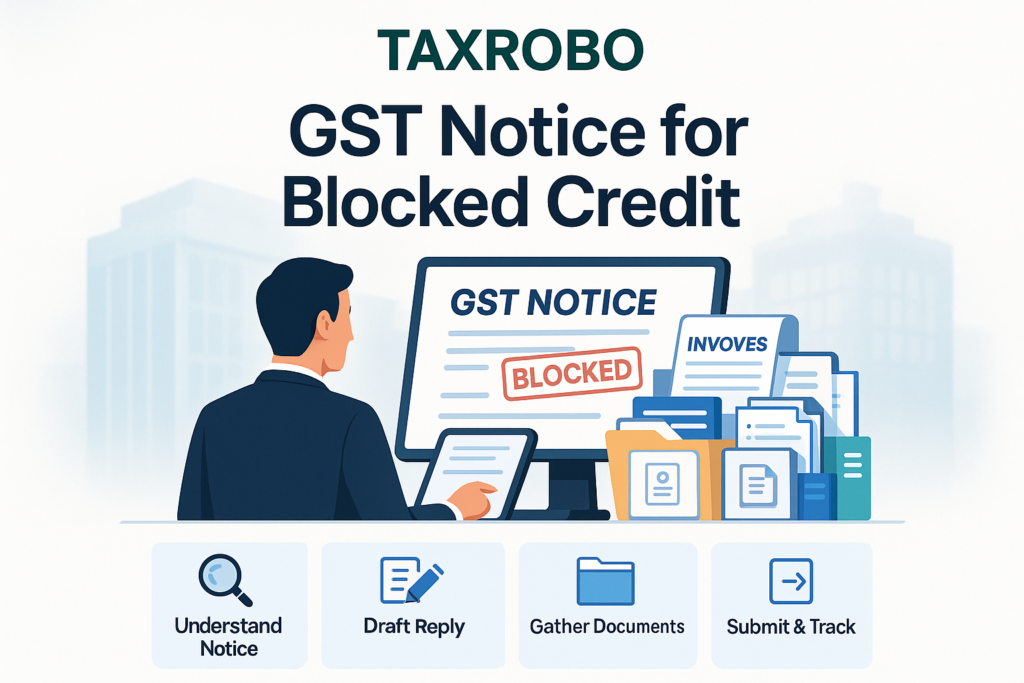

GST Notice for Blocked Credit – Reply Format & Supporting Documents
Receiving a notice from the GST department can be a stressful experience for any business owner. One of the most common yet daunting communications is a notice related to blocked Input Tax Credit (ITC). This is a formal inquiry from tax authorities questioning the validity of ITC you’ve claimed in your returns, essentially putting your tax credits on hold. Responding in a timely and structured manner is crucial to avoid hefty penalties, interest, and potential legal battles. This comprehensive article provides a detailed guide on the correct GST notice reply format, lists the essential supporting documents you’ll need, and explains how to effectively navigate the entire process in India.
2. Understanding Why You Received a GST Notice for Blocked Credit
Before you can draft a reply, it’s vital to understand the root cause of the notice. GST officers use sophisticated data analytics to flag discrepancies, and a notice is their way of seeking clarification. Understanding the specific reason cited will help you gather the right evidence and formulate a precise response. Most of these notices are triggered automatically by the system when the data you file doesn’t align with the data reported by your suppliers or the rules laid out in the GST law.
Common Reasons for an ITC Mismatch or Blockage
- GSTR-2A/2B vs. GSTR-3B Mismatch: This is the most frequent trigger. The Input Tax Credit you claimed in your summary return (GSTR-3B) is higher than the credit that is auto-populated in your GSTR-2A or GSTR-2B. GSTR-2B is a static statement reflecting the GSTR-1 returns filed by your suppliers, and the tax department considers it the primary source of truth for eligible ITC.
- Supplier Non-Compliance: The issue might not be on your end. If your supplier has collected GST from you but failed to file their GSTR-1 or has not remitted the collected tax to the government, the credit will not appear in your GSTR-2B. The department will then question your ITC claim, as one of the fundamental conditions for claiming ITC is that the tax must be paid to the government by the supplier.
- Ineligible ITC Claimed (Section 17(5)): The GST Act has a specific list of goods and services on which ITC is strictly not allowed. This is known as blocked credit. If you have inadvertently claimed ITC on items like motor vehicles (with certain exceptions), food and beverages, club memberships, or construction of immovable property, the system will flag it, leading to a notice.
- Late ITC Claims: There is a strict deadline for claiming ITC for a financial year. The credit must be claimed by the 30th of November of the following financial year or the date of filing the annual return for that year, whichever comes first. Any claim made after this statutory deadline is invalid and will be questioned.
- Documentation Errors: Simple clerical errors can also lead to notices. The tax invoice provided by your supplier might be missing crucial details like their GSTIN, your GSTIN, a proper HSN code, or the correct tax breakup. An invalid or incomplete invoice is not a valid document for claiming ITC.
Decoding the Notice: What to Look For
When you receive the notice, don’t panic. Instead, carefully dissect it to understand exactly what the department is asking. Look for these key details:
- Notice Form Number: The form number tells you the nature of the inquiry. Typically, a preliminary notice for discrepancies comes in Form GST ASMT-10 (Notice for Scrutiny of Return). If the officer is not satisfied or the issue is more serious, it may escalate to a Form GST DRC-01 (Show Cause Notice).
- Notice Reference Number (ARN/RFN): This unique number is your key to the entire case. You must quote this Reference Number in all your replies and future communications related to this specific issue.
- Discrepancy Details: The notice will have a table or an annexure that clearly lists the reasons for the proposed demand. It will specify the tax periods (e.g., April 2022 to March 2023), the specific invoices in question, and the exact amount of ITC that has been flagged as a discrepancy.
- Deadline for Reply: This is a non-negotiable date. The notice will specify the due date by which you must submit your response, which is usually 15 or 30 days. Ignoring this deadline can lead to adverse consequences.
3. How to Respond to GST Notice India: A Step-by-Step Guide
A methodical and well-documented response is your best defense. Rushing the process or providing incomplete information can work against you. Follow these steps meticulously to build a strong and convincing case.
Step 1: Conduct a Thorough Internal Review
Before you type a single word of your reply, your first action should be to look inward and verify your own records. This internal audit is the foundation of your response.
- Reconcile Your Data: Pull out your purchase register, accounting software data (like Tally or Zoho Books), and all relevant invoices for the period mentioned in the notice. Meticulously compare this internal data with the ITC you claimed in your GSTR-3B and the credit visible in your GSTR-2B on the GST portal. This three-way reconciliation will pinpoint the exact source of the mismatch.
- Identify the Root Cause: Based on your reconciliation, determine why the discrepancy occurred. Was it a data entry error by your accountant? Did you mistakenly claim ITC on a blocked item? Or is the discrepancy because a supplier failed to file their return on time? Knowing the “why” is crucial for drafting an effective rebuttal.
- Communicate with Your Supplier: If your review confirms that the mismatch is due to your supplier’s error (e.g., they filed their GSTR-1 late or reported the invoice under the wrong GSTIN), contact them immediately. Request them to rectify the error by filing their returns correctly or amending the invoice details in their next GSTR-1. A confirmation email or letter from your supplier acknowledging their mistake can be a valuable supporting document.
Step 2: Compile All Supporting Documents for GST Notice Reply
Your reply is just a claim; your documents are the proof. The tax officer needs concrete evidence to drop the proceedings. Prepare a clear, organized file of all blocked credit notice response documents to substantiate your claims.
- Essential Documents Checklist:
- A legible copy of the tax invoices for which the ITC is being questioned. Ensure they comply with all GST invoice rules.
- A copy of the corresponding e-way bills if the goods’ value exceeded the prescribed limits, as this proves the movement of goods.
- Proof of payment to the supplier. This can be a bank statement highlighting the transaction, NEFT/RTGS transaction receipts, or a cheque clearance statement. This proves your fulfillment of the payment condition.
- Proof of receipt of goods or services. This can include signed delivery challans, goods receipt notes (GRN) from your store or warehouse, or service completion certificates.
- A detailed ledger copy of the supplier from your accounting books, showing the purchase and payment entries.
- A comprehensive reconciliation statement (preferably in an Excel sheet) that clearly explains the difference between your GSTR-3B and GSTR-2B. This statement should break down the reasons for the mismatch invoice-wise, making it easy for the officer to understand.
Step 3: Drafting Your Response: The Perfect GST Notice Reply Format
Your written submission should be formal, factual, and respectful. It should directly address the points raised in the notice without any ambiguity. Use a clear structure to present your case logically. The official reply is filed in Form GST ASMT-11 (for a notice in ASMT-10) or Form GST DRC-06 (for a notice in DRC-01). Below is a sample structure for the detailed letter that you will upload as a PDF attachment.
- Structure of the Reply:
- Part A: Header
[Your Company Name]
[Your Company Address]
[Your GSTIN]
To:
The Proper Officer,
[Designation and Address as mentioned in the notice]
Reference: Notice No. [Enter the RFN/ARN from the notice] dated [Enter Date of Notice]. - Part B: Subject Line
Subject:Reply to Show Cause Notice/Notice under Section [e.g., 61] regarding alleged discrepancy in Input Tax Credit for the tax period [Mention Tax Period, e.g., April 2022 - March 2023]. - Part C: Body of the Reply
- 1. Acknowledgement: “Respected Sir/Madam, we acknowledge the receipt of the aforementioned notice on [Date of Receipt]. We have reviewed the observations raised and are providing our submissions below.”
- 2. Facts of the Case: “The notice under consideration alleges an excess claim of Input Tax Credit amounting to ₹[Amount] due to [Briefly state the primary reason mentioned in the notice, e.g., mismatch between GSTR-3B and GSTR-2B].”
- 3. Point-by-Point Rebuttal/Clarification: This is the most critical section. Address each discrepancy mentioned in the notice as a separate point for clarity.
- Example 1 (Supplier’s Fault): “With reference to Para 3.1 of the notice alleging a mismatch for Invoice No. XYZ from ABC Pvt. Ltd., we submit that the ITC claimed by us is valid. The supplier had erroneously failed to report this invoice in their GSTR-1 for the said month. We have contacted them, and they have now included it in their subsequent return. We are enclosing a copy of the tax invoice (Annexure A), proof of our payment to the supplier (Annexure B), the goods receipt note (Annexure C), and a confirmation email from the supplier (Annexure D) for your kind perusal.”
- Example 2 (Clerical Error): “With reference to Para 3.2 of the notice, we agree that an ITC of ₹[Amount] was claimed in error due to a clerical mistake. We have already reversed this credit via Table 4(B)(2) of our GSTR-3B for the month of [Month, Year] with applicable interest. A copy of the relevant GSTR-3B and the challan for interest payment (Annexure E) is attached.”
- 4. Legal Submissions: Briefly support your claims with legal backing. “We submit that we have fulfilled all the conditions for availing ITC as laid down under Section 16(2) of the CGST Act, 2017. The tax on the said supply has been paid, we are in possession of the tax invoice, and we have received the goods/services.”
- 5. Prayer: “In light of the facts, documentary evidence, and legal submissions provided above, we humbly request your good office to review our case and drop the proceedings initiated via the said notice. We pray that our claim for Input Tax Credit be accepted as valid.”
- Part D: Enclosures & Signature
Enclosures:- Annexure A: Copy of Tax Invoices
- Annexure B: Proof of Payments
- Annexure C: Proof of Receipt of Goods
- [List all other
supporting documents for GST notice reply]
For [Your Company Name],
[Signature of Authorized Signatory]
[Name of Authorized Signatory]
[Designation]
- Part A: Header
Step 4: Submitting the Reply on the GST Portal
Once your reply and all annexures are ready, you need to submit them online through the official portal.
- Log in to the Official GST Portal.
- Navigate to the dashboard and go to: Services > User Services > View Additional Notices/Orders.
- Find the relevant notice using the reference number and click on it.
- You will see an option to ‘Reply’. Click on it.
- This will open the relevant form (ASMT-11 or DRC-06). Fill in any required details.
- There will be an option to upload your detailed written reply (as a single PDF file) and all supporting documents (you can zip them or upload them separately).
- After uploading, file the reply using a Digital Signature Certificate (DSC) or an Electronic Verification Code (EVC).
4. What Happens Next? The GST Blocked Credit Appeal Process India
Submitting your reply is a major step, but the process isn’t over yet. The tax officer will review your submission and decide on the next course of action.
Possible Outcomes After Submission
- Case Dropped: This is the best-case scenario. If the officer is fully satisfied with your explanation and the supporting documents you have provided, they will issue an order dropping the proceedings. For a notice in ASMT-10, this order will be in Form GST ASMT-12. For a notice in DRC-01, it would be in Form GST DRC-05.
- Personal Hearing: If the officer has further questions or feels that some points need more clarification, they may issue a notice for a personal hearing. This is an opportunity for you or your authorized representative to explain your case in person and present any additional evidence.
- Adverse Order: If your reply is found to be unsatisfactory, incomplete, or not backed by sufficient evidence, the officer may issue an order confirming the demand for tax, interest, and penalty. This is known as an Order of Demand, typically issued in Form GST DRC-07.
Filing an Appeal
Receiving an adverse order is not the end of the road. You have the right to challenge the officer’s decision. The GST blocked credit appeal process India provides a structured mechanism for this.
- The first step is to file an appeal with the first Appellate Authority (typically the Joint or Additional Commissioner of GST).
- Time Limit: An appeal against an order must be filed within three months from the date the order is communicated to you. This is a strict deadline, so prompt action is essential.
- Recommendation: The appeal process is more formal and legalistic than the initial reply. It involves drafting detailed grounds of appeal and citing relevant case laws. It is highly advisable to seek professional help from experts like TaxRobo’s GST specialists to represent your case effectively and maximize your chances of success.
5. Conclusion
Facing a GST notice for blocked credit requires a calm, methodical, and proactive approach. The key to a successful resolution lies in a thorough internal review, the collection of strong documentary evidence, and the submission of a clear, fact-based response using the correct GST notice reply format. Remember, the goal is to make it as easy as possible for the tax officer to understand your position and verify your claims. Never ignore a GST notice, as inaction can lead to significant financial liabilities and legal complications for your business.
Navigating the complexities of GST notices can be challenging. If you need expert assistance in drafting a professional reply, representing your case, or managing your overall GST compliance, contact the specialists at TaxRobo today!
6. Frequently Asked Questions (FAQs)
Q1: What is the time limit to reply to a GST notice for blocked credit?
The time limit to respond is always mentioned in the notice itself. Typically, for a scrutiny notice (ASMT-10), you are given 30 days, while for a show-cause notice (DRC-01), the period is often 15 to 30 days. It is absolutely crucial to adhere to this deadline to avoid negative consequences.
Q2: What happens if I fail to reply to a GST notice on time?
If you fail to respond within the stipulated time, the GST officer has the authority to proceed based on the information available to them. This usually means they will pass an ex-parte order, confirming the entire proposed demand for tax, along with mandatory interest and penalties, without considering your side of the story.
Q3: Can I submit additional documents after filing my initial reply?
It is always best practice to submit all relevant documents and evidence with your initial reply to make your case as strong as possible from the outset. However, if the officer calls for a personal hearing, you are generally allowed to present additional documents and explanations to further support your case.
Q4: Do I need a Chartered Accountant or a Tax Consultant to prepare the GST notice reply format?
While it is not legally mandatory to hire a professional to reply to a notice, it is highly recommended. A seasoned CA or tax consultant understands the legal nuances, the expectations of the tax department, and how to frame a reply that is technically and legally sound. Their expertise can significantly improve your chances of getting a favorable outcome and can save you from potential future liabilities.