
GST LUT Compliance Notice – Reply Format & Resolution Guide
Receiving a formal notice from the tax department can be a daunting experience for any exporter. When you’re focused on growing your global business, a letter flagging potential non-compliance can cause significant stress and operational disruption. For exporters utilizing the Letter of Undertaking (LUT) route, a GST LUT compliance notice is one such communication that requires immediate and careful attention. An LUT is a crucial document that allows you to export goods or services without paying IGST upfront, thereby protecting your working capital. This notice indicates that the GST authorities have found a potential discrepancy or believe you haven’t fulfilled the conditions associated with the LUT. This comprehensive guide will demystify the process, providing a clear, step-by-step framework for understanding the notice, drafting a professional response, and ensuring a swift resolution so your export business remains compliant and thriving.
What is a Letter of Undertaking (LUT) and Why is it Crucial for Exporters?
To fully grasp the implications of a compliance notice, it’s essential to understand the role of the LUT itself within the GST framework. The system is designed to promote exports by ensuring that domestic taxes do not get exported, making Indian goods and services more competitive in the international market.
Understanding the Basics of GST LUT
Under the Goods and Services Tax (GST) regime, exports are classified as “zero-rated supplies.” This means that while the goods or services are taxable, the rate of tax applied to the final export product is zero. Exporters have two primary pathways to achieve this:
- Export with Payment of IGST: An exporter can first pay the applicable Integrated GST (IGST) on the export transaction and then subsequently file for a refund of the tax paid. While effective, this method can temporarily block a significant amount of working capital until the refund is processed.
- Export without Payment of IGST: Alternatively, an exporter can furnish a Letter of Undertaking (LUT) to the GST department. This is a formal declaration (filed using Form GST RFD-11) stating that they will fulfill all the requirements of an export transaction. By filing an LUT, they can export goods or services without paying any IGST, thus avoiding the entire process of payment and refund, which is immensely beneficial for maintaining healthy cash flow.
Who is Eligible to File a GST LUT?
Not every registered person is automatically eligible to use the LUT facility. The government has set specific criteria to ensure that this privilege is not misused. To be eligible, a registered taxpayer must:
- Be registered under the GST Act.
- Intend to supply goods or services to other countries or to Special Economic Zones (SEZs).
- Not have been prosecuted for any offense under the CGST Act or any other existing laws where the tax evaded exceeds ₹2.5 crores.
The LUT is valid for the financial year in which it is filed. This means a fresh LUT must be submitted for each new financial year. You can file your LUT and find more information on the official GST Portal.
Common Reasons for Receiving a GST LUT Compliance Notice
GST compliance notices are rarely random; they are typically triggered by data mismatches or failures to meet prescribed timelines, often flagged by the department’s automated systems. Understanding these common triggers is the first step in preventing them and effectively responding if you do receive one.
Failure to Submit Proof of Export
This is the most frequent reason for a notice. When you export under an LUT, you are obligated to provide evidence that the goods have actually left the country. This proof, usually in the form of a shipping bill, must be submitted within three months from the date of the invoice. For services, you must receive payment in convertible foreign exchange within one year. Failure to provide this documentation within the stipulated timeline is a direct violation of the LUT’s conditions and prompts an automated notice.
Discrepancies in GSTR-1 and Shipping Bills
The GST Network (GSTN) and the Indian Customs Electronic Gateway (ICEGATE) systems are designed to communicate with each other. The details of your exports that you declare in your GSTR-1 return (like invoice number, date, value, and shipping bill number) are cross-referenced with the data filed by your customs agent on the ICEGATE portal. Any mismatch in this information—be it a typo in the invoice number, a difference in the taxable value, or an incorrect port code—can raise a red flag and trigger a compliance notice. For more details on this process, see our guide on How to File GST Returns Online: A Step-by-Step Guide of the GST Filing Process & Procedure.
Non-realization of Export Proceeds
A critical condition tied to exporting under an LUT is the realization of export proceeds. As per regulations set by the Reserve Bank of India (RBI), payment for exported goods must be received in convertible foreign currency within nine months of the export date. Banks are required to issue a Bank Realization Certificate (BRC) as proof of this transaction. If the system does not find a corresponding BRC against an export invoice within this period, it assumes non-compliance, leading to the issuance of a GST LUT compliance notice.
Inaccurate Information in LUT or Returns
Beyond the major triggers, simple clerical errors can also cause problems. This includes providing incorrect HSN codes for your products, misreporting values in your GSTR-1 or GSTR-3B returns, or providing inaccurate details in your initial LUT application itself. The GST department’s data analytics tools are sophisticated enough to spot such inconsistencies, which can lead to further inquiry.
How to Respond to a GST LUT Compliance Notice: A Step-by-Step Guide
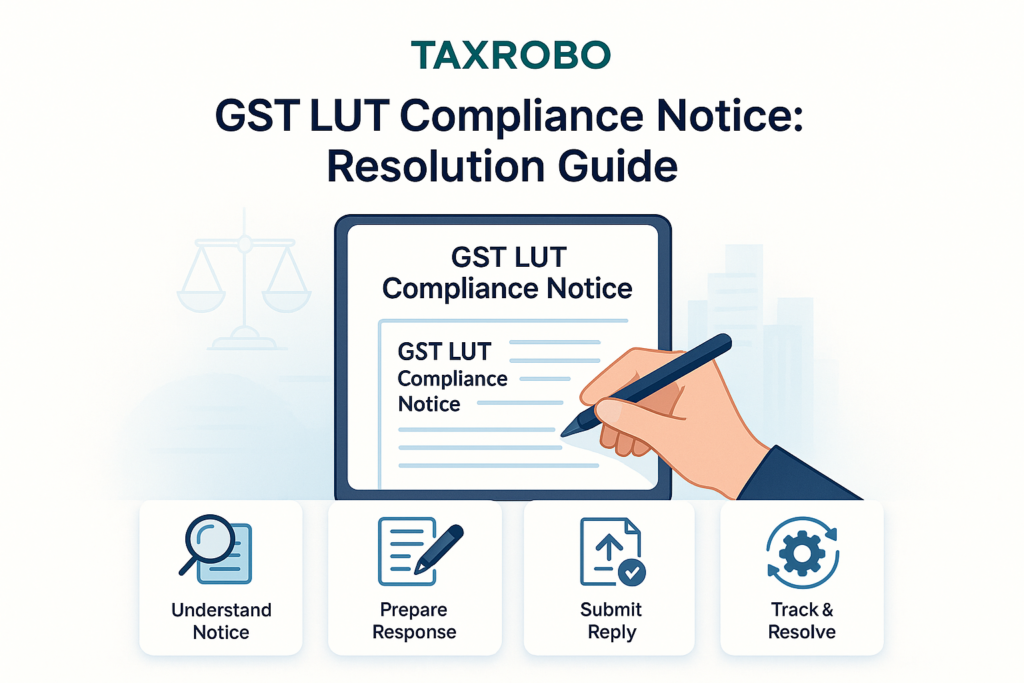
Receiving a notice can be unsettling, but a structured and timely response can resolve the issue efficiently. The key is to be methodical and provide clear, evidence-backed explanations. Following this process will help you craft an effective reply.
Step 1: Analyze the Notice Thoroughly
The first rule is not to panic. Read the notice carefully to understand exactly what the department is asking. Look for these key components:
- Document Identification Number (DIN): A unique number that authenticates the notice.
- Show Cause Notice (SCN) Reference Number and Date: This is the official reference for all your future correspondence. For a broader understanding, refer to our article on How to Respond to a GST Show Cause Notice: A Step-by-Step Guide.
- The Specific Discrepancy: The notice will clearly state the reason it was issued (e.g., “Non-submission of Shipping Bill for Invoice No. 123”).
- Deadline for Response: Note the date by which you must submit your reply, which is typically between 7 and 30 days.
Step 2: Gather All Relevant Documents
Before you start writing, collect all the necessary paperwork to support your case. A complete and organized set of documents makes your reply strong and credible. Your checklist should include:
- A copy of the GST LUT compliance notice you received.
- The LUT certificate (ARN receipt) for the financial year in question.
- The specific export invoices mentioned in the notice.
- Shipping Bills, Bills of Lading, or Airway Bills as proof of export.
- Bank Realization Certificates (BRCs) or Foreign Inward Remittance Certificates (FIRCs) as proof of payment realization.
- Copies of your GSTR-1 and GSTR-3B filings for the relevant period.
Step 3: Draft a Professional Reply (GST LUT Reply Format Guide India)
Your written response should be formal, clear, and directly address the points raised in the notice. This is a critical element of any GST compliance notice response example. Follow this structure for a professional reply:
- Header: Address the reply to the specific tax officer and jurisdiction mentioned in the notice.
- Subject Line: Be precise. For example: “Reply to Show Cause Notice regarding LUT Compliance – Reference No. [Insert Notice Number] dated [Insert Notice Date]”.
- Reference: Clearly state the SCN number and date again in the opening line of your letter.
- Body of the Reply:
- Begin by acknowledging the receipt of the notice.
- Address each allegation or discrepancy point-by-point. Use headings or numbered paragraphs to respond to each query separately.
- Provide factual explanations backed by evidence. Attach your supporting documents as annexures and refer to them clearly in your reply.
- Example: “In response to Point 1 of the notice concerning the non-realization of payment for Invoice No. ABC/EXP/23-24/001 dated 01-Apr-2023, we wish to state that the payment was duly received on 15-Nov-2023. We are attaching the Bank Realization Certificate (BRC No. XXXXXX) from our authorized dealer bank as Annexure-A to this reply.”
- Annexures: At the end of the letter, create a neat list of all the documents you are attaching (e.g., “Annexure-A: Copy of BRC,” “Annexure-B: Copy of Shipping Bill”).
- Conclusion and Prayer: Conclude by summarizing that you have complied with all the necessary conditions of the LUT and respectfully request the officer to review the submissions and drop the proceedings.
- Signature: Sign off with your name, designation, and company stamp (if applicable).
Step 4: Submit Your Response Online
The final step is to submit your reply and all the scanned documents through the GST portal. Navigate to Services > User Services > View Notices and Orders, find the relevant notice, and use the “Reply” option to upload your letter and the annexures.
Proactive GST LUT Notice Resolution Strategies and Best Practices
The best way to handle a notice is to avoid receiving one in the first place. Adopting proactive compliance measures can save you time, money, and stress. Incorporating these GST LUT notice resolution strategies into your workflow is key to long-term success.
Maintain Meticulous Documentation
Good record-keeping is your first line of defense. Create a digital and physical filing system where all export-related documents—invoices, shipping bills, BRCs, LUT copies, and GST returns—are stored chronologically and are easily accessible. When every document is at your fingertips, responding to a notice becomes a simple task of retrieval and submission. Understanding The Importance of Accurate Record-Keeping to Prevent GST Demand Notices is fundamental.
Conduct Regular Reconciliations
Don’t wait for the department to find discrepancies. Make it a monthly practice to reconcile your records. This involves:
- GSTR-1 vs. Shipping Bills: Match the data in your GSTR-1 with the data on the ICEGATE portal to ensure perfect alignment.
- Invoices vs. BRCs: Track your export invoices and match them against incoming foreign payments and the corresponding BRCs issued by your bank. This is a crucial part of the GST LUT compliance process India.
Adhere to All Timelines
Timeliness is non-negotiable in tax compliance. Use a calendar or compliance management software to set reminders for crucial deadlines, such as the 3-month window for submitting export proof and the 9-month period for payment realization. Consistently meeting these timelines drastically reduces your risk of receiving a notice.
When to Seek Professional Help
While you can handle straightforward notices with a well-drafted reply, certain situations warrant expert intervention. If the notice involves complex legal interpretations, a high tax amount, or multiple discrepancies, it is wise to consult a tax professional. TaxRobo’s team of GST experts specializes in handling departmental notices and can ensure your reply is accurate, professional, and effective.
Conclusion
A GST LUT compliance notice may seem intimidating, but it is a manageable part of the compliance process. By understanding the common triggers, adopting a systematic approach to your response—involving careful analysis, thorough documentation, a structured reply, and timely submission—you can address the department’s concerns effectively. More importantly, by shifting to a proactive mindset focused on meticulous record-keeping and regular reconciliations, you can significantly minimize the chances of receiving such notices in the future. This ensures your export operations remain smooth, allowing you to focus on what you do best: growing your business globally.
Don’t let GST compliance notices disrupt your business. Partner with TaxRobo for expert guidance and peace of mind. Get in touch with our specialists today!
Frequently Asked Questions (FAQs)
1. What is the time limit to respond to a GST notice?
The time limit to respond is always mentioned in the notice itself. This period typically ranges from 7 to 30 days from the date of issuance. It is absolutely crucial to adhere to this deadline, as failing to respond in time can lead to the officer making a decision based on the information they have, which may not be in your favor.
2. What are the consequences of ignoring a GST LUT compliance notice?
Ignoring a notice can have serious repercussions for your business. The immediate consequence is that the department may withdraw your LUT facility. This would force you to pay IGST on all future exports and then go through the cumbersome process of claiming refunds. It can also lead to the imposition of penalties and the initiation of legal proceedings for recovery of the tax amount that was not paid due to the LUT.
3. Can I file a new LUT for the next financial year if I have a pending notice?
Generally, yes, you can file a new LUT for the upcoming financial year even if you have a pending notice for the current year. However, if the proceedings related to the notice conclude against you and the officer orders the withdrawal of your LUT facility, it could impact your eligibility for future LUTs. Therefore, it is always best to resolve any pending GST LUT compliance notice promptly.
4. What is a Bank Realization Certificate (BRC) and why is it vital?
A Bank Realization Certificate (BRC) is an official document issued by your bank as confirmation that you have received payment for your exports in a foreign currency. It is a critical piece of evidence to prove that you have fulfilled the conditions of the LUT and complied with RBI regulations regarding export proceeds. Without a BRC, you cannot prove to the GST authorities that the export transaction has been successfully completed, which is a primary reason for compliance notices.