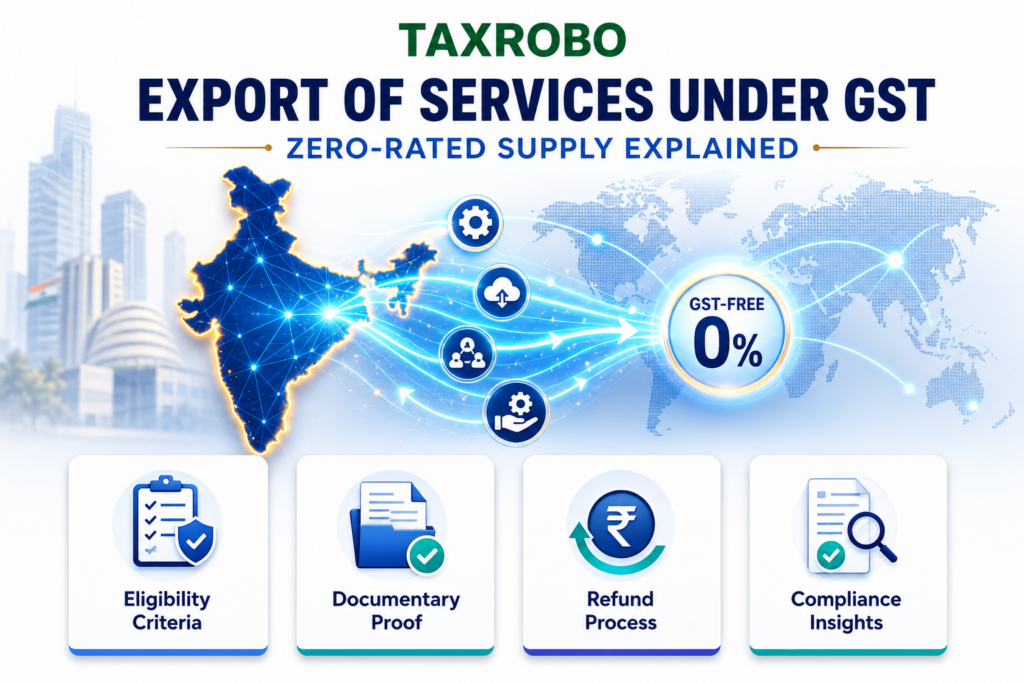

Export of Services Under GST: Zero-Rated Supply Explained
In today’s interconnected digital world, the opportunity for Indian businesses and freelancers to offer services globally has never been greater. However, while this expansion is lucrative, it brings the challenge of navigating complex tax laws. The Goods and Services Tax (GST) regime, in particular, has specific rules that can be confusing for service exporters. This is where understanding the concept of export services under GST becomes crucial. This post will serve as your comprehensive guide, simplifying how these transactions are treated as ‘zero-rated supplies’, what your compliance obligations are, and how you can leverage the system to your financial advantage. We will break down the GST implications for service exports India to ensure you can focus on growing your global client base with confidence.
What Qualifies as an “Export of Services” Under GST?
It’s a common misconception that simply providing a service to a client based outside India automatically qualifies as an “export.” The GST law is very specific about this. To be officially recognized as an export of service, a transaction must meet all five mandatory conditions laid out in Section 2(6) of the Integrated Goods and Services Tax (IGST) Act, 2017. Failing to meet even one of these criteria means the transaction will not be treated as an export, and standard GST rates will apply. Adhering to these services export guidelines India is the first and most critical step in ensuring compliance and availing tax benefits.
According to the export services under GST India regulations, the following five conditions must be satisfied:
- The supplier of the service is located in India. Your business must be registered and operating from India.
- The recipient of the service is located outside India. Your client must be based in a foreign country.
- The place of supply of the service is outside India. The GST law has specific “Place of Supply” rules to determine where a service is consumed. For most professional services, the place of supply is the location of the recipient.
- The payment for such service has been received by the supplier in convertible foreign exchange. You must be paid in a currency like USD, EUR, GBP, etc., or in Indian Rupees where permitted by the Reserve Bank of India (RBI).
- The supplier and recipient are not merely establishments of a distinct person. For example, providing a service from your Indian head office to your own branch office abroad would not qualify as an export of service.
Understanding Zero-Rated Supply Explained India
Once you’ve confirmed that your transaction qualifies as an export of service, it’s classified as a “zero-rated supply” under GST. This special status is the government’s way of promoting exports and ensuring Indian goods and services remain competitive on the global stage. It is a fundamental concept for anyone involved in international trade.
What is a Zero-Rated Supply?
A zero-rated supply is a transaction on which the GST rate is effectively zero. However, the most significant advantage is that the supplier (the exporter) can still claim a refund for the Input Tax Credit (ITC) paid on raw materials, inputs, and input services used to provide that export service. This simple zero-rated supply definition India highlights the core benefit: it prevents the “export of taxes.” By allowing exporters to claim back the GST they’ve paid on their business expenses, the final cost of the service to the foreign client does not include embedded Indian taxes. This policy is one of the most important GST export services benefits India offers to its businesses.
Zero-Rated vs. Exempt vs. Nil-Rated Supplies
The terms zero-rated, exempt, and nil-rated are often used interchangeably, but they have distinct meanings and implications under GST. Confusing them can lead to incorrect compliance and financial loss. The primary differentiator is the availability of Input Tax Credit (ITC). Understanding zero-rated supply India requires a clear grasp of these differences, which are summarized in the table below.
| Type of Supply | GST Rate | Input Tax Credit (ITC) Claim | Example |
|---|---|---|---|
| Zero-Rated | 0% | Yes, available | Export of IT services, consulting services to a US client. |
| Exempt | – | No, not available | Healthcare services, educational services supplied domestically. |
| Nil-Rated | 0% | No, not available | Basic food items like salt, grains, and jaggery. |
As you can see, only a zero-rated supply allows you to recover the GST paid on your business inputs, making it uniquely beneficial for exporters.
The Two Pathways for Export Services Under GST
The GST framework provides service exporters with two distinct options to manage their tax obligations for zero-rated supplies. Understanding the nuances of GST Refunds for Exporters & IT Companies – Latest Procedure & Timelines can help you choose the pathway that best suits your business’s cash flow and administrative preferences.
Option 1: Export with Payment of IGST (and Claim a Refund)
This is the more straightforward route, often preferred by businesses with a healthy amount of accumulated Input Tax Credit. It involves treating the export like a normal taxable supply initially, but with a clear path to getting the tax amount back.
The Process:
- You create an export invoice and charge the applicable IGST rate on the value of the service (e.g., 18%).
- You pay this collected IGST amount to the government when you file your monthly GSTR-3B return.
- The details you file in your GSTR-1 and GSTR-3B, along with other export documentation like the Bank Realisation Certificate (BRC), act as your application for a refund.
- Once the GST portal verifies the export details and the tax payment, the IGST amount you paid is automatically refunded to your registered bank account.
This option is best for: Businesses that have a significant amount of ITC accumulated from their domestic purchases and expenses. Paying IGST on exports allows them to utilize this credit, rather than letting it sit idle or going through a separate refund process for unutilized ITC.
Option 2: Export without Payment of IGST (Using a LUT)
This is the most popular option for service exporters as it improves cash flow by eliminating the need to pay tax upfront. This route requires you to furnish a Letter of Undertaking (LUT) to the tax department.
The Process:
- You must file a Letter of Undertaking (LUT) on the official GST Portal using Form GST RFD-11. An LUT is a document where you declare that you will fulfill all the requirements of an export.
- Once your LUT is accepted (which is usually an instant online process), you are authorized to export services for that financial year without charging or paying IGST.
- On every export invoice, you must include a mandatory declaration stating: “Supply meant for export under Letter of Undertaking without payment of IGST.”
- Even though you don’t pay IGST on the final service, you can still claim a refund for any unutilized ITC that has accumulated from your business expenses.
Who is eligible?: Any taxpayer registered under GST who intends to export is eligible to file an LUT, provided they have not been prosecuted for tax evasion exceeding ₹250 lakh.
Essential Compliance and Documentation for Service Exports
Whether you choose to pay IGST or use an LUT, maintaining proper documentation is non-negotiable. Strong record-keeping is the cornerstone of successful export service compliance India and ensures a smooth refund process.
Invoicing and Payment Proof
Your documentation serves as the legal evidence of your export transaction. It must be clear, accurate, and readily available for verification by tax authorities.
- Export Invoice: The invoice is the primary document. It must be distinct from a domestic invoice and contain specific details, including:
- The endorsement: “SUPPLY MEANT FOR EXPORT ON PAYMENT OF IGST” or “SUPPLY MEANT FOR EXPORT UNDER LUT WITHOUT PAYMENT OF IGST”.
- Name and address of the recipient (your foreign client).
- The currency in which the invoice is raised.
- GSTIN of the supplier.
- A clear description of the services provided.
- Bank Realisation Certificate (BRC)/FIRC: This is a crucial document issued by your bank. A BRC or a Foreign Inward Remittance Certificate (FIRC) is definitive proof that you have received payment for your services in convertible foreign exchange, fulfilling one of the key conditions for an export.
Reporting in GST Returns
Accurate reporting in your monthly or quarterly GST returns is essential to ensure your export transactions are correctly recorded in the government’s system, which is vital for processing refunds.
- GSTR-1: This is your statement of outward supplies. All export sales, whether made with or without payment of IGST, must be reported in Table 6A (Exports) of the GSTR-1 form.
- GSTR-3B: This is the summary return where you declare your tax liability. The total value of your zero-rated supplies (exports) should be reported in Table 3.1(b) (Outward taxable supplies (zero-rated)).
For a detailed walkthrough, see our guide on How to File GST Returns Online: A Step-by-Step Guide of the GST Filing Process & Procedure.
Conclusion
Mastering the rules for export services under GST is a powerful way for Indian service providers to unlock global markets efficiently. By understanding that your exports are ‘zero-rated supplies’, you can ensure that your services are priced competitively without the burden of domestic taxes. The flexibility to choose between exporting with IGST payment and claiming a refund or exporting under a Letter of Undertaking (LUT) allows you to select a compliance path that aligns with your business’s cash flow needs. Ultimately, meticulous documentation and accurate reporting are the keys to staying compliant and making the most of the benefits offered under the GST regime.
Navigating the nuances of export services analysis India and ensuring flawless GST compliance can be complex. If you need professional assistance with filing your LUT, claiming ITC refunds, or managing your GST returns, contact the experts at TaxRobo today for a consultation.
Frequently Asked Questions (FAQs)
Q1: What is the main difference between a zero-rated supply and an exempt supply?
A: The key difference is the availability of Input Tax Credit (ITC). With a zero-rated supply (like exports), you can claim a refund on the GST paid on your inputs. For exempt supplies, you cannot claim ITC.
Q2: I am a freelancer earning in dollars. Do I need to get a GST registration?
A: Yes, if your aggregate turnover exceeds the threshold limit (₹20 lakh or ₹10 lakh for special category states), you must register for GST to export services. There is no threshold exemption for exports of services, and properly Launching Your Startup Right – Mastering GST Registration in India is mandatory to claim export benefits.
Q3: How long is a Letter of Undertaking (LUT) valid for?
A: An LUT is valid for one financial year. You must file a new LUT for each financial year.
Q4: What happens if I export services under an LUT but don’t receive the payment within the prescribed time?
A: As per GST rules, payment for exported services must be received within one year from the date of export. If not, you will be liable to pay IGST on the transaction along with interest.