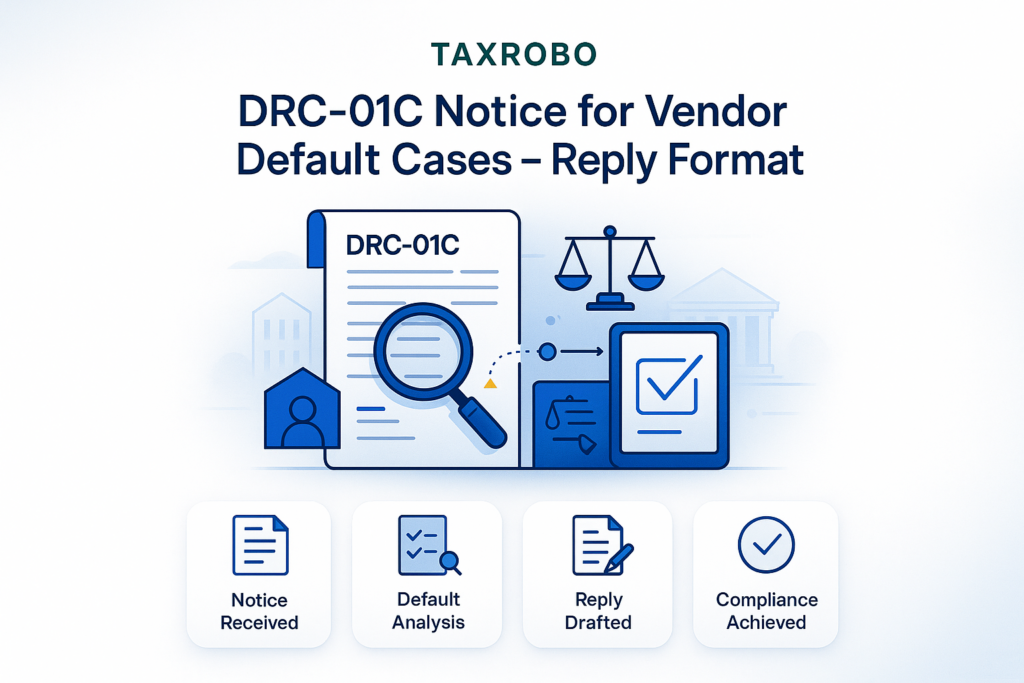

Received a DRC-01C Notice? Here’s How to Respond Correctly
The GST portal has just sent you an intimation named ‘DRC-01C’. Seeing any official notice can be stressful—and our guide on How to Handle GST Notices – ASMT-10, DRC-01, DRC-07 Explained Simply covers many common ones—but don’t panic. This automated alert is becoming increasingly common for businesses across India, and understanding the correct DRC-01C notice reply format is the first step toward resolving it without any hassle. In simple terms, Form DRC-01C is a notice about a mismatch between the Input Tax Credit (ITC) you claimed in your GSTR-3B and the details your supplier filed in their GSTR-1, which reflects in your GSTR-2B. Responding correctly and within the stipulated 7-day window is crucial to avoid having your ITC reversed, paying unnecessary interest and penalties, and even having your future GSTR-1 filing blocked. This guide will provide a clear, step-by-step breakdown of the official response process and best practices for handling DRC-01C cases India.
What is Form DRC-01C? A Simple Explanation for Vendors
Form DRC-01C is an automated intimation generated by the GSTN system under Rule 88D of the CGST Rules, 2017. Its primary function is to flag discrepancies between the ITC claimed by a taxpayer and the ITC available to them as per their suppliers’ filings. Think of it as an early warning system designed by the tax department to ensure compliance and prevent revenue leakage. The entire mechanism is built on comparing two key GST returns, and understanding this comparison provides a clear DRC-01C explanation for vendors. It is a critical component of the vendor default notice guidelines India, aimed at making the entire GST chain more transparent and accountable.
The core issue that triggers a DRC-01C notice is a mismatch between your GSTR-3B and your GSTR-2B. Let’s break this down:
- GSTR-3B: This is the monthly summary return you file. It’s where you declare your total sales, tax liability, and the total Input Tax Credit (ITC) you are claiming for that period. It is a self-declaration.
- GSTR-2B: This is an auto-generated statement that acts as your official ITC eligibility record. It is created based on the GSTR-1 (sales returns) filed by all your suppliers. If a supplier has declared an invoice with your GSTIN, the corresponding ITC becomes available in your GSTR-2B.
The notice is automatically triggered when the ITC you claimed in your GSTR-3B is higher than the amount available in your GSTR-2B by a pre-defined threshold. To understand the broader context, see our detailed article on How to Resolve ITC Mismatch Issues – GSTR-2A/2B vs 3B Guide.
There are several common reasons why you might receive a DRC-01C notice:
- Supplier Non-Compliance: The most frequent cause is your vendor or supplier failing to file their GSTR-1 on time. If they don’t file, the invoice won’t appear in your GSTR-2B, creating a mismatch.
- Supplier Error: Your supplier may have filed their GSTR-1 but made a mistake, such as entering the wrong GSTIN, an incorrect invoice value, or reporting an inter-state transaction as an intra-state one (or vice-versa).
- Your Clerical Error: You might have inadvertently made a mistake while filing your GSTR-3B, such as a data entry error leading to a claim of excess ITC.
- Legitimate Timing Differences: You may have claimed ITC for an invoice from a previous tax period, which is perfectly legal under Section 16(4) of the CGST Act. However, the system might flag it as a mismatch for the current month if the amount is significant.
Step-by-Step Guide: Replying to a DRC-01C Notice in India
Once you receive the intimation, follow a systematic process to prepare your response. Acting quickly and methodically is key to resolving the issue efficiently.
Step 1: Access and Analyze the Notice
Before you can formulate a reply, you need to understand exactly what the system has flagged.
- Where to find it: Log in to the official GST Portal. Navigate using the following path: Services -> Returns -> Return Compliance. Here, you will find an option for Form DRC-01C (Intimation of difference in ITC).
- Understand the Details: The notice is divided into two parts. Part A is the intimation itself, which you can view or download. It will contain a reference number and the details of the discrepancy. More importantly, it will have an annexure that provides a list of the specific invoices or suppliers that are causing the mismatch. This detailed annexure is the starting point for your
vendor default notice response India.
Step 2: Reconcile Your Records
With the notice details in hand, your next step is to conduct an internal audit. Compare the information provided in the DRC-01C annexure with your own financial records to find the root cause of the problem.
Follow this checklist for a thorough reconciliation:
- Check your purchase register and accounting software against the invoices mentioned in the notice.
- Pull out the physical tax invoice received from the vendor to verify details like GSTIN, date, and value.
- Confirm that you have proof of payment made to the vendor for that specific invoice.
- Ensure you have proof of receipt of goods or services, such as a signed delivery challan or an e-way bill.
The objective of this exercise is to definitively identify the source of the mismatch. Is the error on your part, or is it a clear case of vendor default? The answer will determine your next steps.
Step 3: Decide Your Response Strategy
Based on your reconciliation, you will fall into one of two scenarios. Your response strategy must align with your findings.
Scenario A: You Agree with the Discrepancy (Your Error)
If your internal audit reveals that you have indeed claimed excess ITC by mistake, the correct course of action is to accept the discrepancy and pay the differential amount.
- Action: You must pay the excess ITC you claimed, along with any applicable interest calculated from the date of claim to the date of payment.
- Process:
- First, accurately calculate the tax and interest liability.
- Make the payment using Form GST DRC-03 on the GST portal.
- Once the payment is complete and an Application Reference Number (ARN) is generated, you can file your reply.
- In Part B of Form DRC-01C, you will select the option to provide the ARN of your DRC-03 payment.
- This prompt payment and compliance is the most straightforward way of
handling DRC-01C cases Indiawhen you are at fault.
Scenario B: You Disagree with the Discrepancy (Vendor’s Error or Other Valid Reason)
If your records are correct and the mismatch is due to a supplier’s error or another valid reason, you must provide a clear and well-documented justification.
- Action: Prepare a detailed reply explaining why your ITC claim is valid, supported by evidence.
- Common Valid Reasons to Mention:
- “A typographical error was made while filing GSTR-3B. The ITC amount was entered as ₹50,000 instead of ₹5,000. This will be rectified in the GSTR-3B for the next tax period.”
- “The Input Tax Credit claimed pertains to a valid tax invoice from a previous tax period and has been claimed within the time limit prescribed under Section 16(4) of the CGST Act.”
- “The discrepancy is due to an error made by our supplier in their GSTR-1 filing. We have informed them, and they have confirmed that the invoice will be correctly declared/amended in their upcoming GSTR-1.” (It is highly recommended to attach proof of this communication).
This justification is the most critical part for anyone searching for a vendor default reply template.
The Official DRC-01C Notice Reply Format Explained
Understanding the structure of the reply form on the GST portal is key to submitting a successful response. This section breaks down the official DRC-01C notice reply format.
Part A: The Intimation from the GST System
Part A of Form DRC-01C is the notice you receive. It is system-generated and contains all the details of the discrepancy, including the amount mismatched and the relevant tax periods. You cannot edit this part; it is for your information only and serves as the basis for your reply.
Part B: Your Response – The Reply Template
Part B is the interactive section where you file your response. The portal provides two distinct options based on the scenarios discussed earlier.
Option 1: Payment Made (If you agree with the notice)
If you have accepted the discrepancy and paid the amount via DRC-03, your process is simple.
- Field: ARN of DRC-03
- Instruction: You must enter the Application Reference Number (ARN) that was generated after you successfully submitted Form DRC-03. This ARN acts as a digital receipt and links your payment to the DRC-01C notice, effectively closing the loop and confirming your compliance.
Option 2: Providing Reasons (If you disagree with the notice)
If you believe your ITC claim is valid, this is the section where you will make your case.
- Field: Reasons
- Instruction: This is a text box where you must provide a structured, clear, and concise justification. Do not submit a vague or incomplete reply. Structure your response professionally.
Here is a sample vendor default reply template you can adapt:
“Dear Sir/Madam,
In response to the DRC-01C intimation with Reference No. [Enter Notice Reference Number], we have reconciled our records. We confirm that the ITC of ₹[Amount] was claimed against a valid tax invoice [Invoice No. XXX] dated [DD/MM/YYYY] from our supplier, [Supplier Name], GSTIN: [Supplier’s GSTIN].
The discrepancy highlighted in the notice has arisen because the said supplier failed to report this invoice in their GSTR-1 for the tax period of [Month, Year]. We have already contacted the supplier regarding this omission, and they have assured us they will declare this invoice in their upcoming GSTR-1.
For your verification, we have attached a self-attested copy of the tax invoice, proof of payment (bank statement entry), and the e-way bill associated with the receipt of goods. We respectfully request you to kindly treat our ITC claim as valid and drop the proceedings initiated via this intimation.
Thank you.”
- Attachment: The GST portal allows you to attach supporting documents. This is your chance to provide evidence. You can upload a maximum of 4 files, with each file not exceeding 5MB. Essential documents include invoice copies, payment proofs, e-way bills, or screenshots of email communication with the vendor.
Conclusion: Proactive Compliance is Key
Receiving a GST notice can be daunting, but a DRC-01C is a manageable issue if addressed correctly. The key is to act swiftly: analyze the notice, meticulously reconcile your books, and file a clear and timely reply using the proper DRC-01C notice reply format. Remember, ignoring a DRC-01C notice is not an option. It can lead to automatic tax recovery proceedings under Section 79 and, more critically, block your ability to file GSTR-1 or IFF for future periods, bringing your business operations to a halt. Proactive compliance is always the best strategy. Ensuring you know How to File GST Returns Online: A Step-by-Step Guide of the GST Filing Process & Procedure can prevent many such issues from arising in the first place.
Navigating GST notices can be complex, and a small mistake can lead to larger issues. If you need help replying to DRC-01C notice India or want to ensure your overall GST compliance is flawless, TaxRobo’s expert team is here to assist. Contact us today for a hassle-free experience!
Frequently Asked Questions (FAQ)
1. What happens if I fail to reply to a DRC-01C notice within 7 days?
If you neither pay the disputed amount via DRC-03 nor submit a satisfactory reply in Part B within 7 days, the GST system is designed to take automated action. The disputed ITC amount will be considered recoverable under Section 79 of the CGST Act. Furthermore, and more immediately impactful, you may be blocked from filing your GSTR-1 or using the Invoice Furnishing Facility (IFF) for subsequent tax periods until the matter is resolved.
2. Can I get an extension for replying to the DRC-01C notice?
As of now, the GST portal does not have a provision to formally request an extension for filing a reply to Form DRC-01C. The 7-day deadline is system-enforced and is considered a strict timeline. Therefore, it is crucial to act promptly upon receiving the intimation.
3. The vendor has corrected their return after I received the notice. What should I do?
This is a positive development and a common scenario. Even if the vendor rectifies their mistake, you must still file a reply to the DRC-01C notice. In the “Reasons” section of Part B, clearly state that the discrepancy was due to the supplier’s error, which has now been rectified in their GSTR-1 for [mention the period of filing/amendment]. If possible, log in to your GST account, check that the invoice now reflects in your GSTR-2B, take a screenshot, and attach it as proof with your reply.
4. What are the key documents to attach with my DRC-01C reply?
The documents you attach should directly support the reason you provide in your reply. The most important ones are:
- A clear, scanned copy of the tax invoice in question.
- Proof of payment to the vendor, such as a bank statement screenshot or a transaction receipt.
- Proof of receipt of goods/services, like a signed delivery challan, transporter receipt, or the relevant e-way bill.
- If the issue is a vendor error, any email or written communication with the vendor where they acknowledge the error and promise to rectify it. For more information on GST rules, you can refer to the CGST Rules, 2017 on the CBIC website.