
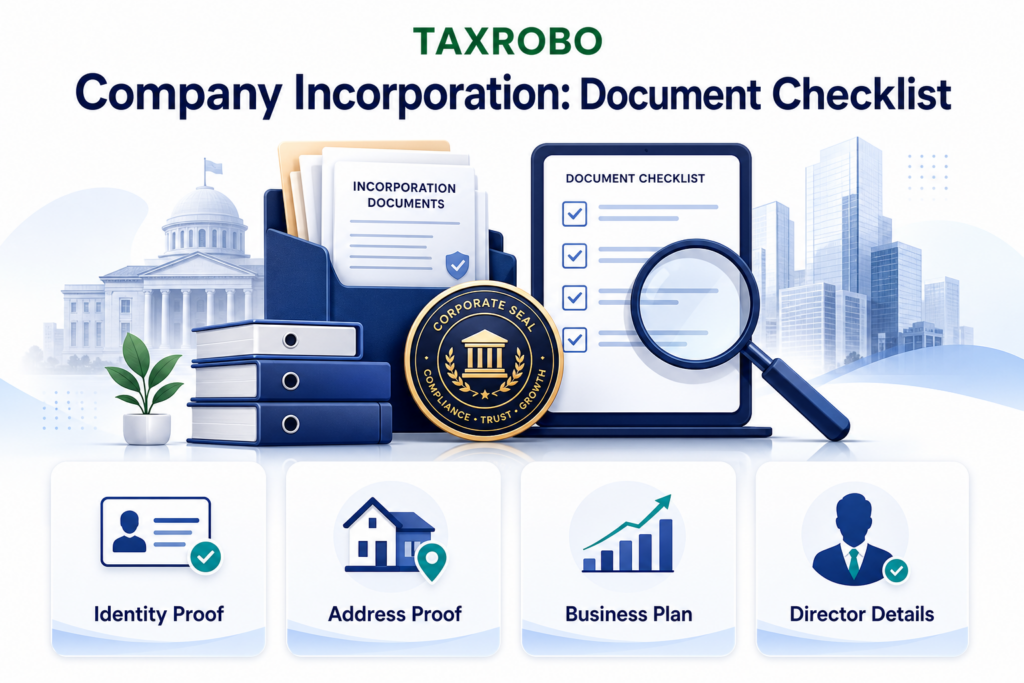

Documents Required for Company Incorporation: A Complete Checklist
Bringing a new business idea to life is an exhilarating journey for any entrepreneur. However, the path from a brilliant concept to a legally recognized company is paved with procedural requirements, with the overall How to Register a Company in India: Complete Process & Checklist often feeling like a daunting hurdle. Understanding the complete list of documents required for company incorporation is the first, most critical step to ensuring a smooth and delay-free registration process. This comprehensive guide from TaxRobo is designed to be your ultimate resource, breaking down every necessary document into a simple, easy-to-follow checklist, ensuring you are well-prepared to launch your venture. This incorporation documents checklist India will serve as your roadmap from start to finish.
Before You Compile Documents: Pre-Incorporation Essentials
Before you even begin gathering your identity proofs and address details, there are two foundational digital prerequisites you must secure. These are essential for interacting with the Ministry of Corporate Affairs (MCA) portal and are non-negotiable for any proposed director of a new company in India. Getting these in order first will prevent significant delays later in the process.
Step 1: Obtain a Digital Signature Certificate (DSC)
A Digital Signature Certificate, or DSC, is the electronic equivalent of a physical signature. It is a secure digital key that verifies your identity electronically when filing documents online. For company incorporation, it is mandatory for the proposed directors to have a Class 3 DSC. This specific class provides the highest level of assurance and is used to sign the electronic forms, such as the main SPICe+ incorporation form, which are submitted on the MCA portal. Think of it as your digital passport for all official company filings; without it, you cannot authenticate and submit the necessary e-forms to the Registrar of Companies (RoC).
Step 2: Apply for the Director Identification Number (DIN)
A Director Identification Number (DIN) is a unique 8-digit identification number assigned by the Central Government to any individual who is appointed as a director of a company. It is a mandatory requirement, and a person cannot hold the position of a director without a valid DIN. In the past, this was a separate application process. However, the procedure has been streamlined. For new directors who do not have an existing DIN, the application is now integrated directly into the company incorporation form itself, known as SPICe+. The DIN is allotted upon the approval of the incorporation form, simplifying the process for first-time entrepreneurs.
Core Documents Required for Company Incorporation from Directors & Shareholders
Once the digital essentials are sorted, the next step is to compile the personal identification documents for all proposed directors and shareholders. The requirements vary slightly depending on whether the individual is an Indian national or a foreign national/NRI. Accuracy and clarity of these documents are paramount, as any discrepancy can lead to the rejection of your application.
For Indian Nationals
For directors and shareholders who are Indian citizens and residents, the documentation process is straightforward. Ensure all copies are clear, self-attested (signed by the individual), and up-to-date.
- PAN Card: A self-attested copy of the Permanent Account Number (PAN) card is mandatory. It serves as the primary identification document for all financial and legal purposes in India.
- Identity Proof: A self-attested copy of any one of the following government-issued documents:
- Aadhaar Card
- Voter’s Identity Card (Election Card)
- Passport
- Driving License
- Address Proof: A self-attested copy of the latest version of any one of the following documents. Crucially, the document must not be older than two months from the date of filing and must clearly state the individual’s name as mentioned on the PAN card.
- Latest Bank Statement
- Latest Electricity Bill
- Latest Telephone Bill (Landline or Postpaid Mobile)
- Photograph: A recent passport-sized photograph of each director and shareholder is required.
For Foreign Nationals / NRIs
For foreign nationals or Non-Resident Indians (NRIs) looking to become directors or shareholders in an Indian company, the documents must undergo an additional step of authentication to be considered valid by the Indian authorities.
- Passport: A notarized or apostilled copy of the passport is mandatory. This is the primary proof of identity.
- Address Proof: A notarized or apostilled copy of a recent document like a bank statement, utility bill (electricity, gas), or driving license. As with Indian nationals, this should not be older than two months.
- Identity Proof: A notarized or apostilled copy of a government-issued identity card can also be submitted.
Important Note on Authentication:
The terms ‘Notarized’ and ‘Apostilled’ are crucial here.
- Apostille: If the foreign national resides in a country that is a signatory to the Hague Convention, their documents must be apostilled by the competent authority in their home country. This is an international certification that makes the document valid in all Hague Convention member countries, including India.
- Notarization: If the country is not a signatory to the Hague Convention, the documents must be notarized by a public notary in that country and then consularized by the Indian Embassy there.
Proof of Registered Office: Verifying Your Business Address
Every company in India must have a registered office address within the country from the date of its incorporation. This address is used for all official communication from government departments. The documents you need to provide will depend on whether the property is owned or rented. Whether you are gathering company registration documents Bangalore or trying to find out the required documents for starting a company Mumbai, the proof of a registered office is a universal and crucial requirement.
If the Property is Owned by a Director/Promoter
If one of the company’s own promoters or directors owns the property being used as the registered office, the documentation is simpler.
- Proof of Ownership: A copy of the Conveyance Deed, Sale Deed, or Registration Deed showing ownership of the property.
- Proof of Address: A recent utility bill like an Electricity Bill, Gas Bill, or Telephone Bill, or a Property Tax receipt. This document must not be older than two months.
- No Objection Certificate (NOC): While the director owns the property, it is best practice to include a simple NOC from the owner (the director themselves) stating they have no objection to the premises being used as the company’s registered office.
If the Property is Rented
This is the more common scenario for startups and new businesses. If you are leasing a commercial or residential space for your office, you will need documents from the legal owner of the property.
- Rent/Lease Agreement: A valid, notarized copy of the rental agreement or lease deed between the property owner and one of the company directors (acting on behalf of the proposed company).
- No Objection Certificate (NOC): This is a mandatory document. It is a formal letter signed by the landlord/property owner explicitly stating that they have no objection to their premises being used as the registered office for the proposed company.
- Proof of Ownership & Address: You must also provide a copy of a recent utility bill (not older than two months) or a property tax receipt in the name of the landlord to verify their ownership and the address.
The Final Incorporation Documents Checklist for MCA Filing
With the personal and address proofs compiled, the final stage involves drafting and filing the legal documents and prescribed e-forms with the Registrar of Companies (RoC). This is where your documents required for company incorporation checklist India culminates. These documents define the company’s structure, purpose, and rules of operation. If you are still evaluating your options, our guide Comparing Business Structures: Private Limited, LLP, OPC & More can be very helpful.
Memorandum of Association (MoA)
The MoA is the charter of the company and is considered its constitution. It defines the company’s scope of operations and its relationship with the outside world. This critical document contains several key clauses:
- Name Clause: The approved name of the company.
- Registered Office Clause: The state in which the registered office is located.
- Objects Clause: This is the most important part, detailing the main business activities the company will undertake.
- Liability Clause: States that the liability of the members is limited.
- Capital Clause: Mentions the authorized share capital of the company, a key consideration detailed in our guide on How Much Capital is Required to Start a Private Limited Company?.
Articles of Association (AoA)
If the MoA defines what the company will do, the AoA defines how it will do it. The AoA outlines the internal rules, regulations, and management framework of the company. It covers topics like the rights of shareholders, the appointment and powers of directors, rules for board meetings, and procedures for share transfers.
SPICe+ (INC-32) Form
SPICe+ (Simplified Proforma for Incorporating Company Electronically Plus) is the cornerstone of the modern incorporation process in India. It is a single, integrated web form submitted on the MCA portal that combines applications for multiple services into one. Filing this form effectively handles:
- Name Reservation (Part A)
- Company Incorporation (Part B)
- DIN Allotment for new directors
- PAN and TAN application for the new company
- GSTIN, ESIC, EPFO, and Professional Tax registration
e-AGILE-PRO-S (INC-35)
Linked directly to the SPICe+ form, e-AGILE-PRO-S (Application for Goods and services tax Identification number, employees’ state Insurance corporation registration pLUs Employees’ provident fund organisation registration, Professional tax registration, and Opening of bank account and Shops and Establishment registration) is the form used to apply for various mandatory registrations. It simplifies the post-incorporation compliance burden by bundling these applications together.
Declarations and Consents
Finally, a few declarations are required to complete the filing:
- INC-9: This is now an auto-generated declaration by the first subscribers and directors, confirming that they are compliant with the provisions of the Companies Act, 2013.
- DIR-2: This is a formal consent letter signed by each individual who agrees to act as a director of the proposed company.
Conclusion
Starting a company is a significant milestone, and having a firm grasp of the paperwork is your first step toward success. The process can be broken down into three clear stages: securing director prerequisites (DSC, DIN), compiling personal and address proofs (for directors and the registered office), and finally, filing the legal forms (MoA, AoA, SPICe+). Ensuring you have a complete and accurate set of the documents required for company incorporation not only speeds up the registration but also builds a strong legal foundation for your business from day one.
Ready to start your company without the bureaucratic hassle? Let the experts at TaxRobo handle the entire incorporation process for you, ensuring every document is perfect and every compliance is met. Contact us today for a free consultation and launch your dream venture with confidence!
Frequently Asked Questions (FAQs)
Q1: Can I use my home address as the registered office for my company?
Yes, you can absolutely use a residential address as the registered office for your company. You simply need to provide the required documents, which include a No Objection Certificate (NOC) from the property owner (even if it’s a family member) and a recent utility bill as proof of address.
Q2: What is the difference between MoA and AoA?
The Memorandum of Association (MoA) is the company’s charter that defines its objectives and powers—essentially, what the company can do. The Articles of Association (AoA), on the other hand, is the company’s internal rulebook that defines its regulations and management structure—essentially, how the company will operate to achieve its objectives.
Q3: Are digital signatures (DSC) mandatory for all directors?
Yes, the DSC of at least one director is mandatory for digitally signing the incorporation e-forms. However, it is highly recommended that all proposed directors obtain a DSC, as it will be required for various future compliance filings, such as annual returns and board resolutions.
Q4: How long does company incorporation take after all documents are submitted?
Typically, if all documents are in order and there are no queries from the department, the Registrar of Companies (RoC) can approve the incorporation and issue the Certificate of Incorporation within 7-10 working days. This timeline is subject to the processing speed at the respective RoC office.
Q5: Do I need to be physically present in Delhi to get a company incorporation documents list Delhi prepared?
No, you do not. The entire company incorporation process in India is now 100% online. With the help of professionals like TaxRobo, you can be anywhere in the world and register a company in Delhi or any other state in India without being physically present. All documents can be shared and filed electronically.