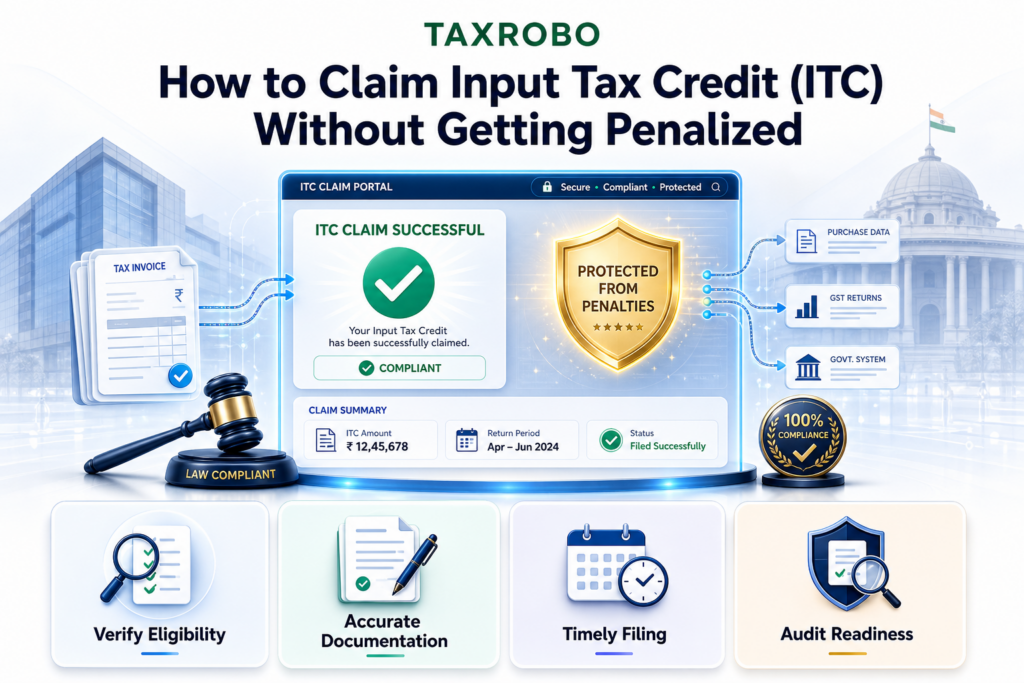

How to Claim Input Tax Credit (ITC) Without Getting Penalized: A 2024 Guide for Indian Businesses
Input Tax Credit (ITC) is one of the most powerful features of the Goods and Services Tax (GST) system, offering a direct way to reduce your business’s tax liability. However, this significant financial benefit comes with a high risk of notices and penalties if not handled correctly. Many small business owners in India find themselves struggling with the complex rules, often leading to either missing out on valid claims or making incorrect filings that attract unwanted attention from tax authorities. This guide will serve as your clear, step-by-step roadmap on how to claim ITC in India correctly, ensuring you maximize your benefits while staying fully compliant. We will break down the entire process to help you claim input tax credit confidently and avoid the common pitfalls that lead to penalties.
What is Input Tax Credit (ITC) and Why Does It Matter?
Before diving into the process, it’s crucial to understand the fundamental concept of ITC and its importance for your business’s financial health. Think of it as the backbone of the GST regime, designed to prevent the cascading effect of taxes (i.e., tax on tax) and create a seamless flow of credit throughout the supply chain. Mastering this concept is the first step toward efficient tax management and cost reduction for your enterprise.
Defining Input Tax Credit (ITC)
In simple terms, Input Tax Credit is the credit you receive for the GST you have already paid on your business purchases, which are known as “inputs.” These inputs can include raw materials, capital goods, and various services used to run your business. The ITC mechanism allows you to deduct this paid tax from your final GST liability on sales, or “outputs.” A helpful analogy is to think of it like this: It’s like getting a refund on the tax paid for your raw materials, which you can then use to pay the tax on your final product. This ensures that tax is ultimately levied only on the value added at each stage, making the entire system more efficient and transparent.
Who is Eligible to Claim Input Tax Credit?
The eligibility to claim ITC is not universal and is subject to specific conditions. The primary requirement is that your business must be registered under the GST law. Any unregistered business or individual cannot avail the benefits of ITC. Furthermore, the goods or services on which you are claiming the credit must be used or intended to be used in the course or furtherance of your business. This means ITC is not available for goods or services used for personal consumption. Additionally, you cannot claim ITC on inputs that are used for making “exempt supplies,” which are goods or services that do not attract GST.
A Quick Look at GST Components: CGST, SGST, and IGST
Understanding the basic components of GST is essential for proper ITC utilization. GST is levied in three forms:
- CGST (Central Goods and Services Tax): Collected by the Central Government on intra-state transactions (within the same state).
- SGST (State Goods and Services Tax): Collected by the State Government on intra-state transactions.
- IGST (Integrated Goods and Services Tax): Collected by the Central Government on inter-state transactions (between two different states) and imports.
The utilization of ITC follows a specific sequence. For example, the credit of IGST must first be used to pay IGST liability. Any remaining IGST credit can then be used to pay CGST and SGST liabilities, in that order. Similarly, CGST credit can only be used to pay CGST and then IGST, but not SGST. This cross-utilization hierarchy is a critical aspect of the input tax credit rules for businesses in India.
The 4 Golden Rules: Essential Conditions to Claim Input Tax Credit
The GST law, specifically Section 16 of the CGST Act, lays down four fundamental and non-negotiable conditions that must be met to claim ITC. Think of these as the pillars upon which your entire claim rests. Failing to satisfy even one of these can lead to the denial of your credit and potential penalties. Therefore, adhering to these prerequisites is the key to claiming input tax credit without penalties.
Condition #1: Possession of a Valid Tax Invoice or Debit Note
This is the most critical piece of documentary evidence required. The GST law is very clear: No valid invoice, no ITC. Your claim must be backed by a proper tax invoice, a debit note issued by your supplier, or another prescribed tax document. This document is not just a simple bill; it must contain specific mandatory details as per the GST rules, including:
- Supplier’s name, address, and GST Identification Number (GSTIN).
- Recipient’s name, address, and GSTIN.
- A unique, consecutive serial number.
- Date of issue.
- HSN (Harmonized System of Nomenclature) code for goods or SAC (Services Accounting Code) for services.
- Description and quantity of goods or services.
- Total value of the supply.
- The applicable rate and amount of tax (CGST, SGST, or IGST).
- Place of supply.
Without all these details correctly mentioned, the invoice may be considered invalid, putting your ITC claim at risk.
Condition #2: You Must Have Received the Goods or Services
You can only claim ITC for goods or services that you have actually received. This condition prevents businesses from claiming credit prematurely based solely on an invoice. The GST law requires the physical receipt of goods or the actual provision of services before the credit can be claimed in your GST return. There is a notable exception to this rule known as the “bill to ship to” model. In this scenario, you (the buyer) may direct the seller to ship the goods directly to a third party. Even though you do not physically receive the goods, you are still deemed to have received them for the purpose of claiming ITC.
Condition #3: The Supplier Has Paid the Tax to the Government
This is one of the most challenging yet crucial conditions. Your eligibility to claim ITC is directly linked to your supplier’s compliance. The GST you paid to your supplier must have been deposited by them with the government by filing their GST returns, primarily the GSTR-1 (statement of outward supplies). The GST system is designed to verify this automatically. The invoices uploaded by your supplier in their GSTR-1 reflect in your GSTR-2A and GSTR-2B. The government now strictly mandates that you can only claim ITC that appears in your auto-generated GSTR-2B statement. This makes it imperative to deal with compliant suppliers who file their returns on time.
Condition #4: You Have Filed Your GST Return (GSTR-3B)
The final step to lock in your ITC claim is to file your own GST return. The actual credit is claimed by declaring the eligible amount in your monthly or quarterly GSTR-3B return. This return is a summary of your sales, purchases, and the resulting tax liability after adjusting for the ITC. Until you have successfully filed your GSTR-3B for the relevant tax period, your ITC claim is not considered complete. This condition ties all the previous prerequisites together, as your GSTR-3B declaration is a formal assertion to the tax department that you have met all the necessary conditions to claim the credit.
The Step-by-Step ITC Claim Process in India
Navigating the GST portal and understanding the sequence of events can seem daunting, but the ITC claim process in India is systematic. By following these steps diligently every month, you can ensure a smooth and accurate ITC claim, minimizing the chances of errors and future complications.
Step 1: Your Supplier Files GSTR-1
The process begins not with you, but with your supplier. When you purchase goods or services, your supplier issues a tax invoice. They are then required to report this transaction by uploading the invoice details in their GSTR-1 return, which is typically filed by the 11th of the following month. This action is what feeds the data into the GST Network (GSTN) and makes the information available to you as the recipient.
Step 2: Reconcile Your Purchases with GSTR-2B
Once your supplier files their GSTR-1, the details of your inward supplies (purchases) are automatically populated in a statement called GSTR-2B, available on the GST Portal. GSTR-2B is a static, auto-drafted statement that is generated for you each month and serves as a definitive record of the ITC available to you. Your most critical task is to reconcile your purchase records with the data in GSTR-2B.
Actionable Tip: Before filing your GSTR-3B, always download your GSTR-2B statement. Meticulously match every invoice in your accounting books with the entries in GSTR-2B. You should only claim the ITC that appears in this statement to avoid any mismatches that could trigger a notice from the tax department.
Step 3: Claiming the Eligible ITC in Your GSTR-3B
After a thorough reconciliation, the next step is to file your GSTR-3B return. In this form, you will declare your summary figures for sales, tax liability, and eligible ITC. Specifically, Table 4 of the GSTR-3B form is where you report your ITC claims, broken down into categories like IGST, CGST, and SGST. The figures you enter in this table should be based on the reconciled data from your GSTR-2B and your purchase register, ensuring accuracy and compliance with the law.
Step 4: Final Tax Payment and Filing the Return
In the final step, the GST portal will automatically calculate your net tax liability. The eligible ITC you claimed in Table 4 will be deducted from your total output tax liability for the month. The remaining balance is the net tax you need to pay to the government. Once you have paid this amount through the portal (via cash ledger) and offset the liabilities, you can proceed to file your GSTR-3B return. With this final submission, your ITC claim for the period is officially completed.
How to Avoid Costly Mistakes and Claim Input Tax Credit Penalties in India
Vigilance is the key to successfully navigating the complexities of ITC and avoiding penalties. The GST department’s systems are becoming increasingly sophisticated at flagging discrepancies, making it more important than ever to be aware of common errors. Understanding these traps is the first step toward building a robust compliance process and protecting your business from financial repercussions related to claim input tax credit penalties India.
Mistake #1: Claiming ITC on “Blocked Credits” (Section 17(5))
The GST law specifically lists certain goods and services on which you cannot claim ITC, even if they are used for business purposes. This list is detailed under Section 17(5) of the CGST Act and is often referred to as “blocked credits.” Claiming ITC on these items is a common error that can lead to penalties and interest. Some of the most common examples of blocked credits include:
- Motor vehicles for transportation of persons with a seating capacity of 13 or less (including the driver), except when used for specific business purposes like passenger transport, imparting driving training, or further supply of such vehicles.
- Food, beverages, and outdoor catering services.
- Membership of a club, health, and fitness center.
- Health and life insurance policies, unless it is obligatory for an employer to provide them to employees under any law.
- Goods lost, stolen, destroyed, written off, or disposed of by way of gift or free samples.
- Works contract services when supplied for the construction of an immovable property (other than plant and machinery).
Mistake #2: Not Reversing ITC When Required
There are specific situations where you are required to reverse the ITC you have already claimed. The most common scenario is the 180-day rule for payment to suppliers. If you receive an invoice and claim ITC but fail to pay the supplier the full invoice value (including tax) within 180 days from the date of the invoice, you must reverse the ITC you availed. This reversed amount must be added back to your output tax liability, along with applicable interest. However, you are allowed to re-claim this ITC once you make the payment to the supplier.
Mistake #3: Reconciliation Errors and Mismatches
One of the biggest red flags for the tax authorities is a mismatch between the ITC you claim in your GSTR-3B and the ITC available in your GSTR-2B. Many businesses make the mistake of claiming ITC based solely on their internal purchase records without verifying it against the GSTR-2B. This discrepancy is easily caught by the GSTN’s automated systems and is a primary reason for receiving scrutiny notices (like Form ASMT-10). Always remember the golden rule: if it’s not in your GSTR-2B, do not claim it. Instead, follow up with your supplier to ensure they upload the invoice correctly.
Mistake #4: Missing the Deadline to Claim ITC
The law provides a specific timeframe within which you must claim your ITC. Missing this deadline means you forfeit the credit forever. For any invoice or debit note pertaining to a financial year, the last date to claim input tax credit is November 30th of the following financial year, or the date of filing the annual return (GSTR-9) for that year, whichever is earlier. For example, for an invoice dated in the financial year 2023-24, you must claim the ITC by November 30, 2024, or the date you file your FY 2023-24 annual return, whichever comes first.
Conclusion
Mastering Input Tax Credit is not just about compliance; it’s about optimizing your business’s cash flow and profitability. By understanding the core principles and adhering to a disciplined process, you can confidently navigate the GST landscape. Remember these key takeaways:
1. Always ensure you possess a valid tax invoice with all mandatory details before making a claim.
2. Make it a non-negotiable monthly habit to reconcile your purchase records with your GSTR-2B.
3. Be vigilant about blocked credits and other restrictions to avoid incorrect claims.
4. File your GSTR-3B accurately and on time, ensuring you pay your suppliers within the 180-day limit.
A systematic and disciplined approach is the best way to claim input tax credit effectively and stay penalty-free. This ensures you receive the benefits you are entitled to without the stress of departmental notices.
Managing GST compliance can be complex. If you want to ensure you are claiming input tax credit without penalties and can focus on growing your business, the experts at TaxRobo are here to help. Contact us for a consultation today!
Frequently Asked Questions about Claiming ITC
Q1. What is the final deadline to claim input tax credit for a financial year?
A: The deadline is November 30th of the next financial year or the date of filing the annual GST return (GSTR-9) for that year, whichever comes first. For example, for FY 2023-24, the deadline is November 30, 2024, or the date of filing the annual return, whichever is earlier.
Q2. Can I claim ITC on capital goods like machinery?
A: Yes, you can claim ITC on capital goods such as machinery that are used or intended to be used in the course of your business. The only condition is that you should not have claimed depreciation on the tax component (GST) of such goods under the Income Tax Act, 1961.
Q3. What should I do if my supplier has not uploaded an invoice and it’s not showing in my GSTR-2B?
A: You should immediately contact your supplier and request them to file their GSTR-1 correctly and include your invoice. You cannot and should not claim ITC on an invoice until it is reflected in your GSTR-2B. Consistent follow-up and working with compliant vendors is crucial to avoid losing credit.
Q4. Can a salaried person with a rental income business claim ITC?
A: If you are a salaried individual but also run a business for which you are registered under GST (e.g., renting out a commercial property), you can claim ITC. For the rental business, you can claim ITC on GST paid for business expenses related to that property, such as maintenance services, repair costs, brokerage fees, etc., provided all other conditions for claiming ITC are met.