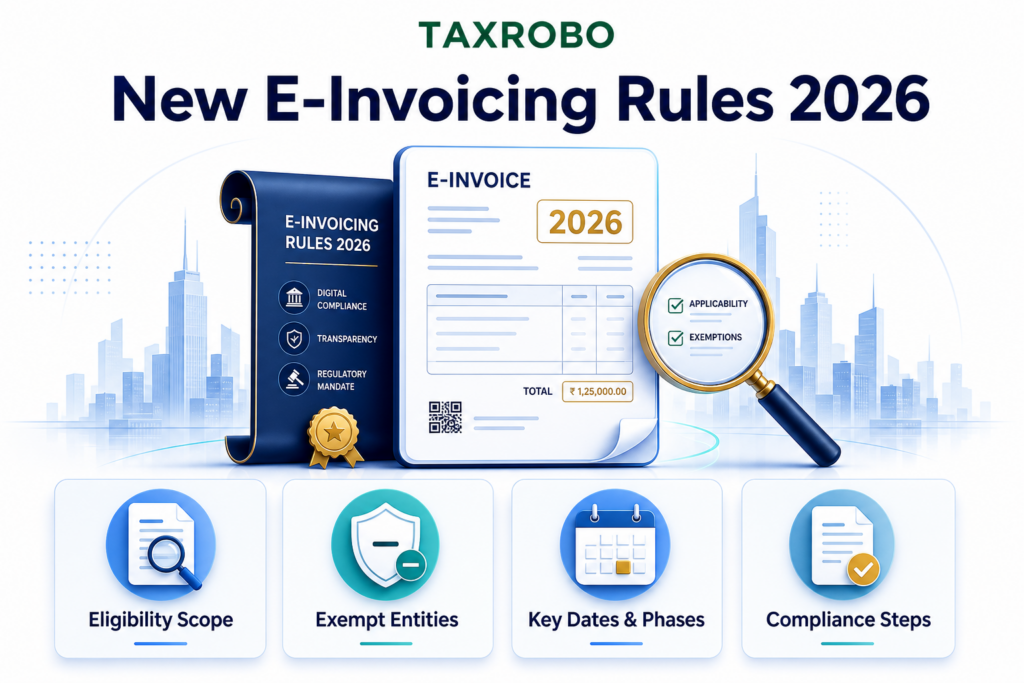

New E-Invoicing Rules 2026: Applicability and Exemptions
Meta Description: A comprehensive guide to the upcoming E-invoicing rules 2026 in India. Understand the new turnover limits, applicability, exemptions, and compliance requirements for small businesses and SMEs. Prepare your business with TaxRobo.
India’s Goods and Services Tax (GST) framework is in a constant state of evolution, with a clear and consistent drive towards greater digitalization and transparency. A cornerstone of this digital transformation is the phased implementation of electronic invoicing. As the government continues to expand its scope, it is crucial for businesses to stay ahead of the curve. This article serves as your definitive guide to the expected E-invoicing rules 2026, breaking down what small business owners need to know about the new turnover limits, who needs to comply, who is exempt, and how to prepare for a seamless transition. Understanding the evolving e-invoicing rules India has set forth is no longer optional; it’s essential for compliance and business continuity.
What is E-Invoicing? A Quick Refresher for Indian Businesses
Before diving into future changes, let’s clarify a common misconception. E-invoicing, under the Indian GST system, is not about generating your invoices from scratch on a government portal. Instead, it refers to the process of reporting your standard, already-generated B2B (Business-to-Business) invoices to a designated government portal known as the Invoice Registration Portal (IRP). To fully grasp the basics of invoicing under this regime, refer to our guide on Understanding GST Invoicing: A Detailed Guide.
The process works like this: you continue to create invoices using your own accounting or ERP software. The invoice data is then sent in a specific format (JSON) to the IRP for validation. The IRP authenticates the data, checks for duplicates, and, if everything is in order, returns a digitally signed e-invoice with two crucial components. This system is key to understanding e-invoicing for Indian businesses as it integrates with existing business processes rather than replacing them entirely.
Key Components: The Invoice Reference Number (IRN) and QR Code
Once the IRP successfully validates an invoice, it generates and adds two key elements:
- Invoice Reference Number (IRN): This is a unique, 64-character hash generated by the IRP for every invoice submitted. The IRN is the definitive proof that an invoice has been officially registered with the government.
- Quick Response (QR) Code: The IRP also generates and digitally signs a QR code that contains select details of the invoice, including the GSTINs of the supplier and recipient, invoice number, date, value, HSN codes, and the IRN.
An invoice that carries a valid IRN and a scannable QR code is considered a legitimate e-invoice. The presence of these elements authenticates the transaction for tax purposes. For more official details, you can visit the official GST e-invoice portal.
The Road to 2026: A Timeline of E-Invoicing Applicability in India
The government’s strategy for implementing e-invoicing has been methodical and phased, ensuring that the system is stable and that businesses have time to adapt. This gradual reduction of the turnover threshold demonstrates a clear intention to eventually bring most GST-registered businesses under the e-invoicing umbrella. Understanding this journey provides crucial context for what’s to come.
From ₹500 Crore to ₹5 Crore: The Journey So Far
The phased rollout showcases the progressive applicability of e-invoicing in India, starting with the largest corporations and gradually moving towards smaller enterprises. Here’s a quick look at the timeline of the Aggregate Annual Turnover (AATO) thresholds:
- October 2020: E-invoicing became mandatory for businesses with an AATO exceeding ₹500 Crore.
- January 2021: The threshold was lowered to include businesses with an AATO over ₹100 Crore.
- April 2021: The scope was further widened to cover businesses with an AATO above ₹50 Crore.
- April 2022: The limit was more than halved, making it mandatory for those with an AATO over ₹20 Crore.
- August 2022: The threshold was once again reduced to ₹10 Crore.
- August 2023: In the latest update, e-invoicing was made mandatory for businesses with an AATO exceeding ₹5 Crore.
This consistent, downward trend is a clear signal from the tax authorities: digitalization is the future, and universal e-invoicing is the destination.
Decoding the New E-Invoicing Rules 2026: What’s Next?
Following the established pattern of threshold reduction, the next logical step in this digital journey is to bring an even larger segment of the Indian economy into the e-invoicing framework. The E-invoicing rules 2026 are anticipated to be the most significant expansion yet, impacting a massive number of micro, small, and medium enterprises (MSMEs). Businesses that have so far been exempt must now begin serious preparations for compliance.
The Anticipated New Turnover Threshold for 2026
While an official notification is awaited, it is widely anticipated by tax experts and industry watchers that the new e-invoicing guidelines 2026 will lower the Aggregate Annual Turnover (AATO) threshold to ₹1 Crore. This move would align the e-invoicing mandate with the threshold for mandatory HSN code reporting and E-way bill requirements for intra-state movement in many states, creating a more harmonized compliance environment.
It is crucial to correctly understand ‘Aggregate Annual Turnover’. AATO is calculated at the PAN level, not the GSTIN level. This means you must sum the turnover of all your business locations/branches operating under the same PAN. It includes the value of all taxable supplies, exempt supplies, exports, and inter-state supplies.
The E-Invoicing Impact on Indian Taxpayers and Small Businesses
Lowering the threshold to ₹1 Crore will have a profound e-invoicing impact on Indian taxpayers, especially small businesses. Many of these businesses currently rely on manual or semi-automated accounting processes. The shift to e-invoicing will necessitate:
- Investment in Digital Infrastructure: Businesses will need to adopt or upgrade their accounting software to ensure it can integrate with the IRP, either directly via APIs or through a GST Suvidha Provider (GSP).
- Process Automation: Manual billing processes will become inefficient and prone to errors. The new rules will push businesses towards automating their entire invoice-to-payment cycle.
- Real-Time Compliance: E-invoicing is a real-time process. Unlike traditional return filing, invoices must be registered on the IRP as they are generated, demanding a shift in mindset and operational discipline.
- Staff Training: Employees involved in billing and accounting will need to be trained on the new software and compliance workflows.
E-Invoicing Applicability and Exemptions: Who’s In and Who’s Out?
With the rules changing, it’s vital to have a clear checklist to determine if your business falls under the new mandate. Below, we break down who needs to comply and who remains exempt.
Checklist: Who Must Comply with the E-Invoicing Rules 2026?
Your business will likely be required to generate e-invoices starting in 2026 if it meets the following criteria:
- You are a registered person under GST.
- Your aggregate turnover in *any* preceding financial year from 2017-18 onwards exceeds the new threshold (anticipated to be ₹1 Crore). It’s important to note that if you crossed the threshold in any previous year, even if your current turnover is lower, you are still required to comply.
- The mandate applies to the following types of transactions:
- Supplies to other registered persons (B2B).
- Supplies made to Special Economic Zones (SEZs).
- All Exports (with or without payment of tax).
The Official List of Exemptions from E-Invoicing Rules in India
Despite the turnover criteria, the government has provided specific exemptions from e-invoicing rules in India for certain categories of registered persons. These entities are not required to generate e-invoices, regardless of their annual turnover:
- Special Economic Zone (SEZ) Units (Note: SEZ Developers are required to comply).
- Insurers, Banking Companies, and Financial Institutions, including Non-Banking Financial Companies (NBFCs).
- Goods Transport Agencies (GTAs) that are providing services in relation to the transportation of goods by road in a goods carriage.
- Suppliers of passenger transportation services.
- Suppliers of services by way of admission to the exhibition of cinematograph films in multiplex screens.
For the most current list, it’s always advisable to refer to the latest notifications from the Central Board of Indirect Taxes and Customs (CBIC).
Your Step-by-Step Guide to E-Invoicing Compliance in India
Getting started with e-invoicing can seem daunting, but breaking it down into manageable steps makes the process much clearer. Here is a simple guide to ensure your business meets all e-invoicing compliance requirements India has put in place.
Step 1: Verify Your Turnover and Applicability
The first and most critical step is to determine if the rules apply to you. Carefully review your financial statements and GST returns for all financial years starting from 2017-18. Calculate your Aggregate Annual Turnover (AATO) at the PAN level for each year. If your AATO crossed the mandated threshold (e.g., ₹5 Crore currently, or the anticipated ₹1 Crore in the future) in any of those years, you must comply.
Step 2: Select an E-Invoicing Solution
You have several options for generating e-invoices. The best choice depends on your business’s scale and transaction volume:
- API-Based Integration: For businesses with high transaction volumes, directly integrating your existing ERP or accounting software with the IRP via APIs is the most seamless solution.
- GSP/ASP Services: You can use the services of a licensed GST Suvidha Provider (GSP) or Application Service Provider (ASP). These firms provide software and platforms that bridge the gap between your accounting system and the IRP.
- Offline Utility Tools: For businesses with a very low volume of invoices, the government provides free offline tools where you can manually enter invoice data and generate the required JSON file for uploading to the IRP.
Firms like TaxRobo can help you assess your needs and guide you in selecting and implementing the most cost-effective and efficient solution for your business.
Step 3: Register on the Invoice Registration Portal (IRP)
This is a simple, one-time process. If e-invoicing is applicable to your GSTIN, you can register on the official IRP. The system will use your GSTIN to send an OTP to your registered mobile number for verification. Once registered, you can create API credentials or start using the portal.
Step 4: Generate, Report, and Print Your E-Invoice
The final workflow is straightforward:
- Create Invoice: Generate your standard invoice in your ERP or accounting software as you normally would.
- Upload to IRP: Your software will convert the invoice data into the prescribed JSON format and upload it to the IRP.
- Receive Validation: The IRP validates the data in real-time and sends back the digitally signed JSON with the unique IRN and QR code.
- Update and Print: Your system will receive this data and embed the QR code onto your final invoice. You must then issue this e-invoice (with the QR code printed on it) to your customer.
Benefits vs. Challenges for Newly Covered SMEs
The transition to e-invoicing brings both opportunities and hurdles for small and medium enterprises. A balanced perspective can help businesses prepare effectively.
The Bright Side: Key E-Invoicing Benefits for Indian SMEs
While compliance is mandatory, it unlocks several powerful advantages that can improve business efficiency and cash flow:
- Faster and Guaranteed Input Tax Credit (ITC): For your customers (the buyers), e-invoicing guarantees the availability of ITC, as the transaction is validated by the government in real-time. This can improve your business relationships.
- Reduction of Errors: Automation minimizes human errors in data entry and reduces the time spent on invoice reconciliation between suppliers and recipients.
- Auto-Population of GST Returns: Data from your e-invoices is automatically populated into your GSTR-1 and the recipient’s GSTR-2A/2B, simplifying the return filing process significantly. For those new to the process, our How to File GST Returns Online: A Step-by-Step Guide of the GST Filing Process & Procedure can be a valuable resource.
- Simplified E-Way Bill Generation: Part-A of the E-Way Bill is auto-filled from the e-invoice data. You only need to add vehicle details to generate the E-Way Bill, saving time and effort.
- Improved Access to Credit: E-invoices serve as validated, trustworthy documents, making it easier for SMEs to access formal credit through invoice discounting and financing platforms.
Navigating the Hurdles: Common Challenges and Solutions
Newly covered businesses will face some initial challenges. Here’s how to think about them:
- Challenge: Initial cost of software and implementation.
Solution: Explore cost-effective, cloud-based accounting and e-invoicing solutions that operate on a subscription model, avoiding large upfront capital expenditure. - Challenge: Need for 24/7 system uptime and internet connectivity.
Solution: Choose reliable software providers with good technical support. For intermittent connectivity issues, some solutions allow for batch uploading of invoices. - Challenge: Handling amendments and cancellations.
Solution: Understand the rules: cancellations are only possible on the IRP within 24 hours. After that, any changes must be made via debit or credit notes, which also need to be reported to the IRP. - Challenge: Training staff on the new processes.
Solution: Start early. Plan training sessions and create simple process documents for your team to follow. Partner with a compliance expert like TaxRobo to guide your team through the transition.
Conclusion
The expansion of the E-invoicing rules 2026 to include businesses with a turnover as low as ₹1 Crore is an inevitable and significant step in India’s journey towards a fully digital tax economy. While this transition may seem challenging for many small businesses, proactive preparation is the key to a smooth and successful adoption. Compliance is not merely a legal obligation; it is an opportunity to streamline your financial operations, reduce errors, and enhance business efficiency. The long-term benefits of improved data accuracy, faster credit cycles, and simplified compliance far outweigh the initial hurdles.
Feeling overwhelmed by the upcoming e-invoicing rules 2026? Don’t navigate these changes alone. Contact TaxRobo’s GST experts today for a consultation and ensure your business is fully prepared and compliant.
FAQs: Answering Your Top E-Invoicing Questions
1. What are the penalties for non-compliance with e-invoicing rules?
Failure to issue a valid e-invoice when required is a serious offense. The penalty for not issuing a valid invoice is ₹10,000 or 100% of the tax due, whichever is higher, for each non-compliant invoice. More importantly, an invoice without a valid IRN is not considered a legal tax invoice. This means your customer (the recipient) will not be able to claim Input Tax Credit (ITC) on that purchase, which can lead to business disputes and loss of customers.
2. Do I need to generate e-invoices for B2C transactions?
No, e-invoicing is currently mandatory only for B2B (supplies to other GST-registered persons) transactions, exports, and supplies to SEZ units. For B2C (Business-to-Consumer) transactions, there is a separate requirement for businesses with an aggregate annual turnover exceeding ₹500 Crore to generate and display a dynamic QR code on their invoices to facilitate digital payments.
3. How do I cancel an e-invoice if I make a mistake?
An e-invoice can be cancelled on the Invoice Registration Portal (IRP), but only within 24 hours of its generation. After the 24-hour window has passed, it cannot be cancelled on the IRP. The only way to nullify the invoice after this period is by issuing a formal credit note (which itself needs to be reported to the IRP) or by manually amending the transaction details in your GSTR-1 filing for that tax period.
4. Is an e-way bill still required after generating an e-invoice?
Yes, the requirement for an e-way bill remains separate and is triggered if the consignment value of goods being transported exceeds ₹50,000. However, the e-invoicing system greatly simplifies this process. When you generate an e-invoice, the data required for Part-A of the e-way bill is automatically captured. You can then use the IRN to fetch this data and only need to add the transporter and vehicle details in Part-B to quickly generate the corresponding e-way bill. For a detailed walkthrough, you can follow our Guide to GST E-Way Bill Generation.