
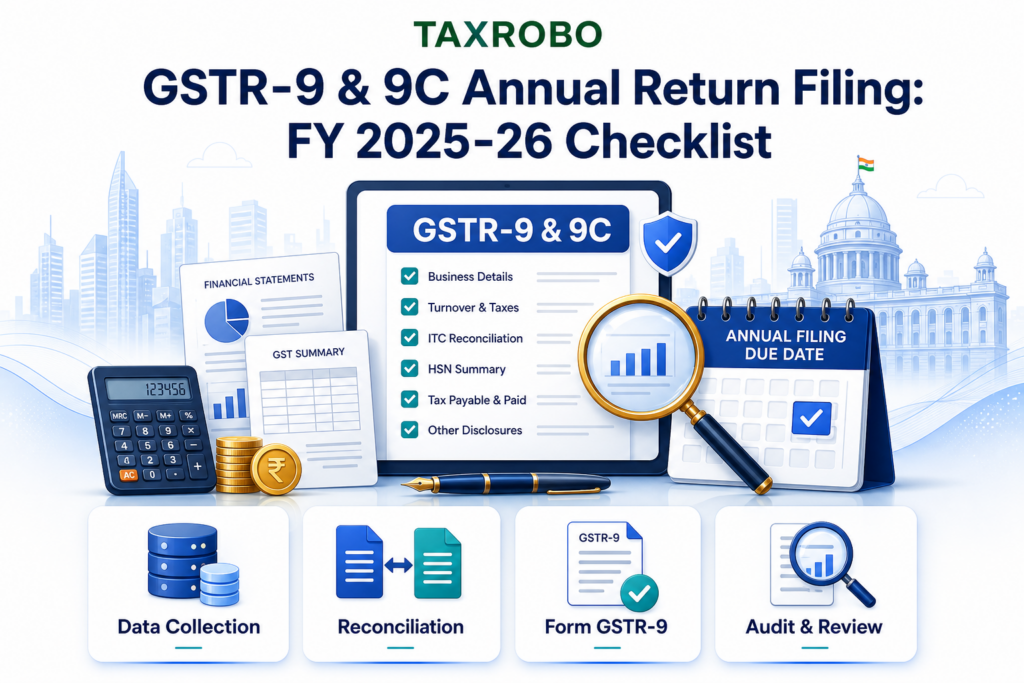

GSTR-9 and 9C Annual Return Filing: Your Ultimate Checklist for FY 2025-26
As the financial year 2025-26 comes to a close, business owners across India face the crucial task of filing their GST annual returns. The process can seem daunting, filled with complex tables and reconciliation requirements, but with the right preparation and a systematic approach, it becomes entirely manageable. This post provides a comprehensive annual return filing checklist specifically designed for GSTR-9 and GSTR-9C to help you navigate the process smoothly, ensure complete compliance with tax laws, and avoid the costly penalties that can arise from errors or delays. Think of this guide as your roadmap to a stress-free and accurate annual filing season.
What are GSTR-9 and GSTR-9C? A Quick Refresher for Business Owners
Before diving into the detailed checklist, it’s essential to have a clear understanding of the two key components of GST annual filing. While they are often mentioned together, GSTR-9 and GSTR-9C serve distinct purposes and have different applicability criteria. Getting these basics right is the first step towards accurate compliance.
Understanding GSTR-9: The Annual Return
GSTR-9 is the primary annual return that must be filed once a year by eligible taxpayers registered under the GST regime. Essentially, it is a detailed consolidation of all the monthly or quarterly returns (such as GSTR-1 for outward supplies and GSTR-3B for summary returns) that you have filed throughout that financial year, a process detailed in our guide on How to File GST Returns Online: A Step-by-Step Guide of the GST Filing Process & Procedure. It presents a comprehensive picture of your business’s transactions and tax payments for the entire year in one single document.
- Who files it? Filing GSTR-9 is mandatory for all registered taxpayers with an aggregate annual turnover exceeding ₹2 crores. For businesses with a turnover up to ₹2 crores, filing this return is optional but often recommended for maintaining a clean compliance record.
- What it contains: The form captures a detailed summary of all outward supplies made, inward supplies received, taxes paid (CGST, SGST/UTGST, IGST), and Input Tax Credit (ITC) claimed during the financial year. This is a key part of the
GSTR-9 annual return filing Indiaprocess.
Decoding GSTR-9C: The Reconciliation Statement
GSTR-9C is not a return but a reconciliation statement. Its purpose is to ensure that the data reported in your GST annual return (GSTR-9) is in complete agreement with the data in your audited annual financial statements. This statement acts as a bridge between your GST filings and your accounting records, highlighting any differences and providing explanations for them. It is a critical audit and verification tool for the tax authorities.
- Who files it? Filing GSTR-9C is mandatory for all registered taxpayers with an aggregate annual turnover exceeding ₹5 crores during the financial year.
- What it requires: This statement must be prepared and then self-certified by the taxpayer. The
GSTR-9C return filing processinvolves a detailed reconciliation of turnover, tax paid, and Input Tax Credit, ensuring there are no discrepancies between the GST ecosystem and the audited books of accounts.
Due Dates and Penalties for GSTR-9 & 9C for FY 2025-26
Meeting deadlines is one of the most critical aspects of tax compliance. Missing the due date for annual return filing FY 2025-26 can lead to significant financial penalties that can impact your business’s bottom line. Therefore, it is crucial to be aware of the filing deadline and the consequences of any delay.
Mark Your Calendar: Filing Deadline for FY 2025-26
The due date for filing both the GSTR-9 annual return and the GSTR-9C reconciliation statement for the financial year 2025-26 (covering the period from 1st April 2025 to 31st March 2026) is 31st December 2026. This deadline is fixed and applies to all eligible taxpayers across the country.
- Pro Tip: While this is the statutory deadline, the government sometimes announces extensions based on various factors. Always keep an eye on the official GST Portal for any notifications or press releases regarding deadline extensions to stay updated.
The Cost of Delay: Late Fees and Penalties
Failing to file your annual returns on time attracts specific late fees as prescribed under the GST law. Understanding these penalties underscores the importance of timely compliance.
- For GSTR-9: A late fee of ₹200 per day of delay is applicable. This is split into ₹100 for CGST and ₹100 for SGST/UTGST. However, there is a cap on the total penalty, which is limited to a maximum of 0.50% of the taxpayer’s turnover in the respective state or union territory (0.25% for CGST and 0.25% for SGST/UTGST).
- For GSTR-9C: There is no separate, specific penalty prescribed for the late filing of GSTR-9C. However, since GSTR-9C must be filed along with GSTR-9, the penalty for the late filing of GSTR-9 automatically applies. Essentially, you cannot file GSTR-9C without filing GSTR-9, making the deadline and penalty for GSTR-9 applicable to the entire process.
Your Ultimate GSTR-9 Annual Return Filing Checklist for FY 2025-26
A systematic approach is the best way to tackle the complexities of GSTR-9. By breaking down the process into manageable phases, you can ensure that no detail is overlooked. This step-by-step annual return filing checklist will guide you from data collection to the final submission, ensuring accuracy and peace of mind.
Phase 1: Data Gathering and Reconciliation
This initial phase is the foundation of your entire filing process. Accurate data collection and meticulous reconciliation are non-negotiable for a correct GSTR-9 return. Rushing through this stage often leads to errors and future complications.
- Collect All Returns: The first step is to compile all the GSTR-1 (for outward supplies) and GSTR-3B (summary returns) that you have filed for the financial year, covering the period from April 2025 to March 2026. These documents are the primary source of data for your GSTR-9.
- Download GSTR-2A/2B: Log in to the GST portal and download the auto-populated GSTR-2A (dynamic) and GSTR-2B (static) statements for the entire financial year. GSTR-2B is the crucial document for confirming your eligible Input Tax Credit (ITC).
- Compile Financials: Keep your audited or final financial statements, including the Profit & Loss statement and the Balance Sheet, ready. Your books of accounts are the ultimate source of truth for your business’s financial performance.
- Reconcile Outward Supplies: Meticulously compare the total turnover and the taxes paid as recorded in your books of accounts with the consolidated figures from your GSTR-1 and GSTR-3B filings for the year. Identify and document the reasons for any discrepancies, such as credit notes issued but not declared or invoices missed in monthly filings.
- Reconcile ITC: This is one of the most critical reconciliation tasks. Compare the total ITC you have claimed in your GSTR-3B returns throughout the year with the eligible ITC available as per your GSTR-2B statements and the ITC recorded in your books of accounts. Create a detailed report of any mismatches and investigate the reasons.
Phase 2: Verifying Details in the GSTR-9 Form
Once your data is reconciled, the next step is to populate the GSTR-9 form. This section serves as a GST annual return filing guide to help you accurately fill in the various tables of the form.
- Part II (Tables 4 & 5): This part requires details of all outward supplies made during the year. Carefully verify the figures for taxable supplies, supplies to SEZ (with and without tax payment), exports, deemed exports, exempt supplies, and nil-rated supplies. Ensure the tax amounts (IGST, CGST, SGST) declared here match your reconciled data from Phase 1.
- Part III (Tables 6, 7 & 8): This section deals with Input Tax Credit.
- Table 6: Verify the details of ITC availed as declared in your GSTR-3B returns. The auto-populated figures should be cross-checked with your records.
- Table 7: Report details of any ITC that you have reversed during the year as per Rule 42 & 43 of the CGST Rules, as well as other ineligible ITC.
- Table 8: This table reconciles your ITC as per GSTR-2A/2B with the ITC claimed in GSTR-3B (Table 6B).
- Part IV (Table 9): Cross-check the details of tax paid as declared in your GSTR-3B returns for the financial year. This table should reflect the actual tax paid in cash and through ITC.
- Part V (Tables 10 to 14): This part is for declaring transactions from FY 2025-26 that were amended or reported in the returns of the next financial year (i.e., between April 2026 and the specified date). For example, if you missed an invoice from March 2026 and reported it in your GSTR-1 for April 2026, it must be declared here.
- Part VI (Tables 17 & 18): Provide the HSN-wise summary of all outward and inward supplies. This is a crucial
GSTR-9 compliance requirement. Ensure you use the correct number of HSN digits as per your turnover slab (4 digits for turnover up to ₹5 crores, 6 digits for turnover above ₹5 crores).
Phase 3: Final Review and Filing
The final phase is about ensuring everything is perfect before you hit the ‘submit’ button. Since GSTR-9 cannot be revised after filing, this final check is your last opportunity to correct any mistakes. To be extra cautious, review our GST Annual Return (GSTR-9 & 9C) Filing Guide – Common Errors to Avoid to ensure you haven’t overlooked any frequent pitfalls.
- Address Discrepancies: If your reconciliation reveals any additional tax liability that was not paid during the year, you must pay it now. This payment should be made through Form DRC-03, along with any applicable interest for the delay.
- Final Review: Before filing, use the “Preview Draft GSTR-9” option on the GST portal to download a PDF of the form. Review every single table offline, preferably with a colleague or your accountant. Compare the figures one last time against your reconciled worksheets.
- File the Return: Once you are completely satisfied with the accuracy of the data, you can proceed to file the return. You will need to authenticate it using a DSC (Digital Signature Certificate) for companies or LLPs, or an EVC (Electronic Verification Code) for other taxpayers.
A Practical GSTR-9C Filing Checklist for Accountants and Business Owners
For businesses with an annual turnover exceeding ₹5 crores, filing GSTR-9C is mandatory. This GSTR-9C filing checklist for accountants provides a focused guide on the critical reconciliation points within the form, ensuring a seamless certification process.
Part A: Reconciliation Statement
Part A of GSTR-9C is the core of the reconciliation process, where figures from audited financials are matched against the GSTR-9 return.
- Table 5: This is the starting point for turnover reconciliation. Reconcile the gross turnover as per your audited financial statements with the total turnover declared in your GSTR-9 (from Table 5N). You must clearly state the reasons for any un-reconciled differences.
- Table 7: After reconciling gross turnover, you need to reconcile the taxable turnover. Start with the turnover from Table 5 and adjust for exempt, nil-rated, and non-GST supplies to arrive at the taxable turnover, which should then match the figure in GSTR-9.
- Table 9: Reconcile the total tax paid. This involves matching the rate-wise tax liability (e.g., 5%, 12%, 18%, 28%) and the amount paid as per the reconciliation statement with the total tax paid as declared in GSTR-9. Any difference must be explained and, if it results in a shortfall, paid via DRC-03.
- Table 12: This table is crucial for reconciling the Net Input Tax Credit. Match the ITC availed as per your audited financials with the total ITC availed in GSTR-9 (Table 7J). Any differences must be clearly reported and justified.
- Table 14: Report the expense-wise ITC claim as recorded in your audited financial statements. This provides a breakdown of ITC on major expenses like purchases, freight, rent, etc., and should reconcile with the total ITC claimed.
Part B: Certification
Part B is the certification portion of the GSTR-9C form, which validates the accuracy of the reconciliation statement prepared in Part A.
- Obtain Certification: Once Part A is accurately filled and all reconciliations are complete with valid reasons for any differences, the statement needs to be certified. As per the latest rules, GSTR-9C is self-certified by the taxpayer.
- File on Portal: The self-certified GSTR-9C must be filed on the GST portal along with the GSTR-9 annual return and a copy of the audited financial statements.
Conclusion: Simplify Your Filing with a Solid Checklist
Filing GSTR-9 and GSTR-9C is a non-negotiable part of your annual GST compliance obligations. This is just one component of a larger framework, and our complete GST Compliance Checklist for FY 2025–26 – Monthly, Quarterly & Annual Tasks can help keep you on track all year. While the forms may seem intricate, the process becomes significantly more manageable when approached with diligence and structure. By following a structured annual return filing checklist, you can ensure data accuracy, avoid last-minute rushes, prevent late fees and penalties, and maintain a clean compliance record with the tax authorities. Proactive data reconciliation throughout the year and a thorough final review before submission are the ultimate keys to a successful and stress-free annual filing season.
Feeling overwhelmed? TaxRobo’s expert team is here to simplify your GST compliance. Let us handle the complexities of the GST annual return filing guide for you. Contact us today for an expert consultation and ensure your business is 100% compliant!
Frequently Asked Questions (FAQs)
1. Is filing GSTR-9 mandatory for all taxpayers?
Filing GSTR-9 is mandatory for taxpayers with an aggregate annual turnover of more than ₹2 crores in the financial year. For businesses and individuals with a turnover up to ₹2 crores, filing the GSTR-9 is optional.
2. Can I revise my GSTR-9 or GSTR-9C after filing?
No. Currently, the GST law does not provide an option to revise a filed GSTR-9 or GSTR-9C. This makes it extremely important to use a detailed checklist for GSTR-9 filing in India to ensure that all the information provided is accurate and complete on the first attempt, as any errors discovered later cannot be rectified through a revised return.
3. What should I do if I find a tax liability that was not paid during the financial year?
Any additional tax liability that you discover during the preparation of GSTR-9 (for example, due to a reconciliation mismatch) can be paid voluntarily by the taxpayer through Form DRC-03. This payment should include the outstanding tax amount plus any applicable interest calculated from the original due date of the tax payment.
4. Do I need to provide an HSN summary in GSTR-9?
Yes, providing an HSN (Harmonized System of Nomenclature) summary is mandatory. Taxpayers with an annual turnover of up to ₹5 crores must provide a 4-digit HSN summary for all B2B outward supplies. Taxpayers with a turnover above ₹5 crores must provide a 6-digit HSN summary. A summary for inward supplies is also required in Table 18 of GSTR-9. For a detailed breakdown, it helps to understand the HSN & SAC Code Complete Guide – Choosing the Correct Code for GST.
5. What is the main difference between GSTR-9 and GSTR-9C?
GSTR-9 is the annual return which is a consolidation of all your periodic returns (GSTR-1, GSTR-3B) for the financial year. It is filed by the taxpayer themselves. GSTR-9C, on the other hand, is a reconciliation statement. Its purpose is to match the data reported in GSTR-9 with the data in your audited financial statements. It is applicable only for taxpayers with a turnover exceeding ₹5 crores and must be self-certified.