
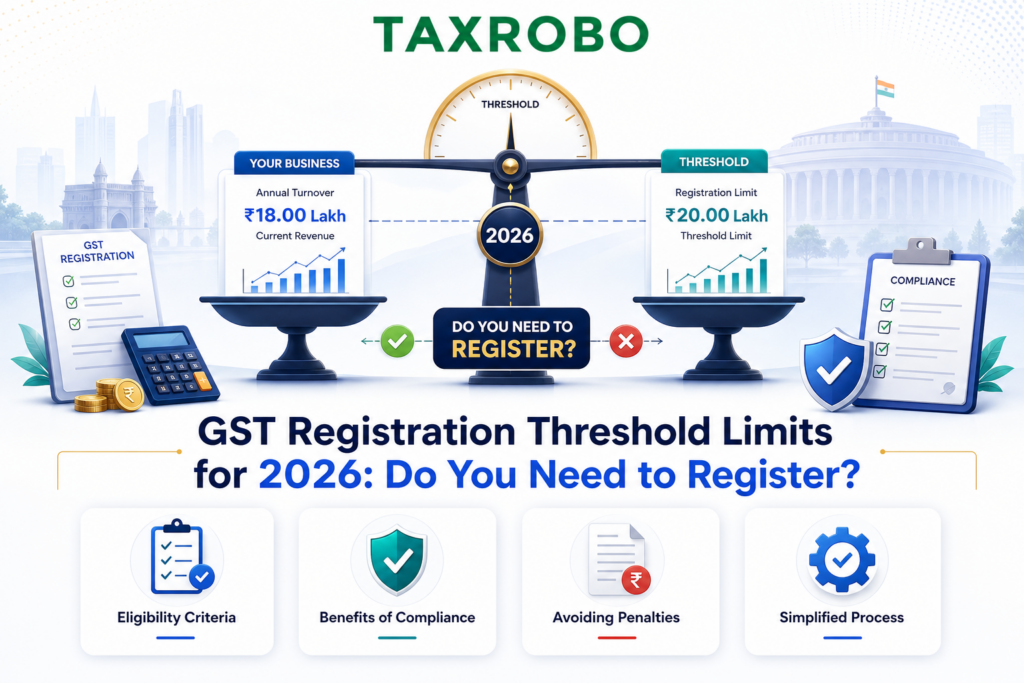

GST Registration Threshold Limits for 2026: Do You Need to Register?
As a small business owner, freelancer, or even a salaried individual with a growing side hustle in India, staying on top of tax regulations is crucial for success and peace of mind. With rules constantly evolving, one of the most pressing questions for 2026 is about GST registration. Understanding the GST registration threshold limits is the first and most important step to ensure legal compliance, avoid hefty penalties, and run your business smoothly. This guide is designed specifically for you, breaking down complex tax laws into simple, actionable information. We will explore everything you need to know about GST compliance for small businesses India, the latest GST limits 2026 India, and answer the critical question: “Do you need to register for GST?”
Understanding the Basics: What is GST?
Before diving into the numbers, let’s quickly refresh our understanding of what GST is. The Goods and Services Tax (GST) is a single, comprehensive indirect tax that replaced numerous other indirect taxes in India, such as VAT, service tax, and excise duty. It is a destination-based tax, meaning it’s levied at the final point of consumption. For small businesses in India, this unified system simplifies the tax structure, making GST compliance more straightforward than the previous web of multiple taxes. It’s designed to create a common national market, streamlining commerce across the country.
What are CGST, SGST, and IGST?
When you see a GST bill, you’ll notice it’s often split into different components. This is because both the Central and State governments have the power to levy and collect GST.
- CGST (Central Goods & Services Tax): This portion of the tax is collected by the Central Government on transactions happening within a single state (intra-state transactions).
- SGST (State Goods & Services Tax): This is collected by the State Government on the same intra-state transaction where CGST is applied. So, for a sale in Maharashtra, both CGST and Maharashtra’s SGST will be charged.
- IGST (Integrated Goods & Services Tax): This tax is collected by the Central Government on transactions that occur between two different states (inter-state transactions), like a sale from Maharashtra to Karnataka. IGST is also applicable to imports and exports.
Why is GST important for your business?
Understanding and complying with GST is not just a legal requirement; it offers significant benefits to your business. The most important advantage is the elimination of the “cascading effect” of taxes, where you previously paid tax on tax. Under GST, you get to claim Input Tax Credit (ITC). This means if you are a registered business, you can claim back the GST you paid on your business purchases (inputs) when you file your GST returns. For a detailed walkthrough, see our guide on How to File GST Returns Online: A Step-by-Step Guide of the GST Filing Process & Procedure. This reduces your overall tax liability, lowers your cost of doing business, and ultimately makes your products or services more competitive. Proper GST registration also enhances your business’s credibility, making it easier to work with larger corporations that prefer dealing with GST-compliant vendors.
The Core Question: Understanding GST Registration Threshold Limits for 2026
Now for the main event. The answer to “When to register for GST in India?” primarily depends on your annual aggregate turnover. The government has set specific GST registration threshold limits to keep small businesses and service providers out of the immediate compliance net. It’s crucial to know these registration thresholds for GST India to determine if you need to get a GST Identification Number (GSTIN).
For the financial year 2025-2026, the thresholds remain consistent, providing stability for businesses. Here’s a clear breakdown:
Threshold for Businesses Supplying Goods
If your business is exclusively involved in the supply of goods, the mandatory GST registration limit is an annual aggregate turnover of ₹40 Lakhs. This higher threshold was introduced to support small manufacturers and traders.
How to Calculate “Aggregate Turnover”:
It’s essential to calculate this figure correctly. Aggregate turnover is the total value of:
- All taxable supplies
- Exempt supplies
- Exports of goods or services
- Inter-state supplies
This calculation is done on an all-India basis for everyone operating under the same PAN. It does not include the GST (CGST, SGST, IGST) you charge to your customers or the value of inward supplies on which you pay tax under the reverse charge mechanism.
Threshold for Businesses Providing Services
If your business is involved in providing services exclusively, or a mix of both goods and services, the mandatory GST registration limit is an annual aggregate turnover of ₹20 Lakhs. This lower threshold applies to a wide range of professionals like consultants, freelancers, designers, and software developers.
Special Category States: What are the Different Limits?
To support economic development in certain regions, the government has defined ‘Special Category States’ with different threshold limits. If your business is based in one of these states, you need to be aware of these specific rules.
| State/Union Territory | Threshold for Goods | Threshold for Services |
|---|---|---|
| Arunachal Pradesh | ₹20 Lakhs | ₹10 Lakhs |
| Manipur | ₹20 Lakhs | ₹10 Lakhs |
| Meghalaya | ₹20 Lakhs | ₹10 Lakhs |
| Mizoram | ₹20 Lakhs | ₹10 Lakhs |
| Nagaland | ₹20 Lakhs | ₹10 Lakhs |
| Puducherry | ₹20 Lakhs | ₹10 Lakhs |
| Sikkim | ₹20 Lakhs | ₹10 Lakhs |
| Telangana | ₹40 Lakhs | ₹20 Lakhs |
| Tripura | ₹20 Lakhs | ₹10 Lakhs |
| Uttarakhand | ₹40 Lakhs | ₹20 Lakhs |
For the most updated list and any recent changes, it’s always a good practice to check the official CBIC website.
When is GST Registration Mandatory, Regardless of Turnover?
While turnover is the primary factor, there are several situations where a business must register for GST irrespective of its annual turnover. This is a critical aspect of knowing when to register for GST India, as overlooking these rules can lead to significant penalties.
Businesses Making Inter-State Taxable Supplies
If you are supplying goods from one state to another, you are required to register for GST, even if your turnover is as low as ₹1. For example, a seller in Gujarat selling a product to a customer in Rajasthan must have a GSTIN. However, there’s a key exception: service providers making inter-state supplies are exempt from this rule and only need to register if their turnover crosses the ₹20 Lakh threshold.
E-commerce Sellers and Aggregators
Anyone selling goods through an e-commerce platform like Amazon, Flipkart, or Myntra must mandatorily register for GST. This rule applies from the very first sale, with no turnover threshold. The same applies to the e-commerce aggregators themselves. This ensures that the tax chain is maintained in the rapidly growing online marketplace. This area has specific nuances, which are covered in our guide on GST for E-commerce Businesses: Key Considerations.
Casual and Non-Resident Taxable Persons
A casual taxable person is someone who occasionally undertakes transactions involving the supply of goods or services in a state where they do not have a fixed place of business. A common example is setting up a temporary stall at a trade fair or exhibition in another state. Similarly, a non-resident taxable person is someone from outside India who occasionally supplies goods or services in the country. Both must register for GST before starting their business activities.
Other Compulsory Cases
A few other scenarios require mandatory GST registration:
- Reverse Charge Mechanism (RCM) Payees: Businesses that are required to pay tax under the RCM.
- Input Service Distributors (ISD): An office that receives tax invoices for services used by its branches and distributes the credit to those branches.
- Agents supplying on behalf of a taxable person.
The Step-by-Step GST Registration Process in India
If you’ve determined that you need to register for GST, the good news is that the GST registration process India is entirely online and relatively straightforward. Following the steps correctly and having the right documents ready can make the process smooth and quick.
Documents Required for GST Registration (GST Registration Requirements India)
Before you begin the application on the portal, gather the following documents. This list covers the core GST registration requirements India for most small businesses and proprietorships.
- PAN Card of the individual, company, or partnership. GST registration is linked to your PAN.
- Aadhaar Card of the proprietor, partners, or directors. Aadhaar authentication is now mandatory for faster processing.
- Proof of Business Registration: For companies, the Certificate of Incorporation. For partnerships, the Partnership Deed.
- Address Proof of the Place of Business: This can be an electricity bill, property tax receipt, municipal khata copy, or a valid rent agreement along with an NOC from the property owner.
- Bank Account Details: A scanned copy of a cancelled cheque or the first page of your bank passbook/statement showing the business’s name, account number, and IFSC code.
- Photographs: Passport-sized photographs of the proprietor, partners, or directors.
- Digital Signature Certificate (DSC): A DSC is mandatory for Companies and LLPs.
Navigating the Official GST Portal
The entire registration happens on the official government website. Here is how you can do it:
- Step 1: Generate a Temporary Reference Number (TRN)
- Visit the official GST Portal.
- Go to Services > Registration > New Registration.
- Fill out Part A of the form. You will need to provide your legal name (as per PAN), PAN, email address, and mobile number.
- The portal will verify your mobile number and email address with an OTP. Upon successful verification, you will receive a Temporary Reference Number (TRN) on your mobile and email.
- Step 2: Complete the Application Form
- Go back to the GST Portal and this time select “New Registration” and then the “Temporary Reference Number (TRN)” option.
- Enter the TRN and the captcha, and proceed with the OTP verification.
- You will be directed to Part B of the application form, which is a detailed form with several sections. You need to fill in your business details, promoter information, principal place of business, bank accounts, and details of goods/services.
- This is where you will upload all the documents mentioned earlier. Ensure your scanned copies are clear and in the prescribed format (usually PDF or JPEG under 100 KB or 1 MB).
- After filling all the details and uploading the documents, submit the application using a DSC or E-Signature (EVC).
What to Expect After Applying
Once you submit the application, an Application Reference Number (ARN) is generated and sent to your email and mobile number. You can use this ARN to track the status of your application. A tax officer will review your application and documents. If everything is in order, your GST registration certificate and GSTIN will be approved within 3 to 7 working days. If the officer finds any discrepancies, they may raise a query. You will need to respond to this query with the required clarification or documents within the stipulated time.
Conclusion: Are You Ready for GST Compliance in 2026?
Staying updated with the GST registration threshold limits is non-negotiable for any aspiring or established business in India. For 2026, the key takeaways are the ₹40 Lakh turnover limit for businesses dealing exclusively in goods and the ₹20 Lakh limit for those providing services or a mix of both. However, it is equally important to remember the scenarios where registration is mandatory regardless of turnover, such as for inter-state suppliers of goods and e-commerce sellers. Being proactive about compliance not only saves you from penalties but also builds a strong, credible foundation for your business to grow. For those just starting, our Ultimate Guide to GST Registration for Small Businesses provides a comprehensive overview.
Navigating GST rules can be complex. Don’t risk penalties due to non-compliance. Let TaxRobo’s experts handle your GST registration and filing seamlessly. Contact us today for a free consultation!
Frequently Asked Questions (FAQs)
1. Do I need GST registration if I am a salaried individual with a small side business?
Answer: Yes, if your total turnover from the side business crosses the specified threshold limits (₹20 Lakhs for services, ₹40 Lakhs for goods). Your salary is not included in this turnover calculation, as it’s considered under “salaries” and not business income. So, if you are a freelance consultant earning ₹22 Lakhs a year from your side hustle, you must register for GST. This is a common question for anyone asking do I need GST registration India.
2. What are the penalties for not registering for GST when it is mandatory?
Answer: Failure to register for GST when you are liable to do so is a serious offense. The penalty can be 10% of the tax due or ₹10,000, whichever is higher. In cases of deliberate tax evasion or fraud, the penalties can be much more severe, potentially up to 100% of the tax amount due, along with legal prosecution.
3. Can I register for GST voluntarily even if my turnover is below the limit?
Answer: Yes, you can. Voluntary registration is a strategic choice for many small businesses. The main benefit is that it allows you to claim Input Tax Credit (ITC) on your business purchases, which can lower your costs. It also enables you to issue tax invoices to your customers, who can then claim ITC on their end. This improves your business’s credibility and makes you a more attractive vendor, especially for B2B transactions.
4. How long does the GST registration certificate remain valid?
Answer: Once granted, a GST registration certificate for a regular taxpayer is valid until it is surrendered, cancelled, or suspended by the tax authorities. Unlike some other licenses, it does not have an expiry date and does not require periodic renewal. However, you must ensure you remain compliant with all GST filing and payment obligations to keep your registration active.