
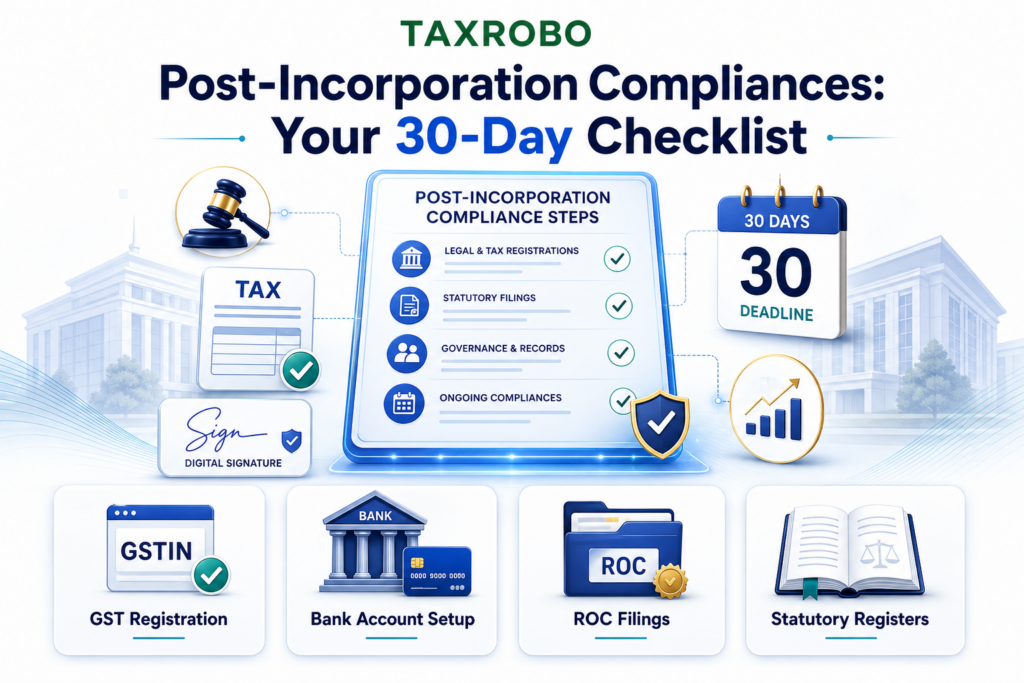

Post-Incorporation Compliances Every Founder Must Complete in 30 Days
Meta Description: Just incorporated your startup? Congratulations! Now, ensure you meet these critical post-incorporation compliance requirements within 30 days. Our guide for Indian founders covers auditor appointment, bank accounts, INC-20A, and more to avoid penalties.
Congratulations, founder! You’ve successfully navigated the complexities of company registration and are now holding a Certificate of Incorporation. This is a monumental achievement worth celebrating. However, a common misconception among new entrepreneurs is that the heavy legal lifting is over. In reality, the first 30 to 60 days post-incorporation are a critical period filled with mandatory post incorporation compliance requirements. Failing to meet these initial deadlines can lead to significant penalties, operational roadblocks, and unnecessary stress. Understanding your immediate founder responsibilities after incorporation is not just about ticking boxes; it’s about building a strong, compliant foundation for your business to thrive upon. This article will serve as a clear, step-by-step startup founder compliance guide India, breaking down the most essential post-incorporation tasks you must complete right away.
Your Immediate 30-Day Compliance Checklist for Indian Startups
Now that your company is officially registered with the Ministry of Corporate Affairs (MCA), the compliance clock has officially started ticking. The actions you take in this initial month are crucial for ensuring your business remains in good legal standing from day one. This section covers the core post-incorporation compliance for startups that demand your immediate attention. Missing these early deadlines can create a domino effect of complications, so it’s vital to address them proactively. Let’s walk through the most urgent tasks on your checklist.
Step 1: Appoint the First Auditor (Within 30 Days of Incorporation)
One of the very first governance tasks you must complete is the appointment of your company’s first statutory auditor. According to Section 139(6) of the Companies Act, 2013, the Board of Directors is legally obligated to appoint the first auditor within 30 days from the date of incorporation. This auditor will be responsible for auditing the company’s financial statements and ensuring they present a true and fair view of its financial position. This step is a cornerstone of corporate governance and signals to stakeholders that your company is committed to financial transparency from the outset.
The process for this appointment is straightforward but time-sensitive:
- Conduct the First Board Meeting: Convene the first meeting of your company’s Board of Directors. The primary agenda for this meeting should be to pass a formal resolution for the appointment of a practicing Chartered Accountant or a CA firm as the company’s first auditor.
- Obtain Auditor’s Consent: Before passing the resolution, you must reach out to the proposed auditor and obtain two key documents from them: a written consent letter confirming their willingness to act as the auditor and a certificate confirming that their appointment, if made, will be in accordance with the prescribed conditions and that they are not disqualified for appointment under the Companies Act, 2013.
- File Form ADT-1 (Good Practice): While filing Form ADT-1 with the Registrar of Companies (ROC) to intimate the appointment of the first auditor is not mandatory, it is considered a best practice for good corporate governance. For all subsequent auditor appointments (at the Annual General Meeting), filing ADT-1 within 15 days of the appointment is mandatory. Completing this step for the first auditor as well keeps your records clean.
Actionable Tip: The incorporation compliance timeline India is strict. Do not wait until the 29th day to start this process. Begin your search for a qualified and reputable Chartered Accountant (CA) firm as soon as you receive your Certificate of Incorporation.
Step 2: Open a Company Current Account (Immediately)
A dedicated bank account in the name of your company is not just a suggestion; it’s a non-negotiable requirement. All financial transactions of the company, especially the initial infusion of share capital from subscribers, must be routed through this official account. This practice is fundamental for maintaining financial transparency, simplifying accounting, and fulfilling other critical mandatory filings after incorporation in India, such as the declaration for commencement of business. Commingling company funds with personal finances is a serious governance error that can lead to legal and tax complications down the line. A separate current account establishes your company as a distinct legal entity.
To open a company current account, the bank will typically require the following documents:
- Certificate of Incorporation: Proof of your company’s registration.
- Memorandum of Association (MOA) & Articles of Association (AOA): The charter documents of your company.
- Company PAN Card: The unique Permanent Account Number assigned to your company.
- Board Resolution: A resolution passed by the Board of Directors authorising the opening and operation of the bank account, and specifying the authorised signatories.
- KYC Documents: Identity and address proof (PAN, Aadhaar, Passport, etc.) of all directors and authorised signatories.
- Registered Office Address Proof: A utility bill, lease agreement, or other document proving the location of your company’s registered office.
Actionable Tip: When selecting a bank, look beyond basic services. Consider banks that offer robust digital platforms and specialized services for startups, such as seamless integration with accounting software like Zoho or Tally, streamlined international payment gateways, and dedicated relationship managers.
Step 3: Infuse Share Capital & File for Commencement of Business (Form INC-20A)
This is arguably the most critical of all post incorporation compliance requirements India for a new company. Before you can begin any business operations, you must complete a crucial two-part process involving your share capital. First, all individuals or entities who subscribed to the Memorandum of Association (the first shareholders) must deposit the amount of share capital they committed to into the newly opened company current account. This action demonstrates that the company is adequately capitalized as per its initial filings. Once this capital has been received, the second part of the process begins. The company must file a declaration for commencement of business, known as Form INC-20A, with the Registrar of Companies (ROC). This form, which must be verified by a practicing professional (CA, CS, or CWA), confirms that every subscriber has paid the value of the shares agreed to be taken by them.
While you have a window of 180 days from the date of incorporation to file Form INC-20A, it is highly advisable to complete this task as soon as the bank account is active and capital is infused. The consequences of not filing this form are severe. A company is legally barred from commencing any business activities or exercising any borrowing powers until Form INC-20A is filed and approved. Non-compliance can result in a hefty penalty for the company and every officer in default. In prolonged cases of non-filing, the ROC may initiate the process of striking the company’s name off the register. For official forms and details, you can visit the Ministry of Corporate Affairs (MCA) portal.
Essential Registrations & Governance Tasks
Beyond the immediate 30-day window, a set of other vital registrations and governance practices must be established to ensure smooth and compliant operations. Fulfilling these requirements lays the groundwork for sustainable growth and helps you avoid future legal hurdles. These tasks are fundamental to long-term regulatory compliance for startups in India and demonstrate a commitment to building a well-governed organization from the very beginning.
Verify PAN and TAN Issuance
During the company incorporation process using the modern SPICe+ form, the applications for both PAN (Permanent Account Number) and TAN (Tax Deduction and Collection Account Number) are integrated. PAN is a unique ten-digit alphanumeric identifier essential for all financial transactions, from opening a bank account to filing income tax returns. TAN is a ten-digit alphanumeric number required for any entity responsible for deducting or collecting tax at source (TDS/TCS). While these numbers are now automatically allotted upon incorporation, the founder’s job isn’t done. You must proactively verify that the PAN and TAN have been issued by the Income Tax Department and follow up to receive the physical cards. No significant financial transaction or tax-related compliance can proceed without a PAN, and TAN is mandatory if your company plans to pay salaries, rent, or professional fees, as you will be required to deduct TDS on these payments.
Apply for Goods and Services Tax (GST) Registration (If Applicable)
Goods and Services Tax (GST) is a comprehensive indirect tax levied on the supply of goods and services across India. Unlike PAN, GST registration is not automatically granted upon incorporation. Instead, it is linked to your business activity and turnover. You are mandatorily required to register for GST under several conditions:
- If your aggregate annual turnover is projected to exceed the prescribed threshold (₹40 lakh for suppliers of goods and ₹20 lakh for suppliers of services in most states).
- If you are engaged in any inter-state supply of goods, regardless of turnover.
- If your business operates as an e-commerce operator or aggregator.
- If you are classified as a casual taxable person or a non-resident taxable person.
The GST regime is structured into Central GST (CGST), State GST (SGST), and Integrated GST (IGST), depending on whether the transaction is intra-state or inter-state. You can complete the registration process on the official GST Portal.
Actionable Tip: Even if you are not yet required to register for GST, consider voluntary registration. This allows your business to claim Input Tax Credit (ITC) on the GST paid for business purchases (like laptops, office rent, etc.), which can significantly improve your cash flow. It is wise to consult with a tax expert like TaxRobo to assess if voluntary registration is beneficial for your specific business model.
Issue Share Certificates & Maintain Statutory Registers
Formalizing ownership and maintaining proper corporate records are key founder responsibilities after incorporation. Within 60 days of incorporation, your company must issue formal share certificates to all the subscribers of the MOA. These certificates serve as legal proof of ownership for the shareholders. It’s crucial to note that these certificates must be properly stamped according to the stamp act of the state where the company’s registered office is located. Failure to pay the correct stamp duty can render the share certificates invalid.
In addition to issuing certificates, the Companies Act, 2013, mandates that every company maintain a set of statutory registers at its registered office. These registers are a record of the company’s key administrative and governance matters. Some of the most important registers include:
- Register of Members (in Form MGT-1): A detailed record of all shareholders.
- Register of Directors and Key Managerial Personnel (KMP): Contains details of the company’s leadership.
- Register of Charges: A log of any charges created on the company’s assets.
- Minutes of Board and General Meetings: A formal record of all decisions made in board and shareholder meetings.
Conclusion
Successfully incorporating your company is just the first step on a long entrepreneurial journey. The real work of building a sustainable and compliant business begins now. Navigating the initial post incorporation compliance requirements correctly—from appointing an auditor and opening a bank account to infusing capital and filing Form INC-20A—sets a strong, unshakeable foundation for your company’s future. Proactive compliance is always simpler, cheaper, and less stressful than dealing with penalties and legal notices reactively. By prioritizing these tasks, you are not just fulfilling legal obligations; you are instilling a culture of good governance that will pay dividends for years to come.
Feeling overwhelmed? You don’t have to manage this alone. The experts at TaxRobo specialize in helping startups navigate their compliance journey seamlessly, ensuring no deadline is missed and no detail is overlooked. Contact us today for a free consultation on your post-incorporation needs and let us be your startup founder compliance guide India. Partner with us and focus on what you do best: building your business. Contact TaxRobo for Company Compliance Services.
Frequently Asked Questions (FAQs)
Q1. What are the penalties if I miss the 30-day deadline to appoint the first auditor?
If the Board of Directors fails to appoint the first auditor within the stipulated 30 days, the responsibility then shifts to the members (shareholders) of the company. The Board must inform the members, who are then required to appoint the auditor within 90 days at an extraordinary general meeting (EGM). Failure to comply with these provisions can make the company and its officers liable for penalties as prescribed under the Companies Act, 2013.
Q2. Do I need a GST number immediately after registering my company?
Not necessarily. GST registration is contingent upon your business activity and turnover, not the date of incorporation. You are only required to register for GST once you meet the specified criteria, such as your annual turnover exceeding the threshold limit (e.g., ₹20/40 lakh), or if you are engaged in specific activities like inter-state supply of goods.
Q3. Can I start billing my clients before filing Form INC-20A?
No. This is a critical point of compliance. A company is legally prohibited from commencing any business activities, which includes issuing invoices, entering into binding contracts, or borrowing funds, until Form INC-20A (Declaration of Commencement of Business) is filed and approved by the ROC. Engaging in business before this can lead to severe penalties for both the company and its directors.
Q4. What are the top 3 post incorporation compliance requirements I must prioritize?
The absolute top three priorities that are interconnected and foundational for all other activities are:
- Holding the first Board Meeting to pass necessary resolutions, including the appointment of the first auditor (within 30 days).
- Opening a dedicated company bank account to keep finances separate and transparent.
- Depositing the share subscription money into the new bank account and immediately preparing to file Form INC-20A.