
How to Choose the Perfect Name for Your New Company in India: A Complete Guide
Meta Description: Struggling to choose the perfect company name for your new venture in India? Our complete guide covers legal checks, creative tips, and common mistakes to help you find a unique and memorable name. Start your business with confidence with TaxRobo!
Introduction: Your Company’s First and Most Important Asset
You have a brilliant business idea, a solid plan, and the passion to succeed. But before you can launch, you face your first major decision: naming your company. This crucial first step can feel overwhelming, but getting it right is essential. Your company name is far more than just a label; it is the foundation of your brand identity, the very first impression you make on potential customers, and a critical legal asset that you will own and protect for years. A great name can set you apart from the competition, build trust, and become a powerful marketing tool. Conversely, a poorly chosen name can lead to customer confusion, limit your growth, or even land you in legal trouble. This comprehensive guide will walk you through everything you need to know to choose the perfect company name for your Indian business, covering brainstorming techniques, crucial legal checks, and the final steps to secure your name in the digital world.
Part 1: The Foundation – What Makes a Great Company Name?
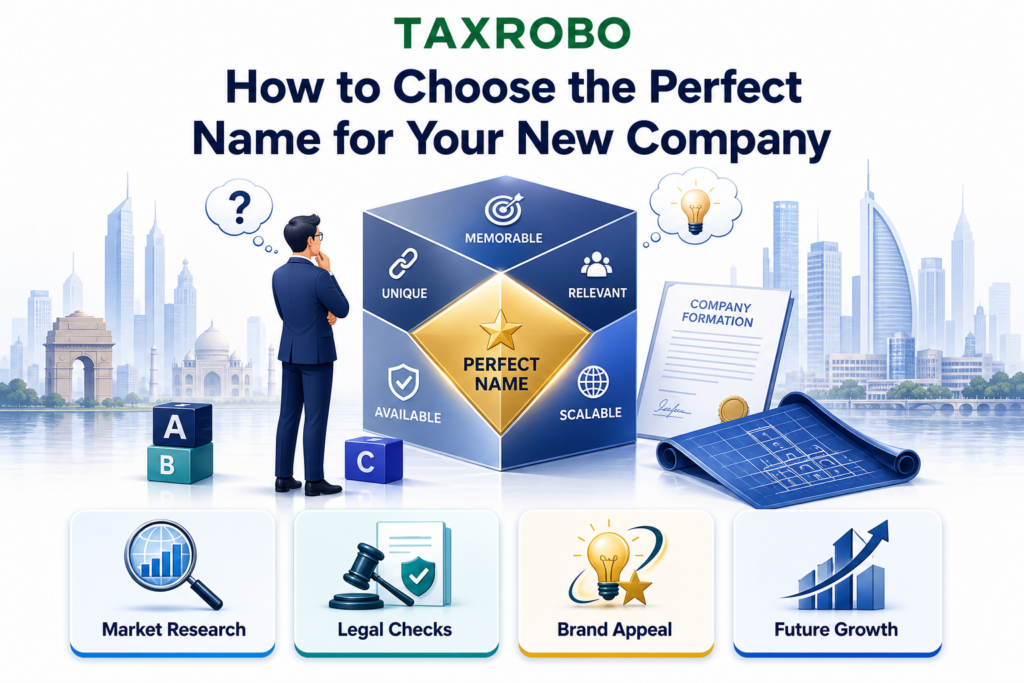
Before diving into creative brainstorming or legal paperwork, it’s vital to understand the fundamental qualities of a strong business name. These principles form the bedrock of a successful brand and will guide you through the selection process. A name that ticks these boxes is more likely to be approved by the authorities, resonate with customers, and stand the test of time. This section of our perfect business name guide India breaks down the essential characteristics that separate a good name from a great one, setting you on the right path from the very beginning.
Memorable and Easy to Spell
In today’s fast-paced digital world, simplicity is king. Your company name should be easy for customers to recall, pronounce, and type into a search engine or social media platform without hesitation. If potential clients struggle to remember your name or have to guess its spelling, you risk losing them to a competitor with a more straightforward identity. A simple but effective test is to say the name out loud several times. Is it a tongue-twister? Does it sound awkward? Share it with friends or family and see if they can spell it back to you easily. Avoid using complex spellings, silent letters, or unconventional words that might cause confusion. Names like “Paytm” or “Nykaa” are excellent examples of being unique yet incredibly easy to remember and spell.
Relevant to Your Business
While abstract names can be powerful, a name that hints at your services, industry, or core values can give you an immediate advantage. It helps customers instantly understand what you do and what you stand for. For instance, a name like “QuickDigit Solutions” immediately suggests a company that offers fast, technology-based services. However, it’s crucial to strike a balance. A name that is too literal or descriptive might limit your future growth. The goal is to be relevant without being restrictive. Think about the core benefit you offer. Is it speed, quality, luxury, or affordability? Incorporating this essence into your name can create a powerful and lasting connection with your target audience.
Unique and Distinctive
Your business name is your primary tool for standing out in a crowded marketplace. A generic or bland name will blend into the background, making it difficult for customers to differentiate you from your competitors. A unique name, on the other hand, is a powerful asset for brand recall. This distinctiveness is not just a marketing advantage; it’s a legal necessity. The Ministry of Corporate Affairs (MCA) in India will reject names that are identical or too similar to existing companies or Limited Liability Partnerships (LLPs). Choosing a name that is truly one-of-a-kind is the first and most important step toward getting official approval and building a brand that can be legally protected.
Scalable and Future-Proof
When you are just starting, it can be tempting to choose a name that is very specific to your initial product or location. However, this can become a major obstacle as your business grows. For example, a name like “Mumbai T-Shirt Printers” is excellent if you only ever plan to print t-shirts in Mumbai. But what happens when you want to expand to Delhi or start selling hoodies and caps? You’re stuck with a name that no longer reflects the full scope of your business. A better, more scalable name might be “Urban Threads” or “PrintVibe,” which offers the flexibility to expand into new product lines and geographical markets without needing a complete rebrand down the line. Always think about your long-term vision when choosing your name.
Part 2: The Creative Process – How to Brainstorm Your Company Name
With the foundational principles in mind, it’s time for the creative part: generating name ideas. This process should be a mix of structured thinking and free-flowing creativity. Don’t censor yourself initially; the goal is to create a long list of possibilities that you can later refine. By exploring different angles and naming styles, you’ll increase your chances of discovering a name that is not only catchy but also meaningful and strategically sound. Many of the best company names in India have emerged from a thoughtful and structured brainstorming process like the one outlined below.
Start with Core Keywords
The best way to begin is by creating a “mind map” of words related to your business. This will serve as your raw material for building name combinations. Organize your list into a few key categories to ensure you cover all aspects of your brand identity.
- Industry/Service: List words that describe what you do. Examples could include tech, software, finance, capital, food, kitchen, fashion, consulting, solutions, logistics, express.
- Customer Value: Think about the primary benefit you offer your customers. Examples include speed, quick, quality, premium, trust, secure, affordable, easy, connect.
- Emotion/Feeling: Consider the emotions you want your brand to evoke. Examples might be joy, success, zen, ease, power, bold, bright, bliss.
Once you have these lists, you can start combining them, adding prefixes or suffixes, and playing with different variations to see what sticks.
Explore Different Naming Styles
There is no single formula for a great name. Companies use various approaches, each with its own pros and cons. Understanding these styles can help you find a direction that aligns with your brand personality.
- Descriptive: These names clearly and directly state what the company does. They are great for SEO and immediate customer understanding.
- Indian Example: PolicyBazaar (an online marketplace for insurance policies).
- Evocative: These names suggest a benefit, a feeling, or a bigger idea related to the brand. They are more metaphorical and can create a strong emotional connection.
- Indian Example: Dream11 (evokes the idea of creating a dream fantasy sports team).
- Invented/Abstract: These are completely new words created for the brand. They are highly unique and easy to trademark but require more marketing effort to build meaning.
- Indian Examples: Zomato, Swiggy. These names had no prior meaning but are now synonymous with food delivery.
- Founder Names: Using the founder’s name lends a sense of history, trust, and personal commitment to the brand. This is a classic approach often seen in established industries.
- Indian Examples: Tata Group, Dr. Reddy’s Laboratories.
- Compound Names: This popular method involves combining two or more words to create a new, often catchy name that is both unique and relevant.
- Indian Example: BookMyShow (a simple combination of “book,” “my,” and “show”).
Check for Cultural and Linguistic Nuances
In a country as diverse as India, this step is absolutely critical. A word that sounds great in one language could have an unintended, negative, or even offensive meaning in another. Before you fall in love with a name, it is essential to check its meaning and connotations in major Indian languages like Hindi, Tamil, Bengali, Telugu, and Marathi. A quick search online or consulting with native speakers can save you from a major branding disaster down the road. This diligence ensures your name will be well-received across different regions as your business expands.
Part 3: The Legal Checklist – How to Choose a Company Name in India That Gets Approved
This is arguably the most important part of the entire process. A creative and memorable name is useless if it gets rejected by the government. To choose a perfect company name in India, you must understand and comply with the guidelines set by the Ministry of Corporate Affairs (MCA). The Registrar of Companies (ROC), which operates under the MCA, is responsible for approving all company names, and they follow a strict set of rules to prevent public confusion and legal disputes. This section provides a detailed breakdown of how to choose a company name in India that will pass legal scrutiny.
Understanding MCA (Ministry of Corporate Affairs) Guidelines
The primary regulation governing company names is Rule 8 of the Companies (Incorporation) Rules, 2014. This rule outlines the various conditions under which a name will be considered “undesirable” and, therefore, rejected by the ROC. The core principle behind these rules is to ensure that every company has a distinct identity and that the public is not misled by names that are too similar to existing entities or that falsely imply a connection to the government or a registered trademark. Familiarizing yourself with these rules is the first step to avoiding a rejection notice.
Key Rules to Avoid Rejection
While the official rules are extensive, they can be simplified into a few key principles that every entrepreneur must follow. Violating any of these is the most common reason for name rejection.
- Rule 1: Identical or Too Similar to Existing Names: Your proposed name cannot be identical or phonetically similar to the name of an existing company or LLP registered with the MCA. “Phonetically similar” means it sounds the same even if the spelling is different (e.g., “Ekart” vs. “Xkart” or “Kwik” vs. “Quick”). The name must be distinct enough in both its spelling and pronunciation to avoid any public confusion.
- Rule 2: Infringes on a Registered Trademark: Even if a name isn’t taken by another company, it will be rejected if it is identical or too similar to a trademark registered under the Trade Marks Act, 1999. Using someone else’s trademark as your company name is a direct infringement and can lead to serious legal consequences beyond just MCA rejection. This makes a trademark search a non-negotiable step.
- Rule 3: Implies Association with Government: Names containing words like “National,” “Union,” “Central,” “Federal,” “Republic,” “PM,” “Rashtrapati,” or any word suggesting patronage of the central or state government are heavily restricted. These names are generally not allowed unless you have obtained specific prior approval from the Central Government.
- Rule 4: Offensive or Against Public Policy: The proposed name must not be offensive to any section of people or contain words or phrases that are against public policy. It should not violate any laws or promote illegal activities.
How to Perform a Name Availability Check: A Step-by-Step Guide
Before formally applying, you must conduct a thorough search to see if your desired name is available. For a complete understanding of the process, you can refer to our guide on Company Name Search for Name Availability. This due diligence dramatically increases your chances of first-time approval.
- Step 1: Free MCA Portal Search: The MCA provides a free public search tool on its V3 portal. You can use the “Check Company Name” feature to run a preliminary search for your proposed name. This will show you if any existing companies or LLPs have identical or closely similar names.
- Actionable Link: Perform your search on the official MCA portal: MCA Services
- Step 2: Public Trademark Search: This is a crucial step that many entrepreneurs overlook. A name might be available on the MCA portal but could conflict with a registered trademark. To avoid future legal battles, you must search the national trademark database maintained by the Controller General of Patents, Designs and Trade Marks.
- Actionable Link: Conduct a thorough search on the official IP India portal: IP India Public Search
Part 4: The Digital Checklist – Securing Your Online Identity
In the modern business landscape, your legal company name is only one piece of the puzzle. Your online identity is equally, if not more, important for reaching customers. Once you have a shortlist of names that have passed the legal checks, you must immediately verify their availability in the digital realm. A perfect name is one that you can own consistently across all platforms. These selecting company name tips India will ensure your brand has a cohesive and professional online presence from day one.
Check Domain Name Availability
Your website is your digital headquarters. Ideally, your domain name should be the same as your company name for brand consistency and ease of recall. Before finalizing a name, check if the corresponding domain name is available. The most sought-after extensions are `.com` (for global reach) and `.in` (for an India-focused business). Use a domain registrar website like GoDaddy or Namecheap to instantly check if your desired domain is available for purchase. If your exact name is taken, you might consider slight variations, such as adding a keyword like “get,” “app,” or “india” (e.g., “getinnovate.com” if “innovate.com” is taken), but an exact match is always the strongest option.
Check Social Media Handles
Social media is a critical channel for marketing and customer engagement. A consistent brand name across all platforms reinforces your identity and makes it easy for customers to find and follow you. Before you commit to a name, search for its availability as a username or handle on the major platforms relevant to your business, such as Instagram, Facebook, LinkedIn, and Twitter (X). Securing these handles, even if you don’t plan to use them immediately, is a crucial step in protecting your brand identity online and preventing others from squatting on your name. A uniform digital presence across your website, email, and social media profiles projects professionalism and builds customer trust.
Conclusion: Finalizing Your Name and Taking the Next Step
Choosing a name for your new venture is a journey that blends creativity, strategy, and legal diligence. By following a structured process, you can navigate this challenge with confidence. The path is clear: first, brainstorm creatively based on the core principles of a great name; second, perform rigorous legal checks on the MCA and Trademark portals to ensure it’s available for registration; and finally, verify its digital availability to secure your online brand identity. Following this structured process is the surest way to choose the perfect company name that not only resonates with customers but also builds a strong, legally defensible brand and avoids future roadblocks.
Once you have a few strong, vetted options, the journey has just begun. The next step is to officially reserve your chosen name with the MCA and proceed with company incorporation. To learn more about this, read our complete guide on How to Register a Company in India: Complete Process & Checklist. Feeling overwhelmed by the paperwork and legal requirements? Let TaxRobo’s experts handle the entire process for you. We manage everything from the initial name search and approval to complete company registration, ensuring a smooth and compliant start for your business.
Contact us today and let’s build your dream company together! TaxRobo Company Registration Service
Frequently Asked Questions (FAQs)
1. What happens if my proposed company name is rejected by the MCA?
If your name is rejected, the MCA will provide a reason for the rejection in its notification (e.g., “phonetically similar to an existing company” or “infringes on a registered trademark”). You will then need to re-evaluate your choice and re-apply with a new, compliant name. This can cause delays in your business launch. Using a professional service like TaxRobo can help you conduct a thorough search upfront to significantly minimize the chances of rejection and ensure a faster approval process.
2. Can my brand name be different from my registered company name?
Yes, this is very common. Your registered name is your official legal entity name (e.g., “Innovate Digital Solutions Private Limited”), while your brand name (also known as a “trade name” or “Doing Business As” name) is what you market to customers (e.g., “Innovate”). While you can operate under a different brand name, it is highly recommended to register that brand name as a trademark to protect it legally from being used by others.
3. How long does company name approval take in India?
Typically, a name reservation application filed through the MCA’s SPICe+ Part A form is processed quite quickly. If the proposed name is unique and complies with all MCA rules, you can expect an approval or rejection within 1-3 working days. Any discrepancies or similarities can lead to queries from the MCA, extending the timeline.
4. Do I need to trademark my company name?
While registering your company with the MCA protects your legal entity name within the MCA database (i.e., no other company can register with the exact same name), it offers very limited protection. A trademark registration, on the other hand, provides much broader, nationwide protection for your brand name, logo, and tagline. It prevents anyone in your industry (or related industries) from using a confusingly similar name for their goods or services. Trademarking is a crucial step for long-term brand protection and is highly recommended for any serious business. To understand this better, read our article: Secure Your Brand’s Future Trademark Your Brand – Registration, Benefits & The Cost of Neglect.
- Protect your brand identity: TaxRobo Trademark Registration Service