
GST Notice under Section 74 – A Step-by-Step Guide to Drafting Your Reply
You open your email one morning to find an official communication from the GST department. It’s a notice, and the words ‘Section 74’ and ‘Intent to Evade Tax’ immediately cause alarm. What do you do next? Receiving a GST notice under Section 74 can be a daunting experience for any business owner or salaried individual. This is not a routine inquiry; it’s a serious allegation from the GST authorities suggesting they suspect a deliberate attempt to evade tax through fraud, willful misstatement, or the suppression of facts. A timely, well-structured, and factually accurate response is absolutely critical to mitigate potentially severe financial penalties. Understanding the correct reply format and the procedure for responding is essential for every taxpayer in India to navigate this challenge successfully. This article will guide you through the entire process, covering what the notice means, the immediate steps you should take, a detailed reply format, and the potential consequences of non-compliance.
What is a GST Notice Under Section 74? Decoding the Law
A notice issued under Section 74 of the Central Goods and Services Tax (CGST) Act, 2017, is a formal Show Cause Notice (SCN) from the tax authorities. It is dispatched when a proper officer has reason to believe that there has been a short payment of tax, non-payment of tax, an erroneous refund, or incorrect availing of Input Tax Credit (ITC) with a clear intent to defraud the government. The presence of mens rea, or a guilty mind, is the core element that distinguishes this section from others. The allegations are grave, and the authorities issue this notice to demand an explanation as to why the proposed tax, interest, and a hefty penalty should not be recovered from you. It is the first formal step in a legal process that requires your immediate and careful attention.
The Legal Basis: Section 74 of the CGST Act, 2017
Section 74 of the CGST Act specifically empowers tax officials to determine and demand tax liabilities in cases where fraudulent intent is suspected. The key difference lies in the reason for the tax discrepancy. It is crucial to distinguish this from Section 73 of the same act. While both sections deal with the recovery of unpaid or short-paid tax, Section 73 applies to bona fide cases—errors or omissions made without any intention to evade tax. Section 74, on the other hand, is invoked for deliberate actions such as fraud, willful misstatement of facts, or suppression of information to avoid tax liability. This distinction is critical because the penalties under Section 74 are significantly higher, reflecting the severity of the offense. Understanding the Key Differences Between Sections 73 and 74 of the CGST Act in GST Demand Notices is the first step in formulating a robust defense and reply.
Common Triggers for a Section 74 Notice in India
Tax authorities use sophisticated data analytics tools to identify potential cases of tax evasion. Handling GST notice Section 74 in India effectively begins with understanding the common red flags that can trigger such a notice. Being aware of these can help businesses maintain better compliance and avoid scrutiny.
- Significant Mismatch in GSTR-1 and GSTR-3B: A major discrepancy between the outward supplies declared in GSTR-1 and the summary tax liability paid via GSTR-3B is a primary trigger.
- ITC Claimed from Cancelled Registrations: If you have claimed Input Tax Credit (ITC) from suppliers whose GST registration was cancelled retrospectively, it raises suspicion.
- Discrepancy in ITC: GSTR-3B vs. GSTR-2A/2B: Claiming more ITC in your GSTR-3B than what is auto-populated in your GSTR-2A or GSTR-2B is a significant point of scrutiny. The Impact of GSTR-2A and GSTR-3B Mismatches on ITC Claims can be severe and often leads to such notices.
- Suppression of Turnover: Intentionally not reporting certain sales invoices or under-reporting the value of supplies to reduce tax liability.
- Fraudulent Invoicing: Issuing tax invoices without the actual supply of goods or services, a practice often associated with fake ITC rackets.
- Claiming Ineligible ITC: Knowingly availing ITC on goods or services that are blocked under Section 17(5) of the CGST Act.
Your First Steps: A Checklist for Responding to a GST Notice
Upon receiving a notice under Section 74, your immediate actions can significantly influence the outcome. A systematic approach is crucial to avoid mistakes and build a strong case. Panicking can lead to hasty decisions, so follow this structured checklist to ensure you cover all necessary bases.
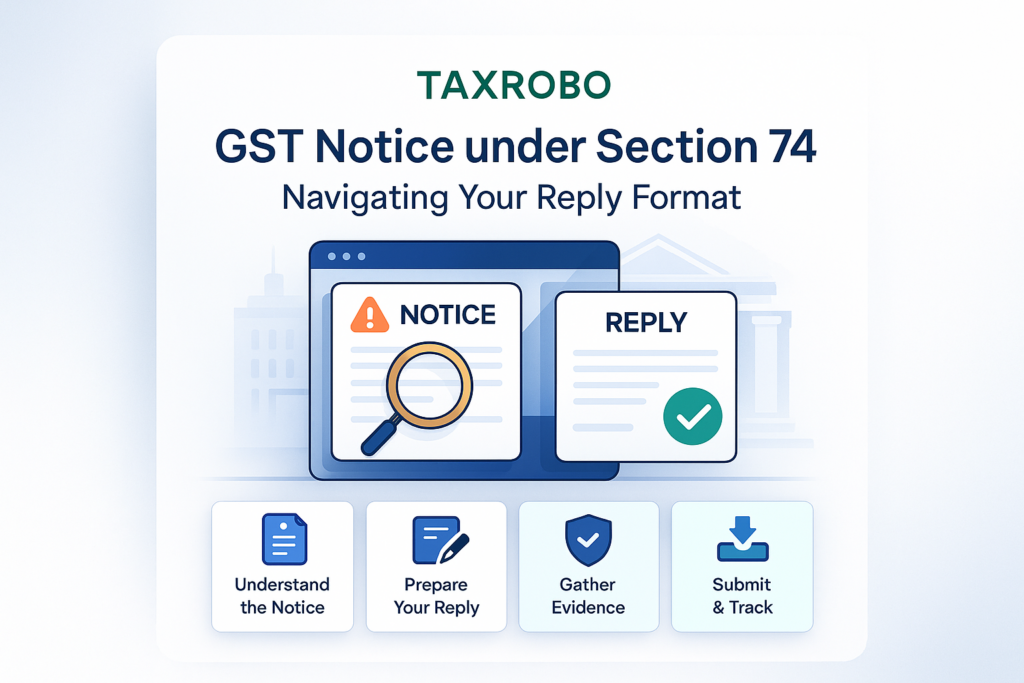
Step 1: Acknowledge and Verify the Notice
The first rule is to never ignore the notice. Acknowledging its receipt is paramount. Carefully check the deadline for filing your reply, which is usually mentioned within the notice itself. Missing this deadline can lead to an ex-parte order passed against you, confirming the tax demand and penalty without considering your side of the story. Equally important is to verify the authenticity of the notice. Every genuine notice from the GST department will have a unique Document Identification Number (DIN). You can and should verify this DIN on the official GST Portal to ensure the communication is legitimate and not a phishing attempt. This simple verification step protects you from potential scams and confirms that you are responding to a valid legal document.
Step 2: Analyse the Allegations Carefully
Once you have verified the notice, read it thoroughly and meticulously. The Show Cause Notice (SCN) is a detailed document that will outline the specific allegations against your business. Focus on understanding the exact discrepancies pointed out by the tax officer. The notice will quantify the amount of tax, interest, and penalty being demanded and provide the grounds or reasons for these allegations. Break down the notice into individual points of contention. For instance, is the issue related to an ITC mismatch, an undeclared sale, or something else? Gaining a crystal-clear understanding of what you are being accused of is the foundation for preparing a targeted and effective reply. Do not rush this step; a misinterpretation of the allegations can lead to an irrelevant or weak response.
Step 3: Compile All Supporting Documents
With a clear understanding of the allegations, your next task is to gather all the documentary evidence that can support your case and refute the claims made in the notice. This is a critical part of the GST notice response procedure. Create a dedicated file or folder for this case and systematically organize all relevant paperwork for the period in question. This compilation should be comprehensive and directly address the points raised in the SCN.
Key documents to gather include:
- Copies of all relevant GST returns: GSTR-1, GSTR-3B, GSTR-9 (annual return), and GSTR-2A/2B.
- Financial records: Tax invoices, credit notes, debit notes, and e-way bills related to the transactions under scrutiny.
- Proof of transactions: Bank statements that correspond to the payments made or received for the supplies in question.
- Reconciliation statements: Any internal workings or reconciliation statements you have prepared, such as GSTR-1 vs. GSTR-3B, Books of Accounts vs. GSTR-3B, or GSTR-3B vs. GSTR-2A/2B.
Having this documentation ready will not only help you draft a strong reply but will also be essential during a personal hearing, if one is scheduled.
The Core of Your Response: GST Notice Reply Format India
Drafting the reply is the most crucial stage of the process. Your response must be formal, structured, and address every allegation with factual clarity and documentary evidence. A well-prepared Section 74 GST notice response demonstrates your commitment to compliance and presents your case in the most professional manner. Following established GST compliance notice reply guidelines ensures that your submission is taken seriously and is easy for the officer to review. A haphazard or incomplete reply can be detrimental to your case.
Essential Components of a Compliant Reply
To ensure your response is comprehensive and professional, it should be structured logically. A compliant reply to GST notice India should always contain the following components, presented in a clear and orderly fashion.
- Letterhead: Always use your official business letterhead for the reply. This adds a layer of authenticity and professionalism.
- Addressee Details: Correctly state the full designation and office address of the officer who issued the notice. This information will be available on the SCN itself.
- Reference Details: This is vital for easy identification. Clearly mention the unique Show Cause Notice (SCN) reference number and the date of the notice. Also include your GSTIN.
- Subject Line: The subject should be concise and precise. For example: “Reply to Show Cause Notice under Section 74 of the CGST Act, 2017, dated [Date of SCN].”
- Introduction: Begin by formally acknowledging the receipt of the notice, mentioning its reference number and the date you received it.
- Point-by-Point Rebuttal: This is the heart of your reply. Do not write a generic, long-form paragraph. Instead, address each allegation from the SCN one by one in separate, numbered paragraphs. State the allegation as mentioned in the notice, and then provide your detailed, factual rebuttal. Refer explicitly to the supporting documents you have attached (e.g., “as evidenced by Invoice No. 123 attached as Annexure A”).
- Legal Submissions: If your defense involves legal interpretations, cite the relevant sections of the CGST Act, rules, official circulars, or relevant case law (judgments from tribunals or courts) that support your position. This adds significant weight to your arguments.
- Prayer/Conclusion: Conclude your reply with a formal “prayer.” In this section, you should summarize your stance, assert that you have not willfully evaded tax, and respectfully request the officer to consider your submissions and drop the proceedings and the proposed demand.
Sample Reply Template for a GST Notice under Section 74
To help you structure your response, here is a clear, fill-in-the-blanks template. You can adapt this format to fit the specific details of your case.
[Your Company Letterhead]

Date: [Date of Reply]

To,
The [Designation of the Officer],
[Address of the GST Office]

Subject: Reply to Show Cause Notice (Ref: [SCN Reference Number]) dated [Date of SCN] under Section 74 of the CGST Act, 2017.

Ref: GSTIN - [Your GSTIN]

Respected Sir/Madam,

1.  This letter is in response to the Show Cause Notice (SCN) referenced above, which was received by us on [Date of Receipt]. We have carefully reviewed the allegations mentioned in the SCN and wish to submit our detailed response for your kind consideration.

2.  Our point-wise submissions to the discrepancies raised are as follows:
    *   Allegation 1: [State the exact allegation from the SCN, for example, "Mismatch of turnover between GSTR-1 and GSTR-3B for FY 2022-23 amounting to Rs. X"].
    *   Our Reply: [Provide your detailed factual reply. For instance, "The alleged mismatch is due to an amendment made in a subsequent month's GSTR-1 to correct an invoice value. The tax was correctly paid in the original month via GSTR-3B. We are enclosing a reconciliation statement (Annexure A) and copies of the relevant returns (Annexure B) to clarify this position."].

    *   Allegation 2: [State the next allegation from the SCN, for example, "Wrongful availment of ITC from XYZ Corp (GSTIN: ...), whose registration has been cancelled."].
    *   Our Reply: [Provide your detailed factual reply. For instance, "At the time of the transaction on [Date], the supplier's GSTIN was active on the GST portal. We have a valid tax invoice (Annexure C), proof of payment via bank transfer (Annexure D), and proof of receipt of goods. Therefore, the ITC was claimed legitimately as per the conditions of Section 16 of the CGST Act."].

3.  We are enclosing the following documents as annexures to support our claims and submissions:
    *   Annexure A: Reconciliation Statement
    *   Annexure B: Copies of GSTR-1 and GSTR-3B for the relevant period
    *   Annexure C: Copy of Tax Invoice from XYZ Corp
    *   Annexure D: Bank Statement showing payment to XYZ Corp

Prayer

In light of the facts, legal submissions, and documentary evidence presented above, we humbly submit that the allegations of willful misstatement and suppression of facts are not applicable in our case. We request your good office to review our submissions and graciously drop the proceedings initiated via the aforementioned SCN and the demand proposed therein. We assure you of our full cooperation in this matter.

Thank you.

Yours faithfully,

For [Your Company Name],

[Your Name/Authorized Signatory]
[Your Designation]
Filing Your Reply and Navigating the Next Steps
Drafting the reply is only half the battle. Submitting it correctly and understanding the subsequent process is just as important. The entire process of navigating GST notice Section 74 is managed online through the official portal, ensuring transparency and a documented trail of all communications.
How to Submit Your Reply on the GST Portal
Your detailed written reply, along with all the supporting annexures, must be submitted electronically. The designated form for this purpose is Form GST DRC-06.
Here is the step-by-step process for online submission:
- Log in to the official GST Portal using your credentials.
- Navigate to the main dashboard and go to: Services > User Services > View Additional Notices/Orders.
- Click on ‘View’ for the relevant notice. You will see all the details of the SCN.
- Look for the ‘Reply’ tab or button. Clicking this will take you to Form GST DRC-06.
- In the form, you can type a brief summary of your reply.
- The most important step is to upload your detailed, signed reply letter (as drafted above) and all supporting documents as a single PDF or multiple PDFs. Ensure your files are clearly named (e.g., ‘Reply_to_SCN.pdf’, ‘Annexure_A.pdf’).
- Submit the form using either a Digital Signature Certificate (DSC) or an E-Verification Code (EVC).
What to Expect After Filing the Reply
Once your reply is submitted, the adjudicating officer will review your submissions. There are three primary outcomes:
- Proceedings Dropped: If the officer is fully satisfied with your explanation and the supporting documents provided, they will conclude the proceedings. An order will be issued in Form GST DRC-08 dropping the show-cause notice, and the matter will be closed.
- Personal Hearing: If the officer requires further clarification or is not entirely convinced by your written reply, they will schedule a personal hearing. You will receive a notification with the date and time. This is an opportunity to explain your case in person, often with the help of your tax consultant or CA.
- Order Issued: If, after reviewing your reply and conducting a personal hearing (if any), the officer is still not satisfied, they will issue an order confirming the demand. This order, issued in Form GST DRC-07, will detail the final amount of tax, interest, and penalty you are liable to pay. You have the right to appeal this order before the appellate authority.
Penalties and Consequences of Non-Compliance
The financial implications of a notice under Section 74 are severe, which is why a diligent response is crucial. The penalty structure is designed to be a strong deterrent against tax fraud. The standard penalty levied under this section is an amount equal to 100% of the tax demanded. This means if the tax short-paid is Rs. 5 Lakhs, the penalty will also be Rs. 5 Lakhs, leading to a total liability of Rs. 10 Lakhs plus applicable interest. You can read more about the Penalties Associated with GST Demand Notices: A Detailed Analysis of Sections 73 and 74.
However, the law provides a concession as an incentive for early compliance. If the taxpayer voluntarily pays the full amount of tax and interest, along with a reduced penalty of 25% of the tax amount, within 30 days of the SCN’s issuance, the notice is deemed concluded, and all further proceedings are dropped. This can result in significant savings and is a critical strategic point to discuss with your tax advisor. Ignoring the notice is the worst possible course of action. It will result in an ex-parte order confirming the full tax, interest, and 100% penalty, followed by stringent recovery proceedings, which can include freezing bank accounts and attaching property.
Conclusion
Receiving a GST notice under Section 74 is undoubtedly a serious matter that requires immediate and meticulous attention. However, it is not a final verdict. By staying calm and adopting a structured approach, you can address the allegations effectively. The key takeaways are simple but vital: do not ignore the notice, verify its authenticity, carefully analyse the allegations, prepare a factual, point-by-point reply supported by strong documentary evidence, and submit it on time using the correct format. A well-drafted, evidence-backed response can successfully demonstrate your compliance and potentially lead to the proceedings being dropped, saving your business from heavy financial burdens.
The legal nuances of a GST notice can be complex. If you need expert assistance in drafting a professional and compliant reply, the specialists at TaxRobo are here to help. Contact us today to ensure your case is handled with precision and care.
Frequently Asked Questions (FAQ)
1. What is the time limit to reply to a GST notice under Section 74?
The notice itself will specify the time limit for submitting your reply. Typically, this period is 30 days from the date of receipt of the notice. It is absolutely crucial to adhere to this deadline to avoid adverse, ex-parte decisions.
2. What is the main difference between a notice under Section 73 and Section 74?
The primary difference is intent. Section 73 is invoked for tax shortfalls that occur due to genuine errors or omissions, without any fraudulent intent. The penalties are consequently lower (up to 10% of the tax). Section 74 is reserved specifically for cases where there is evidence of fraud, willful misstatement, or suppression of facts to evade tax. This attracts a much harsher penalty, equivalent to 100% of the tax amount.
3. What happens if I don’t reply to a GST notice under Section 74?
If you fail to reply within the stipulated time, the proper officer is empowered to pass an ex-parte order based on the information and evidence available to them. This will almost certainly result in the confirmation of the full tax demand, interest, and the maximum 100% penalty. Following this order, the department can initiate stringent recovery proceedings against you and your business.
4. Do I need a Chartered Accountant (CA) or a lawyer for replying to a GST notice?
While it is legally possible to reply on your own, a notice under Section 74 involves serious allegations of fraud. The stakes are very high, and the legal arguments can be complex. It is highly recommended to seek professional help from an experienced CA or tax lawyer. They can help you draft a reply using the correct GST notice reply format India, ensure your legal arguments are sound, and represent you effectively during personal hearings, significantly improving your chances of a favourable outcome.