
GST Notice for ITC Mismatch (2B vs 3B) – Reply Format
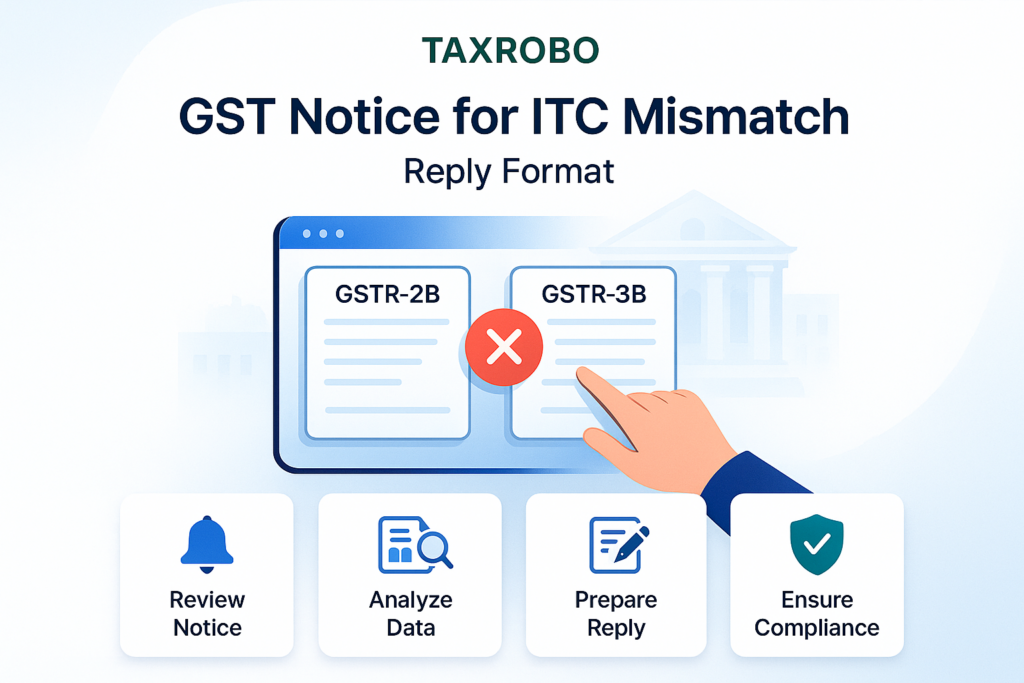
Receiving an official-looking envelope from the GST department can be a stressful moment for any business owner. Your mind races with questions: What did I do wrong? Is this a major problem? The most common reason for such a communication is an ITC mismatch notice India, a formal query about differences in your tax filings. This notice, often in Form GST DRC-01B, highlights a discrepancy between the Input Tax Credit (ITC) available in your GSTR-2B and the amount you claimed in your GSTR-3B. It’s crucial to understand that a timely and accurate response is not just a formality; it’s a vital step in maintaining your GST compliance for businesses India and avoiding potential interest and penalties. This comprehensive guide will demystify the entire process, from understanding GST ITC mismatch to providing you with a clear and actionable GST notice reply format that you can use to address the department’s concerns confidently.
What is an ITC Mismatch? (A Clear ITC 2B vs 3B Explanation)
Before drafting a reply, it’s essential to understand the root cause of the notice. The discrepancy arises from two key GST forms that serve very different purposes. Getting a grasp on this ITC 2B vs 3B explanation is the first step toward resolving the issue efficiently. Think of it as comparing what you were eligible to claim versus what you actually claimed. The GST system automatically flags any differences between these two figures, triggering a notice to seek clarification from you, the taxpayer. This automated scrutiny is a cornerstone of the GST regime, designed to ensure that every credit claim is legitimate and accounted for within the tax ecosystem. A mismatch doesn’t automatically mean you’ve made a mistake; it could be due to a supplier’s error or a simple timing difference. However, the responsibility to explain and justify this gap falls squarely on your shoulders.
Decoding the Forms: GSTR-2B vs. GSTR-3B
To understand the mismatch, let’s break down the roles of these two critical forms in the GST ecosystem. They are the two sides of the ITC coin, representing the available credit and the claimed credit, respectively.
- GSTR-2B (The ‘Available’ Credit): GSTR-2B is a static, auto-drafted statement that the GST portal generates for you each month. It is a read-only document that acts as your official guide, showing the total Input Tax Credit (ITC) available to you for a specific tax period. This statement is compiled based on the GSTR-1 (Return for outward supplies) and Invoice Furnishing Facility (IFF) returns filed by all your suppliers. Because it’s static and generated on a fixed date (typically the 14th of the following month), it provides a stable and unchangeable record of the ITC that the system recognizes as available to you for that period. It serves as a benchmark against which your claims are measured.
- GSTR-3B (The ‘Claimed’ Credit): In contrast, GSTR-3B is a self-declared summary return that you, the taxpayer, must file every month or quarter. This is the form where you declare your total sales, calculate your tax liability, and, most importantly, state the total amount of ITC you are actually claiming for that period. The figures you enter in GSTR-3B are based on your own books of accounts and purchase records, which is why Maintaining Accurate Accounting Records for Tax Purposes is fundamental. The conflict arises when the ITC amount you claim in your GSTR-3B is higher than the amount reflected as available in your GSTR-2B, leading the tax authorities to question the difference.
Common Reasons for an ITC Mismatch
An ITC mismatch is one of the most common GST filing issues in India. The difference between GSTR-2B and GSTR-3B isn’t always a sign of fraudulent activity; it often stems from procedural or clerical errors, which are among the most Common Mistakes in GST Return Filing and How to Avoid Them, by either you or your supplier. Identifying the specific cause is key to resolving ITC discrepancies effectively. Here are some of the most frequent reasons:
- Supplier Errors: Your supplier may have filed their GSTR-1 return for the month after the GSTR-2B for that period was already generated. In this case, the credit is valid but will appear in the GSTR-2B of the subsequent month.
- Incorrect Details: A simple mistake by the supplier, such as entering the wrong GSTIN for your business, an incorrect invoice number, or the wrong invoice date, can lead to the credit not appearing in your GSTR-2B.
- Typographical Errors: You (the taxpayer) might have made a clerical error while manually entering the ITC figures in your GSTR-3B, accidentally claiming a higher amount than you were entitled to based on your purchase invoices.
- Transitional Credit: Sometimes, you may have received the goods or services and the corresponding invoice within a month, but your supplier has not yet uploaded the invoice details in their GSTR-1. You might claim this ITC based on your records, causing a temporary mismatch until the supplier files their return.
- Ineligible ITC: You may have inadvertently claimed credit on items that are specifically blocked or ineligible under GST law. Common examples include ITC on food and beverages, club memberships, or motor vehicles under certain conditions, which can lead to a notice.
Step-by-Step Guide: How to Respond to a GST Notice for ITC Mismatch
Receiving a notice can be unnerving, but a systematic approach can simplify the entire process. Follow these steps to prepare a thorough and effective response. This structured method ensures you cover all bases and present your case clearly to the tax officer.
Step 1: Don’t Panic – Reconcile Your Data
The first and most important step is to stay calm and begin a methodical reconciliation. Hasty responses can lead to more errors. The goal is to get a clear, invoice-level picture of what caused the mismatch.
- Action: Log in to the official GST Portal. Navigate to the ‘Returns’ dashboard to access your filed returns and statements.
- Download Reports: For the specific tax period mentioned in the notice, download both your GSTR-2B statement and your filed GSTR-3B return.
- Invoice-Level Check: The real work begins here. Create a simple reconciliation sheet in Excel. In one column, list all the ITC details from your GSTR-2B. In another column, list the ITC as per your own purchase register or accounting software. Compare these two lists line by line. This detailed check will help you pinpoint the exact invoices that are present in your books but missing from GSTR-2B, or vice versa. This meticulous comparison is the foundation for
resolving ITC discrepanciesand forms the core of your reply.
Step 2: Identify and Categorize the Reasons
Once your reconciliation sheet has highlighted the specific invoices causing the mismatch, the next step is to understand why each discrepancy occurred. This categorization is crucial because it will form the backbone of your written reply, allowing you to address each point logically.
- Based on your invoice-level check and communication with your suppliers, classify each mismatch. For instance, create categories like:
- “Supplier Failed to File GSTR-1 on Time”
- “Clerical Error in our GSTR-3B (Excess Claim)”
- “Supplier Entered Incorrect Invoice Details”
- “ITC is Valid but will Reflect in Next Month’s GSTR-2B”
- “ITC Incorrectly Claimed on Ineligible Supply”
This structured approach transforms a confusing list of mismatches into a clear set of justifiable points that you can present to the tax officer.
Step 3: Gather Supporting Documents
Your words alone are not enough; you must back up every claim with solid evidence. The tax officer needs documentary proof to verify your justifications and close the notice. Start compiling a file of all necessary documents.
- Make a checklist of essential documents to be attached as annexures to your reply. This should include:
- A copy of the detailed reconciliation statement you prepared in Step 1.
- Clear, legible copies of all the tax invoices that are part of the discrepancy.
- Proof of payment to the supplier for these invoices, such as highlighted bank statements or transaction receipts.
- Where applicable, copies of e-way bills or delivery challans to serve as proof of the actual receipt of goods or services.
Having these documents organized and ready will not only strengthen your case but also demonstrate your diligence and commitment to compliance.
The Perfect GST Notice Reply Format (Form DRC-01B)
Now we come to the most critical part: drafting the response. The notice you receive, DRC-01B, has two parts for your response. Understanding how to structure your reply is key to a successful outcome. This section provides the ideal GST notice reply format to ensure your submission is professional, clear, and comprehensive.
Part A: Acknowledging the Discrepancy
When you receive the notice on the GST portal, you are first required to respond via Part A of Form DRC-01B. This part is for your initial acknowledgment. If, after your reconciliation, you find that the department is correct and you have claimed excess ITC, you can agree with the discrepancy. In this case, you should pay the excess ITC amount along with applicable interest through Form GST DRC-03 and provide the payment details (ARN of the DRC-03) in your Part A submission. This often resolves the matter quickly.
Part B: Structuring Your Written Reply
If you disagree with the discrepancy wholly or in part, you must furnish a detailed written reply in Part B. This is where your thorough preparation pays off. A well-structured letter makes it easy for the tax officer to understand your position. Your reply should be formal, precise, and supported by the documents you gathered in the previous step.
Here is a breakdown of the essential components of your written reply:
- Subject Line: This must be clear, professional, and easy to identify. Always include the Notice Reference Number (ARN) and the tax period. For example: “Reply to Notice in Form GST DRC-01B dated [DD/MM/YYYY] for ITC Mismatch for the period [Tax Period]”.
- Reference: In the body of the letter, clearly state the notice number and the date you received it. This ensures your reply is correctly mapped to the ongoing proceeding.
- Introduction: Begin with a formal acknowledgment of the notice. State the purpose of your letter, which is to provide a detailed justification for the alleged ITC mismatch.
- Reason-wise Justification: This is the heart of your reply. Do not write a long, confusing paragraph. Instead, use a table to present your explanations for each discrepancy in a clean, organized manner. This makes it incredibly easy for the officer to review and verify your claims.
S.No. Discrepancy Reason (As per your reconciliation) Our Justification Supporting Document Annexure No. 1. ITC for Invoice #INV123 from Supplier X (GSTIN) not appearing in GSTR-2B. The supplier filed their GSTR-1 for the month of April after the due date. The credit for this invoice is now correctly reflecting in our GSTR-2B for the month of May. Annexure 1: Copy of Invoice & Bank Statement. Annexure 2: Screenshot of May GSTR-2B. 2. Excess ITC of Rs. 5,000 claimed in GSTR-3B. This was a clerical error during data entry. We acknowledge the excess claim and have reversed the amount of Rs. 5,000 along with applicable interest via Form DRC-03. Annexure 3: Copy of DRC-03 Challan. 3. ITC for Invoice #INV456 from Supplier Y (GSTIN) not appearing in GSTR-2B. The supplier incorrectly entered another party’s GSTIN. We have contacted them, and they have agreed to amend this in their next GSTR-1. We have fulfilled all conditions under Section 16. Annexure 4: Copy of Invoice, E-way Bill, and email communication with the supplier. - Concluding Prayer: End the letter with a polite and formal request. Ask the officer to kindly review your submission and the attached documentary evidence, and to consider dropping the proceedings initiated by the notice.
Sample Template for the GST Notice Reply Format
[Date]

To,
The Proper Officer,
[Jurisdiction/Address as per Notice]

Subject: Reply to Notice in Form GST DRC-01B for ITC Mismatch for the period [Tax Period]
Reference No: [Notice ARN/Reference Number]

Respected Sir/Madam,

1.  This is with reference to the notice cited above, received by us on [Date of Receipt], regarding a discrepancy in the Input Tax Credit (ITC) claimed in Form GSTR-3B versus that available in Form GSTR-2B for the tax period [Tax Period].

2.  We have carefully reviewed our records and the discrepancy pointed out. Our detailed point-wise reply and reconciliation are as follows:

    [Insert the Reason-wise Justification Table as shown above]

3.  We are enclosing the following documents as evidence to support our submission:
    a. Reconciliation Statement (Annexure 1)
    b. Copies of relevant Tax Invoices (Annexure 2)
    c. Copies of relevant Bank Statements (Annexure 3)
    d. Copies of other supporting documents (e.g., DRC-03 Challan, E-way Bills) (Annexure 4)

4.  In light of the facts and documentary evidence presented, we humbly request your good office to review our submission and drop the proceedings initiated by the said notice.

We assure you of our full cooperation in this matter.

Thank you.

Sincerely,
For [Your Company Name]

[Your Name/Authorized Signatory]
[Designation]
GSTIN: [Your GSTIN]
Conclusion: Proactive Compliance is Key
Successfully navigating a GST notice for ITC mismatch boils down to a systematic and well-documented approach. Remember the core steps: Reconcile your data meticulously, categorize the reasons for each mismatch, gather all supporting documents, and use a clear and structured GST notice reply format. A notice is not an accusation; it is an opportunity for you to clarify your position and demonstrate your commitment to compliance. Being organized and proactive is the best defense against GST filing issues in India and ensures that your business remains in good standing with the tax authorities.
Navigating GST notices can be complex, and a single mistake can lead to unnecessary liabilities. If you need expert assistance in drafting a professional reply, reconciling your ITC, or managing your overall GST compliance for businesses India, don’t leave it to chance. Contact the experts at TaxRobo today for a hassle-free experience and peace of mind.
Frequently Asked Questions (FAQs)
1. What is the time limit to reply to an ITC mismatch notice (DRC-01B)?
Typically, you must furnish a reply or pay the demanded amount within seven working days from the date of the notice. However, it is crucial to always check the specific due date mentioned in the notice you received, as this can sometimes vary.
2. What happens if I ignore a GST notice for ITC mismatch?
Ignoring a GST notice is a serious compliance lapse. If you fail to respond within the stipulated time, the tax officer is empowered to assume that you have accepted the discrepancy. They may proceed with demand and recovery actions under the GST Act. The disputed amount, along with applicable interest and penalties, can then be recovered from you through various means, including freezing bank accounts.
3. Can I correct an ITC mismatch in the next month’s GSTR-3B?
It depends on the nature of the mismatch. If you have claimed excess ITC by mistake, you should reverse it in the GSTR-3B of a subsequent month, along with the applicable interest. If the ITC was valid but missed by the supplier in their GSTR-1, you can claim it in your GSTR-3B once it reflects in your GSTR-2B. However, if you have already claimed it and received a notice, you must justify this timing difference in your notice reply.
4. What are some other common GST notice types?
Besides ITC mismatches, businesses frequently receive other notices. Understanding these common GST notice types is crucial, and our guide on How to Handle GST Notices – ASMT-10, DRC-01, DRC-07 Explained Simply provides a detailed overview. Some examples include Form ASMT-10 for scrutiny of returns where discrepancies are found, Form GSTR-3A for failure to file GST returns, and notices for differences in tax liability between GSTR-1 and GSTR-3B. Each notice type has a specific purpose and requires a distinct response.