
DRC-13 Notice to Bank under GST – Reply Format & Next Steps
Has your bank frozen your account due to a GST demand? You’ve likely been served a Form GST DRC-13 notice. This situation can bring business operations to a grinding halt, causing immense stress and financial disruption. Understanding this notice and how to respond is not just important—it’s critical for your business’s survival. This guide provides a detailed DRC-13 notice reply format and outlines the essential next steps you must take to handle the situation swiftly and effectively, ensuring you regain control of your finances as quickly as possible.
What is a Form GST DRC-13 Notice? A Simple Breakdown
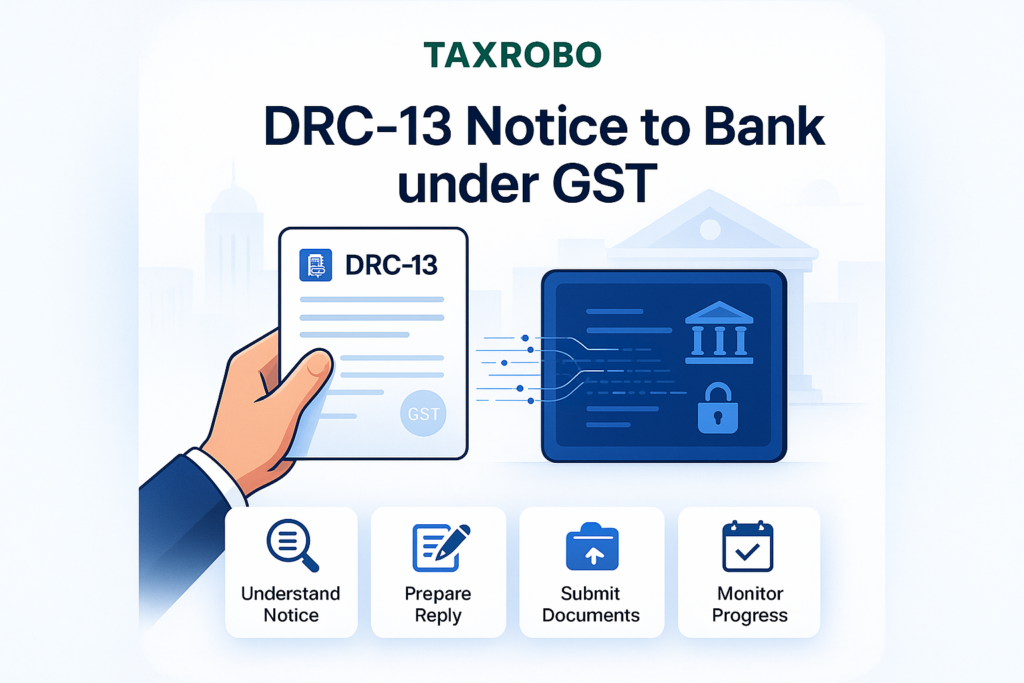
At its core, Form GST DRC-13 is a recovery notice. It is not sent to you directly but to a third party that holds money on your behalf, most commonly your bank. Think of it as the GST department’s final tool to collect outstanding tax dues when a taxpayer has failed to pay a confirmed liability. The notice instructs the third party—your bank, for instance—to pay your dues directly to the government from the funds they hold for you. This action is serious and has immediate consequences for your cash flow.
The Legal Basis: Garnishee Proceedings under GST
The power to issue a DRC-13 notice comes from a legal concept known as “garnishee proceedings.” This is outlined under Section 79(1)(c) of the CGST Act, 2017. The term “garnishee” simply refers to a third party (like a bank) who is instructed by a court or authority to hold the assets of a debtor (the taxpayer) to settle a debt with a creditor (the GST department). It is a last-resort recovery mechanism used by tax authorities when a taxpayer has not paid a confirmed GST liability despite receiving a formal demand order. This notice legally obligates the third party to prioritize the government’s demand over the taxpayer’s claim to the funds.
Who Issues It and Who Receives It?
Understanding the players involved is crucial for navigating the process.
- The Issuer: The Proper Officer of the relevant GST Department is authorized to issue a Form GST DRC-13 notice. This is the officer who has jurisdiction over your GST registration and has been pursuing the recovery of the unpaid tax demand.
- The Primary Recipient (The Garnishee): The notice is served directly to the third party who either holds money for you or owes money to you. The most common recipients are:
- Banks where you hold current or savings accounts.
- Debtors or major customers who owe your business money for goods or services supplied.
- The Secondary Recipient (You): A copy of the DRC-13 notice is also provided to you, the defaulting taxpayer. This is for your information so that you are aware that recovery proceedings have been initiated against your accounts or receivables.
Understanding the DRC-13 Notice Procedure in India
The issuance of a DRC-13 notice is not a random event; it’s the final step in a defined legal process. A clear grasp of the Procedural Steps Following the Issuance of a GST Demand Notice: A Taxpayer’s Guide helps in formulating an effective response. The process is designed to ensure that the government can recover confirmed dues without undue delay once a taxpayer has failed to comply with their obligations.
The Trigger: From Demand Order to Recovery
The journey to a DRC-13 notice follows a specific sequence of events, starting long before your bank account is frozen.
- Demand Confirmation: First, a tax demand is confirmed against you through an official order. This is typically issued in Form GST DRC-07 after an assessment, audit, or investigation is completed.
- Failure to Pay: The taxpayer is given a specific period, usually three months from the date of the order, to pay the demanded amount.
- Initiation of Recovery: If you fail to pay the dues within this stipulated timeframe and have not obtained a stay from an appellate authority, the GST officer is legally empowered to initiate recovery proceedings under Section 79 of the CGST Act. The issuance of Form GST DRC-13 is one of the most common and effective methods used in these proceedings.
Action Taken by the Bank (or Third Party)
Upon receiving a Form GST DRC-13 notice, your bank has a legal obligation to comply immediately. They cannot ignore the notice or seek your permission before acting. The bank will typically take the following actions:
- Mark a Lien/Freeze the Account: The bank will immediately mark a lien or freeze your bank account for the amount specified in the notice. If the balance in your account is less than the demanded amount, the entire balance will be frozen.
- Remit Funds to the Government: The bank is required to remit the specified amount directly to the government’s treasury on behalf of the GST department. They will provide a compliance report to the tax officer confirming the payment.
The Immediate Impact on Your Business
The consequences of a DRC-13 notice are severe and immediate, hitting the core of your business operations.
- Complete Cash Flow Disruption: Your ability to conduct business comes to a standstill. You will be unable to make payments to suppliers, pay employee salaries, cover rent, or meet any other operational expenses.
- Failed Financial Commitments: Cheques issued by you may bounce, and auto-debits for loan EMIs or other services will fail, leading to financial penalties and a negative impact on your credit score.
- Reputational Damage: A frozen bank account can damage your business’s reputation with your bank, suppliers, and other financial stakeholders, making future dealings more difficult.
How to Respond: The Official DRC-13 Notice Reply Format
Your response to this notice must be immediate, precise, and formally documented. A well-drafted letter is your primary tool to communicate your position to the GST officer and request the withdrawal of the notice. This section provides a detailed DRC-13 notice reply format and covers how to respond to DRC-13 notice India effectively.
Essential Components of Your Reply Letter
Your reply should be structured professionally and contain all necessary information and supporting documents. Use the following template as a guide:
[Your Company Letterhead]
To,
The Proper Officer,
[Jurisdiction/Office Address mentioned in the notice]
[City, State, PIN Code]
Date: [Date of Reply]
Subject: Reply to Form GST DRC-13 Notice – [Your GSTIN] – [Notice Reference Number] dated [Date]
Reference:
1. GSTIN: [Your GST Identification Number]
2. Notice Reference No.: [Number mentioned on the DRC-13 copy]
3. Notice Date: [Date of the DRC-13 notice]
Respected Sir/Madam,
Body Paragraph 1 (Acknowledgement):
This is with reference to the Form GST DRC-13 notice cited above, issued by your good office to our bank, [Bank Name, Branch Address, Account Number], for the recovery of an alleged outstanding demand of ₹[Amount]. We hereby acknowledge the receipt of a copy of the said notice.
Body Paragraph 2 (Statement of Facts & Action Taken):
(Choose the scenario that applies to you)
- Scenario A (If you have already paid the demand):
We wish to inform you that the demanded amount of ₹[Amount] pertaining to the order [Order Number] dated [Order Date] has already been paid in full via Form GST DRC-03 on [Date of Payment]. The ARN for the said payment is [ARN Number]. A copy of the payment challan is attached herewith for your ready reference and verification. - Scenario B (If you have filed an appeal against the demand):
We would like to bring to your kind attention that we have disputed the demand confirmed in the order [Order Number] dated [Order Date] and have filed a statutory appeal against it before the learned Appellate Authority on [Date of Filing Appeal]. The Appeal Reference Number is [Appeal Number]. In compliance with Section 107(6) of the CGST Act, 2017, we have made the mandatory pre-deposit of ₹[Amount], which is [10% or 25%] of the disputed tax amount. Accordingly, the recovery of the balance amount is deemed to be stayed. A copy of the appeal acknowledgement and the pre-deposit challan are enclosed for your perusal. - Scenario C (If you have requested payment in installments):
We acknowledge the outstanding liability. However, due to severe financial hardship, we are currently unable to pay the entire amount in one go. We have filed an application for payment of the tax in installments using Form GST DRC-20 on [Date of Application]. The application is pending consideration by the competent authority. A copy of the filed application is attached for your reference.
Body Paragraph 3 (Prayer/Request):
In light of the facts and documents presented above, we humbly request your good office to withdraw the Form GST DRC-13 notice issued to our bank immediately. We also request you to issue the necessary instructions in Form GST DRC-14 to our bank, [Bank Name, Branch], to unfreeze our account so that our business operations are not hampered further.
Enclosures:
1. Copy of Payment Challan (DRC-03)
2. Copy of Appeal Acknowledgement and Stay Application
3. Copy of Installment Application (DRC-20)
(List only the documents you are attaching)
Thank you for your understanding and prompt action in this matter.
Sincerely,
[Your Name/Authorized Signatory]
[Your Designation]
[Your Company Name & Seal]
Submission and Follow-up Guidelines
- Submission Method: Submit the reply physically at the office of the concerned GST officer. Get a stamped acknowledgement on a copy of the letter as proof of submission. You can also send it via registered post with acknowledgement due for a formal record.
- Proactive Follow-up: Do not just submit the letter and wait. Follow up with the GST officer within a day or two. The goal is to ensure they review your submission and issue Form GST DRC-14, which is the official communication to the bank withdrawing the DRC-13 notice.
Critical Next Steps for DRC-13 Notice in India
Knowing the theory is one thing, but taking swift, decisive action is what solves the problem. Follow these next steps for DRC-13 notice India as soon as you become aware of the situation. These DRC-13 bank notice response guidelines India form a practical checklist.
Step 1: Verify the Notice and Contact Your Bank
The first hour is crucial. Don’t panic; act methodically.
- Verify the Details: Carefully check the notice copy you received. Ensure your GSTIN, the demand amount, and the underlying order number are correct. Any discrepancy could be a point of contention.
- Speak to the Bank Manager: Immediately call or visit your bank branch manager. Confirm that they have received the notice and understand the exact status of your account. Ask for the specific amount for which the lien has been marked. This information is vital for your next steps.
Step 2: Evaluate Your Options: Pay or Appeal
Your next move depends on whether you agree with the GST demand.
- If the Demand is Correct: The fastest and simplest solution is to pay the outstanding amount immediately. You can do this on the GST Portal using Form DRC-03. Once paid, use the payment challan as proof in your reply letter to the officer.
- If the Demand is Incorrect/Disputed: If you believe the demand order is unfair, incorrect, or legally flawed, you must act to protect your rights. Immediately consult with a tax professional and file an appeal under Section 107 of the CGST Act. This action is one of the primary Legal Remedies Available for Challenging GST Demand Orders: An Overview. Remember, to secure an automatic stay on recovery proceedings, you must pay a mandatory pre-deposit, which is typically 10% of the disputed tax amount. This is a critical step to legally challenge the demand while getting the DRC-13 notice withdrawn.
Step 3: Communicate with the GST Department
Communication is key to resolution. After deciding your course of action (payment or appeal), you must formally inform the GST department.
- Submit the Formal Reply: Prepare your response using the DRC-13 notice reply format detailed earlier. Tailor it to your specific situation, whether you’ve paid, appealed, or requested installments.
- Provide Supporting Proof: Attach all necessary documents—payment challans, appeal filings, stay orders—to your reply. The stronger your evidence, the faster the officer will act to withdraw the notice. A well-documented reply leaves no room for ambiguity.
Conclusion
Receiving a Form GST DRC-13 notice is undoubtedly a serious and disruptive event for any business. It signifies that the GST department is taking firm action to recover confirmed dues. However, it is a situation that can be managed effectively with a prompt and correct response. The key is to act immediately, evaluate your options, and communicate formally with the department using the proper DRC-13 notice reply format. Ignoring the notice is never an option, as it will only lead to the automatic debit of funds from your account, causing irreversible damage to your business operations. A swift, well-documented reply is your best tool to unfreeze your bank account and restore normalcy. Of course, the best defense is a good offense, which means understanding How to Avoid Common Pitfalls Leading to GST Demand Notices from the outset.
Navigating GST notices can be complex. If you need expert assistance in drafting a professional response, handling appeals, or managing your overall TaxRobo GST Service, contact the specialists at TaxRobo today. Let us handle the paperwork so you can focus on your business.
Frequently Asked Questions (FAQs)
1. Can the GST department take money from my savings account for business GST dues?
Yes. A DRC-13 notice is issued based on the PAN of the taxpayer. The GST department can send the notice to any bank where you hold an account linked to that PAN. This includes your personal savings accounts, fixed deposits, or any other accounts, not just the business’s current account.
2. What is Form GST DRC-14?
Form GST DRC-14 is the withdrawal certificate. It is the form issued by the tax officer to the third party (your bank) instructing them to amend or completely withdraw the original DRC-13 notice. You will receive a copy of this form once your reply is accepted and the officer is satisfied that the demand has been paid, stayed, or otherwise settled. This is the document that officially unfreezes your account.
3. How much time do I have to reply to a DRC-13 notice?
The law does not specify a time limit for the taxpayer to reply. However, the notice sent to the bank is for immediate compliance. This means the bank can transfer the funds at any time after receiving the notice. Therefore, for all practical purposes, you should act and submit your reply on the very same day you learn about the notice to prevent the funds from being transferred to the government.
4. What if the money in my bank account is less than the GST demand?
If the balance in your bank account is less than the amount demanded in the DRC-13 notice, the bank will freeze and remit the entire available balance to the GST department. The notice remains active, and the GST officer can continue to pursue recovery for the remaining shortfall through other means, including attaching any future credits that come into that same bank account.