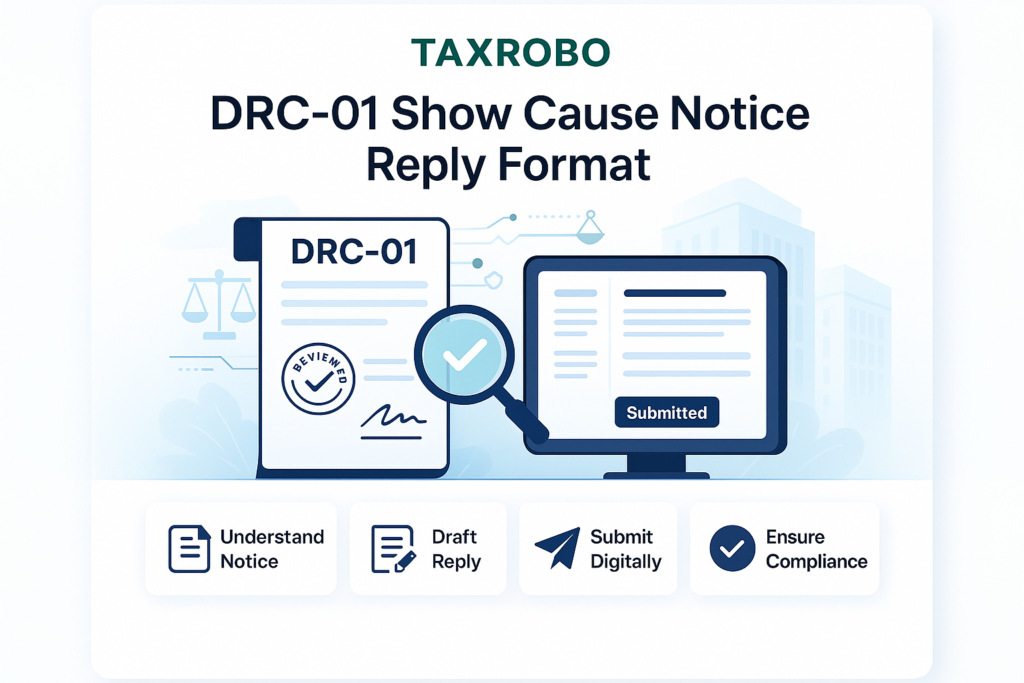

DRC-01 Show Cause Notice under GST – Complete Reply Format
Receiving an official-looking envelope from the GST department can be a stressful moment for any business owner. The sight of a notice can trigger a wave of questions and anxiety. However, it’s important to remember that not every notice is a final demand. One of the most common communications is the DRC-01, or Show Cause Notice, and understanding The Significance of ‘Show Cause Notices’ in GST: Legal Framework and Compliance is key. Understanding the complete show cause notice reply format is your first and most crucial step towards resolving the issue calmly and professionally. This article is designed to be your comprehensive guide, providing a detailed breakdown of what a DRC-01 notice is, why you might have received one, and how to draft an effective response to protect your business interests. We will walk you through the entire process, ensuring you have the knowledge to handle this situation with confidence.
What is a DRC-01 Show Cause Notice and Why Did You Receive It?
Before diving into the format of the reply, it’s essential to understand the notice itself. The DRC-01 is not a confirmation of guilt or a final tax demand. It is a formal communication from a GST officer who has reason to believe that there might be a discrepancy in your tax payments. This could involve an underpayment of tax, a wrongful claim of Input Tax Credit (ITC), or an incorrect refund claim. The notice gives you a fair opportunity to explain your side of the story before any action is taken. A well-drafted and evidence-backed reply can often resolve the matter entirely, preventing further legal complications and financial penalties.
Understanding the Purpose of a Show Cause Notice
Think of a Show Cause Notice (SCN) as a question, not a verdict. The GST department is essentially saying, “We have found these potential discrepancies in your records, and we propose to demand this amount of tax, interest, and penalty. Please show cause (provide reasons and evidence) as to why this demand should not be confirmed.”
The fundamental principle behind the SCN is that of natural justice. It ensures that no adverse order is passed against a taxpayer without giving them a chance to be heard. Responding properly is your legal right and your best defense. A clear, factual, and legally sound reply can persuade the officer to drop the proceedings, saving you significant time, money, and stress. Ignoring the notice, on the other hand, allows the officer to pass an order based solely on their findings, which will almost certainly be against you.
Common Triggers for a DRC-01 Notice in India
So, why did you receive this notice? The reasons can vary, but they usually stem from data mismatches detected by the GST department’s analytical systems. This DRC-01 GST notice response guide outlines some of the most common triggers:
- Mismatch in GSTR-1 and GSTR-3B: This is a major red flag. If the total taxable value or tax liability you declared in your GSTR-1 (statement of outward supplies) is higher than what you declared and paid in your GSTR-3B (summary return), the system will flag the difference as a potential short payment of tax. Proper filing is essential, and our guide on How to File GST Returns Online: A Step-by-Step Guide of the GST Filing Process & Procedure can help prevent such issues.
- Excess Input Tax Credit (ITC) Claim: A common issue arises when the ITC you claimed in your GSTR-3B is significantly more than the eligible credit appearing in your GSTR-2A or GSTR-2B (auto-drafted ITC statements). This suggests you may have claimed credit for invoices that your suppliers did not upload or for which you are not eligible. To understand the rules better, refer to our GST Input Tax Credit (ITC) Full Guide 2025 – Eligibility, Limits & Common Issues.
- Non-payment or Short Payment of Tax: This can be detected during a departmental audit, scrutiny of returns, or other enforcement activities where an officer finds unpaid or underpaid tax liabilities based on your financial records.
- E-way Bill Discrepancies: If there is a major difference between the value of goods transported under e-way bills and the turnover declared in your GSTR-3B, it may indicate suppression of sales.
- Incorrect Classification or Tax Rate Application: Applying a lower GST rate on your goods or services than what is legally required (e.g., charging 5% instead of the correct 12%) is a frequent reason for an SCN.
First Steps: What to Do Immediately After Receiving a DRC-01 Notice
Panic is a counterproductive response. Instead, follow a structured approach to tackle the notice methodically. Here are the immediate steps you should take.
Step 1: Acknowledge and Verify the Notice
First and foremost, do not ignore the notice. Ignoring it is the worst possible action. The first thing to do is to verify its authenticity. You can do this by logging into the GST Portal and checking under ‘Services’ > ‘User Services’ > ‘View Notices and Orders’. Confirm that the Notice Reference Number (or DIN – Document Identification Number), date, and your GSTIN match the physical copy. This ensures you are dealing with a genuine communication from the department.
Step 2: Read the Notice Carefully
Set aside some quiet time and read the entire notice from start to finish. Pay close attention to the following details:
- The Specific Allegations: Understand exactly what the department is accusing you of. Is it an ITC mismatch, a GSTR-1 vs. 3B difference, or something else?
- The Financial Period: Note the specific months or financial years the notice pertains to.
- The Proposed Demand: Identify the exact amount of tax, interest, and penalty being proposed. The notice will have a summary of the demand in Form DRC-01 itself.
- The Deadline for Reply: This is critical. Note the due date for submitting your response, which is typically 30 days.
Step 3: Gather All Relevant Documents
A strong reply is built on strong evidence. You cannot simply state your case; you must prove it. Begin gathering all documents related to the allegations and the period in question. Your document checklist should include:
- Copies of GSTR-1, GSTR-3B, GSTR-2A, and GSTR-2B for the relevant period.
- Sales invoices, purchase invoices, and debit/credit notes.
- Bank statements to prove payments for both sales and purchases.
- Reconciliation statements you may have prepared (e.g., ITC reconciliation between books and GSTR-2B, or sales reconciliation).
- Copies of relevant e-way bills, delivery challans, and goods receipt notes.
- Any correspondence with suppliers or customers that supports your case.
The Complete DRC-01 Show Cause Notice Reply Format
Now, we come to the core of the matter: drafting the reply. A well-structured reply is professional, easy for the officer to understand, and legally robust. It should be drafted on your official business letterhead. Here is a comprehensive template you can adapt.
Part 1: Header and Subject Line
This section sets up the official context of the communication.
To,
The Proper Officer,
[Designation of the Officer as mentioned in the notice]
[Jurisdictional Office Address as mentioned in the notice]
From,
[Your Business Legal Name]
[Your Business Address]
[Your GSTIN]
Subject: Reply to Show Cause Notice No. [Insert Notice Reference Number] dated [Insert Date of Notice]
Part 2: Introduction and Factual Background
Begin the body of your reply by acknowledging the notice and setting the stage.
“Respected Sir/Madam,
1. This is with reference to the Show Cause Notice (SCN) bearing reference number [Insert Notice Reference Number] dated [Insert Date of Notice], issued to us under Section 73/74 of the CGST Act, 2017. We acknowledge the receipt of the said notice on [Date of Receipt].
2. We are a registered entity under the GST Act, engaged in the business of [briefly describe your business, e.g., trading of electronic goods, providing software services]. We have been diligently filing our GST returns and paying all due taxes since the inception of our registration.
3. The aforementioned SCN alleges [briefly summarize the main allegation, e.g., a discrepancy in ITC claimed in GSTR-3B versus that available in GSTR-2A for FY 2021-22]. In this regard, we would like to present the following facts, submissions, and supporting documents for your kind consideration.”
Part 3: Point-by-Point Rebuttal (The Most Critical Section)
This is where you address the allegations directly. Do not write a single, long paragraph. Instead, structure your response by tackling each allegation from the SCN individually. This makes your reply clear and easy for the officer to follow. This is the heart of the complete reply format for DRC-01 GST.
Example Structure:
Allegation 1: Excess claim of Input Tax Credit amounting to ₹75,000 for the period April 2022 to June 2022.
Our Submission on Allegation 1:
“We humbly submit that the allegation of an excess ITC claim of ₹75,000 is incorrect. The said difference is not due to any wrongful claim but arises from the following bonafide reasons:
- Reason A (₹45,000): An amount of ₹45,000 pertains to an invoice (No. INV-098 dated 15-05-2022) from our supplier, M/s ABC Traders (GSTIN: XXXXXXXXXXXXXXX). The supplier filed their GSTR-1 for May 2022 belatedly in July 2022. Therefore, this credit was not reflected in our GSTR-2A/2B for May but appeared later. We had rightfully claimed this ITC in our May 2022 GSTR-3B as we were in possession of the tax invoice and had made the payment. We are attaching a copy of the tax invoice (Annexure A), our bank statement showing payment to the supplier (Annexure B), and a screenshot of the supplier’s GSTR-1 filing status from the portal (Annexure C).
- Reason B (₹30,000): The remaining ITC of ₹30,000 relates to reverse charge mechanism (RCM) liability on legal services received. We have paid the GST on RCM and correctly claimed the corresponding ITC in our GSTR-3B, as permitted by law. A copy of the self-invoice and proof of tax payment is attached as Annexure D.”
Using this structure for every allegation makes your GST show cause notice response template robust and evidence-based.
Part 4: Legal Submissions and Supporting Arguments
After presenting the facts, bolster your case with legal arguments. Cite relevant provisions of the law that support your position.
“In addition to the factual submissions above, we would like to draw your attention to Section 16(2) of the CGST Act, 2017, which lays down the conditions for availing ITC. We submit that we have fulfilled all the prescribed conditions for the ITC claims in question. Furthermore, any procedural delays on the part of our suppliers in filing their returns should not prejudice our right to claim legitimate ITC, as has been held in various judicial pronouncements.”
Pro Tip: This is where legal and technical language becomes crucial. If you are not confident, it is highly advisable to seek professional help. A tax consultant can frame these arguments effectively. For expert assistance, consider booking an TaxRobo Online CA Consultation Service.
Part 5: Prayer and Conclusion
Conclude your reply with a clear and respectful request to the officer.
“In light of the facts, documentary evidence, and legal submissions presented above, it is clear that our claims are bonafide and there has been no short payment of tax or wrongful availment of ITC on our part.
We humbly pray for your good office to consider our submissions favorably, drop the proceedings initiated by the Show Cause Notice No. [Insert Notice Reference Number], and pass an appropriate order to this effect. We are ready to provide any further clarification or documentation as may be required.”
Part 6: Verification and Annexures
Finally, add a verification clause and list all your attached documents.
Verification
I, [Your Name], [Your Designation] of [Your Business Name], do hereby solemnly affirm and declare that the contents of the above submission are true and correct to the best of my knowledge and belief, and nothing has been concealed therefrom.
For [Your Business Name],
[Signature]
[Your Name]
[Designation]
Date:
Place:
List of Annexures:
- Annexure A: Copy of Tax Invoice No. INV-098
- Annexure B: Bank Statement highlighting payment to M/s ABC Traders
- Annexure C: Screenshot of Supplier’s GSTR-1 Filing Status
- Annexure D: Copy of RCM Self-Invoice and Payment Challan
How to File Your DRC-01 Reply on the GST Portal
Once your detailed reply is ready in PDF format along with all scanned annexures, you need to file it online. Here is a step-by-step guide:
- Log in to the official GST Portal using your credentials.
- Navigate to the dashboard and go to Services > User Services > View Notices and Orders.
- On the ‘Notices’ tab, you will see the SCN listed. Find the relevant Notice Reference Number and click on the ‘Reply’ link in the ‘Action’ column.
- You will be taken to the reply submission page. You have two options: type a brief reply in the text box or (highly recommended) upload your detailed, signed reply as a single PDF file.
- Use the ‘Upload’ button to attach your main reply PDF and then upload all supporting annexures one by one. The maximum file size per document is typically 5 MB.
- If you wish to have an in-person meeting with the officer to explain your case, select ‘Yes’ for the ‘Personal Hearing’ option. It is generally advisable to request a personal hearing.
- Once all documents are uploaded, preview your submission. Finally, submit the reply using either a Digital Signature Certificate (DSC) for companies/LLPs or an Electronic Verification Code (EVC) for other taxpayers.
Common Mistakes to Avoid in Your Response
A small mistake can weaken an otherwise strong case. Be mindful of these common pitfalls:
- Missing the Deadline: This is the most critical error. Always file your reply within the time limit specified in the notice. If you need more time, formally request an extension.
- Vague or Emotional Replies: Keep your response professional, factual, and objective. Avoid emotional language or making vague statements. Stick to the facts and support them with evidence.
- Not Providing Evidence: A reply that simply denies the allegations without attaching any supporting documents (invoices, bank statements, reconciliations) carries very little weight. Evidence is everything.
- Admitting Liability Incorrectly: Before you accept any part of the demand, be absolutely sure that the liability is correct. Once admitted, it is very difficult to reverse. If in doubt, consult an expert.
Avoid these common errors. Let TaxRobo’s GST Service experts handle your DRC-01 reply with precision and professionalism.
Conclusion: Responding to a DRC-01 Notice with Confidence
A DRC-01 Show Cause Notice is a serious matter, but it is not a reason to panic. It is a procedural step that gives you the opportunity to defend your case. By understanding the notice, gathering the right documents, using a structured show cause notice reply format, and filing your response on time through the GST portal, you can address the department’s queries effectively. A well-prepared, factual, and evidence-backed reply is your most powerful tool in resolving GST disputes and ensuring your business remains compliant and free from unnecessary liabilities.
Don’t let a GST notice disrupt your business operations. For expert assistance in drafting and filing your DRC-01 reply format for GST India, contact the specialists at TaxRobo today! Our team is equipped to handle the complexities and ensure your case is presented in the strongest possible manner.
Frequently Asked Questions (FAQs)
Q1. What is the time limit to reply to a DRC-01 GST notice?
A. The time limit is generally specified in the notice itself, which is typically 30 days from the date of communication of the notice. However, it’s crucial to check the specific deadline mentioned in your notice as it can sometimes vary.
Q2. What happens if I don’t reply to a DRC-01 show cause notice?
A. If you fail to respond within the stipulated time, the tax officer will proceed with the case ex-parte, meaning they will make a decision based only on the information and evidence available to them. This will almost certainly result in the confirmation of the entire proposed tax demand, along with applicable interest and penalties, through an order in Form DRC-07.
Q3. Can I request an extension for filing the reply?
A. Yes, you can file a formal application or letter with the issuing authority requesting an extension of time. You must provide valid and justifiable reasons for the delay (e.g., unavailability of key personnel, complexity of the case, need to gather extensive data). The decision to grant an extension is at the discretion of the proper officer. It is always advisable to file this request well before the original due date expires.
Q4. Should I hire a professional to draft the GST show cause notice response template?
A. While it is not legally mandatory to hire a professional, it is highly recommended. A professional, such as a Chartered Accountant or a Tax Lawyer, possesses the technical knowledge and practical experience to handle such notices. They understand the nuances of GST law, can interpret the allegations correctly, frame legally sound arguments, and ensure your GST show cause notice response template is comprehensive and compliant. This significantly increases the probability of a favorable outcome and can save you from potentially large financial liabilities.