
REG-23 Notice for Revocation Rejection – How to Reply Successfully
Received a notice in Form GST REG-23? It can be alarming, but it’s not the end of the road for your GST registration. This notice, officially a Show Cause Notice, arrives when a GST officer isn’t satisfied with your application to revoke a previous GST cancellation. Understanding how to frame a timely and accurate REG-23 notice response is absolutely critical to reactivating your GSTIN and resuming your business operations without legal hurdles. This comprehensive guide will walk you through what this notice means, the common reasons you might have received one, and a detailed step-by-step process for filing a reply that gets your GST registration back on track.
Understanding the REG-23 Notice for Revocation Rejection
Before you can draft an effective reply, it’s essential to understand why you received a REG-23 notice in the first place. This notice isn’t a random event; it’s a specific step in a sequence that begins long before it lands in your inbox. Getting a grasp of this journey helps in pinpointing the exact problem that needs fixing, which is the cornerstone of a successful response. The process is a logical progression based on your compliance history and your subsequent actions to rectify it.
The Journey to a REG-23 Notice
The issuance of a REG-23 notice is a consequence of an officer’s review of your request to reactivate a cancelled GST number. Here’s a breakdown of the typical sequence of events that leads to this situation:
- GST Registration Cancellation: Your GST registration was likely cancelled by a tax officer, typically in Form GST REG-19. This usually happens due to serious compliance failures, with the most common reason being the non-filing of GST returns (like GSTR-3B or GSTR-1) for six consecutive tax periods. Other reasons could include non-commencement of business, issuance of invoices without supplying goods/services, or obtaining registration by fraudulent means.
- Application for Revocation: Realizing the need to continue your business, you filed an application in Form GST REG-21 to revoke the cancellation. This application is your formal request to the GST department to reinstate your GSTIN, stating your intention to become compliant.
- Officer’s Dissatisfaction: After you submit your REG-21 application, a proper officer reviews it. They check whether you have fulfilled the primary conditions for revocation. If they find issues—such as still-pending returns, unpaid taxes, or an unconvincing justification for the past non-compliance—they will not approve the revocation outright.
- Issuance of REG-23 Notice: Instead of a flat rejection, the principle of natural justice requires the officer to give you a chance to explain yourself. They issue a Show Cause Notice in Form GST REG-23, detailing the discrepancies or reasons they are not satisfied with your revocation application. This notice essentially asks you to “show cause” why your request for revocation should not be rejected. This is your final opportunity to make your case, making the understanding REG-23 notice revocation India so crucial for business continuity.
Common Reasons Your Revocation Application Was Rejected
The REG-23 notice will specify the exact reasons for the proposed rejection. However, most cases fall into a few common categories. By understanding these, you can preemptively ensure your application is robust or quickly identify the problem if you’ve already received a notice.
- Failure to File All Overdue GST Returns: This is the most frequent reason. The law is clear: before your revocation application can be considered, you must file all returns that were due up to the effective date of cancellation. If even one GSTR-1 or GSTR-3B is pending, the officer is bound to flag it.
- Non-payment of Outstanding Dues: Filing returns is only half the battle. You must also pay all admitted tax liabilities, along with any applicable interest, penalties, and late fees that have accrued. Simply filing a nil return when tax was due, or filing a return without paying the tax, will lead to the rejection of your revocation request.
- Providing Insufficient Reasons or Justification: Your REG-21 application requires you to state the reasons for seeking revocation. A vague or weak explanation like “business was slow” or “was out of station” may not be considered sufficient. The officer looks for a genuine reason for the past non-compliance and a credible assurance of future compliance.
- Not Attaching Necessary Supporting Documents: If your reason for non-compliance was, for example, a serious medical issue, you should have attached supporting documents like medical certificates with your REG-21 application. A lack of corroborating evidence can make your justification appear weak and lead the officer to issue a REG-23 notice.
- Discrepancies Found During Verification: The officer may conduct a physical verification of your business premises or find other discrepancies in the information you have provided. If the business is not operational at the registered address or if there are other inconsistencies, it can become a ground for questioning the legitimacy of your revocation request.
How to Draft and File a Successful REG-23 Notice Response
Receiving a REG-23 notice means you have one last chance to save your GST registration. A hasty, incomplete, or incorrect reply will almost certainly lead to a final rejection. Therefore, it is vital to approach the response systematically and meticulously. The REG-23 notice procedure India requires a combination of clearing your compliance backlog and presenting your case clearly and professionally to the tax authorities. Follow these steps for a successful reply to a REG-23 notice.
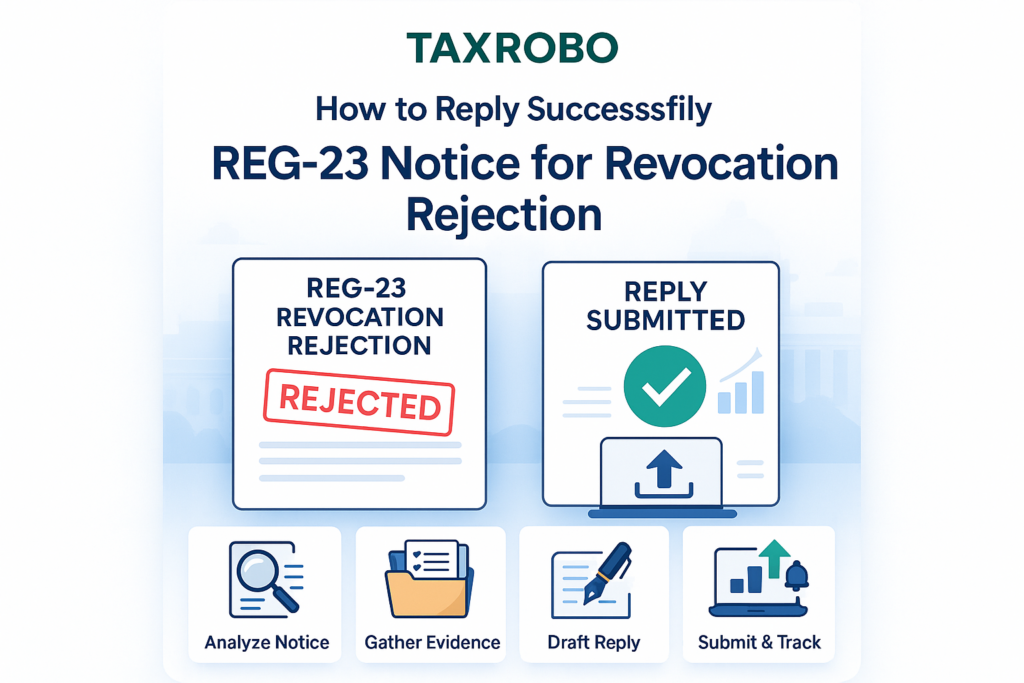
Step 1: Thoroughly Analyze the Notice
The first and most important action is to read the REG-23 notice from start to finish. Do not just skim it. The notice is not a generic template; it contains specific objections and discrepancies identified by the tax officer who reviewed your case. You must identify each point of concern they have raised. Look for mentions of specific pending returns (e.g., GSTR-3B for July to December 2023), unpaid tax amounts, or questions about the reasons you provided. Crucially, note the deadline for submission. You typically have only 7 working days from the date you receive the notice to file your reply. Missing this deadline is equivalent to not replying at all and will result in an automatic rejection of your revocation application.
Step 2: Complete All Pending Compliances (The Most Crucial Step)
This step is non-negotiable and forms the bedrock of your reply. No matter how well-written your explanation is, if you haven’t completed your pending compliances, the officer cannot and will not approve your revocation. Before you even begin drafting your written response, you must take the following actions:
- File All Overdue Returns: Log in to the GST portal and identify every single GSTR-1 and GSTR-3B return that is pending up to the date your registration was cancelled. File all of them without exception.
- Pay All Dues: Filing returns will generate challans for any tax, interest, penalties, and late fees you owe. You must pay these liabilities in full using Form PMT-06. Ensure that your electronic cash and credit ledgers are updated to reflect these payments. Compliance is the only language the system understands, and it is the most powerful part of your revocation rejection notice reply India.
Step 3: Compile Your Supporting Documents
Once all your pending compliances are complete, you need to gather the evidence to prove it. Your written reply will make claims, and these documents will back them up. A strong documentary proof can make the difference between acceptance and rejection. Your evidence file should include:
- A Detailed Written Explanation: Draft a formal letter or statement. Address it to the concerned tax officer. Respond to each and every query or discrepancy mentioned in the REG-23 notice in a clear, point-by-point format. Be respectful and professional. Acknowledge the past non-compliance, briefly explain the genuine reason for it, and most importantly, state that all required compliances have now been completed.
- Proof of Filing Returns: Take screenshots of the GST portal showing the “Filed” status for all the returns you just submitted. Also, download the acknowledgements (ARN receipts) for each return filing.
- Copies of Tax Payment Challans: Download the challans (in Form PMT-06) that show you have paid all outstanding taxes, interest, penalties, and late fees. This is irrefutable proof that all government dues have been settled.
- Other Supporting Evidence: If your non-compliance was due to a specific event (e.g., prolonged illness, a fire at your business premises, etc.), include documentary proof for that. This could be medical records, FIR copies, or bank statements showing a lack of business activity. This adds weight and credibility to your case.
Step 4: How to Submit Your Reply on the GST Portal
With your compliance completed and documents ready, the final step is to submit your reply online. Here is how to reply to REG-23 notice India on the official portal:
- Log in to the official GST Portal.
- Navigate to the dashboard and go to `Services > Registration > Application for Filing Clarifications`.
- On the next screen, you will be prompted to enter the Application Reference Number (ARN). This ARN is mentioned prominently on the REG-23 notice you received.
- Once you enter the ARN, the system will open the response form. You will see two sections: one for a written reply and another for attaching documents.
- You can either type your detailed written explanation directly into the text box or, more preferably, upload the well-drafted reply as a single PDF document.
- In the attachments section, upload all your supporting documents one by one. This includes the return filing acknowledgements, payment challans, and any other evidence you have compiled. Ensure your files are in PDF or JPEG format and that each file is under the size limit (usually 5MB).
- After uploading everything, you must submit the form. You can do this using either a Digital Signature Certificate (DSC) for companies and LLPs or an Electronic Verification Code (EVC) sent to your registered mobile number and email for other taxpayers.
- Once submitted, you will receive an acknowledgement. Be sure to save a copy of this for your records.
What Happens After Submitting Your REG-23 Notice Response?
After you have carefully prepared and submitted your reply, the ball is back in the tax officer’s court. They will review your written explanation and, more importantly, verify the proofs of compliance you have attached. Your case will typically move towards one of two possible outcomes. Understanding these possibilities helps you prepare for the next steps and manage your expectations.
Possible Outcomes from the GST Officer
The officer has a deadline of 30 days from the date you file your revocation application (REG-21) to make a final decision. Your reply to the REG-23 notice is a part of this overall timeline.
- Best Case: Acceptance (Form GST REG-22): If the officer is satisfied that you have filed all your pending returns, paid all your dues, and provided a satisfactory explanation, they will approve your request. They will pass an order in Form GST REG-22, officially revoking the cancellation of your registration. The date of revocation will be effective from the original date of cancellation, meaning your GSTIN is treated as if it were never cancelled. You can immediately resume all business activities, including issuing tax invoices and claiming input tax credit.
- Worst Case: Rejection (Form GST REG-05): If the officer is not satisfied with your reply—perhaps you failed to file all returns, did not pay all dues, or your explanation was found to be inadequate—they will reject your revocation application. This rejection will be communicated through a formal order in Form GST REG-05. This order confirms the cancellation of your GST registration, and your GSTIN remains inactive permanently unless you pursue further legal action.
The Implications of a Final Rejection
Receiving a rejection order in Form GST REG-05 is a serious matter with significant business consequences. The implications of REG-23 notice rejection India are far-reaching and can disrupt your operations severely.
- Inability to Conduct Business Legally: Your business can no longer operate under the cancelled GSTIN. It is illegal to conduct taxable supplies without a valid GST registration.
- Cannot Issue Tax Invoices or Collect GST: You lose the authority to issue GST-compliant invoices and cannot charge or collect GST from your customers. This effectively prevents you from doing business with other registered entities who require valid invoices for their input tax credit.
- Difficulty in Obtaining a New Registration: You may have to apply for a fresh GST registration. However, applying for a new GST registration under the same PAN after a previous one was cancelled for non-compliance can be a difficult and lengthy process. The GST department may scrutinize your new application more heavily, and it could even be rejected.
Conclusion
A REG-23 notice is a critical juncture for any business with a cancelled GST registration. It is your final opportunity to make amends and get your business back on a compliant footing. The key to a successful REG-23 notice response is not just in the words you write, but in the actions you take. The most vital steps are to meticulously analyze the notice, clear every single pending return and tax liability, compile irrefutable proof of your compliance, and file a comprehensive, point-by-point reply before the deadline. Prompt and correct action is paramount to saving your GST registration and ensuring the continuity of your business.
Navigating the REG-23 notice response process India can be complex and stressful, with no room for error. Don’t risk your business’s future on a procedural mistake. Let the experts at TaxRobo handle your GST compliance and ensure your reply is professionally drafted, legally sound, and complete in every respect. Contact us today for a consultation!
FAQs on Replying to a REG-23 Notice
1. What is the time limit to reply to a REG-23 notice?
The standard time limit provided to a taxpayer to reply to a Show Cause Notice in Form GST REG-23 is 7 working days from the date of receiving the notice. This deadline is strict and will be explicitly mentioned in the notice itself. It is crucial to adhere to this timeline.
2. What happens if I miss the deadline or ignore the REG-23 notice?
If you fail to respond within the stipulated 7 working days, the tax officer will assume you have no explanation to offer. They will proceed with the rejection of your revocation application based on the information they already have. A final cancellation order in Form GST REG-05 will be issued, confirming the cancellation of your GSTIN.
3. My reply was rejected. What is my next option?
If your reply is rejected and a cancellation order in Form GST REG-05 is passed, your next legal recourse is to file an appeal. You can file an appeal against the officer’s order with the first Appellate Authority under Section 107 of the CGST Act. This appeal must be filed within three months from the date the rejection order is communicated to you.
4. Can I just apply for a new GST registration instead of replying?
While technically possible, it is highly inadvisable. Applying for a new GSTIN on the same PAN when a previous registration was cancelled due to compliance issues is a major red flag for the tax department. Your new application will likely face intense scrutiny and may be rejected. It is always the best practice to resolve all issues with the existing GSTIN first.
5. Do I need a professional’s help to file the reply?
While the GST portal allows you to file the reply yourself, seeking professional help from a tax consultant or a firm like TaxRobo is highly recommended. Experts understand the legal nuances, can ensure all your compliances are perfectly in order, and know how to draft a response that effectively addresses the officer’s concerns. This significantly maximizes your chances of a successful outcome.