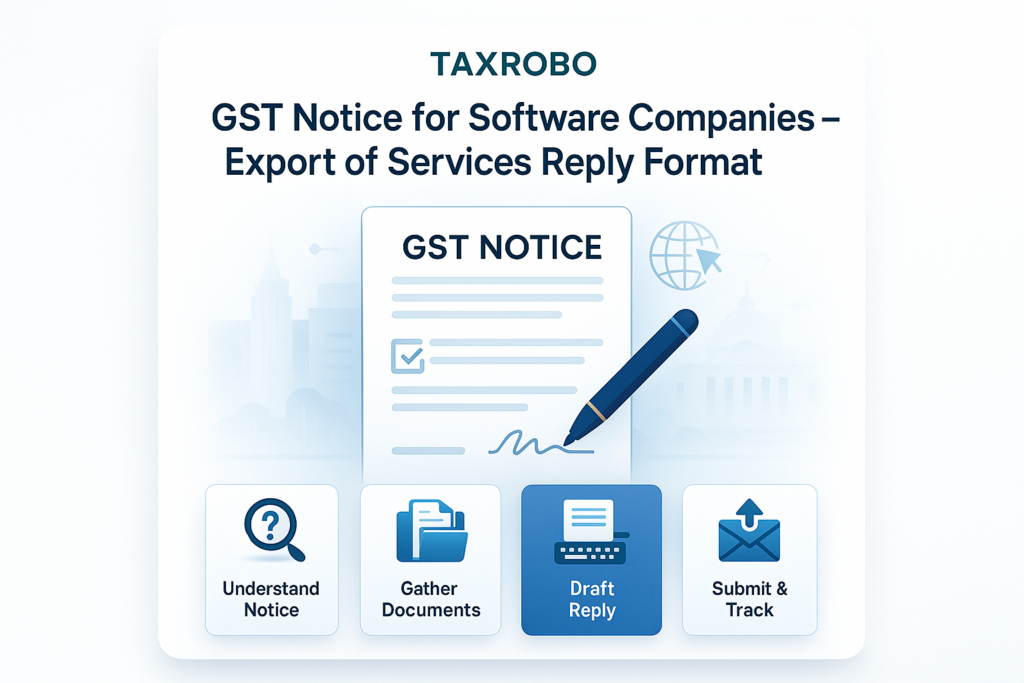

GST Notice for Software Companies – Export of Services Reply Format
Receiving a notice from the GST department can be a daunting experience, especially for software companies navigating the complexities of “export of services.” If you’ve received one, you are not alone. These notices are common in the IT industry, often triggered by minor discrepancies in documentation or filing mismatches related to zero-rated supplies. This article is designed to demystify the process and provide a clear, professional GST notice reply format to help you draft an effective response, protect your business, and ensure long-term compliance. We will break down exactly how to reply to GST notice for exports, turning a stressful situation into a manageable task.
Why Do Software Companies Receive GST Notices for Exports?
Understanding the “why” behind a GST notice is the first step toward resolving it. The GST framework for exports is designed to make Indian services competitive globally by not burdening them with domestic taxes. However, this benefit comes with a stringent compliance framework. The authorities need to verify that the services are genuinely exported and that all conditions are met before allowing the benefit of zero-rated supply. Any perceived gap in this verification process can trigger a notice. Most issues stem from a misunderstanding of the legal requirements or simple clerical errors in reporting.
Understanding “Export of Services” Under GST in India
To effectively defend your case, you must first understand the legal definition of “Export of Services.” According to Section 2(6) of the Integrated Goods and Services Tax (IGST) Act, 2017, a service qualifies as an “export” only if it meets all five of the following conditions. This is a critical checklist under the software service exports GST guidelines.
- Supplier’s Location: The supplier of the service must be located in India.
- Recipient’s Location: The recipient of the service must be located outside India.
- Place of Supply: The place of supply of the service must be outside India.
- Payment: Payment for the service must be received by the supplier in convertible foreign exchange.
- Distinct Entities: The supplier and recipient of the service must not be merely establishments of a distinct person. For example, a branch of your company in the US is not considered a separate recipient.
If even one of these conditions is not met, the transaction is not considered an “export of services” in India, and it could be subject to GST, leading to a notice from the department.
Common Triggers for a GST Notice
Notices are not random; they are typically triggered by specific red flags in your GST filings. Understanding these common triggers can help you not only respond to your current notice but also improve your future GST compliance for software companies.
- Data Mismatch: This is the most frequent cause. A discrepancy between the turnover declared in your GSTR-1 (statement of outward supplies) and your GSTR-3B (summary return) is an immediate red flag for tax authorities.
- Proof of Export: The onus is on you to prove that the service was exported and payment was received. Failure to produce essential supporting documents like Bank Realization Certificates (BRC) or Foreign Inward Remittance Certificates (FIRC) during scrutiny is a major trigger.
- LUT Issues: To export services without paying IGST, you must file a Letter of Undertaking (LUT). A common mistake is failing to file the LUT at the beginning of the financial year or filing it after the export has already taken place. This can lead to the department questioning your claim of a zero-rated supply.
- Incorrect Refund Claims: If you have paid IGST on your exports and are claiming a refund, any errors in the calculation or documentation can lead to a notice questioning the validity of your refund claim.
- Place of Supply Confusion: The GST regulations for software services can be complex. There might be confusion in determining the place of supply, especially when dealing with overseas clients who have a business presence or liaison office in India. Incorrectly identifying the place of supply can invalidate your export claim.
A Step-by-Step Guide to Preparing Your Response
Receiving a notice can cause panic, but a systematic and calm approach is your best defense. Before you start writing your reply, follow these crucial preparatory steps to build a strong and fact-based case.
Step 1: Analyze the Notice and Identify Key Issues
First and foremost, do not panic. A notice is simply a request for information or clarification. Read the document carefully to understand its nature and requirements. Pay close attention to the following details:
- The Reason for the Notice: Identify the specific discrepancy or query raised by the officer. Is it a mismatch in turnover, a request for proof of export, or a query about your LUT? The notice will typically cite the specific sections of the law.
- The Type of Notice: Understand if it’s a simple scrutiny notice (Form ASMT-10) or a more serious Show Cause Notice (SCN).
- The Tax Period: Note the exact financial year or months the notice pertains to.
- The Deadline: Find the date by which you must submit your response. Missing this deadline can lead to further complications.
- The Issuing Authority: Note the designation and jurisdiction of the officer who sent the notice. This is who you will address in your reply.
Step 2: Compile All Supporting Documents
Your reply is only as strong as the evidence you provide. Gather and organize every piece of documentation that supports your claim. A well-documented file demonstrates professionalism and makes it easier for the officer to accept your explanation.
Here is a checklist of essential documents for a software export case:
- A copy of the GST notice you received.
- All Export Invoices issued during the relevant period.
- Service Agreements or Contracts with your foreign clients, clearly outlining the scope of work.
- Bank Realization Certificates (BRCs) or Foreign Inward Remittance Certificates (FIRCs) corresponding to each export invoice. This is non-negotiable proof of payment in foreign currency.
- The valid Letter of Undertaking (LUT) filed for the financial year in question.
- Copies of your GSTR-1 and GSTR-3B returns filed for the period under scrutiny.
- A detailed Reconciliation Statement that explains any differences between the turnover reported in your books of accounts, GSTR-1, and GSTR-3B.
Actionable Tip: Create a dedicated digital folder for each notice. Scan all physical documents and name them clearly (e.g., “Invoice_123_ClientX.pdf”, “FIRC_for_Invoice_123.pdf”). This ensures easy access, organization, and seamless online submission.
The Definitive GST Notice Reply Format for Software Exports
Once you have analyzed the notice and gathered your documents, it’s time to draft the reply. A structured, professional format is crucial. It makes your points clear, easy for the officer to understand, and shows that you are taking the matter seriously. Below is a comprehensive GST notice reply format tailored for software export cases.
Part 1: Header and Subject Line
This section sets the formal tone and provides essential reference details. It should be structured like a professional letter. Using a clear header ensures your reply is routed to the correct officer without delay.
To,
The Designation of the Proper Officer,
[Address of the GST Office]
[City, Pin Code]
From,
[Your Company Name]
[Your GSTIN: XXXXXXXXXXXXXXX]
[Your Registered Address]
Date: [Date of Reply]
Reference No.: [Notice DIN/Reference Number] dated [Date of Notice]
Subject: Reply to Notice regarding [e.g., Scrutiny of Returns under Section 61 / Show Cause Notice under Section 73] for the tax period [e.g., April 2022 to March 2023]
This section should precisely follow the standard for a GST notice reply format India.
Part 2: Introduction and Preliminary Submission
Begin by formally acknowledging the notice. This shows respect for the process and establishes your intent to cooperate fully with the authorities.
Example Text:
“Respected Sir/Madam,
This is with reference to the notice (DIN: [Notice DIN]) dated [Date of Notice] received by us on [Date of Receipt], issued from your good office. We have carefully reviewed the observations and discrepancies noted in the said notice. We would like to express our gratitude for the opportunity to present our case and hereby submit our point-wise reply along with the necessary supporting documents for your kind consideration and perusal.”
Part 3: Point-wise Factual Reply
This is the most critical section of your GST notice reply format. Address each query or allegation from the notice separately. A point-by-point rebuttal is far more effective than a long, narrative paragraph.
Structure for each point:
- Restate the Department’s Observation: Begin by quoting or summarizing the specific point raised in the notice. This shows you have understood the query.
Example: “Observation 1: The notice states that there is a mismatch of Rs. 5,00,000 in the export turnover declared in GSTR-1 and GSTR-3B for the month of October 2022.” - Provide Your Factual Submission: Clearly and concisely present your explanation. Avoid emotional language; stick to the facts.
Example: “Our Submission: In this regard, we humbly submit that our declared turnover is accurate. The alleged mismatch is purely a reporting difference. The turnover of Rs. 5,00,000 pertains to an invoice raised on 31st October 2022, which was correctly reported in the GSTR-1 for October 2022. However, the advance payment for this service was received in September 2022 and was therefore declared in the GSTR-3B for September 2022, in line with the time of supply provisions. There is no short payment of tax.” - Reference the Supporting Evidence: For every claim you make, refer to the documents you have attached. This makes your submission verifiable and credible.
Example: “Supporting Evidence: To substantiate our submission, we are attaching the following documents:- A detailed reconciliation statement explaining the difference (Refer: Annexure A).
- Copy of Invoice No. EXP-075 dated 31/10/2022 (Refer: Annexure B).
- Copy of the FIRC confirming receipt of payment (Refer: Annexure C).
This detailed and evidence-backed structure is the cornerstone of an effective software companies GST notice response format.
Part 4: Legal Submissions and Conclusion
After addressing the factual points, briefly reinforce your position with relevant legal provisions. This adds weight to your reply. Conclude with a formal request, often called a “Prayer.”
Example Text:
“Legal Submission: We submit that our actions are in complete compliance with the provisions of the IGST Act, 2017. As per Section 16 of the IGST Act, the export of services is treated as a ‘zero-rated supply.’ We have fulfilled all five conditions laid down in Section 2(6) of the Act and have filed the necessary LUT, thereby making us eligible for this benefit.
Prayer: In light of the facts, documentary evidence, and legal provisions submitted above, we humbly request your good self to review our submissions, accept our explanation, and drop the proceedings initiated by the aforementioned notice. We assure you of our full cooperation in any further proceedings in this matter.”
Part 5: Verification and Enclosures
Finally, add a verification statement signed by the authorized signatory. This is a legal requirement confirming the authenticity of the information provided. Also, list all the documents you are attaching.
Example Text:
“For [Your Company Name],
Verification
I, [Name of Authorized Signatory], [Designation], do hereby declare that the information provided above is true and correct to the best of my knowledge, information, and belief.
[Signature]
[Name of Authorized Signatory]
[Company Seal]
List of Enclosures:
1. Annexure A: Reconciliation Statement
2. Annexure B: Copy of Export Invoices
3. Annexure C: Copies of corresponding FIRCs/BRCs
4. Annexure D: Copy of valid LUT”
Proactive Measures for Better GST Compliance for Software Companies
Responding to a notice is reactive. The best strategy, however, is to be proactive. By implementing robust internal processes, you can significantly reduce the chances of receiving notices in the first place.
- Maintain Meticulous Records: This cannot be overstated. Keep a dedicated file for every foreign client, containing the service agreement, all invoices, and corresponding FIRCs/BRCs.
- Regular Reconciliation: Make it a monthly practice to reconcile the turnover reported in your accounting software, GSTR-1, GSTR-3B, and the foreign remittances received in your bank account. Catching discrepancies early saves immense trouble later.
- Timely LUT Filing: Mark your calendar. File the Letter of Undertaking on the GST portal at the beginning of every financial year without fail. This is a simple but crucial step.
- Stay Updated: GST laws and procedures are constantly evolving. Regularly visit the official GST Portal to stay informed about the latest notifications and circulars that may affect software exports.
- Seek Expert Help: When in doubt, it’s always best to consult with GST professionals. TaxRobo’s experts can help you ensure seamless GST compliance for software companies and manage any departmental queries effectively.
Conclusion
Responding to a GST notice doesn’t have to be overwhelming if you adopt a systematic and documented approach. The key is to understand the query, gather your evidence, and present your case clearly using a structured GST notice reply format. By carefully analyzing the notice, compiling all supporting documents, and providing clear, fact-based answers, you can resolve the issue efficiently. More importantly, using this experience to implement proactive compliance measures will safeguard your business from similar issues in the future, allowing you to focus on what you do best—innovating and growing your software company.
Received a GST notice? Don’t navigate it alone. Contact TaxRobo’s expert team today for professional assistance in drafting the perfect response to GST notice for software companies and managing your compliance needs.
Frequently Asked Questions (FAQs)
Q1. What is the deadline to reply to a GST scrutiny notice (ASMT-10)?
A. The standard time limit to reply to a notice in Form ASMT-10 is typically 30 days from the date of service of the notice, or as specified in the notice itself. It’s crucial to adhere to this deadline to avoid further action from the department.
Q2. Is a Bank Realization Certificate (BRC) compulsory to prove export of services?
A. Yes, as per GST rules, payment for exported services must be received in convertible foreign exchange. A BRC or FIRC is the primary document issued by a bank to certify this, making it essential evidence to prove your claim of zero-rated supply and satisfy the conditions of export.
Q3. Can I file the GST notice reply online?
A. Yes, the GST portal is designed for online submission of replies. For a scrutiny notice (ASMT-10), the reply must be filed in Form ASMT-11. You can do this by logging in to the GST portal and navigating to Services > User Services > View Additional Notices/Orders, where you can file your reply along with all supporting attachments.
Q4. What are the consequences of not replying to a GST notice?
A. Ignoring a GST notice can lead to serious consequences. The officer may proceed with a best-judgment assessment based on the information available to them, which could result in a higher tax demand. It can also lead to the determination of tax liability along with the imposition of penalties and interest, and potentially trigger further legal action against your business.
Q5. Do I need a tax consultant to draft the response to GST notice for software companies?
A. While it is possible to draft the reply yourself for very simple queries, it is highly recommended to engage a tax professional. An expert can ensure the reply is legally and factually sound, all necessary documents are included, and it is presented in the correct GST notice reply format. Their expertise minimizes the risk of an adverse order and helps in resolving the matter favorably and efficiently.