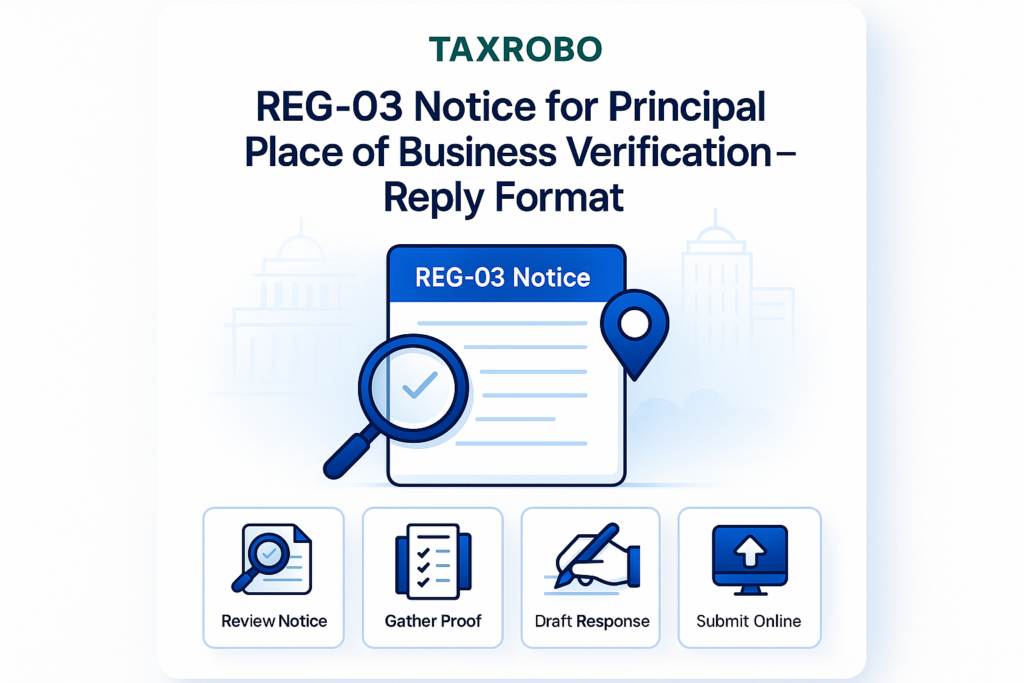

REG-03 Notice for Principal Place of Business Verification – Reply Format
Receiving an official notice from the GST department can be stressful for any business owner. One such common communication is the Form GST REG-03 notice. This post is your complete guide to understanding and responding to a REG-03 notice for Principal Place of Business verification in India. While it might seem daunting, think of it as a simple request for more information rather than a penalty. A timely and accurate reply is crucial for getting your GST registration approved without delays, and we will break down the process, from understanding the notice to filing a perfect reply. Getting a grasp of understanding REG-03 notice for businesses is the first step towards seamless compliance when dealing with business verification notices India.
What is a REG-03 Notice and Why is Your Business Address Critical?
Before drafting a reply, it’s essential to understand what the notice means and why your business address holds so much weight in the GST framework. This knowledge helps in preparing a response that is not only accurate but also addresses the core concerns of the GST officer, paving the way for a smooth approval process.
Decoding the Form GST REG-03 Notice
A Form GST REG-03 is a type of Show Cause Notice (SCN) issued by a GST officer. It is not a demand for tax or a penalty; rather, it’s a formal request for clarification. An officer issues this notice when they are reviewing your GST registration application (Form GST REG-01) and find that some information is missing, unclear, or requires additional supporting documents. The primary purpose of the REG-03 notice Principal Place of Business India is to give you an opportunity to correct discrepancies or provide the necessary evidence to support your application. Responding correctly and within the stipulated time is a mandatory step, as failing to do so can lead to the rejection of your GST registration application altogether.
The Importance of Your Principal Place of Business in GST
Under the GST Act, the “Principal Place of Business” is defined as the primary location from where a business conducts its operations and where its main books of accounts are maintained. This address is not just a detail on a form; it’s a critical component of your GST profile. The importance of Principal Place of Business verification India cannot be overstated for several key reasons:
- Jurisdiction: Your Principal Place of Business determines your GST jurisdiction. It dictates whether you fall under the State GST (SGST) or Central GST (CGST) authority for all compliance, assessments, and audits. An incorrect address can lead to jurisdictional conflicts and administrative hurdles down the line.
- Official Communication: All official notices, orders, and communications from the GST department will be sent to this registered address. Ensuring its accuracy is vital to receive important updates and avoid missing critical deadlines for compliance.
- Compliance & Audits: Tax authorities conduct physical verifications, inspections, and audits at the Principal Place of Business. If the officer cannot locate your business at the given address or finds the premises unsuitable for the declared business activities, it can result in the cancellation of your registration.
Common Reasons for Receiving a REG-03 Notice for Address Verification
The Principal Place of Business verification process India is a stringent check to prevent fraudulent registrations. You might receive a REG-03 notice for your address for several common reasons. Understanding these triggers can help you proactively prepare a stronger initial application.
- Document Mismatch: The documents submitted as address proof, such as an electricity bill, rent agreement, or property tax receipt, are unclear, expired, or not in the name of the applicant or the business owner.
- Address Inconsistency: The address mentioned in the online GST registration form does not exactly match the address specified in the uploaded supporting documents. Even a minor variation can trigger a query.
- Missing No Objection Certificate (NOC): If you are using a residential address or a property you don’t own (e.g., a rented space or a relative’s property), failing to submit a valid NOC from the legal property owner is a very common reason for a notice.
- Inconsistent Business Nature: The nature of your business seems incompatible with the address provided. For example, listing a small residential apartment as the principal place of business for a large-scale manufacturing unit will raise a red flag.
- Verification Discrepancies: The officer may find inconsistencies during a physical site visit or through the Aadhar-based e-verification of the premises, prompting a request for further clarification.
How to Draft and File a Perfect Reply to a REG-03 Notice
Once you’ve understood the “why,” the next step is the “how.” A well-structured, well-documented reply is your best tool to resolve the query quickly. Here’s a systematic approach to drafting and filing a response that satisfies the tax officer.
Step 1: Carefully Analyze the Notice and Note the Deadline
The first rule of how to respond to a REG-03 notice in India is not to panic. Instead, read the notice document thoroughly. The notice will explicitly state the specific discrepancies or the additional documents required by the officer. Don’t make assumptions; focus only on the queries raised. The most critical piece of information on this notice is the deadline for submission. Typically, you are given 7 working days from the date of receiving the notice to file your clarification. Mark this date immediately, as missing this deadline will almost certainly lead to the rejection of your application.
Step 2: Compile the Correct Documents for Your Reply
Your written clarification is only as strong as the documents you provide to support it. Gathering the right paperwork is the most important part of fulfilling REG-03 notice compliance requirements in India. Based on the query, compile clear and valid copies of the required documents.
- If you own the property:
- Latest property tax receipt or challan.
- Copy of the Municipal Khata.
- A recent electricity or water bill in the owner’s name.
- If the property is rented:
- A valid and notarized Rent/Lease Agreement. Ensure it is not expired.
- Proof of ownership of the landlord, such as their latest electricity bill or property tax receipt.
- If it’s a consented/shared property (e.g., using a relative’s home):
- A Consent Letter or a No Objection Certificate (NOC) signed by the property owner.
- The property owner’s proof of ownership (e.g., utility bill or property tax receipt).
- For all cases, it is highly recommended to also include:
- Photographs: Clear photos of the business premises are extremely helpful. Take one picture of the exterior of the building that clearly shows a signboard with your business name and GSTIN (if available). Take another photo of the interior office or workspace.
- Bank Proof: A copy of your business bank account statement or the first page of your passbook that shows the business address.
Step 3: Structure Your Reply in Form GST REG-04
The official response to a REG-03 notice is filed online using Form GST REG-04 on the GST Portal. While the form provides a text box for your clarification, it is best to prepare a structured, point-by-point reply. This is the core of the Reply format for REG-03 notice India. A clear structure makes it easy for the officer to understand your response and co-relate it with the attached documents.
Sample Reply Structure:
Subject: Reply to Show Cause Notice (Reference Number: [Enter Your ARN]) dated [Enter Date of Notice].
Respected Sir/Madam,
This is with reference to the Show Cause Notice issued for our GST registration application bearing the ARN mentioned above. We are providing the following clarifications and documents as requested:
Query 1: [State the first query exactly as mentioned in the REG-03 notice]
Clarification 1: [Provide your direct and clear explanation]. For example: “With reference to the query regarding the proof of ownership, please note that the property is rented from Mr./Ms. [Landlord’s Name]. We have attached a copy of the valid rent agreement dated [Date], a No Objection Certificate (NOC) duly signed by the landlord, and the latest electricity bill of the premises in the landlord’s name as supporting evidence.”
Query 2: [State the second query from the notice]
Clarification 2: [Provide your second explanation]. For example: “Regarding the request for visual verification of the business premises, we have attached two high-resolution photographs. One photograph shows the exterior of the office with a clearly visible signboard displaying our company’s name. The second photograph shows the interior office setup where business operations will be conducted.”
Closing: We believe the above clarifications and the attached documents satisfactorily address the queries raised in the notice. We humbly request you to kindly review the same and approve our GST registration application at the earliest.
Thank you.
Sincerely,
[Your Name/Name of Authorized Signatory]
[Your Business Name]
A Step-by-Step Guide to Filing Form REG-04 on the GST Portal
Once your reply and documents are ready, the final step is to submit them online. The process is straightforward if you follow these steps carefully.
Navigating to the Application
1. Log in to the official GST Portal at https://www.gst.gov.in/.
2. Navigate to the menu: Services > Registration > Application for Filing Clarifications.
3. On the next page, you will be prompted to enter the Application Reference Number (ARN) that was mentioned on your REG-03 notice. Enter the ARN and click the ‘Search’ button.
Submitting Your Clarification and Documents
1. Your original application will be displayed. You will see a notification indicating that a notice has been issued and a response is pending.
2. You will find a text box labeled “Clarification.” This is where you should type or paste the structured, point-by-point reply you prepared earlier.
3. Below the text box, there will be an option to upload supporting documents. Click the “Upload” button and attach all the document files you have compiled. Ensure your files are in the prescribed format (usually PDF or JPEG) and within the size limit (typically under 1MB per file).
4. After uploading all documents and entering your clarification, carefully review everything one last time.
5. Finally, submit the Form REG-04 using either a Digital Signature Certificate (DSC) for companies and LLPs or an Electronic Verification Code (EVC) sent to your registered mobile number and email for other applicants.
What to Expect After You File Your Reply
After you have successfully submitted Form REG-04, the ball is back in the GST officer’s court. They will review your submission, and there are two possible outcomes.
Scenario 1: Approval (Form GST REG-06)
If the officer is satisfied with the clarifications and the documents you have provided, they will approve your GST registration application. You will be notified via email and SMS. Your GSTIN will be activated, and you will be able to download your GST Registration Certificate, which is issued in Form GST REG-06, from the GST portal. This is the ideal outcome and signifies that all compliance requirements have been met.
Scenario 2: Rejection (Form GST REG-05)
If the officer finds your reply unsatisfactory or if the documents provided are still insufficient, they have the authority to reject your application. In this case, they will issue a rejection order in Form GST REG-05. This order will clearly state the reasons for the rejection. If your application is rejected, you cannot appeal this decision directly. Your only option is to start over and file a completely new GST registration application, making sure to rectify the errors that led to the previous rejection.
Conclusion
Responding to a REG-03 notice for Principal Place of Business verification is a procedural step that should be handled with diligence, not alarm. The entire process is manageable if you approach it methodically. Remember the key steps: carefully analyze the notice to understand the exact query, gather clear and valid documents, draft a precise point-by-point reply, and file your clarification in Form REG-04 well before the deadline. A correct and timely response is your direct path to securing a smooth and fast GST registration, which is foundational for your business’s compliance journey.
Navigating GST notices and compliance can be complex. If you need expert assistance with business verification notices in India or any other GST-related matter, TaxRobo’s team of professionals is here to help. Contact us today for a hassle-free experience and let us handle the complexities while you focus on growing your business.
Frequently Asked Questions (FAQs)
Q1. What is the time limit to reply to a GST REG-03 notice?
A: The standard time limit is 7 working days from the date you receive the notice. This deadline will be clearly mentioned in the notice itself. It is crucial to adhere to this timeline to avoid automatic rejection of your application.
Q2. Can I use my home address as the principal place of business?
A: Yes, you can absolutely use a residential address as your principal place of business, which is a common practice for service-based professionals, freelancers, and small home-based businesses. However, you must provide a No Objection Certificate (NOC) from the property owner (if you are not the owner yourself, e.g., if the property is in a parent’s or spouse’s name) along with a valid proof of address like a recent utility bill.
Q3. What happens if I miss the deadline to respond to the REG-03 notice?
A: If you fail to respond within the stipulated time, the GST officer is empowered to reject your GST registration application based on the information available. You will receive a rejection order in Form REG-05. You will then have to begin the entire application process from scratch, which will cause significant delays.
Q4. My documents were uploaded, but the officer still rejected them. What should I do?
A: If your application is rejected even after you submitted documents, you must carefully read the reasons for rejection mentioned in the Form REG-05 order. Common issues include blurry or unreadable scans, expired documents (like an old rent agreement), or documents that are not in the correct legal name. For your new application, ensure all documents are crystal clear, currently valid, and directly address the specific reasons for the prior rejection.