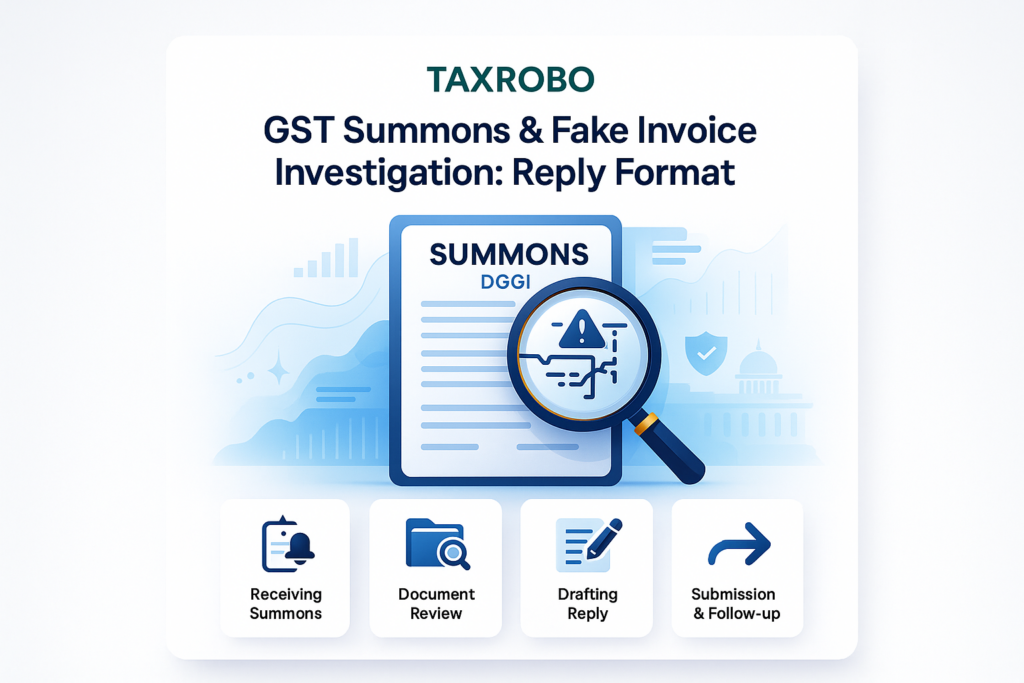

GST Summons from DGGI for Fake Invoice Investigation – Reply Format
Receiving an official summons from a department like the Directorate General of GST Intelligence (DGGI) can be an intimidating and stressful experience for any business owner. This legal document compels you to appear before a GST officer, provide evidence, or produce critical business records. These summons are commonly issued during deep-dive investigations into potential tax evasion, with a significant focus on any suspected fake invoice investigation in India. Understanding how to respond is not just a matter of compliance; it’s a critical step in protecting your business and personal interests. A prompt, accurate, and professionally structured response is crucial. This comprehensive GST investigation response guide will walk you through the entire process, providing a clear DGGI summons reply format to help you respond effectively and confidently.
What is the DGGI and Why Would They Send a Summons?
Before diving into the reply format, it’s essential to understand the authority you’re dealing with and the potential reasons behind their communication. The DGGI is a specialized law enforcement agency, and their involvement signifies that the matter is being treated with a high degree of seriousness. A GST Investigation by DGGI – What It Means & Why You Are Selected is a deep-dive process, and knowing their role and the common triggers for their investigations can provide valuable context and help you prepare a more effective response.
Understanding the Directorate General of GST Intelligence (DGGI)
The Directorate General of GST Intelligence (DGGI) is the apex intelligence and investigative agency for matters related to the Goods and Services Tax (GST) in India. It functions under the Central Board of Indirect Taxes and Customs (CBIC) and is tasked with identifying and combating tax evasion across the country. The DGGI has zonal units and regional offices nationwide, empowering it to conduct complex and widespread investigations into fraudulent activities related to GST. Its officers are highly trained to analyze data, gather intelligence, and uncover sophisticated tax evasion schemes.
Common Reasons for Receiving a DGGI Summons
The DGGI does not issue summons randomly. Their actions are typically based on specific data analytics, intelligence gathered from other agencies, or third-party information. You might receive a summons for several reasons, often interlinked.
- Suspicion of involvement in a
fake invoice case in India: This is currently one of the most common reasons. The DGGI is cracking down heavily on businesses that issue invoices without the actual supply of goods or services, solely for the fraudulent passing of Input Tax Credit (ITC), which can lead to severe penalties as detailed in guides on Fake ITC Cases in GST – Latest Rules, Penalties & Defence Strategy. You could be summoned as a supplier, a recipient, or even an intermediary in such a chain. - Significant Discrepancies: Major mismatches between the data in your GSTR-1 (outward supplies), GSTR-3B (summary return), and GSTR-2A/2B (auto-populated inward supplies) are a huge red flag for tax authorities. These discrepancies can indicate either under-reporting of sales or over-claiming of ITC.
- Non-payment or Short-payment of GST: If the department’s analysis suggests that you have collected GST from customers but have not deposited the full amount with the government, it can trigger an investigation and a summons.
- Fraudulent Claims of Input Tax Credit (ITC): Claiming ITC on ineligible items, using fake invoices, or claiming credit for goods/services not actually received are serious offences that attract the DGGI’s attention.
- Being a Supplier or Recipient Linked to a Fraudulent Entity: Even if your own business practices are compliant, you can be summoned if you have transacted with a business that has been identified as a fraudulent entity or a non-existent taxpayer. The DGGI will want to verify the legitimacy of your transactions with such parties.
The Legal Basis: Section 70 of the CGST Act, 2017
The power of DGGI officers to issue summons is not arbitrary; it is legally backed by Section 70 of the Central Goods and Services Tax (CGST) Act, 2017. This section grants an authorized proper officer the power to summon any person whose attendance is considered necessary, either to give evidence or to produce a document or any other thing in an inquiry. The law also states that such an inquiry is deemed to be a “judicial proceeding,” meaning any statement you give holds significant legal weight. Non-compliance with a summons issued under this section can lead to penalties and legal consequences. You can read the official text of the law on the CBIC website for a deeper understanding.
- External Link: CGST Act, 2017 Document
The DGGI Investigation Process: A Step-by-Step Overview
Understanding the typical flow of a DGGI investigation can help demystify the process and reduce anxiety. While each case is unique, the core stages generally follow a standard procedure from the moment you receive the summons to the conclusion of the inquiry.
Step 1: Receiving and Verifying the Summons
The process begins when you receive the physical copy of the summons. This is a formal legal document, and you must check it carefully. It will contain crucial details that you need to verify:
- Document Identification Number (DIN): Since 2019, any communication from the CBIC, including a summons from the DGGI, must have a computer-generated DIN. This is a critical security feature to prevent unauthorized notices.
- Issuing Officer’s Details: Check the name, designation, and office address of the officer who has issued the summons.
- Date, Time, and Location: The summons will specify the exact date, time, and place where you are required to appear.
Actionable Tip: Your first step should be to verify the authenticity of the summons. You can do this by visiting the official CBIC portal and entering the DIN mentioned on the document. This simple check ensures you are dealing with a legitimate request from the department.
- External Link: CBIC DIN Verification Portal
Step 2: Statement Recording under Oath
When you appear before the summoning officer, your statement will be recorded. It is crucial to understand that this is not an informal chat. The proceedings are formal, and any statement you provide is recorded under oath. This means your statement is considered admissible evidence in a court of law. Therefore, you must:
- Be Truthful: Providing false information can lead to prosecution for perjury, a separate and serious criminal offence.
- Be Precise and Factual: Stick to the facts you know. Do not guess, speculate, or offer opinions. If you do not know the answer to a question, it is better to say so than to provide incorrect information.
- Request a Copy: After your statement is recorded and signed, you have the right to request a copy for your records. This is important for maintaining consistency in any future communication.
Step 3: Submission of Documents
The summons will almost always include a list of documents that you are required to produce. The DGGI investigation process is data-driven, and these documents form the backbone of their inquiry. Common documents requested include:
- Copies of all GST returns for the period under investigation (GSTR-1, GSTR-3B, etc.).
- Purchase invoices and sales invoices related to the transactions under scrutiny.
- Complete bank statements for all business accounts for the relevant period.
- Ledger accounts for the parties involved in the questionable transactions.
- Transport documents like e-way bills, lorry receipts (LRs), and consignment notes to prove the actual movement of goods.
- Stock registers and inventory records.
How to Reply to DGGI Summons: Your Action Plan
Receiving a summons demands a methodical and immediate response. Panicking or ignoring the notice are the worst things you can do. Follow this clear action plan for responding to GST summons India in a way that protects your legal interests.
Action 1: Don’t Panic, But Act Immediately
While a DGGI summons is a serious matter, panic can lead to poor decisions. Stay calm, but do not procrastinate. Ignoring a summons is not an option. It is a legal directive, and failure to comply without a valid reason can lead to penalties under Section 122 of the CGST Act and prosecution under Section 174 of the Indian Penal Code (IPC). Acknowledge the seriousness and begin preparing your response right away.
Action 2: Engage a GST Professional
This is arguably the most critical step. Immediately consult with a qualified Chartered Accountant (CA) or a lawyer who specializes in GST litigation and Indian GST compliance issues. A professional can:
- Interpret the Summons: They can help you understand the exact nature of the inquiry and the specific information the DGGI is seeking.
- Safeguard Your Rights: An expert will ensure your legal rights are protected throughout the investigation process.
- Prepare the Response: They will assist in gathering the correct documents and drafting a professional written reply, which is crucial for creating a formal record.
- Represent You: In many cases, a professional can accompany you during your appearance before the DGGI officer, providing guidance and support during the statement recording.
Action 3: Prepare a Comprehensive Document File
Start gathering all the documents requested in the summons. Do not wait until the last minute. Create a systematic file with clear indexing.
- Organize Chronologically: Arrange invoices, bank statements, and e-way bills by date.
- Make Photocopies: Prepare a self-attested set of photocopies for submission. Carry the original documents with you for verification by the officer.
- Gather Supporting Evidence: If the investigation is about a
fake invoice case in India, gather all possible proof of genuine transactions. This includes proof of payment (bank entries), proof of delivery (signed lorry receipts, weighbridge slips), and any communication with the supplier/recipient.
Action 4: Draft a Formal Written Reply
In addition to appearing in person and submitting documents, it is highly advisable to submit a formal written reply. This document serves as a clear, official record of your cooperation and your side of the story. It demonstrates professionalism and ensures there is no ambiguity in your submission. This written reply is a key part of an effective GST summons India response.
The Definitive DGGI Summons Reply Format
Your written submission should be clear, professional, and directly address the points raised in the summons. Using a structured format ensures that your response is easy for the officer to understand and file. This DGGI summons reply format can be adapted to your specific situation.
Essential Components of Your Written Submission
[On Your Company Letterhead]
Date: [Date of Submission]
To,
The [Summoning Officer’s Name & Designation]
Directorate General of GST Intelligence,
[Zonal Unit/Regional Unit],
[Address as mentioned in the summons]
Subject: Reply to Summons bearing F. No. [Summons Number] dated [Date of Summons] issued in the matter of [Your Company Name / Your Name], GSTIN: [Your GSTIN]
Reference: Your Summons F. No. [Summons Number] dated [Date of Summons]
Body of the Letter:
Paragraph 1 (Acknowledgement and Cooperation):
Dear Sir/Madam,
With reference to the above-mentioned summons received by us on [Date of Receipt], we acknowledge its receipt. We wish to place on record our highest regard for your esteemed office and assure you of our full cooperation with the ongoing investigation. We are committed to providing all necessary information and documents to the best of our ability to facilitate a fair and just inquiry.
Paragraph 2 (Point-wise Response to Queries/Documents):
In response to the specific queries raised and documents requested in the said summons, we are providing the following information and enclosing the relevant documents for your perusal. For the sake of clarity, we are addressing each requirement point-wise as mentioned in the summons:
- Regarding Point 1 of the Summons (e.g., Request for Sales Invoices): We are enclosing herewith self-attested copies of all sales invoices issued to M/s. [Name of Party under Investigation] for the financial year [Year]. These are compiled as Annexure-1.
- Regarding Point 2 of the Summons (e.g., Request for Proof of Payment): We are providing a copy of our bank statement from [Bank Name], Account No. [Account Number], highlighting all payments received from the aforementioned party. This is enclosed as Annexure-2.
- Regarding Point 3 of the Summons (e.g., Request for Proof of Goods Movement): To substantiate the genuine movement of goods, we are enclosing self-attested copies of all corresponding e-way bills and transport lorry receipts (LRs) for the transactions. This complete set is attached as Annexure-3.
(Continue this format for all the points mentioned in the summons. Being this specific and organized in your GST summons India response shows diligence and transparency.)
Paragraph 3 (Annexure List):
Please find enclosed the following documents as annexures for your kind perusal and record:
- Annexure-1: Copy of Sales Invoices from [Date] to [Date].
- Annexure-2: Highlighted Bank Statement from [Date] to [Date].
- Annexure-3: Copies of E-way Bills and Lorry Receipts.
- Annexure-4: Copy of Ledger Account of M/s. [Party Name].
- Annexure-5: Copies of GSTR-1 and GSTR-3B for the relevant period.
Closing:
We reiterate our commitment to full compliance with all Indian GST compliance issues and statutory regulations. We trust that the enclosed documents and our statement will clarify our position. We are available for any further clarification or information that may be required from our end.
Signature Block:
Yours Faithfully,
For [Your Company Name]
(Company Seal/Stamp)
[Your Name]
[Your Designation]
[Contact Number]
[Email Address]
Conclusion
Facing a DGGI summons requires a calm, systematic, and professional approach. While it is a serious matter, it is a manageable one if handled correctly. Remember the key steps: verify the summons immediately, engage a GST expert to guide you, meticulously gather all your documents, and use a structured DGGI summons reply format for your written submission. A well-prepared and transparent response can significantly impact the outcome of the DGGI investigation process, protect your rights, and demonstrate your unwavering commitment to compliance.
Navigating a DGGI investigation can be complex and draining. If you have received a summons or need assistance with any GST matter, the experts at TaxRobo are here to help. Contact us today for professional guidance and representation.
Frequently Asked Questions (FAQ)
Q1. What should I do if I cannot attend the DGGI summons on the given date?
A: You must not ignore it under any circumstances. If you have a genuine and unavoidable reason for being unable to attend (such as a pre-planned out-of-station trip, a medical emergency, or a personal crisis), you must act proactively. Immediately draft and send a formal written letter to the issuing officer requesting an adjournment. Clearly state the reason for your inability to attend, provide supporting proof if possible (e.g., travel tickets, doctor’s note), and suggest an alternative date on which you can appear. Always send this request via registered post or hand-deliver it and get an acknowledgement of receipt.
Q2. Am I required to submit original documents to the DGGI?
A: Typically, you should submit a complete set of self-attested photocopies of all requested documents. However, it is mandatory to carry all the original documents with you when you appear before the officer. The officer will verify the photocopies against the originals. Never hand over your original documents unless the officer issues a formal seizure memo detailing every document being seized. Always demand a copy of the seizure memo for your records if originals are taken.
Q3. Can the DGGI arrest a person during a fake invoice investigation in India?
A: Yes, the law provides for powers of arrest under specific, grave circumstances. There are detailed GST Arrest Provisions – When Can You Be Arrested Under GST? that officers can invoke. Section 69 of the CGST Act empowers the Commissioner to authorize an officer to arrest a person if there are “reasons to believe” they have committed certain serious offences. These offences include issuing invoices or bills without an actual supply of goods or services leading to wrongful availment of ITC, or collecting tax but failing to pay it to the government beyond a three-month period, where the amount exceeds a certain threshold. This is a significant power and is one of the primary reasons why seeking professional legal advice is absolutely critical from the very beginning.
Q4. Is a statement recorded before a GST officer considered evidence?
A: Yes, absolutely. Section 70 of the CGST Act explicitly states that any inquiry conducted by a proper officer shall be deemed to be a “judicial proceeding” within the meaning of the Indian Penal Code. This gives your statement significant legal sanctity. Any information you provide under oath is admissible as evidence in a court of law. Lying or providing deliberately false information can expose you to prosecution for the crime of perjury.
Q5. What is the penalty for not complying with a DGGI summons?
A: Non-compliance with a legal summons is a serious offence. There are two primary consequences. First, under Section 122(3)(d) of the CGST Act, a person who fails to appear when summoned is liable for a penalty which may extend up to ₹25,000. Second, since the inquiry is a judicial proceeding, a deliberate failure to appear can be prosecuted as an offence under Section 174 of the Indian Penal Code, 1860. The authorities can pursue both these actions. Therefore, compliance is not optional.