
GST Arrest Provisions – When Can You Be Arrested Under GST?
When business owners think about the Goods and Services Tax (GST), their minds usually turn to monthly filings, input tax credits, and reconciliation statements. However, the GST framework has a much more serious side that extends beyond simple compliance and penalties. The law includes stringent measures for severe non-compliance, including prosecution and even arrest. This guide will demystify the GST arrest provisions, explaining the specific fraudulent activities that can trigger such drastic action, the legal process that follows, and how you can ensure robust GST compliance in India to safeguard your business from these harsh consequences.
Understanding the Legal Framework: An Overview of GST Arrest Provisions
The power of tax authorities to arrest individuals is not arbitrary; it is clearly defined within the GST law to be used only in cases of significant, deliberate fraud. This authority is a crucial tool for the government to combat large-scale tax evasion that undermines the entire tax system. The primary source for this power is Section 69 of the Central Goods and Services Tax (CGST) Act, 2017, which must be read along with Section 132, the section that specifies the punishable offenses.
Section 69 of the CGST Act, 2017: The Power to Arrest
Section 69 of the CGST Act empowers the Commissioner of GST to authorize the arrest of a person. This is not a power that can be wielded by any tax officer. The decision to arrest can only be made if the Commissioner has “reasons to believe” that an individual has committed one of the major offenses specified under Section 132 of the Act. This “reasons to believe” clause is a significant safeguard, meaning there must be credible evidence and a solid basis for suspicion, not just a vague doubt. This high-level authorization ensures that the power of arrest is used judiciously and only in cases where the integrity of the tax system is at stake.
The Core Conditions for Invoking Arrest
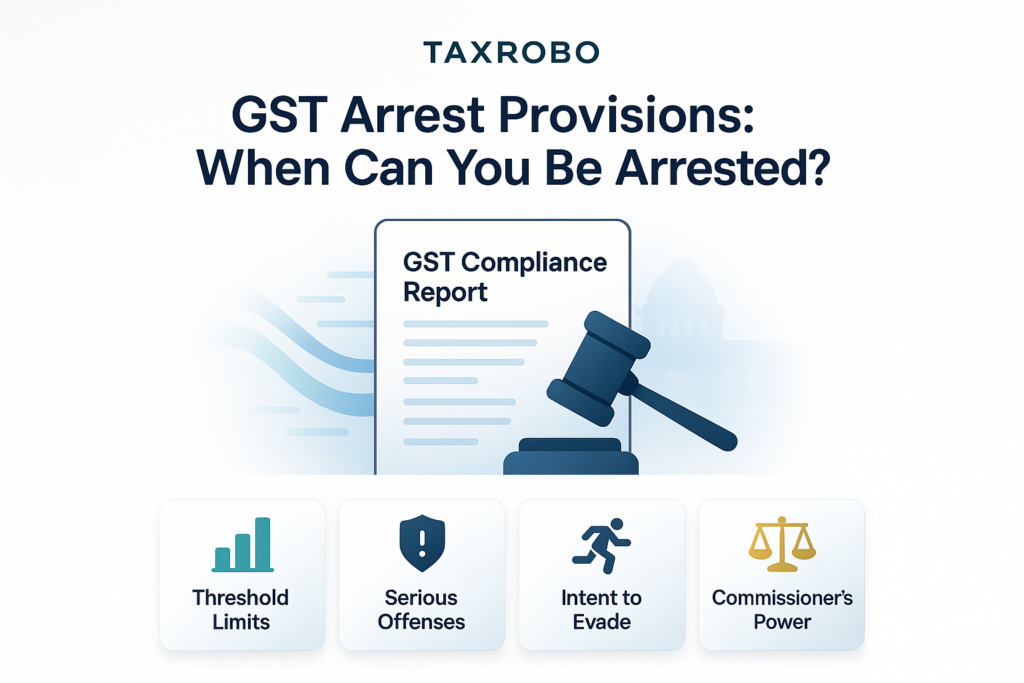
For the GST arrest provisions India to be invoked, three fundamental conditions must be met simultaneously. This multi-layered requirement acts as a check and balance system to prevent misuse of this stringent power.
- Commission of a Specified Offense: The individual must be suspected of committing a specific, serious offense as laid out in Section 132 of the CGST Act. These are not minor procedural lapses but acts of deliberate fraud.
- Monetary Threshold is Crossed: The tax amount involved in the fraudulent activity must exceed a specific monetary limit. Arrest is generally reserved for high-value tax evasion cases.
- Credible Basis (“Reasons to Believe”): As mentioned, the Commissioner must have concrete, justifiable reasons, backed by evidence, to believe that the person has committed the offense and that an arrest is necessary.
These conditions ensure that the GST provisions for businesses are applied fairly, targeting willful defaulters and criminal conspirators rather than honest taxpayers who might make unintentional errors.
When Can You Be Arrested Under GST? Key Offenses Explained
The central question for every business owner is: what specific actions can lead to an arrest? It is crucial to understand that an arrest under GST is not for minor errors like a delayed return or a small calculation mistake. The law reserves this power for deliberate, large-scale fraudulent activities designed to evade significant amounts of tax. The offenses are categorized based on the gravity and the tax amount involved, which also determines whether the offense is bailable or non-bailable.
Offenses Involving High-Value Tax Evasion (The Monetary Thresholds)
The law clearly defines the monetary thresholds that classify an offense as serious enough to warrant an arrest. These offenses primarily revolve around fake invoicing and fraudulent claims of Input Tax Credit (ITC), which are considered some of the most damaging forms of tax evasion.
Non-Bailable Offenses (Tax Evasion > ₹5 Crores)
An offense becomes non-bailable and cognizable when the amount of tax evaded, or the fraudulent refund claimed, exceeds ₹5 crores. In such cases, bail is not a right and is granted only at the discretion of a court. The primary offenses that fall under this category are:
- Issuing Fake Invoices: Creating and issuing invoices or bills without the actual supply of goods or services. This is a common method used to illicitly pass on Input Tax Credit to other businesses.
- Wrongful Availment of ITC: Claiming ITC based on the fake invoices mentioned above. This directly defrauds the government exchequer.
- Non-Payment of Collected Tax: Collecting tax from customers but failing to deposit it with the government for a period exceeding three months from the due date.
- Fraudulent Refund Claims: Illegally obtaining a tax refund by submitting fake documents or information.
If you are found to have committed any of these offenses and the amount involved is over ₹5 crores, you could face imprisonment for up to five years and a fine.
Bailable Offenses (Tax Evasion between ₹2 Crores and ₹5 Crores)
When the tax evasion or fraudulent refund is between ₹2 crores and ₹5 crores, the same offenses are still punishable with imprisonment (up to three years and a fine), but they are classified as bailable. This means the arrested person can secure bail as a matter of right.
The question of when can you be arrested under GST is directly tied to these monetary limits and the nature of the fraud. The legal system views these high-value frauds as serious GST and criminal charges, highlighting the severe GST penalties and prosecution awaiting offenders.
Obstruction and Other Serious Violations
Besides direct tax evasion, Section 132 also criminalizes actions that hinder the work of tax officials. While these may not always lead to an immediate arrest unless tied to a larger fraud, they are serious offenses that can lead to prosecution. These include:
- Obstructing an Officer: Willfully preventing any tax officer from performing their duties under the GST Act.
- Tampering with Evidence: Destroying, concealing, or altering any material evidence or official documents.
- Falsifying Information: Knowingly providing false information or documents during any proceedings.
What Happens After an Arrest? Procedure and Legal Rights
Understanding the process that follows an arrest is crucial for knowing your rights and the legal path ahead. The procedure is governed by the Code of Criminal Procedure (CrPC), ensuring that the rights of the individual are protected.
The Post-Arrest Procedure
- Grounds of Arrest: The arrested individual must be formally informed of the grounds for their arrest as soon as possible.
- Production Before Magistrate: The person must be produced before a Magistrate within 24 hours of the arrest. This 24-hour period excludes the time taken for travel from the place of arrest to the Magistrate’s court.
- Bail Process:
- For Non-Bailable Offenses (tax evasion > ₹2 Crores): Bail is not granted by the tax authorities. The arrested person must apply for bail before the Magistrate, who will decide based on the facts of the case.
- For Bailable Offenses (tax evasion between ₹1 Crore and ₹2 Crores): The Deputy Commissioner or Assistant Commissioner of GST is empowered to grant bail against a bail bond.
Your Rights if Arrested Under GST Law
Even when facing serious allegations, an individual has fundamental legal rights. Knowing these rights is essential to navigate the legal implications of GST arrest.
- Right to be Informed: You have the right to be told the specific reasons and charges for your arrest.
- Right to Legal Counsel: You have the right to consult with and be defended by a lawyer of your choice.
- Right to be Presented Before a Magistrate: As stated, you must be brought before a Magistrate within 24 hours to ensure judicial oversight of the arrest.
Recent GST arrest cases India have shown that courts are increasingly scrutinizing whether tax authorities are following these procedures strictly, reinforcing the importance of these rights.
Proactive Measures: The Importance of GST Compliance in India
The best way to steer clear of the severe consequences of GST arrest provisions is through diligent and proactive compliance. Prevention is always better than facing a legal battle. Strong internal controls and a commitment to transparency are your business’s best defense.
Maintain Meticulous Records and Invoices
Accuracy is paramount. Ensure that your bookkeeping is flawless, every invoice you issue corresponds to an actual supply, and all your tax payments are made on time. Regularly reconcile your GSTR-1 (outward supplies), GSTR-3B (summary return), and GSTR-2A/2B (auto-populated inward supplies) to identify and rectify any discrepancies immediately. This simple habit can save you from major headaches later on.
Verify Your Suppliers and ITC Claims
One of the biggest risks in the GST ecosystem is being unknowingly involved in a fraudulent ITC chain. Always verify the GSTIN and compliance history of your suppliers before doing business with them. You can use the official GST portal to check a supplier’s status and filing history. Refuse to deal with suppliers who insist on cash transactions or offer unusually low prices without proper invoices. Your ITC claims are only as legitimate as your supplier’s compliance. You can verify supplier details on the official GST Portal.
Seek Professional Guidance
Navigating the complexities of GST provisions for businesses can be daunting. The law is intricate, and a minor oversight can sometimes be misinterpreted as a major violation. Engaging with tax professionals ensures your business remains compliant and protected. Experts at TaxRobo can help you maintain clean records, file accurate returns, and develop a robust compliance strategy, protecting you from the severe legal implications of GST arrest.
Conclusion
The GST arrest provisions are a powerful deterrent designed to combat significant, deliberate tax fraud and protect the nation’s revenue. They are not meant to intimidate honest taxpayers who may make minor, unintentional errors. The primary triggers for arrest remain consistent: fake invoicing, fraudulent ITC claims, and the non-deposition of collected tax, all involving substantial monetary amounts. For every responsible business owner, the message is clear: proactive and meticulous GST compliance in India is not just a legal requirement but a fundamental pillar of business sustainability. By staying informed, maintaining impeccable records, and seeking expert advice when needed, you can ensure your business operates smoothly and safely, far from the shadow of such stringent legal actions.
Don’t leave your business vulnerable. For expert assistance with all your GST needs, from filing to strategic advice on GST compliance in India, connect with the experts at TaxRobo today.
Frequently Asked Questions (FAQs) about GST Arrest Provisions
1. Can I be arrested for a simple delay in filing my GST return?
No. Arrest provisions are designed to target large-scale, intentional fraud. A simple delay in filing your GST return typically results in late fees and interest penalties, not arrest. Arrest is reserved for cognizable and non-bailable offenses, such as issuing fake invoices where the tax evasion amount exceeds ₹2 crores or collecting tax and not depositing it with the government.
2. Are the GST arrest provisions applicable to directors of a company?
Yes. Section 137 of the CGST Act deals with offenses by companies. If a company commits an offense, any person who was in charge of and responsible for the conduct of the business at that time (such as directors, managers, secretaries, or other key officers) can be deemed guilty and may face prosecution and arrest.
3. What is the difference between bailable and non-bailable offenses under GST?
A bailable offense is one where securing bail is a matter of right upon furnishing a bail bond. Under GST, offenses where the tax evasion amount is between ₹2 crores and ₹5 crores are bailable. A non-bailable offense is more serious, and bail is not a right. It is granted at the discretion of a judicial Magistrate. Under GST, offenses involving a tax amount exceeding ₹5 crores are non-bailable.
4. Where can I read the official text on GST arrest provisions?
The primary provisions governing arrest under GST are detailed in Section 69 (Power to Arrest) and Section 132 (Punishment for Certain Offenses) of the Central Goods and Services Tax (CGST) Act, 2017. You can access the official act on the website of the Central Board of Indirect Taxes and Customs (CBIC). You can read the full text here: CGST Act, 2017.