
ASMT-10 Notice for E-Invoice vs GST Return Difference – A Step-by-Step Reply Guide
Received a notice from the GST department? The subject line reads ASMT-10, and it points to a mismatch in your data. Don’t panic. With the mandatory implementation of e-invoicing for a growing number of businesses, notices highlighting an E-Invoice vs GST Return difference are becoming increasingly common for taxpayers across India. This scrutiny is part of the tax department’s effort to ensure that the revenue declared and the taxes paid are perfectly aligned across all their digital platforms. This guide will walk you through understanding why you received this notice, how to analyze the discrepancies flagged by the officer, and the exact steps to draft a professional and effective reply. At TaxRobo, we specialize in helping businesses navigate complex GST compliance issues and respond effectively to departmental notices, turning a potentially stressful situation into a manageable compliance task.
Understanding the Basics: E-Invoice and GST Returns
To effectively address a notice concerning the differences between E-Invoice and GST returns, it’s crucial to first understand the two data sources the GST department is comparing. These two components, while interconnected, serve distinct purposes within the GST framework. The department’s advanced automated systems are designed to cross-verify information between the E-invoicing portal and the data you file in your returns. Any deviation, no matter how minor it may seem, can trigger an automated flag, which may lead a tax officer to issue a scrutiny notice like ASMT-10. Understanding the fundamental role of each element is the first step toward a successful reconciliation and response.
What is an E-Invoice in India?
E-invoicing, or electronic invoicing, is a system where B2B (Business-to-Business) invoices are electronically authenticated by the GST Network (GSTN) before being shared with the customer. Instead of simply generating an invoice from your accounting software, the process involves an extra step. You must upload the specified invoice details to the government’s Invoice Registration Portal (IRP). The IRP validates the information, checks for any duplicates, and then digitally signs the invoice, returning it to you with a unique Invoice Reference Number (IRN) and a scannable QR code. You can learn the complete Step-by-Step Process to Generate an e-Invoice and IRN in our detailed guide. This authenticated E-invoice becomes the official document for the transaction. Currently, this system is mandatory for businesses with an aggregate annual turnover exceeding a specific threshold in any preceding financial year. You can access the official portal here: GST E-Invoice Portal.
What are GSTR-1 and GSTR-3B?
GSTR-1 (Statement of Outward Supplies) is the monthly or quarterly return where a registered taxpayer discloses all the details of their sales or outward supplies for that period. A critical feature of the current GST system is the integration between the E-invoicing portal and GSTR-1. Data from all the E-invoices you generate on the IRP is automatically populated into the respective tables of your GSTR-1. This is meant to simplify the filing process and reduce manual errors. However, you still have the ability to edit this data or add other details like B2C sales before filing.
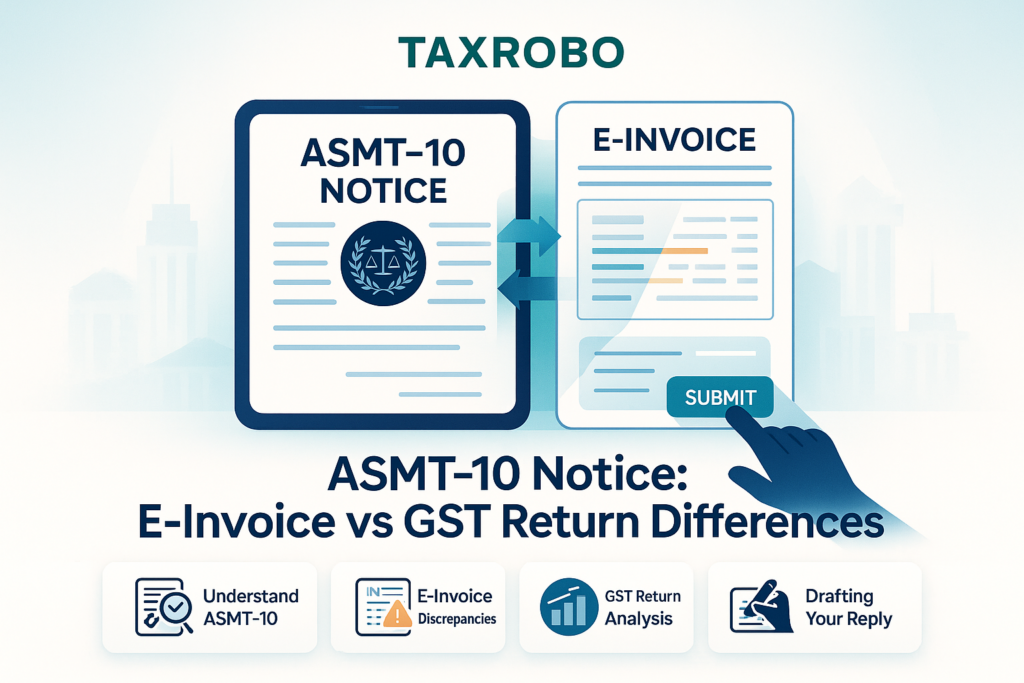
GSTR-3B (Summary Return) is the monthly summary return where taxpayers declare their consolidated GST liabilities, claim Input Tax Credit (ITC), and pay the resultant tax to the government. The tax liability that you declare in your GSTR-3B is primarily based on the sales figures reported in your GSTR-1. The Connection is therefore direct and critical: the E-invoices you generate form the basis of your GSTR-1, and your GSTR-1 forms the basis for the tax you pay via GSTR-3B. The GST department’s systems automatically compare the total taxable value and tax from the E-invoices generated on the IRP with the data you ultimately file in GSTR-1. Any mismatch between these two datasets is what triggers an ASMT-10 scrutiny notice. Knowing How to File GSTR-1 & GSTR-3B Correctly – Step-by-Step Guide 2025 can help prevent these issues.
Decoding Your ASMT-10 Notice for E-Invoice Mismatch
Receiving a formal communication from the tax authorities can be unsettling, but understanding the notice is key to resolving it efficiently. For a broader overview, you can refer to our guide on How to Handle GST Notices – ASMT-10, DRC-01, DRC-07 Explained Simply. The ASMT-10 notice is not a demand for tax but rather the first step in a scrutiny process. It’s the department’s way of saying, “Our system has found a potential inconsistency; please explain it.” Your response determines the next steps and can prevent the issue from escalating into a more serious matter involving demands and penalties. It’s an opportunity to provide clarification and demonstrate your commitment to compliance.
What Exactly is an ASMT-10 Notice?
Form GST ASMT-10 is officially known as a “Notice for intimating discrepancies in the return after scrutiny.” It is issued by a proper tax officer under Section 61 of the CGST Act when they find discrepancies, inconsistencies, or anomalies in the GST returns you have filed. The purpose of this notice is not to create a tax demand but to seek an explanation from you, the taxpayer. It provides you with an opportunity to clarify the E-Invoice vs GST Return difference that the officer has observed. You can either accept the discrepancy and pay the tax differential or provide a detailed explanation with supporting documents to justify your filed returns.
Common Reasons for an E-Invoice vs GST Return Difference
Discrepancies can arise for various reasons, many of which are unintentional. Understanding these common causes can help you quickly identify the source of the mismatch highlighted in your ASMT-10 notice for E-Invoice India.
- E-Invoices Generated, but Missed in GSTR-1: This is a frequent error. An E-invoice might have been successfully generated on the IRP but was accidentally deleted or overlooked during the GSTR-1 filing process, leading to underreporting of sales.
- Amendments and Credit Notes: You might issue a credit or debit note and report it correctly in your GSTR-1, but you may have forgotten to generate a corresponding e-credit/debit note on the IRP. Conversely, an e-credit note might have been generated but missed during GSTR-1 filing.
- Clerical Errors: Simple data entry mistakes can cause significant mismatches. For example, entering an incorrect invoice value or tax amount in GSTR-1 that does not align with the auto-populated E-invoice data.
- Timing Mismatch: An E-invoice could be generated on the last day of a month (e.g., March 31st), but the supply of goods or services was actually completed in the next month. You might account for this transaction in the next month’s GSTR-1 (April), creating a temporary mismatch for March.
- Incorrect Reporting: A common mistake is reporting B2B transactions, for which E-invoices were generated, under the B2C (Business-to-Consumer) supplies section in GSTR-1. The system expects these E-invoice values in the B2B tables, leading to a variance.
Potential Implications of an ASMT-10 Notice for Your Business
Ignoring an ASMT-10 notice or providing an unsatisfactory reply can have significant consequences. The ASMT-10 notice implications for businesses in India are serious and should not be underestimated. If the officer is not convinced by your explanation or if you fail to respond within the stipulated time, they have the authority to take further action.
The officer may:
- Issue a show-cause notice (SCN) under Section 73 (for non-fraud cases) or Section 74 (for fraud cases), initiating a formal demand and recovery process.
- Issue an order in Form ASMT-12 if your explanation is not satisfactory, confirming the tax liability.
- Ultimately raise a formal tax demand via Form DRC-07, which will require you to pay the differential tax along with applicable interest and penalties. This can lead to recovery proceedings if left unpaid.
How to Draft and File a Perfect Reply: ASMT-11
A well-structured, factual, and timely reply is your best tool to resolve the scrutiny at the initial stage. The entire process should be methodical, starting from a careful analysis of the notice to the final submission of your explanation on the GST portal. Following the correct E-Invoice reply format guidelines India is essential for clarity and ensuring the officer understands your position completely.
Step 1: Acknowledge and Analyze the Notice
The first and most important action is to not ignore the notice. As soon as you receive the intimation, acknowledge it and check the deadline mentioned for the reply, which is typically 30 days. Log in to the GST Portal and navigate to `Services > User Services > View Additional Notices/Orders`. Here, you can download the ASMT-10 notice and, more importantly, any accompanying annexures. These annexures often contain the detailed, invoice-level data that the officer has used to identify the discrepancies. Carefully read the officer’s observations and compare them with the data in the annexures to understand the exact nature and quantum of the mismatch they have pointed out.
Step 2: Reconcile Your Data Thoroughly
Before you start writing your reply, you must conduct a thorough internal reconciliation to get to the root of the problem. This is the most critical step, as the strength of your reply depends on the accuracy of your data.
- Download E-invoice Data: Log in to the E-invoice portal and download the signed JSON file or use a GSP to get an Excel report of all E-invoices generated for the period mentioned in the notice.
- Download GSTR-1 Data: Log in to the GST portal and download the filed GSTR-1 data for the same period.
- Compare Datasets: Use a spreadsheet program like Excel to compare the two datasets. A VLOOKUP or similar function can be extremely helpful here. Compare key fields line-by-line: Invoice Number, Invoice Date, Taxable Value, and Tax Amounts (IGST, CGST, SGST).
- Pinpoint Differences: This comparison will help you isolate the exact invoices, credit notes, or transactions that are causing the mismatch. Once identified, you can investigate the reason behind each discrepancy.
Step 3: Structuring Your Reply (E-Invoice Reply Format Guidelines)
Your official reply must be filed in Form GST ASMT-11 on the portal. While the portal provides a text box, it is highly recommended to prepare a detailed, point-by-point explanation on your company’s letterhead, save it as a PDF, and upload it as a supporting document.
Here is a template for your written submission:
- Header: Place your company’s letterhead at the top. Include the Date, the “To” address of the Proper Officer (Jurisdiction), and a clear Subject line: “Reply to Scrutiny Notice in Form GST ASMT-10 for the period [Month/Year] – Reference No. (DIN): [XXXXXXXXXXXX]”
- Paragraph 1 (Introduction): Begin by acknowledging the receipt of the notice. “Respected Sir/Madam, this is with reference to the Notice in Form GST ASMT-10, bearing DIN [Enter the DIN from the notice], dated [Date of Notice], issued to us for the tax period [Month/Year]. We have reviewed the observations raised therein and are submitting our reply as follows.”
- Paragraph 2 (Explanation): This is the core of your reply. Address each discrepancy noted by the officer separately and clearly.
- Scenario 1: You agree with the discrepancy.
“Regarding Observation No. 1, we have reviewed our records and agree with the short payment of tax amounting to Rs. [Amount]. We have duly paid the differential tax of Rs. [Amount] along with applicable interest of Rs. [Amount] via Form DRC-03. The payment challan with ARN: [Number] dated [Date] is attached herewith for your kind perusal and verification.” - Scenario 2: It was a clerical error with no tax impact.
“Regarding Observation No. 2, the noted discrepancy is due to a clerical error wherein Invoice No. [XYZ] was inadvertently reported under the B2C supplies table instead of the B2B table in our GSTR-1 for [Month]. We confirm that this has no impact on our total tax liability for the period, which has been paid correctly. We have rectified this error in the GSTR-1 for the month of [Month/Quarter] via the amendment tables. A screenshot of the rectification is attached.” - Scenario 3: You disagree with the discrepancy.
“Regarding Observation No. 3, we respectfully submit that there is no short payment of tax on our part. The difference noted by your good office is due to [Provide a clear, detailed reason, e.g., a credit note issued after generating the E-invoice which was correctly reported in GSTR-1]. To support our submission, we are attaching a detailed reconciliation sheet in Excel, a copy of the relevant invoice, and the corresponding credit note for your reference.”
- Scenario 1: You agree with the discrepancy.
- Attachments: Clearly list all the documents you are attaching. “Attachments: 1. Detailed Reconciliation Statement. 2. Copy of DRC-03 Challan. 3. Copies of relevant Invoices/Credit Notes.”
- Conclusion: Conclude with a polite request. “In light of the above explanations and the supporting documents provided, we humbly request your good office to review our submission, find it in order, and drop the proceedings initiated via the said notice.”
Step 4: Filing Form ASMT-11 on the GST Portal
Once your written reply and all supporting documents are ready, log in to the GST Portal. Navigate to `Services > User Services > View Additional Notices/Orders` and find the relevant notice. Click on the “Reply” option. You will be taken to the ASMT-11 form. Here, you can type a brief summary in the reply text box and, most importantly, use the “Upload” button to attach your detailed PDF reply and all other supporting documents. Finally, file the form using a Digital Signature Certificate (DSC) or Electronic Verification Code (EVC).
Conclusion: Stay Proactive and Compliant
An ASMT-10 notice is a prompt to be more diligent, not a reason to panic. The key takeaways are to acknowledge the notice promptly, perform a detailed and honest reconciliation of your data, and submit a clear, factual, and well-documented reply in Form ASMT-11 within the deadline. The best strategy, however, is prevention. By implementing a practice of monthly reconciliation, you can avoid the E-Invoice vs GST Return difference from occurring in the first place, ensuring smoother compliance and peace of mind.
Navigating GST notices can be complex, and a small mistake can lead to larger issues. If you need expert assistance in reconciling your data or drafting a professional reply to an ASMT-10 notice, contact the experts at TaxRobo Online CA Consultation Service today. We ensure your business stays compliant and stress-free.
Frequently Asked Questions (FAQs)
Q1. What is the time limit to reply to an ASMT-10 notice?
Answer: The taxpayer is usually given 30 days from the date of the notice to file a reply in Form GST ASMT-11. However, you should always check the specific due date mentioned in your notice. An extension of time can also be requested from the proper officer if you need more time to prepare the reconciliation and reply.
Q2. What happens if my explanation in ASMT-11 is accepted?
Answer: If the proper officer is satisfied with your reply and the supporting documents you have provided, they will conclude the proceedings by issuing an order in Form GST ASMT-12. This order formally drops the notice, and no further action will be taken on the matter.
Q3. Can I make tax payments after receiving an ASMT-10?
Answer: Yes. If you review your records and find that the discrepancy pointed out in the notice is correct and has resulted in a short payment of tax, you should pay the tax amount along with any applicable interest using Form GST DRC-03. You must then mention the payment details (ARN of the challan) in your ASMT-11 reply and attach a copy of the challan.
Q4. Do I need a Chartered Accountant or Tax Consultant to reply to this notice?
Answer: While it is not mandatory to hire a professional, it is highly recommended. A Chartered Accountant or a seasoned Tax Consultant can help ensure that your reconciliation is accurate and your reply is structured correctly, addressing all legal points and presenting your case in the most effective manner. The ASMT-10 notice implications for businesses in India can be serious, and professional guidance is invaluable in minimizing the risk of the case escalating to a demand or penalty.