
ASMT-10 Notice for Books of Accounts vs GST Turnover Mismatch – A Complete Reply Format Guide
Received a notice from the GST department? Don’t panic. An ASMT-10 notice about a mismatch between your books and GST returns is a common scrutiny point, but it requires a careful and timely response. This notice is a preliminary check by tax officers when they find discrepancies in your returns, most commonly a difference between the turnover declared in GSTR-1/GSTR-3B and what’s recorded in your audited financial statements. This guide provides a detailed, step-by-step ASMT-10 notice response format and actionable tips for handling ASMT-10 notice India, ensuring you can reply confidently and correctly to the tax authorities.
What is an ASMT-10 Notice and Why Did You Receive One?
Understanding the fundamentals of this notice is the first step toward drafting an effective reply. It’s not a demand for tax but an opportunity to clarify your financial reporting. Getting this stage right can prevent the issue from escalating into a more serious matter, such as a Show Cause Notice (SCN) or a formal demand. A clear and well-documented response often resolves the scrutiny at the initial stage, saving you significant time, effort, and potential penalties. Let’s break down what the notice means and the common triggers behind it.
Understanding Form GST ASMT-10: More Than Just a Notice
Form GST ASMT-10 is officially titled an “Intimation of Discrepancies in the Return.” It’s crucial to understand that this is not a demand for tax. Instead, it is an opportunity provided to you, the taxpayer, to explain any differences the tax officer has found during their preliminary review. The legal basis for this notice is Section 61 of the CGST Act, 2017, which empowers the proper officer to scrutinize returns and related particulars furnished by a taxpayer. The officer’s goal is to verify the correctness of the return. If they find a discrepancy, they issue an ASMT-10 asking for an explanation. Understanding the notice is the first step in resolving GST discrepancy notice India. You can find more information on compliance procedures on the official GST Portal.
Top 5 Reasons for a GST Turnover Mismatch Notice
A mismatch between your books of accounts and GST returns can happen for various legitimate reasons. Identifying the specific cause is essential for preparing a precise and convincing reply. Here are the top five reasons you might have received an ASMT-10:
- Timing Differences: This is a very common issue, especially at the end of a financial year. For example, you might raise an invoice in March (Financial Year 1), but the payment is received or the goods are delivered in April (Financial Year 2). This can cause a mismatch between the turnover reported in your annual financial statements and your GSTR filings for that period.
- Exempt and Non-GST Supplies: Your profit and loss account includes all sources of income. However, not all income is subject to GST. Income like interest from bank deposits, rent received from a residential property, or proceeds from the sale of fixed assets are recorded in your books but are not part of your taxable GST turnover.
- Incorrect Reporting of Credit/Debit Notes: Adjustments for sales returns, post-sale discounts, or price revisions are handled through credit and debit notes. If there’s a delay in reporting these notes in your GSTR-1 or an error in the reported values, it will lead to a direct mismatch with the revenue figures in your accounting books.
- Clerical Errors: Simple human errors during data entry are a frequent cause. A misplaced decimal, a typo in an invoice value while filing GSTR-1, or reporting a B2C sale as a B2B sale can all create discrepancies that the officer’s system will flag during scrutiny.
- Advances Received vs. Adjusted: Under GST, tax is payable on advances received for the supply of services. However, this advance is later adjusted against the final invoice. A mismatch can occur if the advance was reported in one tax period’s GSTR-1 but the corresponding invoice was raised and adjusted in a later period, creating a temporary difference in reported turnover.
Identifying the correct reason is crucial for preparing the right books of accounts mismatch reply India.
A Step-by-Step Guide to Preparing Your ASMT-10 Reply
A methodical approach is the best way to tackle an ASMT-10 notice. Rushing into a reply without proper groundwork can lead to an unsatisfactory explanation and further scrutiny. By following a structured process, you can ensure your response is comprehensive, well-supported, and addresses all the concerns raised by the tax officer. This systematic approach not only helps in drafting a better reply but also serves as a permanent record of your compliance actions.
Step 1: Acknowledge and Analyze the Notice
The most important first step is to not ignore the notice. As soon as you receive the ASMT-10, acknowledge it and carefully review its contents. Pay close attention to two key details: the deadline for the response (typically 15 to 30 days) and the specific discrepancies the tax officer has pointed out. The notice will list the exact points of difference they have identified. Understanding these points precisely is critical because your entire reply will be structured around providing a point-wise clarification for each of them. Missing the deadline can lead to the officer proceeding with further action based on the information they have, which may not be in your favor.
Step 2: Conduct a Thorough Reconciliation
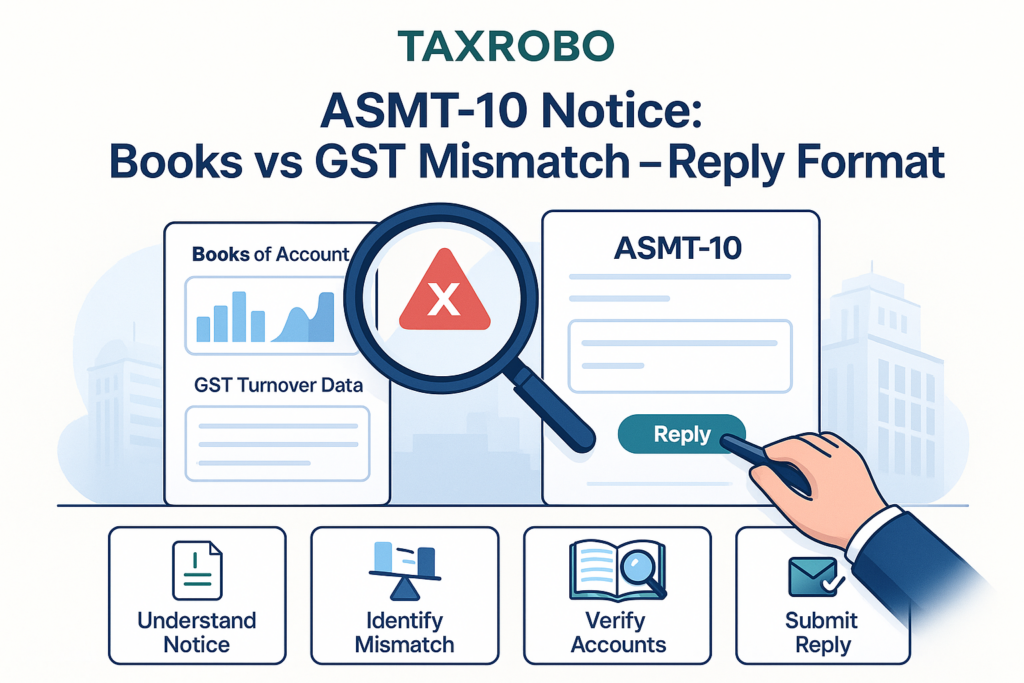
This is the most critical part of your preparation. You need to prepare a detailed reconciliation statement that directly compares the turnover as per your books of accounts with the turnover reported in your GSTR-3B and GSTR-1 for the specific tax period mentioned in the notice. This statement will form the foundation of your reply. A well-prepared reconciliation table makes it easy for the officer to understand your explanation. We recommend creating a table with the following columns to present the information clearly:
| Particulars | Turnover as per Books (₹) | Turnover as per GST Returns (₹) | Difference (₹) | Detailed Reasons for Difference |
|---|---|---|---|---|
| Total Turnover | [Value A] | [Value B] | [A – B] | [Initial Mismatch] |
| Add/Less: Reasons | ||||
| e.g., Interest Income | [Value] | [Not Applicable] | [Value] | Exempt Supply, included in books but not in GST returns |
| e.g., FY Cross-over Invoice | [Value] | [Not Applicable in this period] | [Value] | Invoice raised in March, GST paid in April. Reported in subsequent GSTR-1 |
Step 3: Gather All Supporting Documents
An explanation without evidence is just a claim. To make your reply credible and effective, you must back up every point with strong supporting documents. These documents serve as proof for the reasons you provide in your reconciliation statement. Create a file with all the necessary evidence before you start drafting your reply. Strong documentation is the backbone of any successful GST turnover mismatch notice response. Use this checklist to ensure you have everything you need:
- The detailed turnover reconciliation statement you prepared in Step 2.
- Copies of relevant tax invoices, credit notes, or debit notes that are central to explaining the discrepancy.
- Your audited financial statements (Profit & Loss Account, Balance Sheet) for the relevant period.
- Bank statements to corroborate transactions, especially for income like interest that is not part of GST turnover.
- A copy of the ASMT-10 notice itself for easy reference while drafting the reply.
The Definitive ASMT-10 Notice Response Format (Using Form ASMT-11)
Once your reconciliation is complete and your documents are in order, you are ready to draft the official reply. The response to an ASMT-10 notice must be filed electronically on the GST portal using Form GST ASMT-11. While the form on the portal has specific fields, the core of your reply will be the detailed explanation you provide. Using a clear and structured ASMT-10 notice response format is essential for communicating your position effectively to the tax officer.
Structuring Your Official Reply in Form ASMT-11
Your explanation attached to Form ASMT-11 should be professional, clear, and direct. It should follow a logical structure that makes it easy for the officer to review and accept your submission. Here is a template-like structure you can adapt:
- Reference: Begin by clearly stating the Notice Reference Number (DIN) and the date mentioned in the ASMT-10 you received. This helps the officer immediately connect your reply to the correct file.
- Introduction: Start with a formal salutation. Acknowledge the receipt of the notice and state your intention to provide a comprehensive, point-wise clarification for the discrepancies raised.
- Point-by-Point Explanation: This is the heart of your reply. Address each discrepancy listed in the ASMT-10 one by one.
- For each point, quote the discrepancy as mentioned in the notice.
- Provide a clear, concise reason for the difference. Refer directly to your attached reconciliation statement and other supporting documents.
- Example for Discrepancy 1: “With reference to the observed mismatch of ₹50,000 in turnover, we wish to clarify that this amount pertains to interest income received from a fixed deposit with ABC Bank. As interest income is an exempt supply under GST, it is correctly included in our Profit & Loss Account but is not liable for GST and hence not included in our GSTR-1. A copy of the bank statement and our financial statement are attached for your verification.”
- Attachments: Create a numbered list of all the documents you are attaching with your reply. For example: “1. Detailed Turnover Reconciliation Statement for FY 2022-23. 2. Audited Financial Statements for FY 2022-23. 3. Copy of relevant invoices.”
- Conclusion: Conclude your reply with a polite summary. Reiterate that the discrepancies have been explained satisfactorily and request the officer to find the explanation acceptable and drop the proceedings initiated via the ASMT-10 notice.
Two Potential Scenarios and How to Reply
Your response will fall into one of two categories, depending on whether you agree or disagree with the officer’s findings after your internal review.
- Scenario A: You Agree with the Discrepancy
- Action: It’s possible that the tax officer is correct and you’ve discovered a genuine error, such as an under-reporting of sales. In this case, you must accept the discrepancy.
- Detail: The correct course of action is to pay the differential tax amount, along with any applicable interest for the delay and penalty (if any), using Form DRC-03. After making the payment, you must file your reply in Form ASMT-11. In your explanation, clearly state that you agree with the discrepancy and have paid the dues. Mention the ARN (Application Reference Number) of the DRC-03 challan as proof of payment.
- Scenario B: You Disagree with the Discrepancy
- Action: If your reconciliation proves that your GST returns were filed correctly and the discrepancy is due to a valid reason (like exempt income or timing differences), you should not make any tax payment.
- Detail: This is where the detailed ASMT-10 notice response format outlined above becomes absolutely critical. You will submit your reply in Form ASMT-11 with a detailed point-wise explanation for each discrepancy, strongly supported by your reconciliation statement and all other documentary evidence. Your goal is to provide an irrefutable case that your returns are accurate as filed.
What Happens After You File Your Reply?
Once you have submitted your reply in Form ASMT-11, the ball is in the tax officer’s court. They will review your explanation and the supporting documents you have provided. There are two possible outcomes based on their assessment, and understanding them will help you prepare for the next steps.
- Outcome 1: The Officer is Satisfied
- If your explanation is found to be clear, logical, and supported by sufficient evidence, the officer will be satisfied. In this ideal scenario, they will issue an order in Form ASMT-12, formally accepting your reply and informing you that the proceedings are being dropped. Once you receive the ASMT-12, the matter is considered closed.
- Outcome 2: The Officer is NOT Satisfied
- If the officer finds your reply to be inadequate, unconvincing, or if you fail to reply within the stipulated time, they will proceed with further action. This typically involves initiating proceedings under Section 73 (for non-fraud cases) or Section 74 (for cases involving fraud, willful misstatement, or suppression of facts) of the CGST Act. This will lead to the issuance of a Show Cause Notice (SCN), which is a more formal and serious step towards demanding tax, interest, and penalties. Learning How to Respond to a GST Show Cause Notice: A Step-by-Step Guide is crucial at this stage.
Following ASMT-10 compliance guidelines India meticulously from the start is the best way to ensure you achieve Outcome 1 and avoid any escalation.
Conclusion: Proactive Measures and Key Takeaways
Receiving a notice from the tax department can be stressful, but an ASMT-10 is a manageable issue if handled correctly. A prompt, precise, and well-documented response is your best defense against further complications. By understanding the reasons for the notice and preparing a thorough reply, you can resolve the scrutiny efficiently. Following a comprehensive GST Compliance Checklist for FY 2025–26 – Monthly, Quarterly & Annual Tasks can also help prevent such issues from arising.
- Key Takeaways:
- ASMT-10 is a scrutiny notice, not a final demand. Act on it promptly and professionally.
- A detailed reconciliation statement comparing your books to your GST returns is the non-negotiable foundation of your reply.
- Always use a clear and structured ASMT-10 notice response format and support every claim with strong documentary evidence.
- Proactive Tip: The best way to handle notices is to prevent them. We strongly advise businesses to perform monthly or at least quarterly reconciliations of their turnover as per books of accounts against their GSTR-1 and GSTR-3B filings, and to ensure you know How to File GSTR-1 & GSTR-3B Correctly – Step-by-Step Guide 2025. This proactive habit helps you catch and correct discrepancies early, ensuring your annual filings are accurate and reducing the likelihood of receiving such notices in the future.
Navigating GST notices can be complex. If you need expert assistance in preparing a robust reply or ensuring your business remains compliant, contact the experts at TaxRobo today. Our team is here to help you manage your tax obligations seamlessly through our dedicated TaxRobo GST Service.
Frequently Asked Questions (FAQs)
Q1. What is the time limit to reply to an ASMT-10 notice?
A: The standard time limit to reply to an ASMT-10 notice is 30 days from the date of service of the notice. However, the officer may specify a shorter period (not less than 15 days) in the notice. You can request an extension from the officer, but it is granted at their discretion.
Q2. What are the consequences of not responding to a GST ASMT-10 notice?
A: Ignoring an ASMT-10 notice can lead to serious consequences. The tax officer will assume that you have nothing to say in your defense and may proceed to take further action based on the information available to them. This can result in a formal demand order for tax, interest, and penalties under Section 73 or 74 of the CGST Act.
Q3. Do I have to pay tax immediately after receiving an ASMT-10?
A: No. ASMT-10 is not a demand notice. It is an intimation of discrepancies. You only need to pay tax (via Form DRC-03) if, after your own review and reconciliation, you agree that there has been a shortfall in tax payment. If you believe your returns are correct, you should provide a detailed explanation without making any payment.
Q4. Can I file the ASMT-11 reply offline?
A: No, the reply in Form GST ASMT-11 must be filed online through the GST Portal. You are required to log in to your account, navigate to the “View Additional Notices/Orders” section, and file your reply against the specific notice. You can upload your detailed explanation and all supporting documents as attachments to the online form.
Q5. Why is professional help recommended for an ASMT-10 reply?
A: While you can file the reply yourself, seeking professional help is highly recommended. A tax professional, like those at TaxRobo, can ensure your reconciliation is accurate and comprehensive, the legal language in the ASMT-10 notice response format is precise, and your arguments are presented in the most effective manner. This minimizes the risk of the officer finding your response unsatisfactory, thereby reducing the chances of further proceedings and potential liabilities. Get expert guidance with our TaxRobo Online CA Consultation Service.